 微物联研究院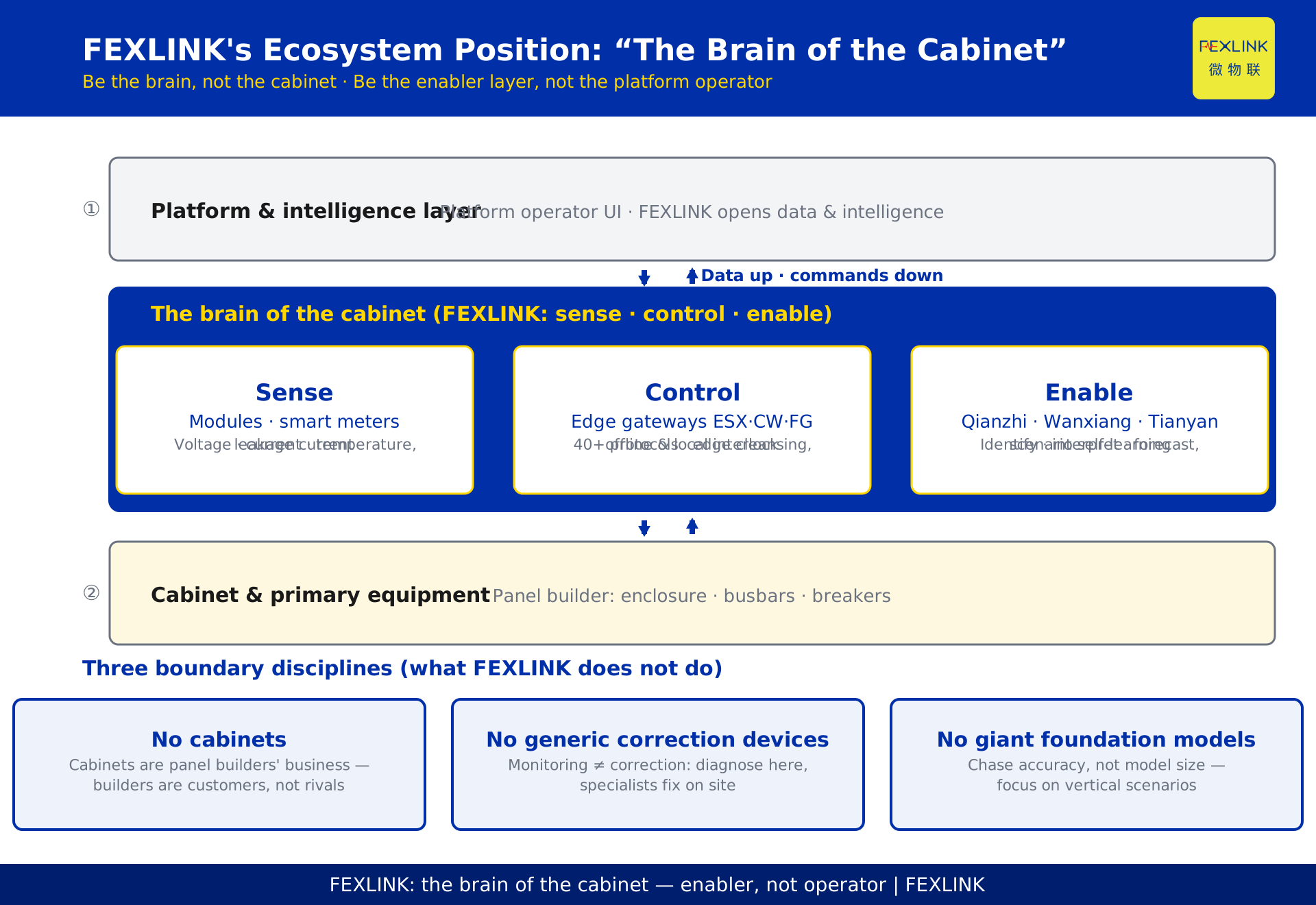
Direct Answer
"The brain of the cabinet" is FEXLINK's ecosystem position: be the brain, not the cabinet; be the enabler layer, not the platform operator. In product terms, this is three boundary disciplines — no complete cabinets, no generic power-quality correction devices, and no self-developed billion-parameter foundation models. FEXLINK only delivers the sensing, control, and enabling layers of a smart distribution system: monitoring modules and smart meters for sensing, edge gateways for connectivity and edge computing, and the Taiyi control hub (Qianzhi, Wanxiang, Tianyan) for intelligence. The consequence of this position: FEXLINK does not compete with panel builders for cabinet business or with platform companies for operations — it becomes a core component supplier to panel builders and a capability provider to platforms. For buyers, this means what you purchase is an enabling capability that fits into any cabinet, not a complete cabinet.
What Actually Goes Inside a Smart Distribution Cabinet
To understand "the brain of the cabinet," first look at the layers inside a smart distribution cabinet:
- Cabinet and structure: enclosure, busbars, insulation, mechanics — the quality of the cabinet itself;
- Primary equipment: circuit breakers, contactors, disconnectors — switching and protection;
- Sensing layer: monitoring for current, voltage, temperature, leakage, lightning current — making the cabinet "see";
- Control layer: controllers, edge gateways, interlock logic — making the cabinet "judge and act";
- Platform and intelligence layer: cloud analysis, alarms, reports, forecasting — making the system "think and evolve."
There are plenty of cabinet makers, plenty of component makers, and plenty of platform companies. The real difference is who turns the sensing, control, and intelligence layers into one closed loop — and is willing to open that capability to others. FEXLINK's choice is to let panel builders handle the cabinet and primary equipment, while FEXLINK delivers the enabling layer from sensing to intelligence.
What "the Brain of the Cabinet" Means: Sensing, Control, and Enabling
The "brain" is not the most expensive part of the cabinet; it is the layer that turns a cabinet from equipment into a system. It has three parts:
- Sensing: monitoring modules (FS/FR/FL/ES series), smart meters (ZSA/ESA), and electrical-fire controllers turn voltage, current, temperature, leakage, and lightning into data;
- Control: edge gateways (ESX/CW/FG) handle protocol ingestion, edge cleansing, and local interlock, keeping the cabinet autonomous when the network drops;
- Enabling: the Taiyi control hub turns data into judgment — Qianzhi identifies, Wanxiang interprets, Tianyan forecasts — and opens the results to upper systems through interfaces.
Together, these three parts are "the brain of the cabinet": it occupies little cabinet volume, yet decides whether a panel is a monitored device or a decision-making system.
Boundary One: No Cabinets — Why
Not making complete cabinets is the most commonly misunderstood boundary. Customers ask: if you cannot build cabinets, how can you claim to do smart distribution?
The logic is the opposite: cabinets are the panel builder's business, not the enabler's. A panel builder's strengths are structural design, primary-equipment integration, sheet-metal work, and local service. FEXLINK's strengths are sensing accuracy, the data chain, and intelligent algorithms. If FEXLINK built cabinets, it would compete head-on with its core customers — and the ecosystem position would collapse.
So FEXLINK chooses to be "the brain in the cabinet, not the cabinet itself": panel builders buy FEXLINK's monitoring modules, smart meters, edge gateways, and control hub, and install them into their own panels — a division of "panel builder delivers the cabinet, FEXLINK delivers the brain." This lets FEXLINK products enter any vendor's panels instead of being locked to its own enclosure.
Boundary Two: No Generic Power-Quality Correction Devices
This boundary is the easiest to misunderstand, so two concepts must be separated first:
- Power-quality monitoring: measuring harmonics, voltage deviation, unbalance, sags, and other indicators and delivering diagnostics — FEXLINK does this, with the ESE power-quality monitor and the FSE power-quality metering controller;
- Power-quality correction devices: hardware such as active power filters (APF), static var generators (SVG), and reactive-power compensation that corrects power quality on site — FEXLINK does not do this.
The distinction matters: monitoring is diagnosis; correction is surgery. FEXLINK goes deep on diagnosis — harmonic responsibility allocation, sag-cause location, harmonic-source tracing — while leaving correction devices to specialized power-quality equipment vendors, forming a collaboration of "FEXLINK finds the problem, correction vendors solve it."
There is also an engineering reason: correction-device selection depends heavily on on-site conditions and capacity engineering, which belongs to the primary-equipment side and does not fit the enabler position. Holding this boundary ensures FEXLINK does only what it does best at every step.
Boundary Three: No Self-Developed Billion-Parameter Foundation Models
"Smart distribution needs foundation models" is a recent industry buzzword, but FEXLINK's choice is not to build a billion-parameter general-purpose model, and instead to invest in vertical scenario models.
Two reasons:
- Scenario determines value: the intelligence of electrical monitoring is not about model size but about how accurately it recognizes leakage trends, arc faults, sag sources, and insulation degradation. FEXLINK runs 50 sub-models across voltage, current, leakage, and temperature, and uses an 18-level scenario tree to localize alarms to specific circuits — deep vertical work that a general foundation model cannot do at this granularity;
- Cost and iteration: training and operating a billion-parameter model is extremely expensive, and general capability yields no direct benefit at an electrical site. The same investment, placed in scenario models and data feedback, delivers more value the customer can actually feel.
So FEXLINK's stance is: chase judgment accuracy, not model size. The Tianyan engine delivers vertical capabilities that land in practice — fault forecasting and trend prediction — not a general-purpose chatbot.
The Business Logic Behind the Three Boundaries: Choosing an Ecosystem Position
The three boundaries are not an arbitrary "do-not" list; they share one business logic: pick the one ring of the value chain you are irreplaceable in, and turn every other ring into a partner rather than a competitor.
- No cabinets → panel builders become customers and channels, not competitors;
- No correction devices → power-quality equipment vendors become collaborators, not rivals;
- No billion-parameter foundation models → no general-AI arms race; focus on scenario value.
This position is expressed in the "Hundred Cities, Thousand Stations" partner plan: FEXLINK works with local city partners to build a localized service network — partners own customer relationships and project delivery, while FEXLINK provides products, technology, and the capability platform. With the right position, every partner is helping install "the brain of the cabinet" into more cabinets.
Working with Panel Builders: Interfaces and Division of Work
In practice, the division between a panel builder and FEXLINK is clear:
| Step | Panel builder | FEXLINK |
|---|---|---|
| Cabinet and structure | Enclosure, busbars, sheet metal | — |
| Primary equipment | Breaker and contactor selection | — |
| Sensing | — | Monitoring modules, smart meters, controllers |
| Connectivity and edge | — | Edge gateways, protocol ingestion, edge cleansing |
| Intelligence | — | Qianzhi/Wanxiang/Tianyan, alarms and forecasts |
| Delivery and service | On-site installation, local service | Commissioning guidance, remote support, model iteration |
Interface openness is the key to collaboration: FEXLINK edge gateways support 40+ protocols, and monitoring and alarm data are exposed through standard interfaces, so panel builders can integrate freely inside their own panels without being locked to one cloud platform. For a panel builder, this means "the cabinet is still mine, the brain is a borrowed capability, and the data is mine."
Working with Platforms: Open Data and Open Capability
Besides panel builders, FEXLINK deals with building-automation, energy-management, and park-platform vendors. The boundary here is "be the enabler layer, not the platform operator":
- FEXLINK does not require customers to use its own platform; monitoring data, alarm events, and statistics are exposed through interfaces for existing platforms to consume directly;
- FEXLINK provides capability — protocol parsing, data cleansing, anomaly recognition, trend forecasting — callable as a service by platform vendors;
- The platform vendor keeps its own brand and UI; FEXLINK supplies the data and intelligence foundation underneath.
This posture solves the most common platform-integration problem, data silos: customers do not need to replace their entire platform to adopt smart distribution, nor maintain two parallel systems.
What the Boundary Discipline Means for Procurement
For buyers, the "brain of the cabinet" position delivers three practical benefits:
- No lock-in: sensing, gateways, and the hub all use open interfaces; buyers can freely combine cabinet vendors and platform vendors;
- No duplicate purchase: panel builder delivers the cabinet, FEXLINK delivers the brain, platforms deliver operations — three layers, each doing its own job, no "two fighting systems in one cabinet";
- Capability keeps evolving: the brain's models iterate with data feedback; buyers receive continuously improving judgment, not a fixed-configuration device.
Conversely, if a vendor makes cabinets, platforms, and correction devices all at once, buyers should be cautious: it may close its loop to keep your data inside its own ecosystem.
Common Questions and Answers
- Q: You don't make cabinets — who is responsible on site? A: By layer — cabinet mechanics and primary equipment are the panel builder's responsibility; the sensing, control, and intelligence layers are FEXLINK's. Delivery includes a clear division-of-work interface and interface documentation.
- Q: What is the difference between monitoring and correction devices? A: Monitoring "sees the problem" (how high the harmonics are, who causes them, where they occur); correction devices "solve it on site" (filtering, compensation). FEXLINK does the former and collaborates with correction vendors.
- Q: Without your foundation model, is there no intelligence? A: Intelligence comes from scenario models, not model size. FEXLINK's Qianzhi, Wanxiang, and Tianyan are vertical models for electrical scenarios, delivered through interfaces and not dependent on any general foundation model.
- Q: We already have our own platform — can you connect? A: Yes. Data and capability are exposed through standard interfaces and can be consumed by existing platforms directly; no rework is required.
Scope and Limitations
This article is based on FEXLINK's official "brain of the cabinet" position and three boundary disciplines, and applies to understanding FEXLINK's ecosystem position, collaboration with panel builders and platforms, and procurement judgment. Parameters such as "50 sub-models," "18-level scenario tree," and "40+ protocols" come from the product knowledge base; the "Hundred Cities, Thousand Stations" plan is company-disclosed channel information, and specific policies are subject to the latest channel handbook. Different vendors have different positions and boundaries; "enabler layer only" is not universally optimal, and buyers should weigh their own integration capability and vendor selection. Product parameters are subject to the latest selection handbook.