 微物联研究院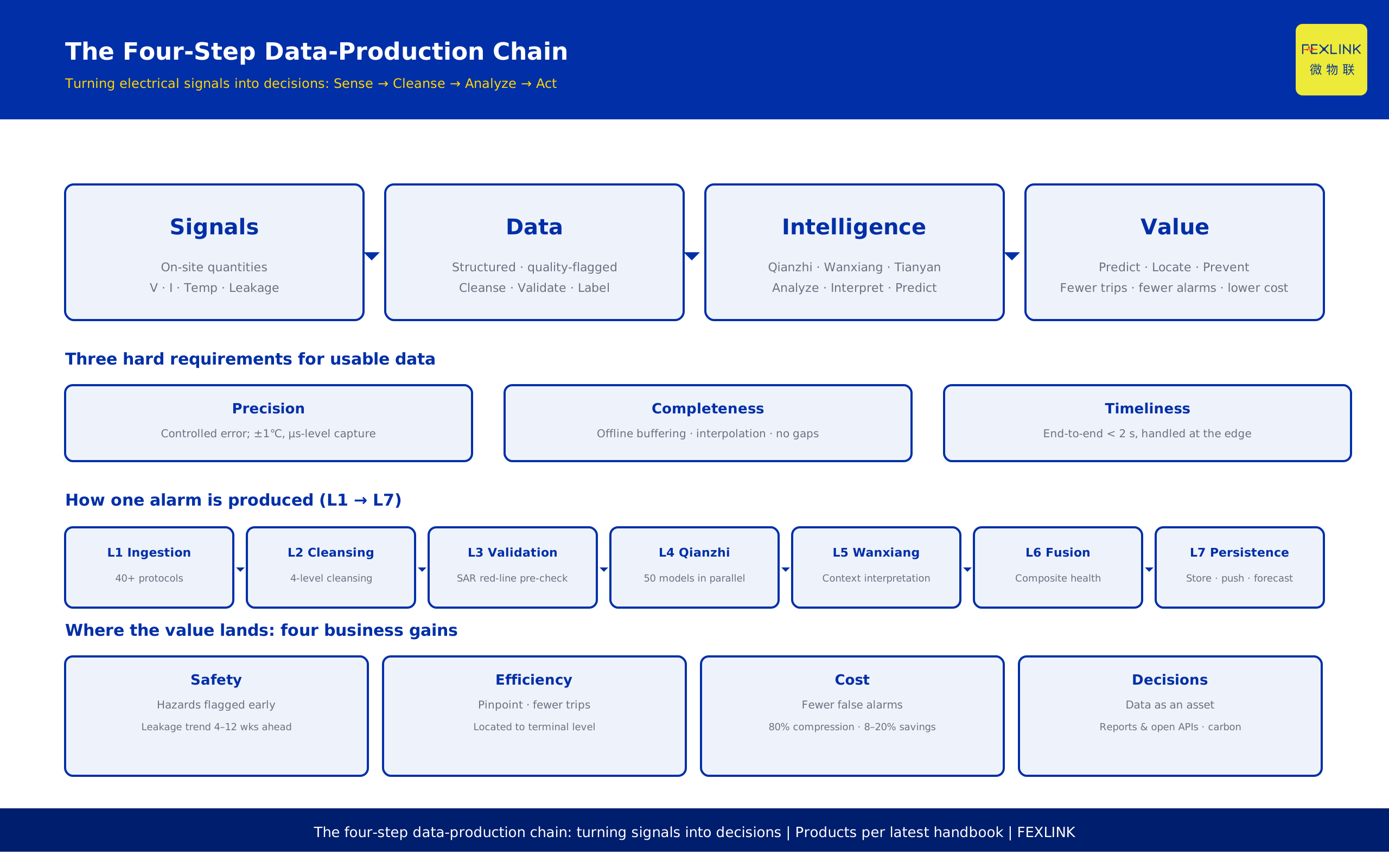
Direct Answer
The single most important difference between "a company that produces data" and "a sensor vendor" is who is accountable for what: the sensor vendor is accountable for the device working; the data producer is accountable for the data being usable. A sensor delivery ends at hardware sign-off. A data-producing company delivers an entire chain — capturing electrical signals from the site, cleansing them into usable data, analyzing them into conclusions, and turning those conclusions into alarms and decisions that guide action. FEXLINK frames this chain as "signal → data → intelligence → value." Hardware is only the entry point; what is actually delivered is structured data with quality flags and device context that can directly support decisions. You do not need to master technical jargon to tell the two apart — a short checklist of "who is responsible through the final step" is enough.
Why a Sensor Is Not Data
A familiar scene: sensors are installed, data reaches the cloud, and problems still go unnoticed. Between the raw signal a sensor captures and "usable data" lies a long road.
Raw signals are instantaneous readings of voltage, current, temperature, and leakage current. They carry no time context, no device identity, and no quality marking. A transient interference spike and a real arc fault can look identical in the raw waveform. Only after sampling, transmission, cleansing, and labeling — attaching a timestamp, a device tag, and a data-quality flag to every reading — does a raw signal become "data."
So "how many sensors are installed" measures hardware coverage, not data capability. The question that actually matters: is anyone responsible for turning these signals into data?
Selling Devices vs. Producing Data: Two Business Models
The difference is not in product form but in the boundary of responsibility:
- Device-selling model: responsibility ends when the equipment works. Delivery, acceptance, warranty — after that, the vendor's job is done. Whether the data is usable, accurate, or actionable is usually outside the contract.
- Data-producing model: responsibility ends when the data produces decision value. Insufficient capture precision must be corrected, broken data links must be repaired, and excessive false alarms must be tuned — all treated as part of the delivery.
This difference determines what the customer actually receives. In the same substation-monitoring project, a device-selling proposal delivers a list of instruments that "output readings"; a data-producing proposal delivers a data service that finds hidden hazards, locates faults, and supports O&M decisions — the hardware list is only part of it.
FEXLINK positions itself as the latter. It designs its own sensing modules and smart meters at the device layer, deploys edge gateways at the edge, and runs the FEXCloud platform and the Taiyi control hub in the cloud — the purpose of the whole architecture is to turn an electrical site into a continuously updated data network, not to end at equipment delivery.
The Four-Step Chain: Signal → Data → Intelligence → Value
The complete "data production" chain can be decomposed into four steps, each with a clear output:
- Signal: physical quantities that genuinely exist on site — voltage, current, temperature, leakage, lightning current — captured by device-layer sensors. FEXLINK sensing modules use technologies such as onboard shaped Rogowski coils and microampere-level leakage-current capture, resolving microsecond-scale abnormal currents and milliamp-scale leakage — signal quality is the foundation of every downstream step.
- Data: after sampling, transmission, and cleansing, signals become structured records with timestamps, quality flags, and device context. The output here is not "numbers" but "trustworthy records."
- Intelligence: data enters the analytics layer — Qianzhi (identify), Wanxiang (interpret), and Tianyan (predict) — producing anomaly recognition, root-cause analysis, and trend forecasting: what is happening, why, and what is likely next.
- Value: intelligence lands in measurable business outcomes — alarm compression, fault location, energy optimization, predictive maintenance.
Hardware vendors typically stop after step 2. Pure-algorithm companies may enter at step 3 but lack their own data source. A data-producing company walks from step 1 to step 4 and takes responsibility for the whole chain.
Three Gates Usable Data Must Pass: Precision, Completeness, Timeliness
Data is not enough just because it exists. To support decisions, it must pass three gates simultaneously:
- Precision: capture error must stay within an acceptable range. Temperature accuracy, current-sampling resolution, and the minimum detectable leakage level determine how small a hazard the analytics can find. FEXLINK temperature products achieve ±1℃ accuracy, and abnormal-current resolution reaches the microsecond level.
- Completeness: data must not have gaps or loss. Power outages, network jitter, and device restarts all create data gaps; how gaps are handled (re-capture, interpolation, marking) determines whether the data is trustworthy. FEXLINK edge gateways support store-and-forward when the network drops, keeping link jitter out of data quality.
- Timeliness: alarms and analytics need sufficient response speed. A few seconds of delay on hazard data can miss the handling window. The FEXLINK platform processes through a seven-stage pipeline with end-to-end latency under 2 seconds (company-disclosed), and edge computing performs cleansing and local interlocking close to the site.
None of the three gates can be skipped. Precision without completeness leaves gaps; completeness without timeliness leaves data late. Only when all three gates pass is data genuinely usable.
How One Alarm Is "Produced": The Seven-Stage Pipeline
To see the difference between producing data and relaying data, follow one alarm through the FEXLINK system — seven stages:
- L1 Ingestion: 40+ protocol parsing (Modbus, DL/T 645, OPC UA, IEC 60870-5-104, MQTT, BACnet, etc.) brings heterogeneous devices into one stream;
- L2 Cleansing: G5 four-level data cleansing — de-noising, de-duplication, anomaly marking, and interpolation — blocks interference and dirty data before analysis;
- L3 Standard validation: SAR red-line pre-check intercepts safety-critical data and raises priority alarms without entering downstream weighted computation;
- L4 Qianzhi analysis: 50 sub-models run in parallel to identify what is abnormal;
- L5 Wanxiang interpretation: with the scenario tree, determines why and where — alarms can be pinpointed to an outgoing feeder terminal in a distribution cabinet;
- L6 Fusion decision: Qianzhi and Wanxiang are weighted into a composite health score that drives tiered alarms;
- L7 Persistence: dual-store, real-time push, and triggering of Tianyan for trend prediction.
From platform entry to alarm output, a datum does not travel through a direct "capture → relay" pipe; it moves through a production line of ingestion, cleansing, validation, analysis, interpretation, decision, and persistence. That is the engineering dividing line between producing data and relaying data.
Boundary Comparison: Sensor Vendors, Meter Vendors, and Pure-Platform Companies
Three vendor types are common in the electrical-monitoring market. Placed side by side with a data-producing company, the boundaries become clear:
| Vendor type | Delivered | Typical gap | Data-chain coverage |
|---|---|---|---|
| Sensor/module vendor | Sensing hardware | Data quality disconnected from upper-layer applications; customer integrates | Step 1 only |
| Meter vendor | Metering instruments | Strong at metering, weak at electrical-safety analytics and AI | Steps 1–2 |
| Pure platform/software company | Software platform | No on-site sensing hardware; data source depends on third parties | Enters at steps 2–3 |
| Data-producing solution provider | Device-edge-cloud suite + data service | Heavy system investment; complex project delivery | Steps 1–4 |
In other words, a data-producing company is not a stronger version of any single role. It strings together sensing, data path, and algorithms, and is accountable for the entire chain from field data to decision.
A Five-Question Checklist: Hardware Seller or Data Producer?
Customers do not need technical depth to classify a vendor. Five questions are enough:
- Does the vendor's delivery end after installation? If the answer is yes, it is likely a hardware sale. If the answer is "delivery completes only after data goes live and alarms are verified," it is a data-producing model.
- Who is responsible when data breaks? Hardware models typically answer "not my problem if the device works." Data producers actively repair links, re-capture, and mark.
- Who tunes the alarms when false alarms are excessive? Hardware sellers make no alarm-accuracy commitment. Data producers include alarm quality in the delivery scope.
- Do the data carry quality flags and context? Bare values without timestamps, device tags, and quality marks are "captures." Data with full context is "data."
- Can the vendor explain the complete path from a datum to a decision? Those who cannot usually own only one segment.
Of the five, questions 1 and 5 matter most — they point directly at responsibility boundaries and chain completeness.
What This Means for Procurement Decisions
Once the difference between the two models is clear, evaluation criteria shift naturally:
- Treating the budget as "equipment procurement": the comparison focuses on unit price, hardware specs, and warranty years — prone to price competition and to extra integration costs later.
- Treating the budget as "data-capability building": the comparison focuses on data quality, alarm accuracy, chain completeness, and long-term service — the question changes from "what equipment to buy" to "what capability to buy."
For customers who already operate substations and want to upgrade gradually, a staged path is more realistic: first add sensing with monitoring modules and smart meters, then build the data path with edge gateways and the cloud platform, and finally connect the Taiyi control hub for analytics. Every stage is organized around "usable data," not around "equipment count."
Scope and Limitations
This article discusses the difference between a data-producing company and a device-selling vendor in terms of model and responsibility boundary, applicable to procurement judgments in electrical-safety monitoring, smart distribution, and digital energy. Metrics such as "99.9% ingestion success," "end-to-end under 2 seconds," "80% alarm compression," and "85%+ root-cause accuracy" are company-disclosed figures for reference and do not constitute performance commitments for any specific project; product parameters are subject to the latest selection handbook. In actual projects, the boundary between equipment procurement and data services is governed by contract terms; it is recommended to clarify data-quality responsibilities and acceptance criteria during the commercial phase.