 微物联研究院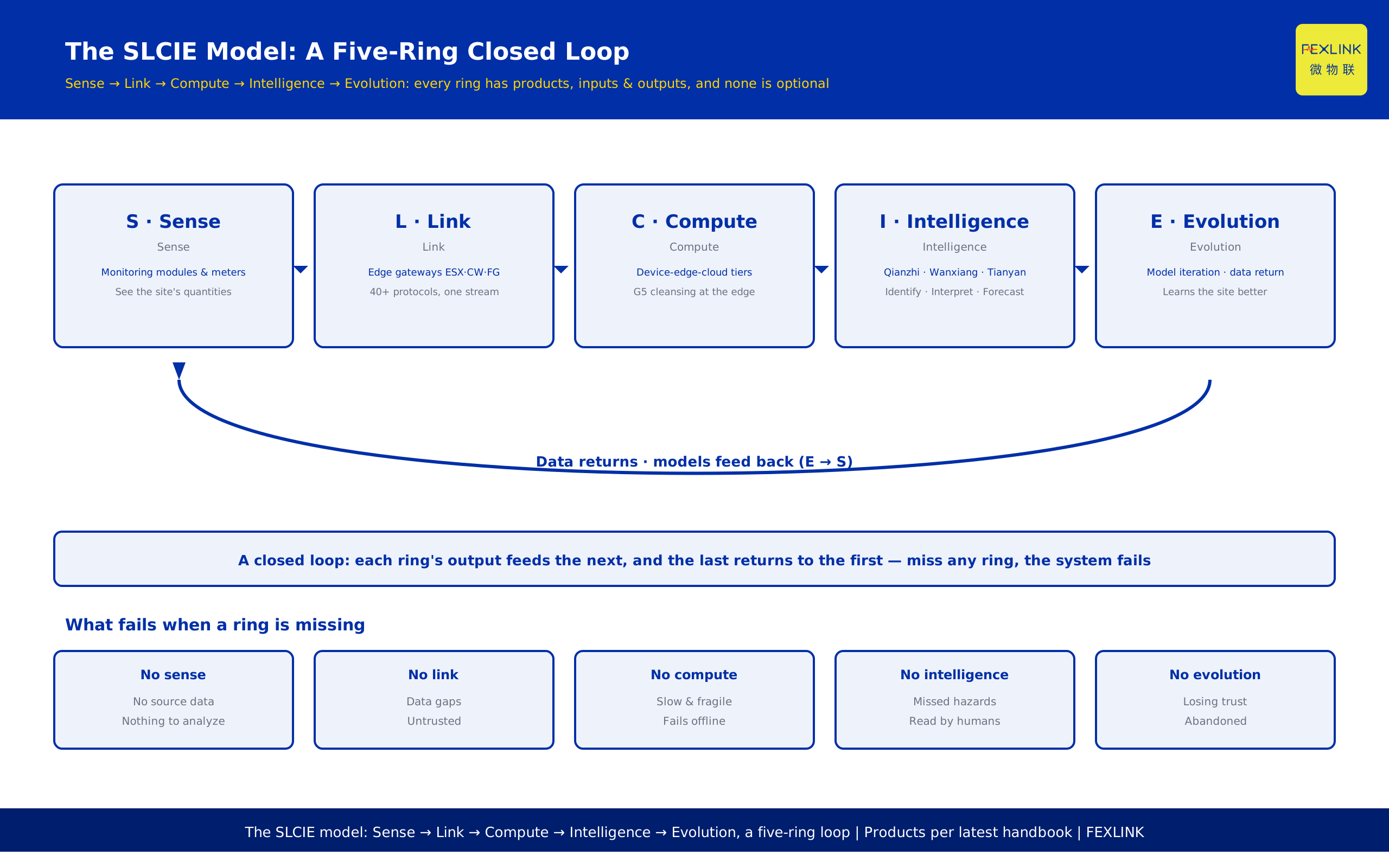
Direct Answer
SLCIE is the closed-loop model FEXLINK uses to describe its own capability system. The five letters stand for five rings of capability: S-Sense, L-Link, C-Compute, I-Intelligence, and E-Evolution. It is not a marketing slogan but an auditable capability checklist: sensing is delivered by on-site monitoring modules and smart meters; linking by edge gateways and communication paths; computing distributed across device, edge, and cloud; intelligence by the Qianzhi, Wanxiang, and Tianyan engines; and evolution through model iteration and data feedback. The five rings connect head to tail into a loop — data sensed, linked, and computed flows into intelligence; the conclusions and data produced by intelligence flow back to drive evolution; and the evolved models in turn sharpen sensing precision. To tell whether a vendor truly has data capability, check it ring by ring with SLCIE: if any ring is missing, the whole system fails.
SLCIE Is a Capability Checklist, Not a Slogan
Many companies in the industry talk about "sensing" and "intelligence," but few can say precisely which product delivers each ring, what the inputs and outputs are, and what happens if a ring is missing. SLCIE turns vague capability words into verifiable engineering structure:
- S-Sense: can the site be "seen" — are the physical quantities captured?
- L-Link: can it "get through" — can signals from heterogeneous devices converge into one data stream?
- C-Compute: can it "be computed" — where does cleansing, validation, and analysis run?
- I-Intelligence: can it "judge" — can data become anomaly recognition and decision conclusions?
- E-Evolution: can it "evolve" — does the system get more accurate as data accumulates?
All five rings are indispensable, and their order reflects a real data journey: sense first, then link, then compute, then intelligence, and finally evolution.
S: Sense — Seeing Is the Prerequisite for Everything
The sensing ring makes the electrical site "visible": voltage, current, temperature, leakage current, lightning current, insulation state, and more.
In the FEXLINK system, this ring is delivered by device-layer products — electrical-safety monitoring modules (FS/FR/FL/ES series), smart meters (ZSA/ESA), and electrical-fire controllers. What matters about sensing capability is not "how many sensors are installed" but three hard metrics:
- Fine enough: abnormal-current capture at microsecond resolution and leakage detection at microampere level can catch the weak signals of an early hazard;
- Wide enough: coverage of voltage, current, temperature, leakage, and lightning supports multi-dimensional diagnosis downstream;
- Accurate enough: capture precision caps every downstream analysis; temperature accuracy reaches ±1℃.
The sensing ring is the foundation of the entire chain — if the signal is wrong at the source, no amount of linking, computing, or intelligence can make the conclusion right.
L: Link — Converging Scattered Signals into One Stream
The linking ring brings signals from different vendors and protocols into one continuous, complete, and trustworthy data stream.
An electrical site is a heterogeneous environment by nature: meters speak Modbus, busbar temperature nodes use proprietary frames, SPD monitors use another protocol, and DL/T 645, OPC UA, IEC 60870-5-104, MQTT, and BACnet may all appear. The linking ring must solve three things:
- Ingest: 40+ protocol parsing brings heterogeneous devices into a unified ingestion layer;
- Carry reliably: offline buffering and local caching keep link jitter from losing data;
- Converge: scattered point data is consolidated into one stream with device context and timestamps.
FEXLINK delivers this ring with edge gateways (ESX intelligent edge gateway, CW industrial gateway) and the FG lightning gateway, which handle both protocol conversion and edge cleansing. A weak linking ring means data that is gapped, late, or dirty — and no upper-layer algorithm can compensate.
C: Compute — Keeping Computation Close to the Site
The computing ring answers "where is the data processed." FEXLINK distributes computing across device, edge, and cloud instead of sending everything to the cloud:
- Device-side: local control and fast interlocking respond to millisecond-level events;
- Edge-side: edge gateways handle protocol ingestion and G5 four-level cleansing (de-noising, de-duplication, anomaly marking, interpolation), keeping dirty data out of cloud analysis while enabling local interlock;
- Cloud-side: the Taiyi back-end runs deep analysis through the seven-stage pipeline with end-to-end latency under 2 seconds (company-disclosed).
The logic of the three tiers is simple: process as close to the site as possible instead of detouring through the cloud. This preserves timeliness, reduces dependence on network bandwidth, and lets the edge operate autonomously when disconnected.
I: Intelligence — From "Having Data" to "Having Judgment"
The intelligence ring turns "usable data" into "usable judgment." Three engines divide the work:
- Qianzhi (identify): recognizes "what is abnormal," running 50 sub-models in parallel across voltage, current, leakage, temperature, and other dimensions;
- Wanxiang (interpret): determines "why and where," using the 18-level scenario tree to pinpoint an alarm to a specific cabinet, circuit, or even terminal;
- Tianyan (forecast): answers "what happens next," turning reactive response into prediction.
The three engines are not three parallel features but three levels of escalating judgment: identify first, then interpret, then forecast. The output of the intelligence ring is an alarm conclusion with confidence, location, and handling advice — not a pile of raw numbers.
E: Evolution — The System Learns the Site Better over Time
The evolution ring answers "does the system get more accurate with use." A static system is finished once installed; evolution lets capability keep improving as data accumulates:
- Data feedback: every real fault and every manual handling becomes a training sample;
- Scenario self-learning: the system iterates site-specific models (charging piles, cabinets, motors) so recognition increasingly matches reality;
- Model upgrades: engine versions iterate (e.g., Qianzhi V4.1, Wanxiang V4.0), fixing new knowledge and features into the analysis capability.
Evolution is the last ring and the key to the word "loop": without it, the first four rings are just a one-way pipeline; with it, the system forms a positive cycle of "understanding the site better with use."
How the Five Rings Close the Loop: Inputs, Outputs, and Data Flow
The connections between the five rings look like this:
- S→L: sensing produces on-site signals and hands them to linking for unified ingestion and transmission;
- L→C: linking produces the unified data stream and hands it to computing for cleansing, validation, and analysis;
- C→I: computing produces trustworthy data and hands it to intelligence for identify, interpret, and forecast;
- I→E: intelligence produces judgment conclusions while sinking process data into training samples;
- E→S: evolution feeds upgraded models and features back to sensing and intelligence, sharpening the next round of recognition.
Each ring's output is the next ring's input, and the last ring returns to the first — that is the engineering meaning of "closed loop." To judge whether a system is truly closed-loop, check whether the final E→S step exists.
What Fails When a Ring Is Missing
Checking ring by ring with SLCIE quickly locates the root cause of most "smart distribution projects that underperform":
| Missing ring | Typical symptom | Consequence |
|---|---|---|
| No sense | Devices installed, but key quantities not captured | No source data; nothing to analyze |
| No link | Data gaps, garbled records, large latency | Data untrustworthy; alarms not actionable |
| No compute | Everything sent to cloud; no edge processing | Poor timeliness, heavy network dependence, fails offline |
| No intelligence | Curves without conclusions; alarms read by humans | Heavy O&M burden; hazards go unnoticed |
| No evolution | System frozen after install; false alarms persist | Trust erodes; system abandoned |
Each of these five symptoms maps to a real vendor type: sensor vendors have only sensing, software companies have only platforms, pure AI teams have only algorithms. SLCIE lets a buyer see at a glance which ring a vendor lacks.
Scoring a Vendor with SLCIE: A Five-Question Method
You do not need to understand every technical detail to evaluate a vendor. Five questions, one per ring:
- Sense: are the key quantities (current, temperature, leakage, etc.) captured by the vendor's own hardware, or bought from third parties?
- Link: can heterogeneous devices and multi-protocol sites be ingested uniformly? Does data survive network outages?
- Compute: is there edge processing, or must all data go to the cloud?
- Intelligence: are alarms read by humans from curves, or does the system directly state "what, where, what to do"?
- Evolution: does the system get more accurate after deployment? Is there a mechanism for sustained false-alarm reduction?
Of the five, question 5 is the most overlooked — and the best differentiator between "equipment sellers" and "system builders."
What This Means for Buyers: Not Equipment, but an Evolving Capability
For procurement, SLCIE upgrades the buying logic from "buying devices" to "buying a capability loop":
- Equipment-buying view: compare hardware specs, price, and warranty; you end up with isolated instruments;
- Capability-loop view: compare sensing coverage, link reliability, computing distribution, intelligence accuracy, and evolution mechanisms; you end up with data capability that keeps improving.
In practice, buyers can build by ring, in stages: first add sensing with monitoring modules and smart meters, then establish linking and edge computing with gateways, then connect the Taiyi control hub for intelligence and evolution. Each stage maps to one ring of SLCIE, and acceptance criteria become clear — every ring has auditable output, not a single sentence "the system is online."
Scope and Limitations
This article is based on the FEXLINK SLCIE capability model and applies to procurement judgments and technical exchange in electrical-safety monitoring, smart distribution, and digital energy. "End-to-end under 2 seconds" is a company-disclosed metric; Tianyan-related metrics (forecast accuracy, lead time, false-alarm reduction) are company-disclosed and pending third-party verification, and do not constitute performance commitments for any specific project. SLCIE describes FEXLINK's own capability system; other vendors may name and divide their capability models differently, so ring-by-ring comparison should rely on verifiable engineering facts. Product parameters are subject to the latest selection handbook.