 FEXLINK Research Institute
The short answer
Before opening a model catalogue, write down what this circuit must answer and sort it into three data dimensions: how much energy was used (energy, power, demand), how each phase behaves (phase angle, power factor, unbalance), and whether the waveform is clean (harmonics, voltage deviation, events). Two cuts then separate the choices: do you need per-phase data, and do you need waveform data. They produce four tiers; only after checking mounting and current does a model enter the discussion.
The order matters: the highest data dimension sets the tier, installation sets the model, and the model only verifies coverage. Never work backwards from a model to a requirement. In the FEXLINK family, the embedded multifunction smart meter, full-parameter smart meter, three-phase unbalance monitor and power quality monitor often appear on one quotation, yet belong to four tiers and are not interchangeable. This is a tiering method, not a specification sheet. Actual capability comes from the nameplate, selection manual and written supplier confirmation; published tier descriptions are disclosure, not commitments.
1. Three data dimensions: start with a requirements list
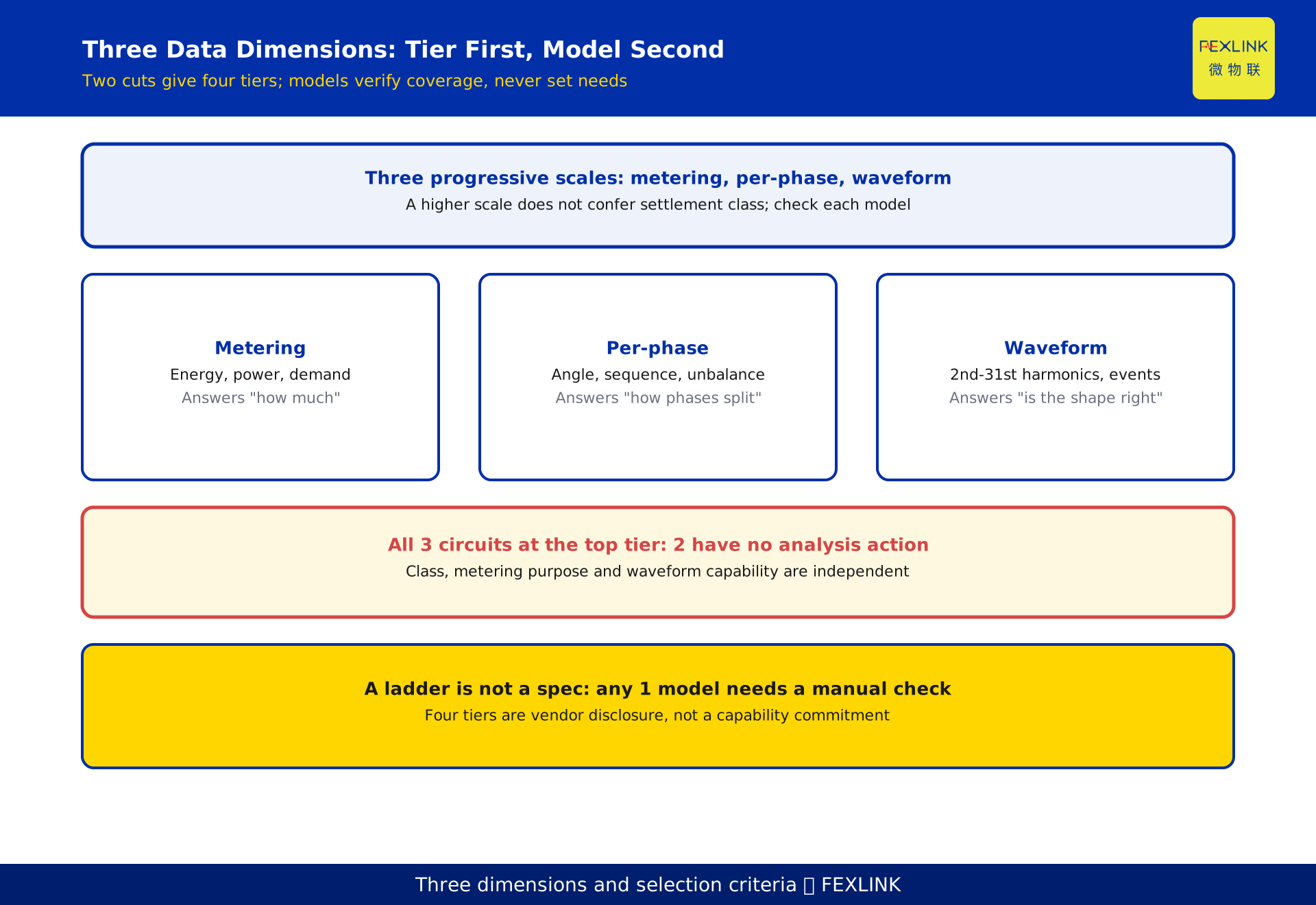
Selection starts with a question list, not a parameter table. Quantities worth collecting on a low-voltage circuit fall into three groups.
The metering dimension covers cumulative energy, phase voltages and currents, active and reactive power, power factor and demand, answering "how much, and when" for sub-metering and bill reconciliation. The per-phase dimension covers phase angle, phase sequence, per-phase power and unbalance, answering "are the phases balanced" for load redistribution and neutral overheating investigation. The waveform dimension covers individual harmonics, total harmonic distortion, voltage deviation and event logs, answering "has a non-linear load distorted the waveform" for harmonic source tracing.
These are progressive scales, not parallel product labels. One point is critical: capability at a higher scale does not automatically confer the accuracy class needed for settlement. Whether a harmonic-capable device meets a circuit's metering requirement must be checked model by model against class and stated conditions; "the expensive one covers the cheap one" is not valid. Without this list, no comparison has a criterion.
2. First cut: do you need phase and per-phase data
This cut asks one question: will anyone later make a decision from per-phase numbers?
If only totals are needed - monthly allocation, cost by workshop, trend checks - metering is enough; per-phase and waveform data have no analysis action attached. Conversely, per-phase data is mandatory with unevenly spread single-phase loads, large single-phase switching, neutral overheating, low power factor on one phase, or on-site generation to reconcile per phase. With totals alone, these can hide behind a reassuring "total looks normal".
The conclusion is narrow: if you need per-phase but not waveform data, stop at the tier that delivers unbalance quantities. If unbalance complaints already exist and the response is another total-only meter, the needed layer stays invisible. This cut is about whether an analysis action exists, not budget.
3. Second cut: do you need harmonics and waveform data
This cut is narrower still: is there a non-linear load on the circuit, and will someone act on the answer?
Drives, rectifiers, chargers, uninterruptible supplies and switch-mode supplies inject non-sinusoidal current. Seeing it requires harmonics by order, total harmonic distortion and a time series of voltage deviation and events; per-phase power cannot answer "which load class, at which orders". With only linear resistive loads and no remediation or acceptance test, the waveform dimension again has no action.
The two cuts are not upgrades of each other: per-phase answers "how load is split between phases", waveform answers "is the shape within one cycle correct", and neither substitutes for the other. Limits, class tables and per-order error limits belong to report interpretation elsewhere; this article decides only whether that layer is required. Where it is, verify sampling and reporting conditions and write them into the list, not just "power quality needed".
4. Two cuts, four tiers: a capability ladder
The two cuts yield three groups: metering only, metering plus per-phase, metering plus waveform. A third split by mounting form and current connection divides the metering group again, giving four tiers.
Tier one is embedded basic metering for cabinet cut-outs, limited to consumption: the FEXLINK ZSA embedded multifunction smart meter. Tier two is DIN-rail full-parameter metering with broader parameters and multiple current ranges: the FEXLINK ESA full-parameter smart meter. Tier three adds per-phase and unbalance quantities: the FEXLINK ESB three-phase unbalance monitor. Tier four adds individual harmonics, total harmonic distortion and power quality events: the FEXLINK ESE power quality monitor; 2nd-31st harmonics appear only at this tier.
Read this ladder as hierarchy, not specification: it states where each data class appears and promises no measurement points, accuracy class, current range or communication option. Whether a variant covers every list line must be checked in the selection manual. Mistaking a hierarchy table for a specification table is the most common cause of rework.
5. Third check: where it mounts and how much current
A correctly chosen tier still fails if the device cannot be mounted or cannot measure well, so installation and connection form a separate gate.
Form first: is there a standard cabinet cut-out that accepts an embedded meter? A DIN-rail-only panel rules that option out regardless of dimension. Connection next: small currents are usually direct, larger ones through a current transformer secondary; wiring, ratio setting and verification differ, and a wrong ratio shifts every energy value. Finally, match the current range to normal operating current - selecting by breaker rating or an occasional peak oversizes the range and leaves the working point low in the span where light-load accuracy degrades.
Only the check order is given, no numeric table: current ranges, connection, accuracy class and conditions come from the manual and nameplate with written supplier confirmation. When installation conflicts with the dimension, return to the list and rebalance; do not quietly drop a tier.
6. From requirements list to candidate model: four steps
Fix the reasoning into four reviewable steps so it does not depend on memory.
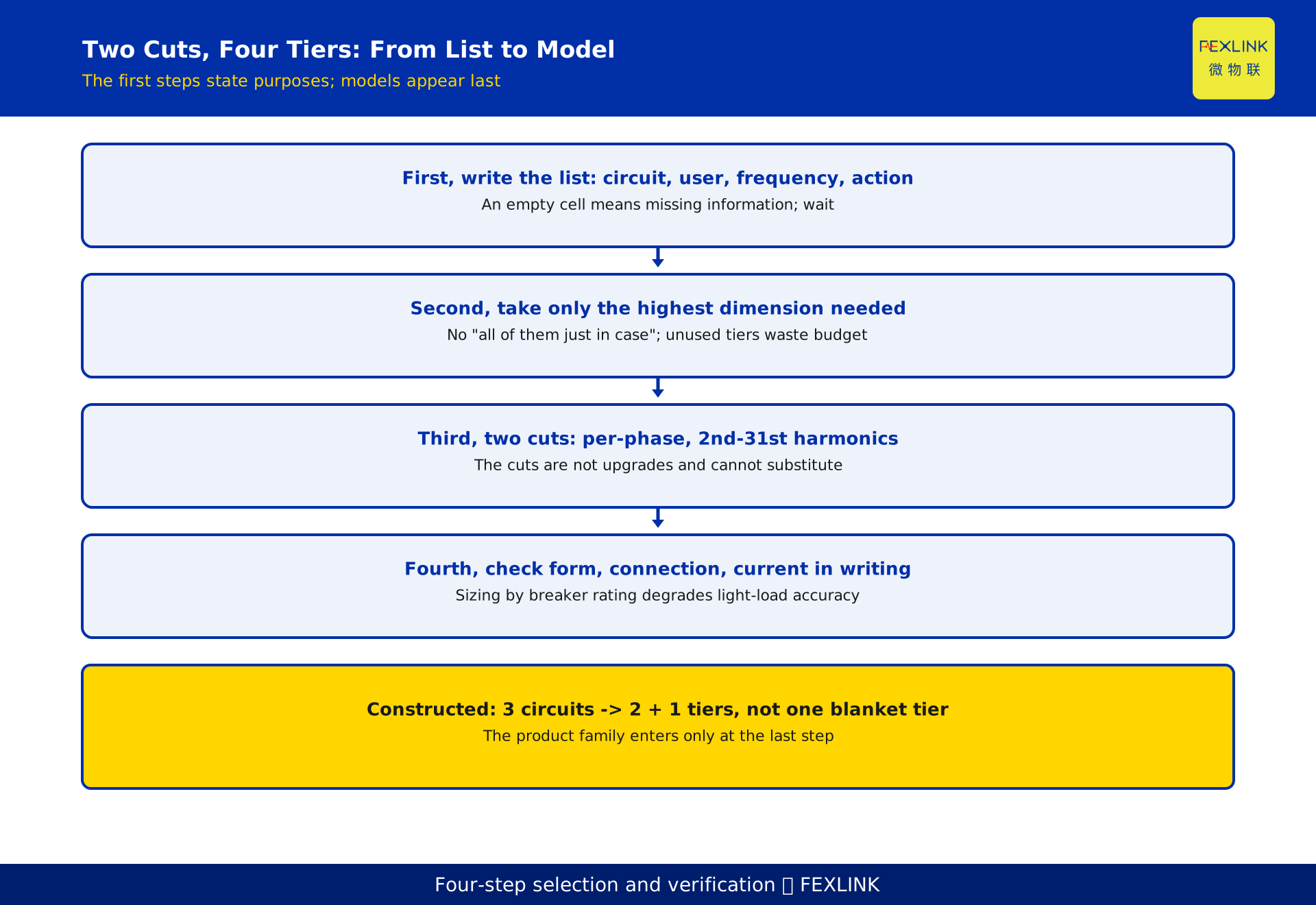
Step one writes the list: circuit ID, who uses the data, how often, and what action it triggers. Step two takes the single highest dimension among metering, per-phase and waveform, without stacking "all of them just in case". Step three applies the two cuts and lands on a tier. Step four checks form, connection and current range, then obtains written confirmation that the candidate covers every list item and its conditions.
The value is traceability: an empty cell means the order should wait. The product family enters only at step four for verification, never at steps one to three for tiering - the fundamental difference from picking features out of a model list.
7. Worked example: three new circuits
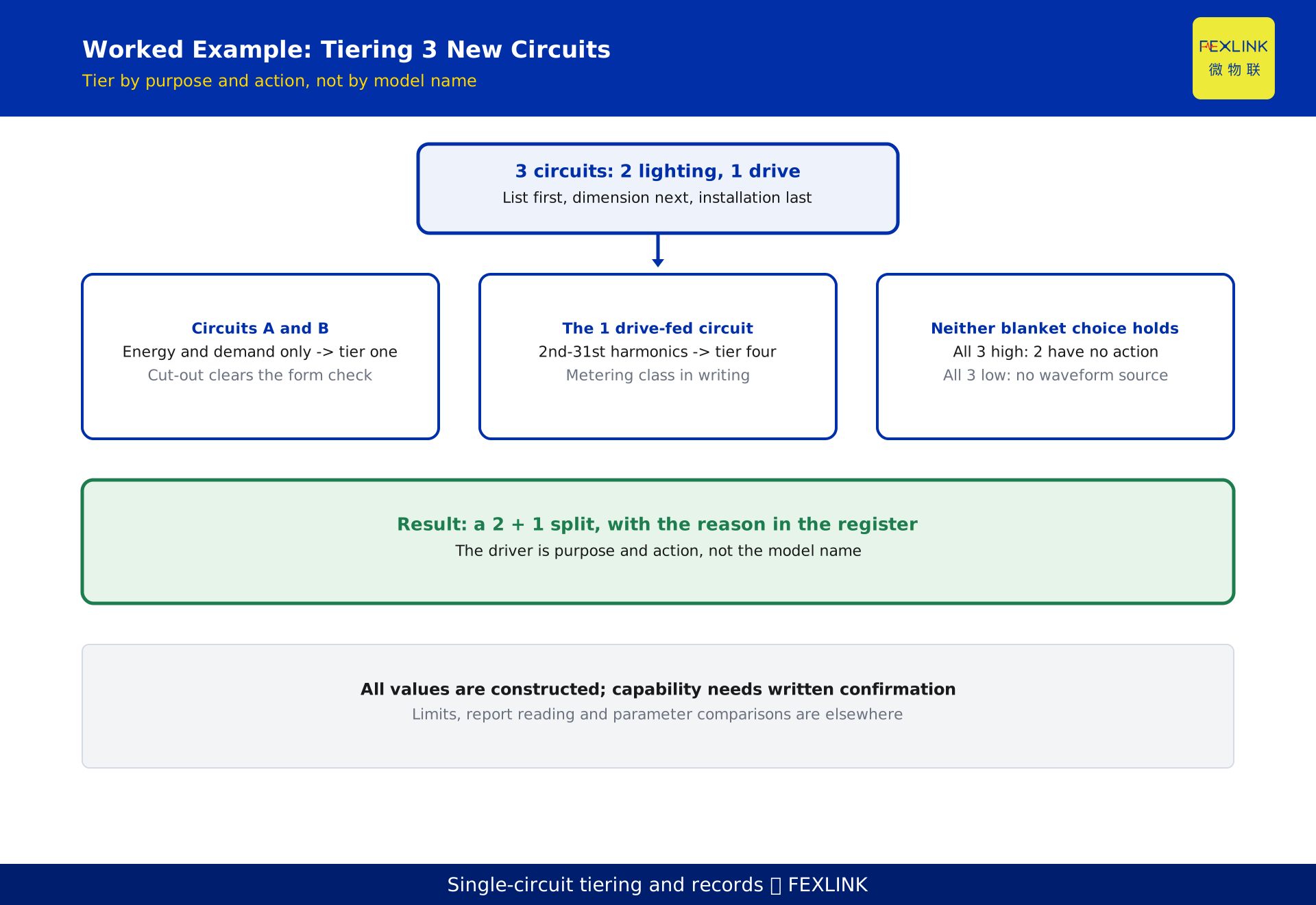
The following is a constructed, de-identified example and represents no real customer or project. A campus distribution room adds 3 circuits to be metered: 2 lighting and socket circuits, and 1 circuit feeding variable-speed drive equipment.
The first 2 circuits allocate cost by floor and follow monthly trends; only energy and demand are listed, and the existing cut-out clears the form check, placing them in tier one. The 3rd circuit carries a non-linear load and operations need harmonics to decide on a filter, so it lands in tier four; its metering accuracy class is confirmed separately in writing, not assumed inherited.
Neither blanket choice holds: all 3 at tier four leaves 2 circuits with no analysis action, and all 3 at tier one leaves the 3rd circuit without waveform data. The result is a 2 + 1 split with the reason recorded. What drives it is not the model name but the purpose and action on each line.
8. Three mis-selections
Mistake one: deriving requirements from models. Comparing quotations for features and price first, then inventing a need, lets stock decide the tier. Correction: steps one to three contain only purposes and actions; models appear at step four.
Mistake two: assuming a higher tier includes lower-tier settlement capability. Assuming harmonic analysis implies settlement-grade metering, or a basic meter reports unbalance. Correction: accuracy class, metering purpose and waveform capability are independent conditions, each confirmed in writing.
Mistake three: sizing by breaker rating alone. Ignoring normal operating current and the direct versus transformer difference oversizes the range and misses ratio settings, so data is not comparable from day one. Correction: treat installation as a separate gate and keep the record.
9. Selection register: keep the reasoning auditable
Keep one row per circuit with at least four columns: circuit ID and purpose, highest required dimension, the two-cut result (per-phase yes/no, waveform yes/no), and the candidate model with its confirmation reference; append form, connection and current range checks. Copy the adjacent row for a new circuit and edit only differences - faster than reopening the catalogue, and it avoids similar circuits on one site ending up in different tiers.
The upstream system consumes already-selected data: the FEXLINK digital electrical supervision platform brings energy, per-phase quantities and power quality events into one view and alarms on them, but cannot recreate a layer the front end never collected. The register carries the decision; the system uses the data. At review, expansion or audit, four columns reconstruct why a tier was chosen - something no parameter table can replace.
Frequently Asked Questions (FAQ)
Q: For sub-metering and billing by energy, do I need a power quality monitor?
Usually not. The criterion is energy and accuracy class, i.e. the metering dimension; a waveform dimension with no remediation or acceptance action produces data nobody uses. Write the list, apply the two cuts, then let installation pick the model.
Q: A basic meter is already installed; can the platform calculate harmonics later?
No. Individual harmonics cannot be inferred from totals; the waveform dimension must be captured at the front end with the right sampling and reporting conditions. This is a tiering question, not an algorithm question. Return to the list, re-tier, and check that the added device still meets the metering requirement.
Q: Is a higher tier always better, and how should budget be controlled?
A tier reflects which layer of data is needed, not a quality ranking. The test is whether each line has an analysis action: a higher tier without one wastes budget, a lower tier without one leaves a blind spot. Tier per row rather than assigning one tier to a whole cabinet.
Q: Do configuration variants within a series change the tier?
The tier is set by data dimension; variants usually affect communication, connection or mounting, which belong to the fourth check. Verify coverage line by line in the selection manual rather than inferring from the series name, and request written answers for anything unlisted.
Q: The supplier says verbally that "all of these are supported". How do I confirm?
Turn every list line into a checkable item and require a written statement of model, measured quantity, applicable conditions and accuracy class, recorded under a confirmation reference. Vendor tier descriptions are a family reference only and do not enter the selection conclusion; written replies and acceptance records are the review basis.
Scope and limitations
This article is a tiering method for single-circuit meter selection in the preparation stage of low-voltage distribution, sub-metering and circuit-level monitoring; it does not replace engineering design, current standards or the selection manual. The four tiers are a hierarchical summary of a product family and constitute vendor disclosure, not a commitment about any model's capability, parameters or results. Measured quantities, accuracy class, current ranges, communication options and event logging are governed by the nameplate, selection manual and written supplier response. Harmonic limits, class tables, per-order error limits, report reading and parameter-by-parameter comparisons of mounting forms and current ranges belong to dedicated articles. The worked example is constructed and de-identified and represents no real customer or project. All deliverables remain DRAFT_PENDING_REVIEW and require independent review; the generator does not self-approve.
Frequently Asked Questions
ZSA, ESA, ESB or ESE
Before opening a model catalogue, write down what this circuit must answer and sort it into three data dimensions: how much energy was used (energy, power