 FEXLINK Research Institute
The short answer
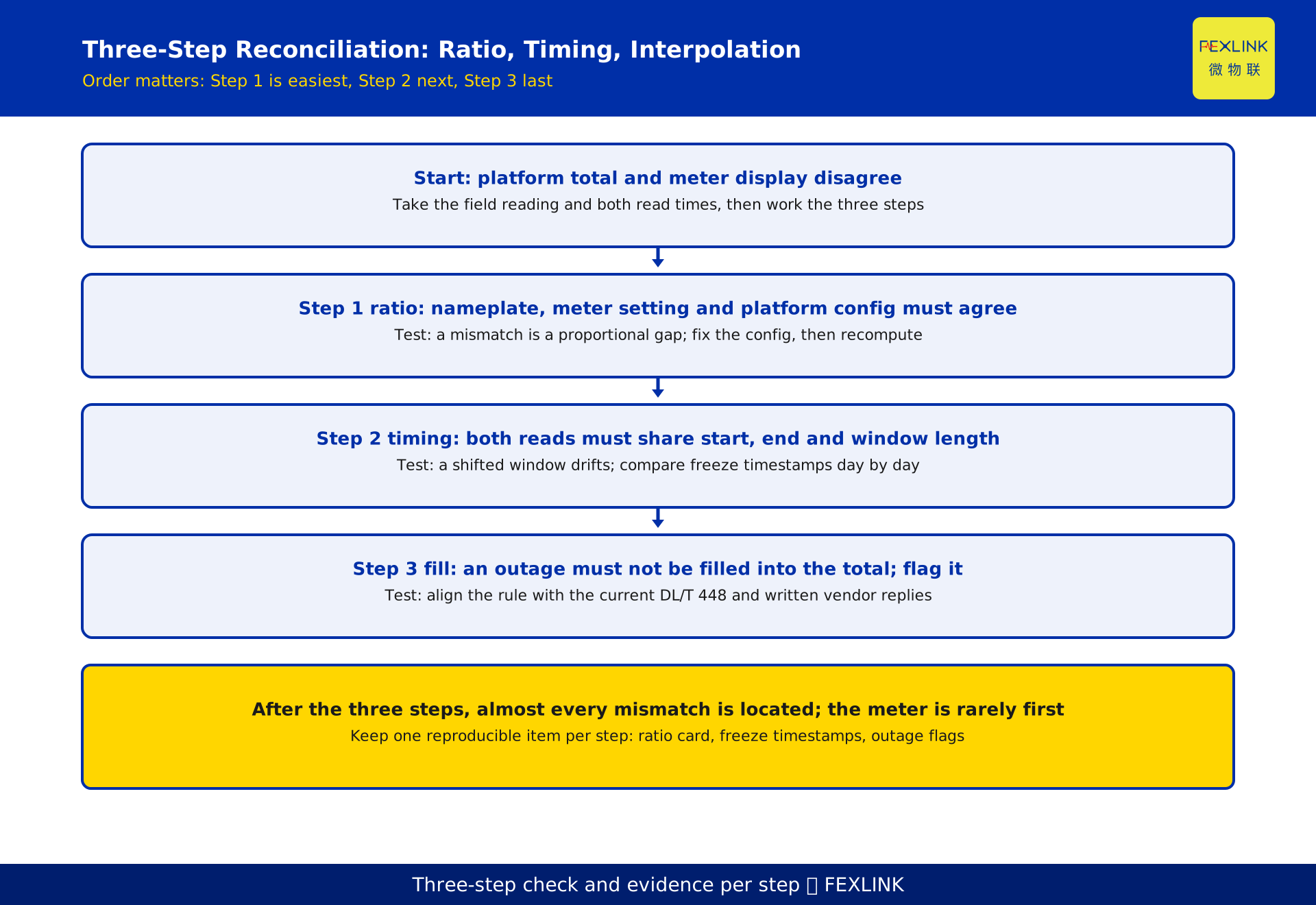
When the platform total does not match the meter display, do not assume the meter failed. Most gaps come from three checkable issues: a CT/PT ratio mismatch with the platform, misaligned frozen reading timestamps, or a communication outage filled with interpolated values. Size the gap first: several times over means a ratio error, a small shortfall means misaligned windows. Then apply a three-step reconciliation: Step 1 checks ratios, Step 2 aligns frozen intervals, Step 3 clears interpolated segments. This usually closes the account without replacing any device.
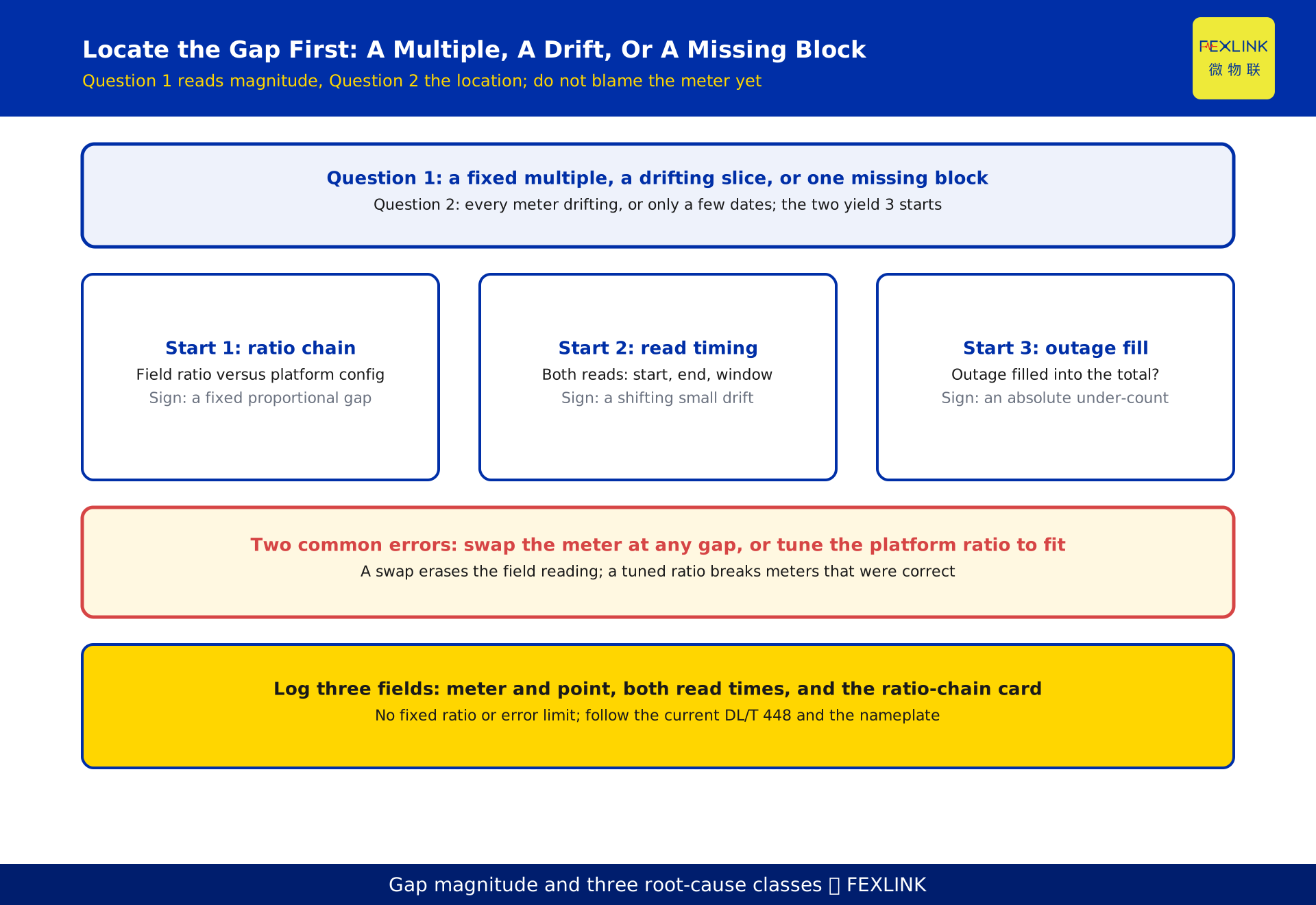
Size the gap first: multiples point to ratios, fractions to timestamps
Start by sizing the gap, not pulling the meter. If the platform reads several times above or below the display, the CT/PT ratio is almost certainly wrong at one end. If the shortfall is modest and shifts each time you check, the reading windows are probably misaligned.
Sizing decides the investigation. Ratio errors are structural: the deviation stays a constant proportion while the setting is unchanged. Timestamp errors are interval-based: the difference moves with the moment you compare. Separate these first, or the three-step method goes to waste. Also check whether the gap belongs to one meter or a whole batch: a single meter points to its own ratio or wiring, a batch to a shared setting or collection policy.
Ratio check: field CT/PT ratios versus platform configuration
Ratios are the first gate and Step 1. With current transformers (CT) or voltage transformers (PT), the display shows primary-side energy and the platform must reproduce that conversion. Three mistakes recur: a platform ratio differing from what is installed, a ratio applied at both gateway and platform so it is multiplied twice, or an engineering-unit conversion multiplying the raw register a second time.
Keep the check reproducible: copy CT/PT nameplate ratios and compare them line by line with platform parameters, confirm the conversion direction, confirm the ratio acts at exactly one point in the chain, and validate a known-load circuit with a small sample. A whole-multiple gap suggests a duplicated or missing ratio before meter accuracy. Ratios and wiring follow nameplates, selection manuals, site surveys and written manufacturer replies; this article gives no fixed values.
Timestamp alignment: do the two reading intervals match
Even with a correct ratio, misaligned timing breaks the reconciliation; this is Step 2. Meters freeze a cumulative reading at a fixed cadence, the platform computes an increment between two frozen points, and the display is instantaneous. Using a different pair of frozen points makes a shortfall inevitable. Month-end manual readings often use the live display while settlement uses daily frozen values, so they are naturally offset.
Three actions align them: confirm the platform freeze cadence matches the meter and do not mix daily and monthly definitions; compare the platform increment from previous to current frozen value against the display at that same frozen instant; check reporting and ingestion timestamps so backfilled data is not filed by arrival time into a neighbouring interval. Once definitions agree, fractional differences vanish. Freeze cadence and storage depth follow the product manual and site configuration.
How outage interpolation distorts cumulative totals
Step 3 clears interpolated segments. When communication drops, some systems fill the gap so the curve looks continuous, but an interpolated number is an estimate, not a metered value. If the outage falls in a billing interval and the filled energy enters settlement, it creates a systematic offset against the real cumulative total that does not vanish when ratios or timestamps are corrected.
Check how the platform handles outage segments: does it flag them abnormal or quietly fill them? Settlement should rest on real frozen increments, with interpolated segments marked and excluded. Distinguish late data from missing data: a backfill after uplink recovery is only a timestamp problem, realigning it is enough; for an interval never collected, no algorithm can reconstruct a metered value. Display may interpolate; settlement may not. Write that boundary into the rules.
One point, one definition: engineering-unit conversion and the ratio chain
The three issues are really one ratio chain: a raw register value becomes a primary-side reading through engineering-unit conversion, then a platform reading through reporting and ingestion. Every hidden ratio multiplies the figure once more. Many discrepancies are two points each contributing a little, compounding into a several-fold error; checking only the platform misses the gateway conversion.
Give every metering point a definition card recording the raw value dimension, which segment applies the transformer ratio, who applies the conversion coefficient, and the final platform formula. One card turns "what do we multiply the display by" into a verifiable equation. State whether the point is metered on the high or low voltage side and which frozen quantity settlement uses, so the same meter is not given different ratios in different reports. Both teams confirm the card and keep versions when it changes.
A reconciliation ledger: record ratio, timestamp, and base readings per meter
Ad hoc checks miss things. A ledger is steadier: one row per meter listing the installed CT/PT ratio, the configured platform ratio, freeze cadence, opening and closing base readings and increment, gap size, classification as ratio, timestamp or interpolation, and the handler's conclusion. Review it before each monthly reconciliation to spot chronic offenders.
The ledger turns "does not match" into "attributable": the same proportion for months suggests a ratio problem, a wandering gap points to freeze timing and interpolation, and a batch shifting on one day reflects a platform change you can confirm in the change log. Keep before-and-after snapshots so recomputation has an evidence chain. Aggregating classifications by quarter pushes error-prone items into the commissioning checklist.
Worked example: locating a park's monthly reconciliation gap
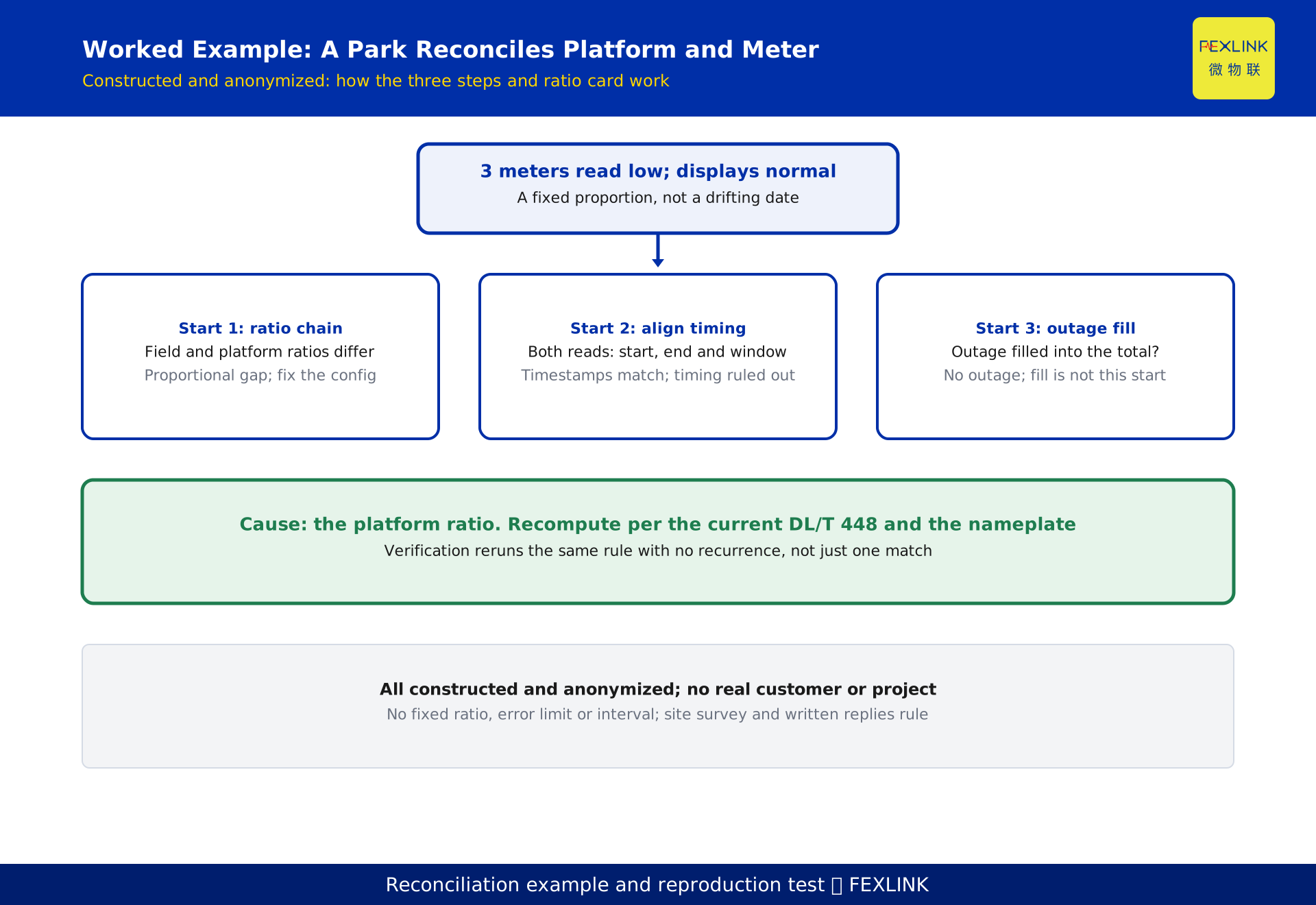
Consider a desensitised constructed case: a park's monthly platform total fell short of manual readings, and the two teams disagreed on why. Sizing came first: the gap was proportional rather than a whole multiple, so a blanket ratio error was set aside.
Step 1 checked ratios: sampling high-voltage-side meters showed one converted at the gateway and given a transformer ratio again at the platform, and another whose setting was never updated after a transformer replacement. Step 2 aligned frozen intervals: manual readings used the month-end live display while the platform used daily frozen values, and backfilled data was filed by arrival time into a neighbouring interval. Step 3 cleared interpolation: a gateway upgrade left two days uncollected and the platform interpolated rather than flagging them, so those values entered settlement.
After fixing all three — ratio at one point only, a unified freeze definition, outage segments flagged — the next month's gap narrowed sharply, with the remainder within normal wiring losses and the instantaneous-to-frozen lag. Sizing then checking three steps against evidence beats pulling meters at the outset; when faults overlap, fixing one alone appears to achieve nothing.
Where products fit: meter, gateway, and the cleaning layer
In product terms, the FEXLINK ESA all-element smart meter outputs a well-formed raw value, the ESX edge gateway performs engineering-unit conversion and store-and-forward locally so an outage does not lose a segment, and the Taiyi control hub L2 cleaning layer separates display-grade from settlement-grade data, flagging outage segments rather than interpolating them while centrally managing ratio and freeze settings. Clear roles show which segment applies the ratio and who writes the anomaly flag.
These products provide collection, conversion and marking, not a substitute for human reconciliation or a promise about the accuracy, ratio range or backfill capacity of any model. Ratio settings, freeze cadence and transformer ratios come from nameplates, selection manuals, site surveys and written manufacturer replies. DL/T 448, the technical management code for electrical energy metering devices, covers metering point arrangement, transformer configuration and accuracy classes; its clauses follow the official text and site design, cited here only as a compliance reference. The platform accepts only confirmed settings. The names above are enterprise-disclosed lineage used for role comparison, not as a basis for conclusions or acceptance.
Boundary with adjacent articles: reconciliation versus mechanisms versus commissioning
This article covers field reconciliation for "platform total versus meter display" with clear boundaries. A separate article explains why abnormal data jumps, freezes, doubles or runs backwards; this one gives actions without expanding the mechanism. Another covers validation gates and data usability grades, and this one expands the settlement step into a workable checklist. A further article covers one-off commissioning reconciliation when a new meter is brought online, whereas this is a systematic method for recurring monthly reconciliation. Cross-vendor protocol misreads and dropout diagnosis are separate; this one assumes the collection chain is healthy.
Mechanisms belong to the abnormal-data article, validation to the data-quality article, commissioning to the integration article, recurring reconciliation to this one. The three-step method of ratio, timestamp and interpolation is the increment.
Frequently Asked Questions (FAQ)
Q: The platform reads far below the display. Is the meter broken?
Do not conclude that first. A several-fold gap points to ratios: a configured ratio too small makes the reading proportionally small, and the meter is usually fine. Only after the three-step check should you consider inaccuracy or verification, which follows metering codes and the manufacturer's process.
Q: Why does the gap change when I reconcile at the same time every day?
The two checks are probably not using the same pair of frozen points. The display is instantaneous, the platform computes an increment between two frozen points, and manual readings often use the month-end display. Compare the platform increment against the display at that frozen instant and verify reporting and ingestion timestamps, not a random snapshot.
Q: Communication was down for a few days and the platform total is short. Is that normal?
If the platform interpolated the outage segment, what is missing is an estimate, not a metered value, and should not enter settlement. Mark the segment missing or abnormal and settle on real frozen increments. Regroup any backfill by frozen point before comparing, and do not mistake late data for missing data.
Q: Both the gateway and the platform ask for a ratio. Will it be applied twice?
Yes, and this is a common source of discrepancy. The ratio must act exactly once, either at the gateway or the platform, never both. Walk the chain to confirm where it acts so the raw value is not multiplied twice. The definition card should state who applies it.
Q: What does DL/T 448 require us to configure?
DL/T 448 is the technical management code for electrical energy metering devices, covering metering point arrangement, transformer configuration and accuracy classes. Its clauses follow the official text and site design, cited here only as a compliance reference, not a substitute for manuals, site surveys or verification. Reconciliation implements recording ratio settings, freeze definitions and anomaly flags in the ledger with version control.
Scope and limitations
This article is a field reconciliation method for a mismatch between platform cumulative total and on-site meter display, intended for monthly reconciliation of installed automatic meter reading systems in parks, buildings and distribution rooms, addressed to energy managers and reconciliation staff. It does not replace metering verification, engineering design, current codes or product manuals. Gap sizing, the three-step method, the ratio-chain definition card and the reconciliation ledger are generalisations of engineering practice, not promises about the accuracy, ratio range, frozen storage depth or backfill capability of any model. No fixed values are given for transformer ratios, error limits, accuracy classes, freeze cadence or collection intervals; parameters follow current effective versions, nameplates, selection manuals, site surveys and written manufacturer replies. Meter inaccuracy mechanisms, new-meter integration parsing, cross-vendor protocol misreads and dropout diagnosis are separate articles. The FEXLINK ESA all-element smart meter, ESX edge gateway and Taiyi control hub L2 cleaning layer are enterprise-disclosed lineage used for role comparison only, not as an acceptance basis. The worked example is a desensitised construction representing no real customer or project. All deliverables remain DRAFT_PENDING_REVIEW and require independent review; the generator does not self-approve.
Frequently Asked Questions
Platform kWh Doesn't Match the Meter Display
When the platform total does not match the meter display, do not assume the meter failed