 FEXLINK Research Institute
The short answer
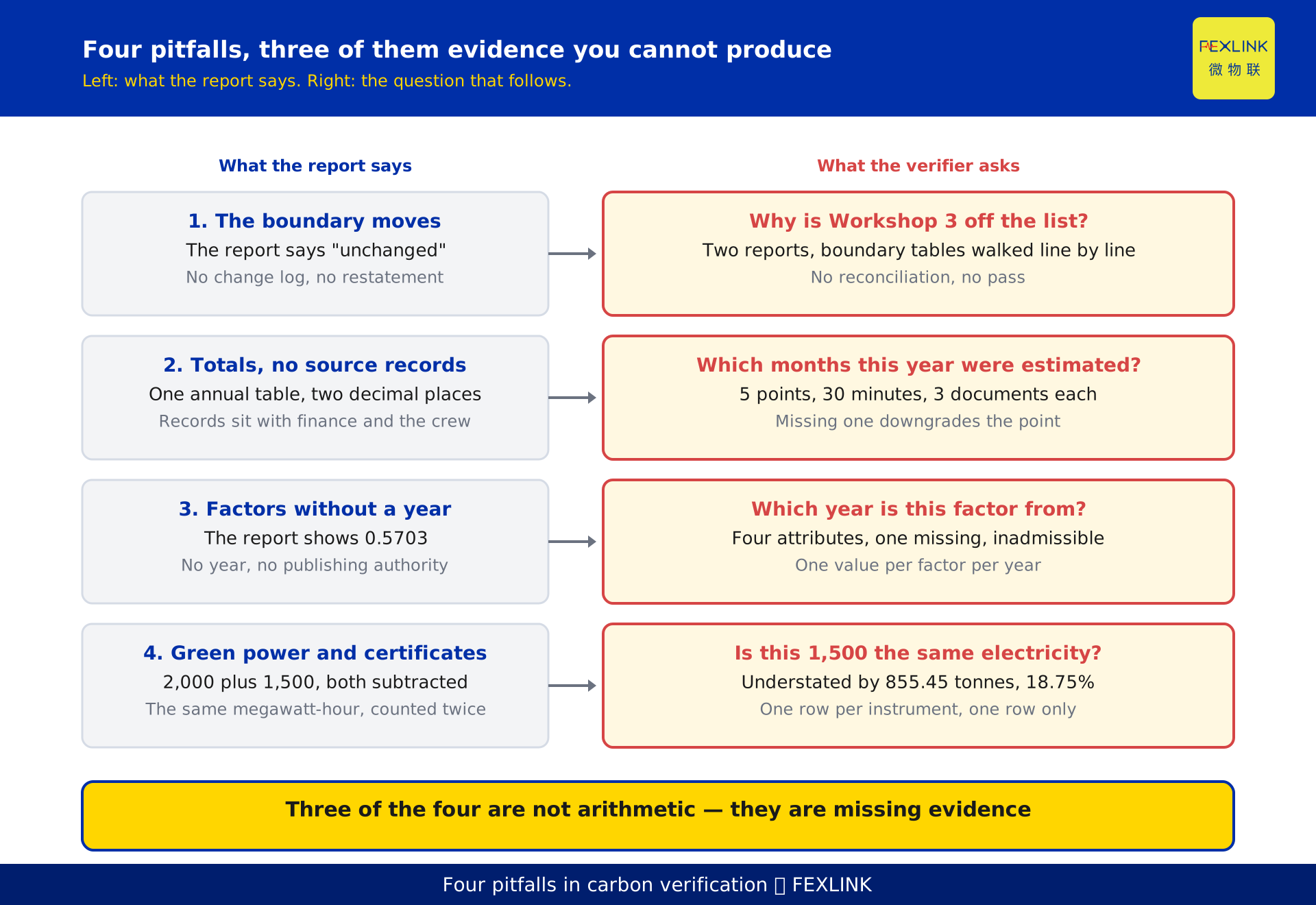
Most carbon reports are rejected not because the arithmetic is wrong, but because the company cannot answer the follow-up question. A verifier does not recalculate your emissions. They pull a few data points and ask where the number came from, why the boundary differs from last year, and which year published the factor. Where you go quiet is where the report fails. Four pitfalls account for most of it: a boundary that shifts every year without explanation, activity data that exists only as a summary total, factors quoted as a bare number with no source or year, and green power plus certificates deducting the same megawatt-hour twice. The first three fail on evidence; the fourth fails on double counting.
Verification is not a recalculation, it is a test of self-evidence
Third-party verification provides reasonable assurance, not an accounting service on your behalf. The work is sampling, interviews, document review and recalculation, and it ends with one question: does the report contain a material misstatement?
Verifier questions follow a fixed pattern. Nobody asks whether you feel good about the number. They ask where it came from, why the boundary sits where it sits, and on what basis that factor was chosen. Those three map to the data chain, the accounting basis and the evidence. Break any one and the report does not pass.
A simple test tells you whether a report is ready: hand your source records to someone else and see whether they reproduce the same number.
Pitfall 1: A boundary that moves, in a report that says "unchanged"
The accounting boundary is not one box. It is three lines: organizational (which legal entities or reporting units), facility (which workshops, auxiliary systems and office buildings), and source (which combustion, process and indirect emissions). Move any one line and the two reports are no longer comparable.
A boundary change is not itself an error. Not disclosing it is. The usual patterns: a new workshop appears but never enters the source list; outsourced processing is counted this year and was not last year, with no explanation.
How does a verifier ask? They lay the two reports side by side and walk the boundary table line by line. "Is this year's site plan the same as last year's?" "Why is Workshop 3 not on the list?" If either goes unanswered, the numbers get recalculated.
Three self-checks, each answerable yes or no: does a boundary change log exist; were prior-year figures restated; can the two boundary tables be reconciled line by line. The second matters most: when the boundary moves, history must be restated, or a change in basis looks like a reduction.
Where a company sets its own significance threshold, for example 5%, a structural change above it requires the base year to be recalculated.
Pitfall 2: Activity data that exists only as a summary total
Activity data breaks most often because it does not sit with the carbon team: electricity with energy, gas with procurement, output with production, money with finance.
Data has three tiers: metered measurement, settlement documents, and mass balance or estimation. All three are permitted but not interchangeable: metered data must trace to a reading, settlement data to an invoice or weighbridge ticket, and an estimate must state its method.
The failures are concrete: the ledger records physical quantity while the invoice records a tax-inclusive amount, and a meter's current transformer ratio does not match its setting, so readings are off by a factor of several and nothing alarms.
How does a verifier ask? "Which months this year were estimated?" "Where is the calibration certificate for this meter?"
One self-check, performed rather than discussed: pick 5 data points at random, set a 30-minute clock, and see whether meter record, settlement document and summary table come out together. If one is missing, that point is downgraded to an estimate.
Electricity is worth fixing first: it usually dominates indirect emissions and is the item most likely to survive as one annual total. An ESA full-parameter smart meter is installed per circuit and freezes readings monthly, and the readings carry their own timestamps, so a sample exports directly as circuit, month and kilowatt-hours. It does not replace settlement documents or the meter register, but it is the link most likely to be sampled.
Pitfall 3: A factor with a number but no source or year
Every factor needs four attributes: name, publishing authority, version or year, and scope of application. Miss one and it is inadmissible. The attribute most often missing is the year: a report states 0.5703 and nobody can say which year that is or who published it.
Three mistakes recur: an old-year factor used for a new reporting year, the commonest, because old figures are easier to find; a regional factor mixed with a national one inside the same year, usually because two people each looked it up once; and an "industry average" cited without a source.
Underneath sits another: GWP versions. The IPCC's Fourth Assessment Report puts methane at 25, the Fifth 28. Use both in one report and the methane line moves by more than ten percent.
How does a verifier ask? "Which year and which authority published this factor?" "Why is page 12 using 0.5703 and page 20 using something else?"
The self-check is a factor table: one row per factor, four attributes present, exactly one value per factor per year.
Pitfall 4: Green power and certificates deducting the same megawatt-hour twice
Start with the formula: indirect emissions from purchased electricity equal net purchased electricity multiplied by the emission factor. Green power works on the multiplier, not the factor — it reduces the quantity, not the coefficient.
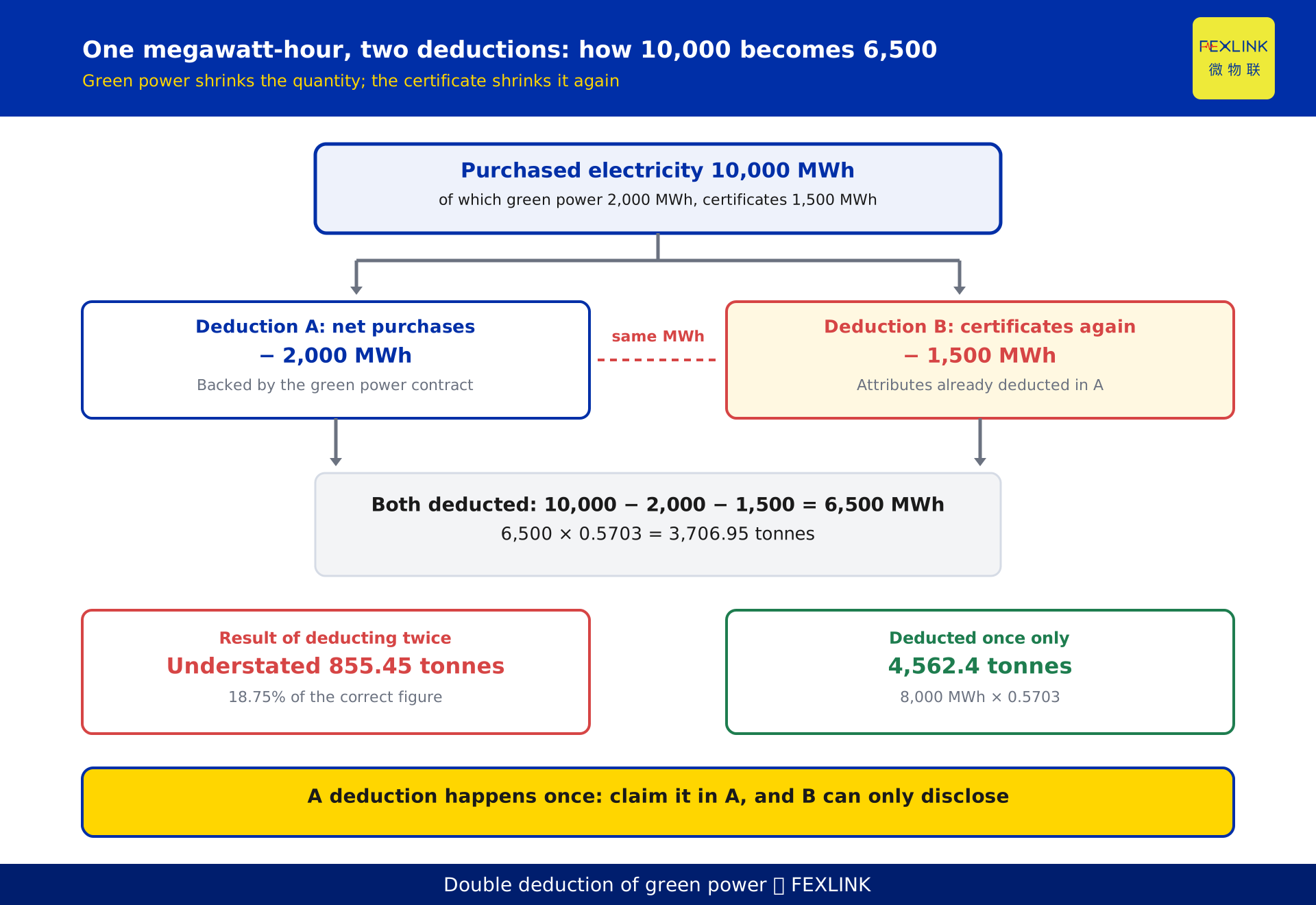
Bundled green power ties energy to its attributes, so the attributes are yours once consumed. Unbundled certificates trade separately, and the electricity behind them may already be pooled into the grid. Either way a deduction happens once only: if the green power volume has left purchased electricity, certificates for the same megawatt-hours cannot be removed again.
Consider an illustrative scenario, constructed only to show the mechanism and describing no real company. A factory purchases 10,000 MWh over the year, of which 2,000 MWh is green power under contract. Procurement separately buys certificates for 1,500 MWh. The report deducts both: 10,000 minus 2,000 minus 1,500 leaves 6,500 MWh. At 0.5703 tCO2/MWh, indirect emissions come out at 3,706.95 tonnes.
Deduct once only, and net purchased electricity is 8,000 MWh with emissions of 4,562.4 tonnes. The gap is 855.45 tonnes, or 18.75% of the correct figure.
How does a verifier ask? "Is the electricity behind these 1,500 MWh of certificates the same as that 2,000 MWh of green power?" "Have the certificates been retired, and to whose account?"
The self-check is a certificate register: one row per instrument, recording serial number, volume, registry body, retirement status and where the deduction is taken. One megawatt-hour, one row.
So choose one instrument, or allocate each separately? It depends on instrument type and the rules in force. Green power volumes are deducted from purchased electricity under the applicable guidance; whether certificates may be deducted, and by how much, depends on whether current rules permit it, and where they do not, disclosure only. Offsets such as CCER sit at the compliance stage, not in Scope 2, so they do not belong in the same table. Follow the guidance in force and the local authority's requirements; this article gives no conclusive figure.
What the four have in common
The boundary failure is one of comparability: two years that are not the same thing, in one table. The evidence failure is one of traceability: the number cannot be walked back to a meter and an invoice. The factor failure is one of reproducibility. The green power failure is one of uniqueness: the same megawatt-hour claimed twice.
The first three can be fixed with paperwork. The fourth cannot: the problem is not missing evidence but too much of it. Filing does not resolve a duplicate claim; only a register does.
A verifier does not require your emissions to be the lowest, only to hold up. Closing these four gaps is what carbon accounting advisory work consists of; running electricity and carbon on one quantity basis is where power-carbon integration begins.
The pre-submission checklist
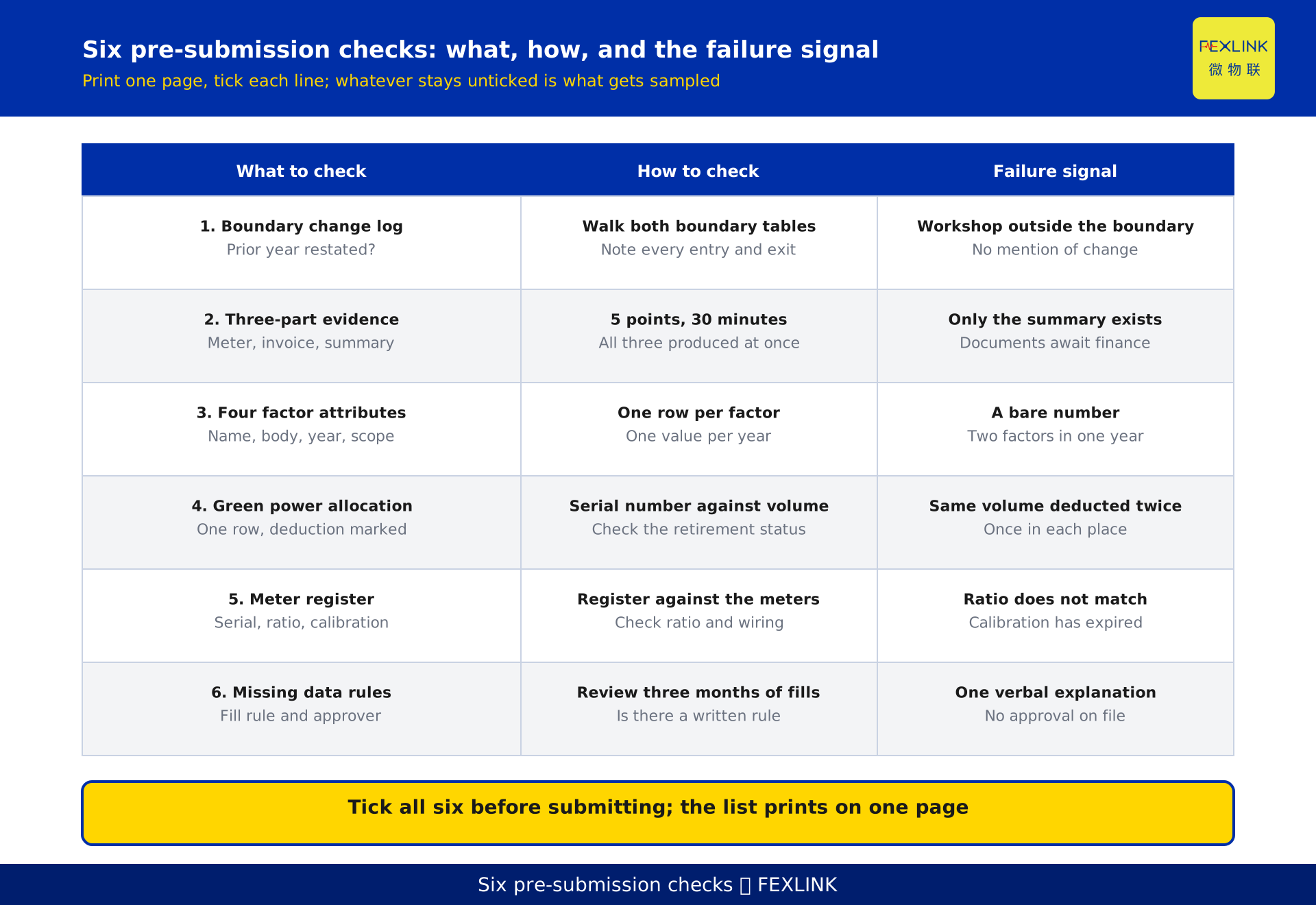
Six items. Anything that cannot be ticked gets fixed before submission.
1. Boundary change log. Walk both boundary tables line by line; every workshop, process and source that entered or left gets a line. Failure signal: a workshop crossed the boundary and the word "change" appears nowhere.
2. The three-part evidence set. Pick 5 points at random and produce meter record, settlement document and summary table within 30 minutes. Failure signal: only the summary exists.
3. Four attributes per factor. One row per factor with name, publishing authority, version year and scope. Failure signal: a bare number, or two electricity factors in one year.
4. Green power and certificate allocation. One row per instrument, deduction location marked. Failure signal: the same volume appears in both the net-purchase and the certificate deduction.
5. Meter register. Check it against the meters on site: serial number, location, transformer ratio, calibration validity. Failure signal: ratio mismatch, or an expired calibration.
6. Missing-data and exception records. How a missing month is filled, how an outlier is judged, who approves it. Failure signal: one sentence saying that is how it was handled at the time.
Whatever cannot be ticked is what the sample will land on.
If you are rejected: the order of remediation
A rejection is not a rewrite, but remediation has an order.
First, classify the findings: basis (boundary, method, factor), evidence (records missing or unreconciled), and calculation (units, conversions, double counting). Fix all three at once and they will still not reconcile.
Second, fix the basis first. Change the basis and every downstream number moves with it; restore the evidence first and it will have to be restored again.
Third, downgrade what cannot be restored. Where a month is missing, fill it by rule, label it an estimate and carry the uncertainty. A verifier will accept an estimate; a verifier will not accept a disguise.
Fourth, restate and explain. When the basis changes, the prior year is restated with the reason and the impact, and the response states what changed, how many tonnes it moved, and what prevents a recurrence.
FAQ
Q: How large a sample will the verifier take?
The sample is set by the verifier's risk assessment, not by the company's preference. What the company controls is whether any sampled point can be evidenced.
Q: Our activity data really is estimated. Does that automatically fail?
No. Estimation is permitted if it is labelled as an estimate, the method and assumptions are stated, and it is kept separate from measured data. What fails is presenting an estimate as a measurement.
Q: Can green certificates be deducted against Scope 2 at all?
It depends on the rules in force: some guidance permits deduction for specified instruments, some requires disclosure without deduction. Either way, a given volume is claimed once.
Q: Last year's report had an error. If we fix it this year, must we restate last year?
Yes. Any change of method, factor or boundary that makes the data incomparable requires restatement and disclosure of the impact. Changing only the current year converts a change of basis into an apparent reduction.
Q: We installed smart meters. Do we still need to keep documents?
Yes. Meter data is part of the source record but does not replace settlement documents or the meter register. Only when the three reconcile do you have an evidence chain; a meter alone proves what the display showed, not which asset or period it belongs to.
Scope and limitations
- This article addresses greenhouse gas reporting and third-party verification in China in general terms; sector guidance for power, steel, cement and other industries sets additional requirements and prevails.
- No specific emission factor values are given; the 0.5703 tCO2/MWh in the worked example is illustrative, and actual accounting must use the factor published for the relevant year. The figures in the fourth pitfall are a constructed scenario describing no real company.
- Rules on green power and certificate deductions change with policy. This article sets out the principle and does not judge whether a given instrument is currently deductible; eligibility and limits for offsets such as CCER are outside scope here.
- The significance threshold (5% in the example) is set in the company's own accounting plan; standards do not prescribe a number. Once set, it should be disclosed and kept stable.
- Standard numbers are cited as currently in force; boundary definitions and data quality requirements in ISO 14064-1 and GB/T 32150 may change between editions and should be rechecked at the time of citation.
- Specifications for the ESA full-parameter smart meter follow the current selection manual; nothing here is a procurement recommendation.
Frequently Asked Questions
How large a sample will the verifier take?
The sample is set by the verifier's risk assessment, not by the company's preference. What the company controls is whether any sampled point can be evidenced.
Our activity data really is estimated. Does that automatically fail?
No. Estimation is permitted if it is labelled as an estimate, the method and assumptions are stated, and it is kept separate from measured data. What fails is presenting an estimate as a measurement.
Can green certificates be deducted against Scope 2 at all?
It depends on the rules in force: some guidance permits deduction for specified instruments, some requires disclosure without deduction. Either way, a given volume is claimed once.
Last year's report had an error. If we fix it this year, must we restate last year?
Yes. Any change of method, factor or boundary that makes the data incomparable requires restatement and disclosure of the impact. Changing only the current year converts a change of basis into an apparent reduction.
We installed smart meters. Do we still need to keep documents?
Yes. Meter data is part of the source record but does not replace settlement documents or the meter register. Only when the three reconcile do you have an evidence chain; a meter alone proves what the display showed, not which asset or period it belongs to.