 FEXLINK Research Institute
Direct Answer
What new requirements does the shift from the energy double control to the carbon double control set on the enterprise energy supervision? The state is gradually shifting the "energy double control" to the "carbon double control", moving the focus of the enterprise energy supervision from "controlling the energy consumption" to "controlling the carbon emission" — the energy data must be convertible into the carbon emission and cover more energy types and scopes, making the energy-carbon integrated metering the new compliance baseline — the policy direction changed, and the focus of the energy management must follow — the energy-carbon integration keeps the supervision aligned.
A scenario: An energy manager of an enterprise sees the policy shift and asks "why should I watch the carbon emission when the total energy is well controlled?" — under the carbon double control, the electricity, the oil and the gas consumption must all be convertible into the carbon emission — watching only the total energy means the carbon cannot be calculated and the policy benefit cannot be received. The logic is that the energy double control manages "how much energy is used" and the carbon double control manages "how much carbon is emitted" — the latter is the extension and the upgrade of the former — the enterprise supervision must upgrade from "watching the energy only" to "watching the energy and the carbon together".
1. The Difference between the Energy Double Control and the Carbon Double Control
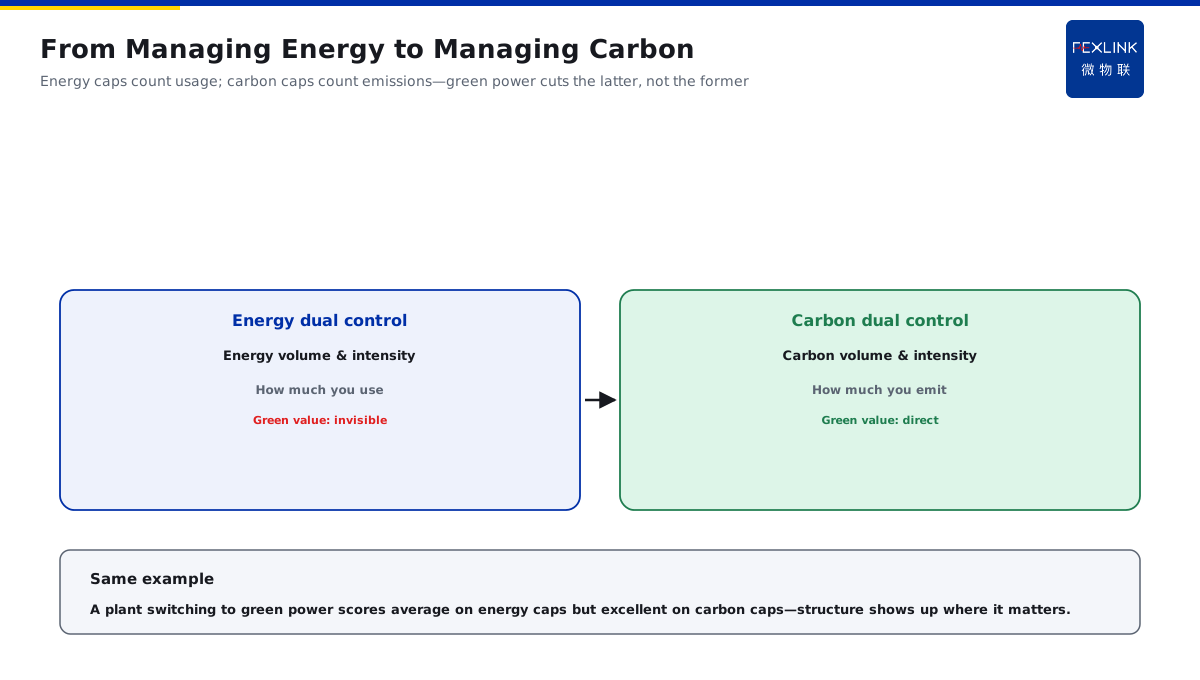
The meaning of the energy double control — controlling the total and the intensity of the energy consumption: managing "how much energy and the energy per unit of the output"; The meaning of the carbon double control — controlling the total and the intensity of the carbon emission: managing "how much carbon and the carbon per unit of the output"; The relation of the two — the energy is the process and the carbon is the result: using energy does not always mean high carbon, and the green electricity is low-carbon; The meaning of the shift — from "managing the energy" to "managing the carbon": encouraging the optimization of the energy structure, with room for the green electricity and the electrification.
In one sentence: the energy double control manages "the energy" and the carbon double control manages "the carbon" — from the process to the result — an enterprise with the green electricity keeps the energy but cuts the carbon — the policy is more precise.
The comparison table of the two controls:
| Dimension | Energy double control | Carbon double control |
|---|---|---|
| Managed | Total and intensity of the energy | Total and intensity of the carbon |
| Focus | How much energy | How much carbon |
| Policy | Energy saving first | Carbon reduction first |
| Green value | Not shown | Shown directly |
| Basis | Energy data | Energy + emission factors |
An example: A factory switches all to the green electricity — under the energy double control, "the total is not down" is average; under the carbon double control, "the carbon is largely down" is excellent — the same electricity, different results under different bases. The logic is that the carbon double control makes "the green value visible" — the optimization of the structure is shown directly in the carbon indicator — adjusting the structure receives the policy benefit.
2. The Logic behind the Policy Shift
The carbon neutrality goal — the carbon peak and the carbon neutrality: controlling the carbon is the core; From two tracks to one — the energy double control gradually shifts to the carbon double control: more focused; The international link — the carbon management links with the international carbon market and the carbon border mechanism: more sensitive for the exporters; The enterprise impact — the high-consumption and high-emission enterprises bear the first impact: the carbon data becomes the hard constraint.
In one sentence: the underlying logic is "the double-carbon goal" — the carbon becomes the core indicator — the high-consumption and high-emission enterprises bear the first impact — the carbon data changes from "voluntary" to "mandatory".
An example: An export manufacturer: the customer asks for the product carbon footprint — the energy data converted into the carbon makes the export compliant — without the carbon data, the order is affected. The logic is that the carbon double control is not a "slogan" but a "grip" — the domestic assessment and the international link work together — without the carbon data, the compliance and the orders are passive.
3. The New Requirements on the Enterprise Metering Scope
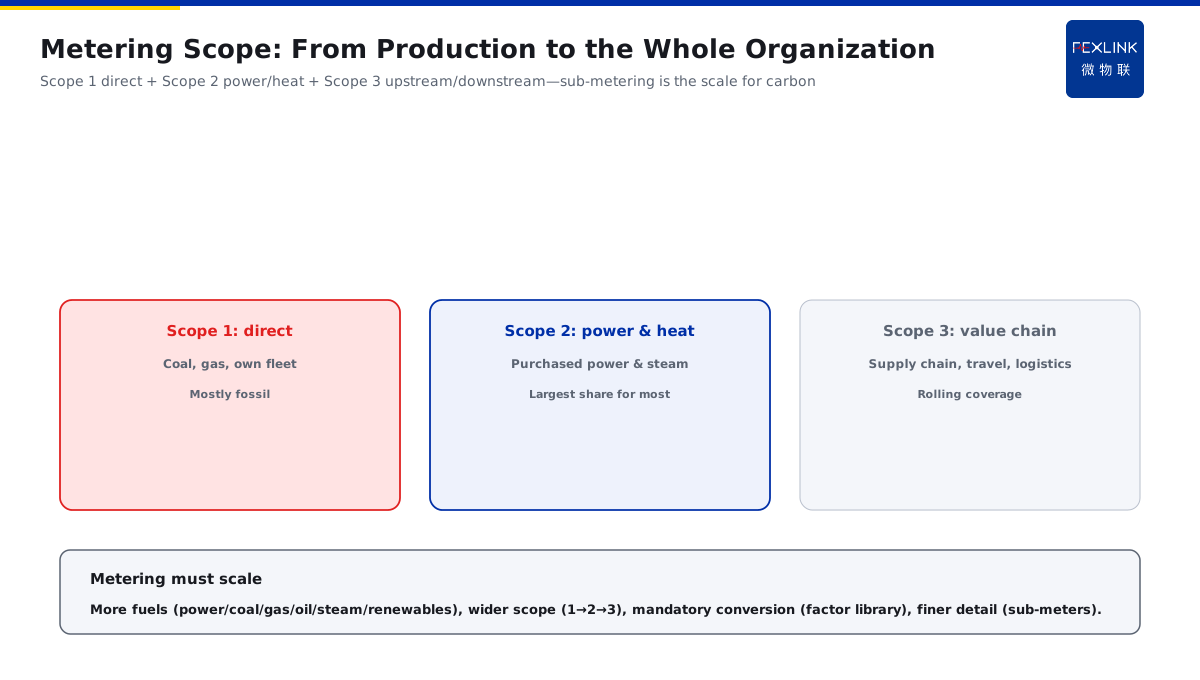
More energy types — from "the electricity and the coal" to "the electricity, the coal, the gas, the oil, the steam and the renewable": complete coverage; A wider scope — from "the production energy" to "the whole-organization emission": the scope 1 (direct), the scope 2 (electricity) and the scope 3 (upstream/downstream) gradually covered; The conversion capability — the energy data must be convertible into the carbon: the emission factor library is the basis; Higher precision — the carbon accounting needs finer sub-items: the sub-metering becomes the standard.
In one sentence: the carbon double control requires "a complete metering, a wider scope, a ready conversion and a higher precision" — the energy metering is the data basis of the carbon accounting — an incomplete metering gives an inaccurate carbon.
The table of the metering scope:
| Scope | Content | Enterprise focus |
|---|---|---|
| Scope 1 | Direct (coal/gas/own vehicles) | Fossil energy |
| Scope 2 | Electricity/heat indirect | Purchased power/heat |
| Scope 3 | Upstream/downstream | Supply chain/travel |
An example: An enterprise accounts its carbon: the scope 1 gas boiler + the scope 2 purchased power — the complete sub-items make it accurate — an incomplete sub-metering gives a large deviation. The logic is that "the incomplete data gives an inaccurate result" — the sub-metering is the "scale" of the carbon — an upgraded metering makes the carbon credible.
4. Why the Energy-Carbon Integration Becomes a Must
The meaning of the integration — the energy metering and the carbon accounting share one data foundation: the same energy data produces both the energy view and the carbon view; Why a must — the two books (the energy ledger + the carbon inventory) have inconsistent bases, duplicate work and mismatched results — the integration solves it from the source; How to realize — the energy quantity + the emission factor library: the energy data converted automatically and consistently; The value — one metering, two outputs: the energy and the carbon indicators are consistent and checkable.
In one sentence: the integration = one data foundation and two outputs — the energy and the carbon are from the same source — with the two books mismatched, the carbon accounting is not credible.
An example: A group uses the integrated platform — the electricity data is converted into the carbon automatically — the energy and the carbon monthly reports are generated from the same source — the audit is consistent — the manual conversion and the disputes of the two-book era disappear. The logic is that the integration is "the inevitable product of the policy shift" — the carbon accounting cannot rely on the temporary manual conversion — one foundation makes both auditable.
5. The Homework the Enterprise Should Do Now
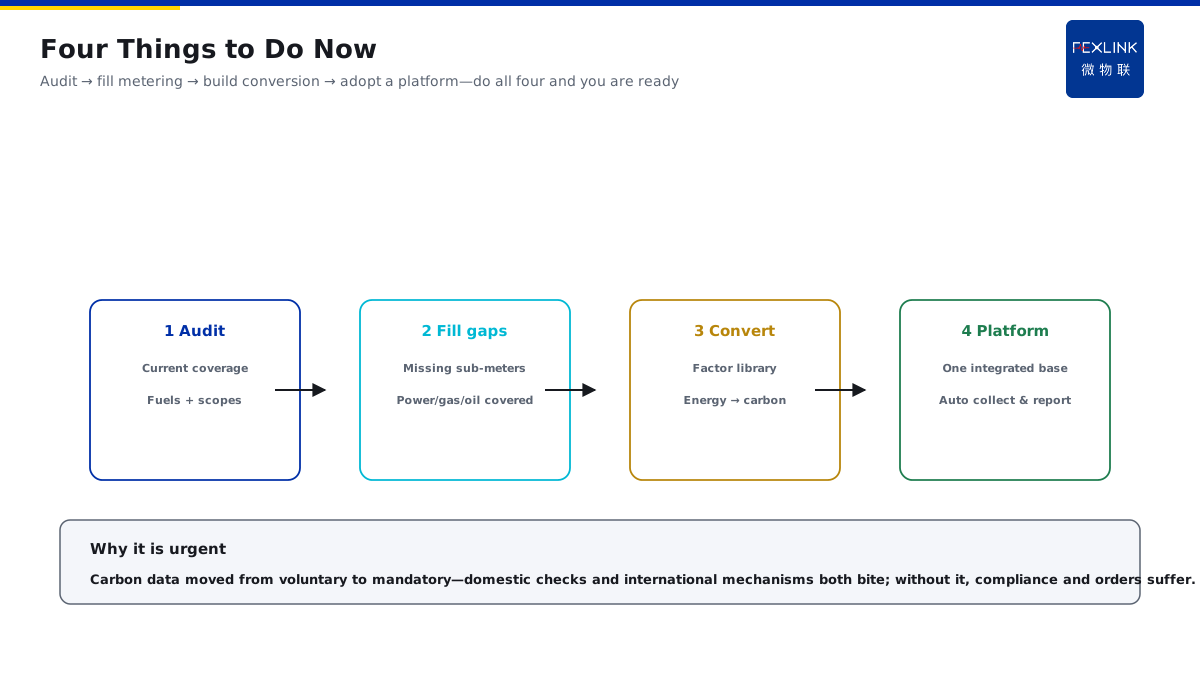
Take the stock — which energy types do the existing meters cover and can they support the carbon accounting? — know the baseline first; Fill the metering gap — add the missing sub-items and types: a complete metering makes the carbon calculable; Build the conversion — the emission factor library and the automatic energy-to-carbon conversion: efficiency and accuracy; Connect the platform — the integrated platform undertakes: automatic collection, conversion and reports.
In one sentence: the enterprise does four things now — take the stock, fill the metering, build the conversion and connect the platform — in place at once, the policy benefit is received.
The homework list table:
| Homework | Action | Key point |
|---|---|---|
| Stock | Know the metering | Types + scope |
| Metering | Fill the gaps | Full coverage |
| Conversion | Factor library | Energy to carbon |
| Platform | Integration | Automatic |
An example: A park follows the homework — taking the stock first (finding the missing gas sub-item) — filling the metering (adding the gas meter) — connecting the platform (automatic conversion) — the quarterly carbon report is generated automatically — the assessment and the customer inquiry both have the data. The logic is that the homework is not "one-time" but "continuous" — the policy changes and the scope expands — the integrated foundation lets the enterprise respond with the constancy.
Back to the energy-carbon autonomy system 4×3×2 and the smart energy-carbon platform — the infrastructure of the carbon double control: the platform embeds the emission factor library, converts the energy data automatically, accounts the scope 1/2/3 as needed and generates the reports from the same source — the 4×3×2 system makes the integration daily — the policy shifts and the enterprise receives it with one foundation.**
Scope and Limitations
- The conclusions in this article are intended for LV distribution and electrical-safety sites. Criteria are compiled from public codes and FEXLINK product documentation, and product parameters follow the latest selection handbook and product knowledge base.
- Quantitative criteria (protection zone, discharge and residual voltage, earth resistance, thresholds and grading) hold under the preconditions stated in this article. Where the site voltage level, earthing arrangement, environmental category or load profile differs, the figures must be recalculated.
- Specific product models and parameters are subject to the latest selection handbook and product knowledge base; this article does not constitute selection or procurement advice.
- Standard numbers cited here refer to the currently effective editions; when a standard is revised, the related quantitative conclusions must be re-checked.
- Deployment and implementation for specific projects must be carried out by qualified engineers based on site survey and design drawings.
Frequently Asked Questions
As Dual Energy Control Shifts to Dual Carbon Control
What new requirements does the shift from the energy double control to the carbon double control set on the enterprise energy supervision