 FEXLINK Research Institute
Direct Answer
Are the energy and the carbon data calculated separately? The integrated energy-carbon data foundation takes the sub-metered energy quantity as the only data source and maps the emission-factor library by the energy type to convert the carbon automatically — "change one energy quantity, and the energy and the carbon update together" — eliminating the two sets of ledgers at the root: no duplicate collection, no duplicate accounting and no temporary reconciliation before the review — one set of data, two bases, the same source and the same output.
A scenario: In a company, the energy ledger belongs to the energy department and the carbon inventory to the EHS — two teams and two datasets — the monthly energy does not match and the annual carbon inventory needs a temporary reconciliation — the audit asks for data and the two sides disagree. The logic is that the root of the split is "two sources" — the energy recorded by the electricity bill and the carbon calculated by the inventory table — two sources never align — the key of the integration is "one source, two conversions": the unique energy quantity and the factor-mapped carbon.
1. The Pain of the Separated Energy and Carbon Data
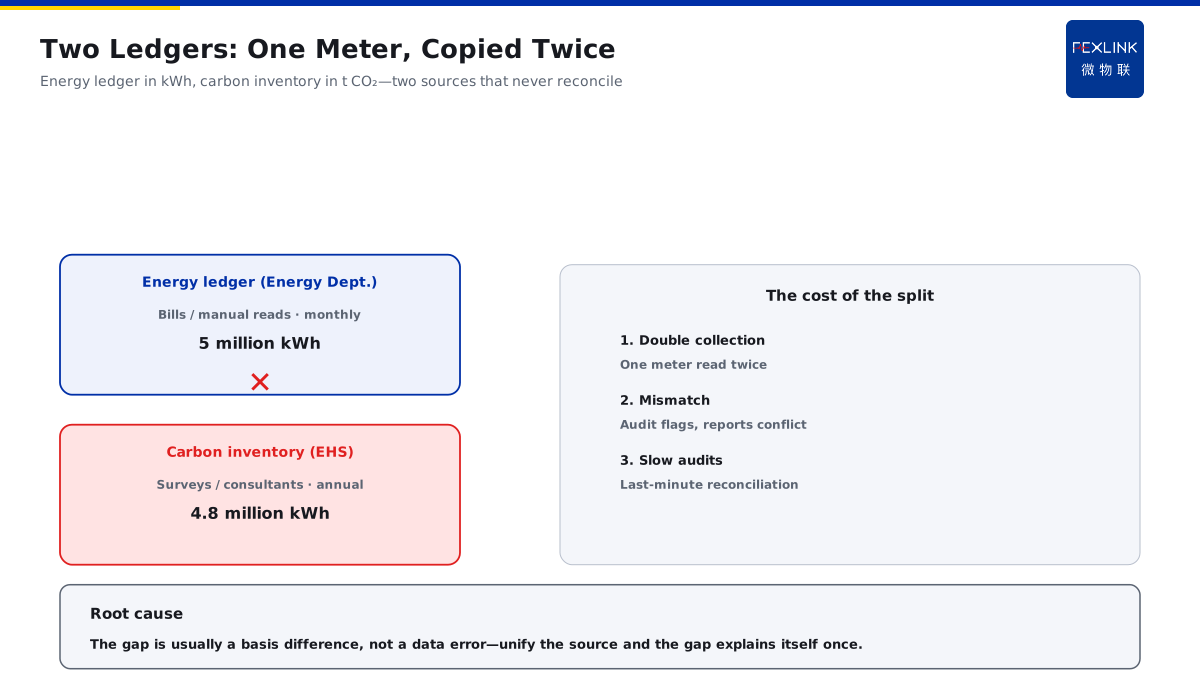
The status of the two ledgers — the energy ledger records by the energy type and the carbon inventory calculates by the emission source: different bases and different data; The waste of the duplicate collection — the same meter is read by the energy department and again by the carbon department: duplicated manpower and errors; The embarrassment of the mismatch — the monthly energy does not match the annual inventory: temporary reconciliation before the review, fixing while checking; The risk of the two ledgers — an inconsistent data is questioned by the auditor and the dual-control report contradicts the carbon report: the compliance risk.
In one sentence: the root of the two ledgers is "two sources" — the same meter read twice and the same energy calculated twice — without a unified source, no reconciliation aligns.
The cost of the separation — the duplicated collection: the same meter read twice; the inconsistency: questioned by the audit and contradictory reports; the different bases: the departments dispute — the three costs all come from the two ledgers. An example: The energy department records 5,000,000 kWh by the bill and the EHS records 4,800,000 by the inventory basis — the annual audit asks about the difference — the two sides spend two hours reconciling and finally find the line-loss basis differs. The logic is that the difference is often not "wrong data" but "different bases" — the same electricity, two bases and two numbers — as long as the source is unified, the base difference is explained once, no reconciliation every time.
2. The Architecture of the Same-Source Foundation: Energy Quantity—Factor Library—Carbon
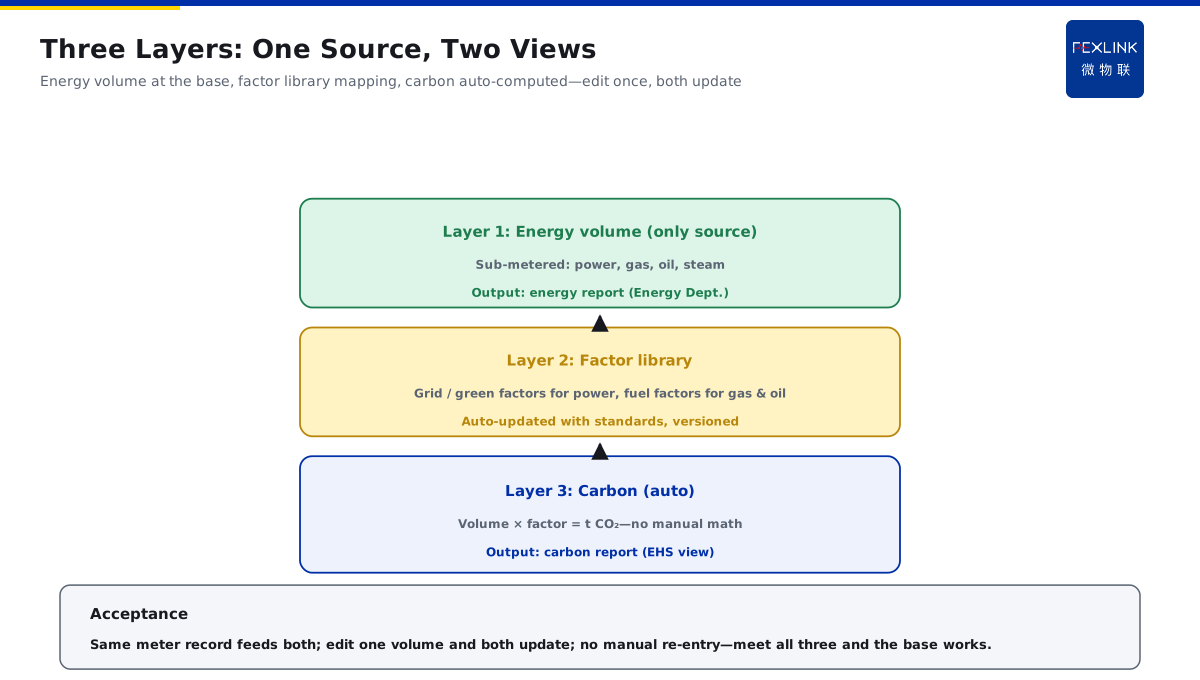
The three layers — the first is the energy quantity (the sub-metered data), the second is the factor library (the mapping of the energy type to the emission factor) and the third is the carbon (the automatic conversion result); The only data source — the energy quantity is the only source: both the energy and the carbon start from it; The automatic conversion — the energy quantity × the emission factor = the carbon: no manual conversion, no secondary error; The dual-basis output — the same energy quantity: the energy basis (kWh/tonne of standard coal) + the carbon basis (tonne CO₂) — one source, two numbers.
In one sentence: the foundation has three layers — the energy quantity at the bottom, the factor library mapping and the carbon converted automatically — from the same source, the energy and the carbon are two numbers — change one energy quantity and the two bases update together.
The core mechanism—change one place, update together — modifying the electricity of a workshop: the kWh of the energy ledger changes and the tonnes of the carbon report follow automatically — not two edits but one edit showing in two — the source is unique and the synchronization is automatic.
The acceptance criteria of the same-source foundation — the energy and the carbon come from the completely same source (the same meter record); changing one energy quantity updates the energy and the carbon together; no manual secondary entry in the energy and the carbon reports — the three achieved, the foundation is integrated. An example: A park connects to the foundation: the meter measures in real time and the platform converts the carbon by the factor automatically — the monthly energy report and the carbon report generate together — the energy department sees the kWh and the EHS sees the tonnes — the same data, two views. The logic is that the essence of the foundation is "collect once, convert twice" — the quantity collected once and the factor converted automatically — the energy and the carbon are not two ledgers but two views of one ledger.
The handling of the base differences — the foundation keeps one base definition (the conversion rule fixed in the platform): the departments no longer disagree; special bases: a separate view without changing the source; the historical migration: converted by the unified basis before entering — the unified base is the default of the foundation.**
3. The Mapping of the Energy Types and the Factors
The elements of the mapping — the energy type (electricity/gas/oil/steam) × the emission factor (the corresponding type): one-to-one; The special handling of the electricity — the purchased electricity by the grid factor and the green power by the zero-carbon factor: the two bases are supported; The handling of the fossil energy — the natural gas and the diesel by their factors: the calorific value and the emission coefficient from the standard; The maintenance of the library — the factors update with the standard: the library is embedded and the replacement is automatic.
In one sentence: the mapping = the energy type → the emission factor — the electricity has the grid and the green zero-carbon factors and the gas and oil have their own — the library follows the standard and the mapping never falls behind.
The maintenance mechanism of the library — the factor source: the standard/authority; the update rule: the new replaces immediately and the old is void with the trace; the version record: each update records the version, the year and the basis — the library lives like the standard, never fixed. An example: In a company's foundation: 10,000,000 kWh by 0.57, the 3,000,000 green kWh by zero and the natural gas by 2.16 kgCO₂/m³ — each type one factor — the platform converts by the mapping and the monthly report comes out automatically. The logic is that the mapping is the center of the foundation — the types and the factors one-to-one and fixed in the library — a new type adds one mapping and the data connects automatically.
4. How the Activity Data Is Collected Automatically from the Meters
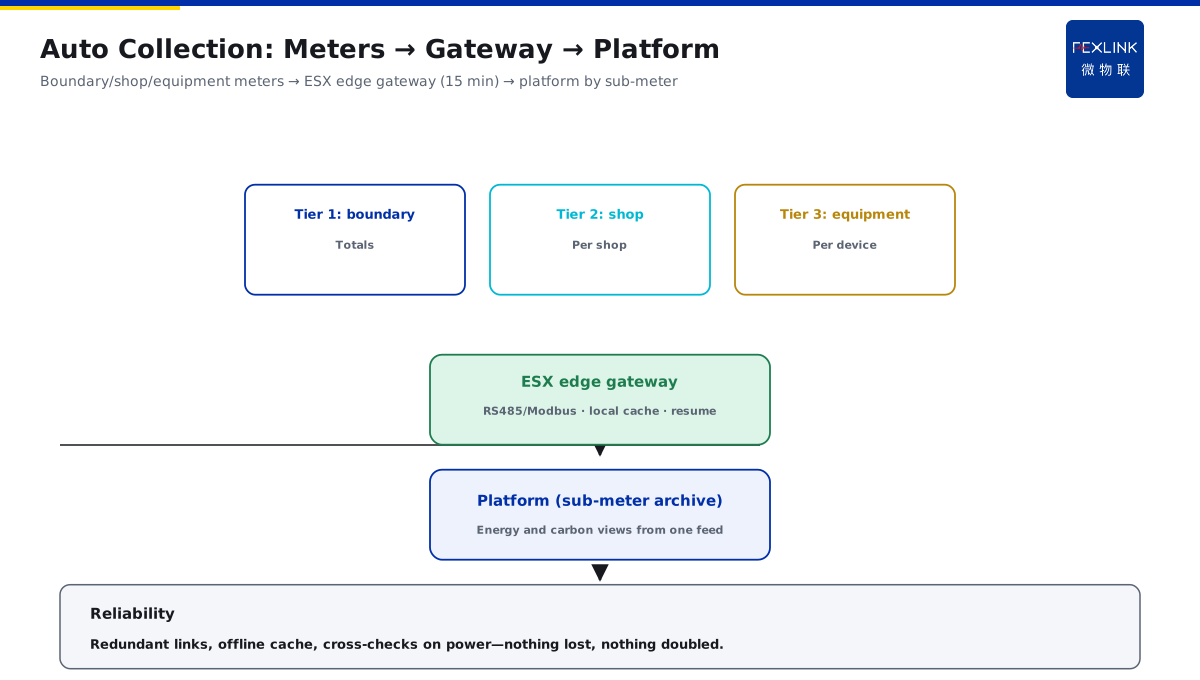
The levels of the collection — the first level (the gateway meter), the second (the workshop/sub-meter) and the third (the equipment meter): collected by layers; The channel of the collection — the smart meter → the edge gateway → the platform: automatic, no manual reading; The frequency of the collection — set as needed (15 minutes/hour/day): the data enters in real time; The quality of the collection — the meters verified and the data continuous: the missing auto-marked and the anomaly auto-alarmed.
In one sentence: the activity data is collected automatically — the meter measures in real time, the gateway aggregates at the edge and the platform archives automatically — no manual reading, no missing data and traceable.
An example: In a park retrofit, the gateway meter, the workshop sub-meters and the equipment meters are all replaced by the smart meters — the ESX gateway collects at 15-minute intervals and the platform archives by the sub-item — the energy department sees the sub-items and the EHS sees the corresponding carbon — the same collection chain. The logic is that the automatic collection is the "blood" of the foundation — the meter is the sensor, the gateway the vessel and the platform the heart — once the chain is through, the energy and the carbon flow automatically and no manual transport.
5. How the Foundation Supports the Carbon Report and the Dual-Control Statement
The support of the carbon report — Scope 1 (the owned emission) + Scope 2 (the purchased electricity/heat): generated automatically from the foundation data; The support of the dual-control statement — the total and the intensity of the energy and the carbon: the same energy quantity, two bases; The reconciliation before the review — the audit asks for data: one-click export, the same source and the traceable basis: no temporary reconciliation; The trace of the difference — when the energy and the carbon mismatch: look back through the quantity → the factor → the carbon: locate the source of the difference.
In one sentence: the foundation is the "unified outlet" of the reports — the carbon report and the dual-control statement come from the same data — one-click export before the review and the reverse trace of the difference — the trouble of the two ledgers disappears at the root.
The statement list supported by the foundation — the total and the intensity of the energy (kWh, tce); the total and the intensity of the carbon (tonne CO₂); the sub-item energy/carbon (workshop, system, equipment); the benchmarking and the trend (period-on-period, year-on-year, baseline) — the four reports, the same data source.
The implementation path (four steps) — first: inventory the metering points (the three-level list); second: retrofit the smart meters and the gateways (ESA + ESX); third: configure the library and the mapping (the types, the factors and the green vouchers); fourth: trial-run the statements and accept (the synchronous check of the energy and the carbon) — the four steps, the foundation in use. An example: At the year-end review, the auditor asks for the energy and the carbon — the platform exports the energy ledger and the carbon report with one click — the same source and the factor sources stated — the auditor checks and passes on the spot — saving two days of reconciliation. The logic is that the efficiency of the review comes from "the same source" — not reconciled on the spot but consistent at the source — the foundation turns "reconciliation before the review" into "same source every day" — the compliance changes from the passive response to the daily order.
Back to the smart energy-carbon IoT platform and the energy-carbon autonomy system 4×3×2 — the landing of the foundation: the ESA full-element smart meter collects the sub-metered energy in real time, the ESX gateway aggregates at the edge and the platform converts the carbon automatically with the embedded library — the energy and the carbon from the same source — the carbon report and the dual-control statement generate automatically — "change one energy quantity, and the energy and the carbon update together" — two ledgers, one foundation.**
Scope and Limitations
- The conclusions in this article are intended for LV distribution and electrical-safety sites. Standard numbers (GB/T 32150) refer to their currently effective editions, and product parameters follow the latest FEXLINK selection handbook and product knowledge base.
- Quantitative criteria (protection zone, discharge and residual voltage, earth resistance, thresholds and grading) hold under the preconditions stated in this article. Where the site voltage level, earthing arrangement, environmental category or load profile differs, the figures must be recalculated. Specific configurations involving ESA all-element smart meter, ESX edge gateway should be verified against actual circuit parameters.
- Specific product models and parameters are subject to the latest selection handbook and product knowledge base; this article does not constitute selection or procurement advice.
- Standard numbers cited here refer to the currently effective editions; when a standard is revised, the related quantitative conclusions must be re-checked.
- Deployment and implementation for specific projects must be carried out by qualified engineers based on site survey and design drawings.
Frequently Asked Questions
Energy and Carbon Data Calculated Separately
The integrated energy-carbon data foundation takes the sub-metered energy quantity as the only data source and maps the emission-factor library by the