 FEXLINK Research Institute
Direct Answer
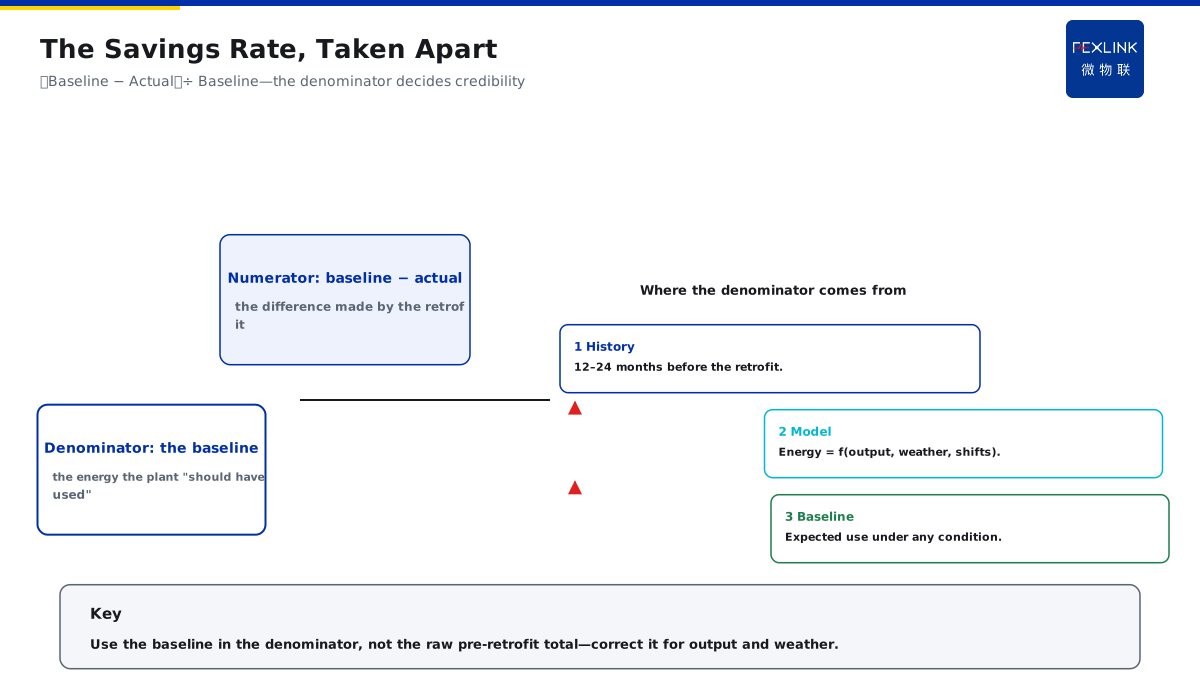
Why are energy-saving claims always self-serving? The saving rate is (baseline energy − actual energy) ÷ baseline energy, where the baseline energy is the electricity that should have been consumed after normalizing external factors such as production and temperature; without an energy baseline first, the saving rate cannot remove business fluctuation and is self-serving by definition.
A scenario: A factory says "the retrofit saved 20%" — but how can it prove the 20% came from the retrofit rather than lower production or cooler weather? The logic is that a credible saving rate needs a baseline first — normalize external factors such as production and temperature, then compute the energy that should have been consumed — the difference before and after the retrofit is the real saving.
1. Why a Direct Before-and-After Comparison Does Not Work
The problem of direct comparison — the business changes: production, temperature and shifts all change energy consumption; The trap of direct comparison — wrong attribution: energy drops, but the reason may be lower production, not an effective retrofit; The error of direct comparison — cannot be removed: external factors are not removed, so the retrofit contribution is unclear; The result of direct comparison — self-serving: without a baseline, the saving rate compares the plant with itself.
In one sentence: direct comparison does not remove production and temperature, so the attribution of energy changes is unclear — the saving rate is self-serving.
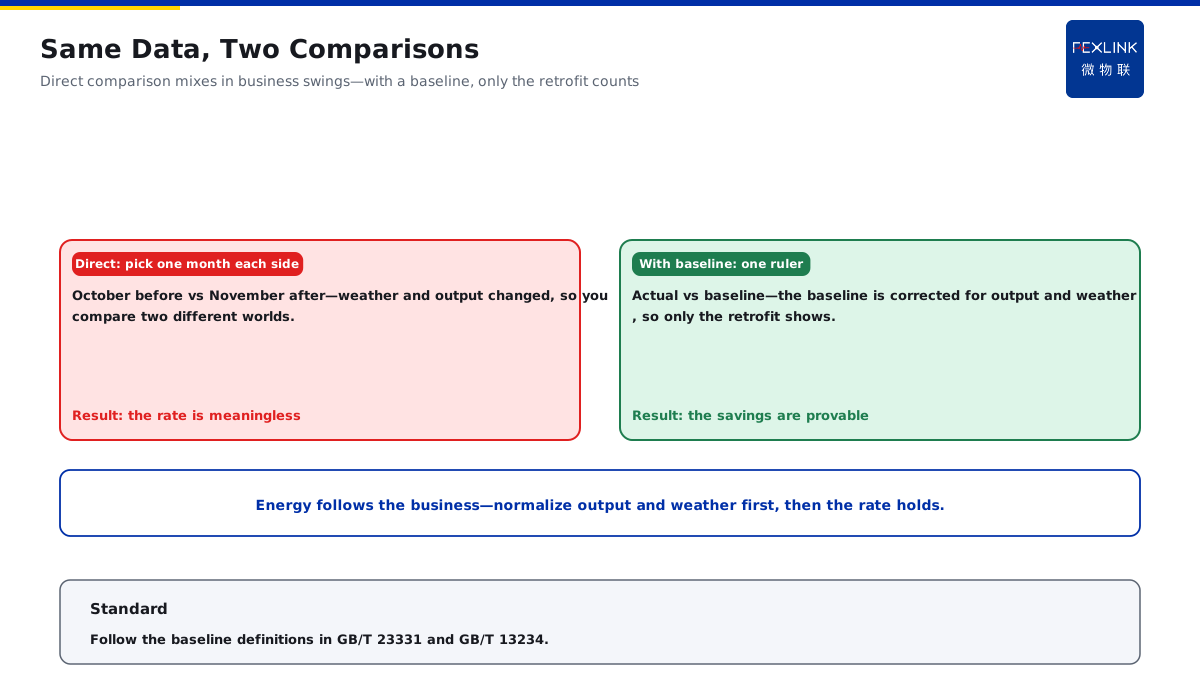
The typical scenario of direct comparison — take one month before and one after the retrofit and compare directly: October before the retrofit and November after — when the weather and production change, the numbers are distorted — a direct before-and-after comparison compares "two different worlds".
The comparison table of direct comparison:
| Comparison method | Business fluctuation removed | Credibility of the saving |
|---|---|---|
| Direct before-and-after | No | Low — production and temperature changes mix into the result |
| With a baseline | Yes | High — only the retrofit contribution is counted |
An example: A factory compares directly: energy drops 20% after the retrofit — but production also drops 18% over the same period — the real saving is less than 2%. The logic is that energy follows the business — when production drops and temperature changes, energy naturally changes — direct comparison counts business changes as a saving — a baseline must remove the business fluctuation to reveal the retrofit contribution.
2. The Definition of the Energy Baseline (EnB)
The definition of the baseline — the reference energy: the electricity that should have been consumed after normalizing external factors; The composition of the baseline — the reference conditions: the correspondence established between key variables such as production, temperature and shifts; The establishment of the baseline — historical data: build the "energy-variable" relationship from pre-retrofit historical data; The update of the baseline — periodic calibration: re-calibrate the baseline after the production structure changes.
In one sentence: the energy baseline is the electricity that "should have been consumed" after normalizing external factors — built from pre-retrofit historical data and calibrated periodically — it is the ruler of saving performance.
The reference standard of the baseline — the practice of an energy baseline can refer to GB/T 23331 (energy management system) and GB/T 13234 (calculation method of energy saving for enterprises): the former requires establishing an energy baseline and the latter gives the standardized scope for computing energy savings.
An example: A factory builds a baseline: it uses one year of historical data to establish the production-energy regression relationship — it obtains the electricity that should be consumed at any production level. The logic is that the essence of a baseline is "comparison" — what level before the retrofit and what level now, measured with the same ruler — without a baseline, saving has no basis — with a baseline, the saving rate has a credible frame of reference.
3. How External Factors: Production, Temperature and Shifts Affect Energy
The effect of production — positive correlation: the higher the production, the higher the energy (energy-using equipment follows); The effect of temperature — seasonal fluctuation: air-conditioning and heating loads change with temperature; The effect of shifts — running hours: more shifts mean longer equipment running and higher energy; Other effects — operating conditions: raw materials, processes and load rates also affect energy.
In one sentence: the external factors are production, temperature, shifts and operating conditions — all make energy "naturally" change.
The quantification direction of external factors — production uses output value or output indicators; temperature uses degree days (HDD/CDD) as an approximation; shifts use running-hour statistics — every variable has a quantifiable scope, so the baseline can be computed accurately.
An example: A factory attributes: summer energy is 10% higher — analysis finds it is caused by higher temperature and increased air-conditioning load, unrelated to the retrofit. The logic is that energy is not isolated — production, temperature and shifts all affect it — energy analysis must first ask "why does this part of the energy change" — is the business changing or is the retrofit effective — when external factors are separated, the saving performance stands — attribution is the starting point of energy analysis.
4. How the Baseline Makes the Saving Rate Verifiable
Verification one, normalization — the same ruler: the baseline and the actual use the same production and temperature scope; Verification two, re-checkable — the data can be audited: the baseline formula, parameters and historical data can all be reviewed; Verification three, fluctuation removed — business fluctuation is removed: production and temperature changes do not pollute the saving result; Verification four, credible result — external recognition: customers and authorities verify under the same scope.
In one sentence: the baseline makes the saving rate verifiable — normalization, re-check, fluctuation removal and external recognition — the result stands up to review.
The four-step self-check of baseline verification — consistent scope: the baseline and the actual use the same variable scope; auditable data: historical data and parameters are archived; clean removal: business fluctuation has been normalized; review passed: a third party can reproduce the same result.
An example: A factory verifies: under the baseline scope, the retrofit saves 8% — the authority reviews the data and recognizes it. The logic is that the credibility of the saving rate comes from being re-checkable — the baseline formula, parameters and historical data are all presented and anyone can verify — production and temperature changes are normalized so the result is not polluted by business fluctuation — the baseline is the "notary" of the saving performance.
Back to the TIANYAN product match — the TIANYAN engine E module (energy analysis) can automatically take historical energy, production and temperature data and build the enterprise energy baseline — after the retrofit, compare under the same scope and the saving rate is automatically computed and re-checkable.
5. Common False Savings When There Is No Baseline
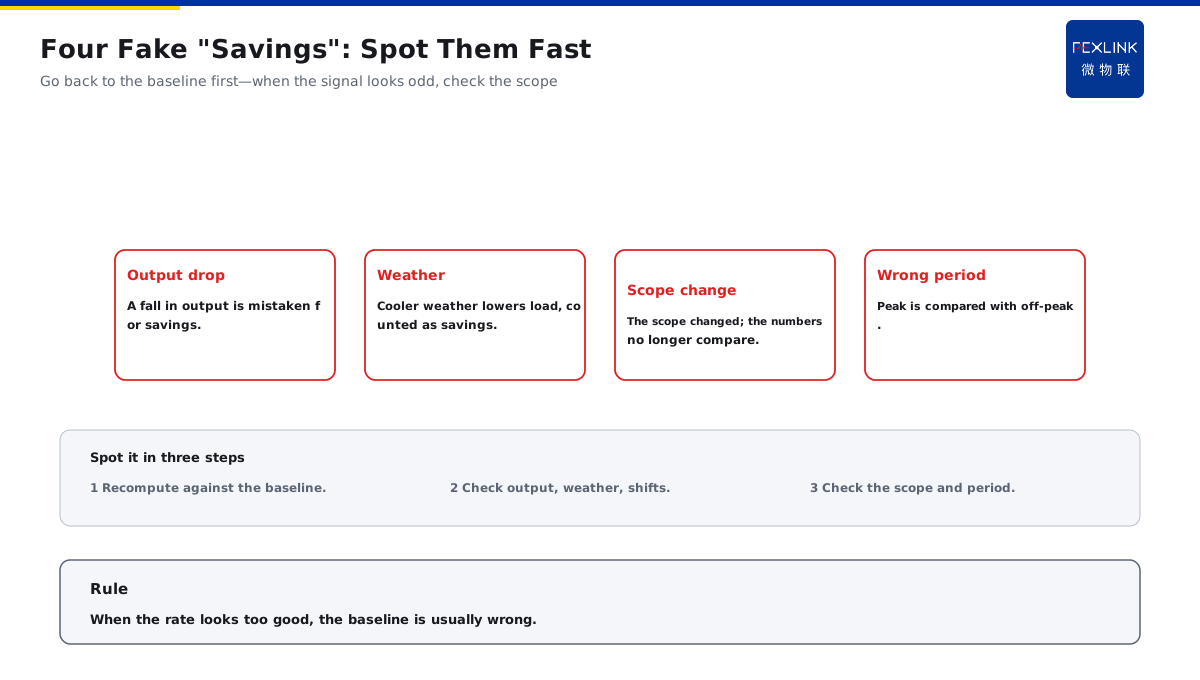
False one, the "saving" of lower production — production drops and energy drops, counted as a saving; False two, the "saving" of weather change — temperature changes and load drops, counted as a saving; False three, the "saving" of statistical scope — the scope is adjusted, so before and after are incomparable but counted as a saving; False four, the "saving" of period misalignment — peak season compared with off-season and cross-period comparison with different periods.
In one sentence: false savings are lower production, weather change, scope adjustment and period misalignment — all mistaken for saving performance.
The identification signals of false savings — a large saving rate with production dropping at the same time, obvious weather change over the same period, a mid-way adjustment of the statistical scope, and a comparison spanning seasons — when any signal appears, return to the baseline first for review.
An example: A factory misreports: it reports the energy reduction caused by lower production as "saving 15%" — after reviewing under the baseline scope, the real saving is only 3%, a clear gap. The logic is that without a baseline, saving performance is easily "watered down" — business fluctuation and scope changes can all be packaged as savings — with a baseline, false savings are visible at a glance — the saving rate is not a computed number but credible evidence.
An energy baseline is a ruler — normalize external factors such as production and temperature and measure the electricity that "should have been consumed" — the difference before and after the retrofit is the real saving. Without an energy baseline, there is no credible saving performance — the saving rate is (baseline energy − actual energy) ÷ baseline energy — build the baseline first and the saving result can be verified.
Scope and Limitations
- The conclusions in this article are intended for LV distribution and electrical-safety sites. Standard numbers (GB/T 23331, GB/T 13234) refer to their currently effective editions, and product parameters follow the latest FEXLINK selection handbook and product knowledge base.
- Quantitative criteria (protection zone, discharge and residual voltage, earth resistance, thresholds and grading) hold under the preconditions stated in this article. Where the site voltage level, earthing arrangement, environmental category or load profile differs, the figures must be recalculated. Specific configurations involving Tianyan engine, E track (energy analytics) should be verified against actual circuit parameters.
- Specific product models and parameters are subject to the latest selection handbook and product knowledge base; this article does not constitute selection or procurement advice.
- Standard numbers cited here refer to the currently effective editions; when a standard is revised, the related quantitative conclusions must be re-checked.
- Deployment and implementation for specific projects must be carried out by qualified engineers based on site survey and design drawings.
Frequently Asked Questions
Why Are Energy-Saving Claims Always Self-Serving
The saving rate is (baseline energy − actual energy) ÷ baseline energy