 FEXLINK Research Institute
Direct Answer
Why does ISO 50001 repeatedly stress the energy baseline (EnB)? ISO 50001 (corresponding to GB/T 23331) requires the organization to establish and maintain an energy baseline EnB and to judge energy performance changes based on EnPI; the key to passing the audit is that the baseline is documented, has data sources, has change records and is periodically re-evaluated — not that the calculation is sophisticated.
A scenario: A company implements the ISO 50001 energy management system — the external audit always questions the energy baseline — the baseline is issued a nonconformity for being built casually and updated without records — it repeatedly corrects. The logic is that the auditor does not look at how advanced the model is but at "whether it exists, whether it is complete and whether it changed" — with documents, sources, change records and periodic re-evaluation, the baseline passes the audit — prepare the four items and pass steadily.
1. The Core Requirements of the Standard for EnB
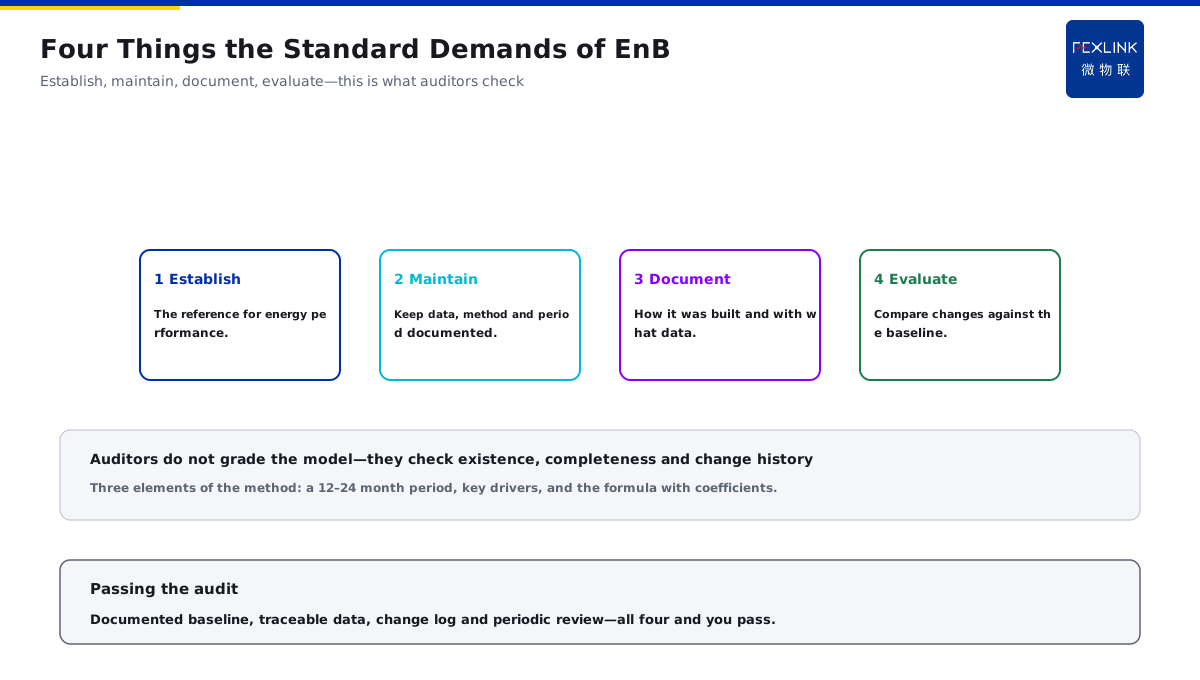
Requirement one, establish the baseline — the organization should establish an energy baseline: as the reference for comparing energy performance; Requirement two, maintain the baseline — the baseline should remain valid: data, method and period should be recorded; Requirement three, explain the method — the establishment method should be explained: how the baseline was built and which data were used; Requirement four, judge the change — changes should be judged based on the baseline: energy performance change relies on baseline comparison.
In one sentence: the core requirements are establishment, maintenance, method explanation and change judgment — all four are indispensable, and the audit checks exactly these.
The three elements of the establishment method — the data period: take 12-24 months of normal production data; variable selection: main drivers such as production and temperature; method recording: average or regression, with the formula and factors written clearly.
An example: A company is audited externally — the auditor first checks the baseline documents — without a method explanation, a nonconformity is issued directly, requiring the method record. The logic is that the standard does not demand "sophisticated calculation" but "evidence available" — the baseline document, establishment method, data source and update record — every item must be presentable — without a method explanation, the baseline is "built casually".
2. The Relationship between EnB and EnPI
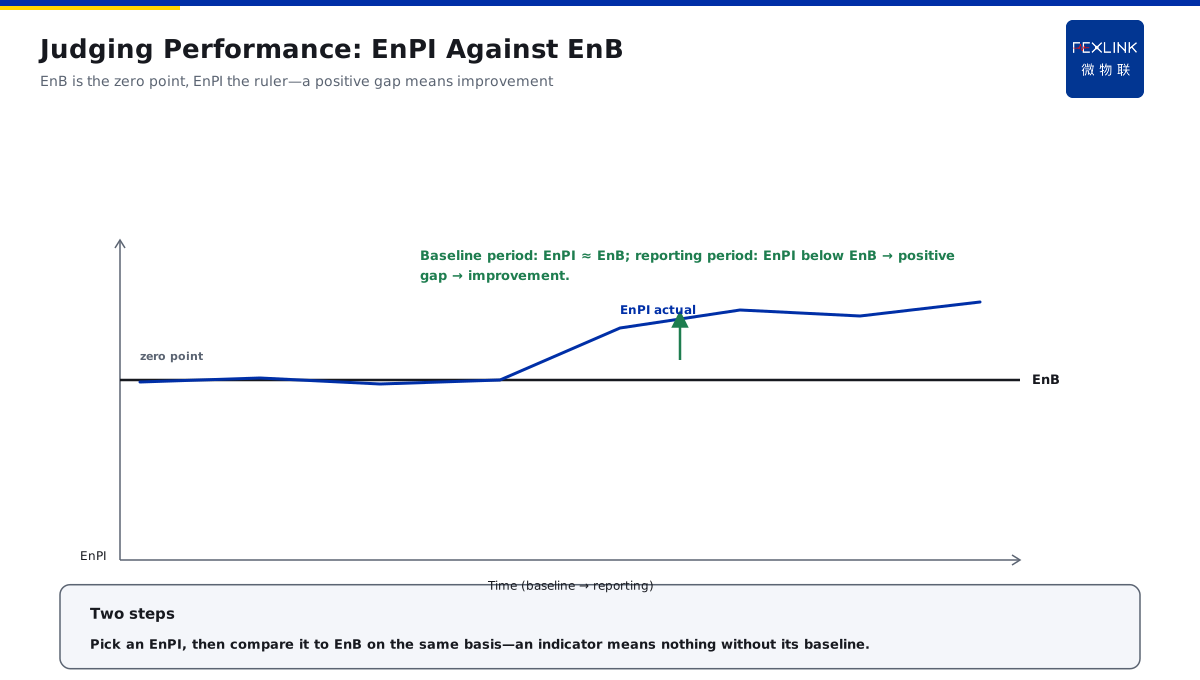
EnB — the reference: the energy baseline, the "zero point of comparison"; EnPI — the performance indicator: the energy performance indicator, the "measuring ruler"; Relationship one — the indicator is calculated on the baseline: the change in EnPI is judged relative to EnB; Relationship two — the change relies on the baseline: whether performance improves or worsens is concluded from the baseline comparison.
In one sentence: EnB is the reference zero point and EnPI is the measuring ruler — the change in EnPI is judged relative to EnB.
The two-step performance judgment — step one: select EnPI (for example, unit product energy or adjusted energy); step two: compare with EnB (same reference and same basis) — a positive difference means improvement and a negative difference means worsening — only after the two steps does the conclusion have a basis.
The correspondence table of EnB and EnPI:
| Element | Role | Description |
|---|---|---|
| EnB (energy baseline) | Reference zero point | The basis for comparing performance change |
| EnPI (performance indicator) | Measuring ruler | Unit consumption, adjusted energy, etc. |
An example: A company system: it establishes the unit product energy EnPI — the external audit requires explaining which EnB the EnPI change is judged against — it passes after adding the baseline, one correction closed without leftovers. The logic is that the auditor asks "against what is the indicator judged" — an EnPI alone means nothing and must be attached to the EnB — the baseline and the indicator appear in pairs, and only then does the performance change have a basis.
3. The Four Document Evidence Items That External Audits Check
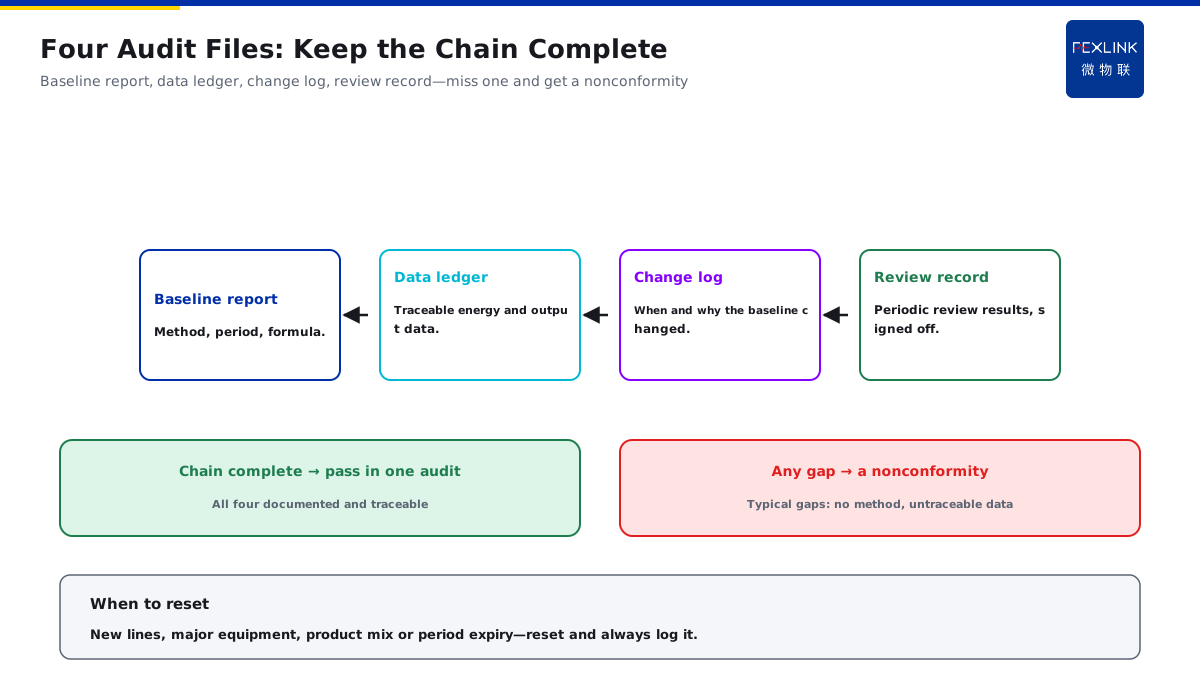
Evidence one, the baseline document — the baseline report: method, data period and formula; Evidence two, the data source — the data ledger: energy and production data with traceable sources; Evidence three, the change record — the change log: when the baseline was reset and why; Evidence four, the re-evaluation record — the re-evaluation record: conclusions and approval signatures.
In one sentence: the four document evidence items are the baseline report, data ledger, change log and re-evaluation record — the external audit checks exactly these four.
The common missing items of the evidence — only the baseline number without a method explanation; data without sources and untraceable; changes without records and reset reasons unexplained; re-evaluation without conclusions and only dates — when any of the four is missing, a nonconformity may be issued.
An example: A company is issued a nonconformity: the baseline update has no records — it adds the change log and writes the reset time and reason — the correction closes and passes the review in one round. The logic is that the external audit checks the "record chain" — document, source, change and re-evaluation — with a complete chain, the baseline withstands questioning — missing one and a nonconformity is issued — prepare in advance and pass once with less rework.
4. When the Baseline Must Be Reset (After Major Changes)
Change one, major structural change — a line is built or removed: the energy structure changes greatly and the original baseline fails; Change two, major equipment renewal — high-energy equipment is replaced: the energy level changes and the baseline needs resetting; Change three, product-structure change — the product type changes greatly: the energy relationship changes; Change four, data-period update — the data period rolls: an expired baseline period needs updating.
In one sentence: reset is required for structural change, equipment renewal, product adjustment and period update — the four types of change trigger a reset, and every reset must leave a record.
The execution flow of the reset — identify the change: confirm the trigger type; back up the old baseline: keep the old baseline archived; build the new baseline: rebuild it with the same method; record the change: write the time, reason and old-new comparison.
An example: A company adds a new line: the energy structure changes — judged by the old baseline, the performance is clearly distorted — it resets the baseline and records the change time and reason — the following audit goes smoothly. The logic is that the baseline is "the reference of the current condition" — when the condition changes, the reference must be updated — without a reset after a major change, the performance judgment is all distorted — the reset must record the change time, reason and new baseline method.
5. The Document Preparation Checklist for Passing the Audit
Checklist one, the baseline document package — the baseline report plus the method explanation; Checklist two, the data ledger — energy and production data plus source explanations; Checklist three, the change and re-evaluation records — the change log plus the periodic re-evaluation records; Checklist four, the internal-audit loop — audit internally first, correct, and then face the external audit.
In one sentence: the checklist is the baseline document package, data ledger, change/re-evaluation records and the internal-audit loop.
The organization order of the document package — build the baseline report first; add the data ledger; then add the change and re-evaluation records; finally audit internally — organize in order to avoid omission.
The self-check questions of the internal audit — is the baseline document package complete? Are the data sources traceable? Are the change records complete? Do the re-evaluation records have signatures? — when all four answer "yes", face the external audit.
An example: A company passes the audit: it prepares the four document packages by the checklist — the external audit passes in one round with no nonconformity and zero correction. The logic is that passing is not improvised but prepared in advance — with the four packages ready, the external audit checks by the list and passes by the list — the internal audit self-checks first, problems are exposed and corrected first — the external audit goes smoothly.
Back to the TIANYAN product match — the TIANYAN engine E module (energy analysis) automatically generates the baseline report, data ledger and change and re-evaluation records — the baseline document package can be exported at any time — when the enterprise welcomes the audit, it takes the documents by the list, and the baseline part is no longer issued nonconformities.
ISO 50001 repeatedly stresses EnB because all performance judgment relies on this "reference zero point" — establishment, maintenance, method explanation and change judgment are four indispensable items — the external audit checks four document evidence items: the baseline report, data ledger, change log and re-evaluation record — reset the baseline after major changes and keep re-evaluation records — with complete documents, the audit passes in one round.
Scope and Limitations
- The conclusions in this article are intended for LV distribution and electrical-safety sites. Standard numbers (GB/T 23331) refer to their currently effective editions, and product parameters follow the latest FEXLINK selection handbook and product knowledge base.
- Quantitative criteria (protection zone, discharge and residual voltage, earth resistance, thresholds and grading) hold under the preconditions stated in this article. Where the site voltage level, earthing arrangement, environmental category or load profile differs, the figures must be recalculated.
- Specific product models and parameters are subject to the latest selection handbook and product knowledge base; this article does not constitute selection or procurement advice.
- Standard numbers cited here refer to the currently effective editions; when a standard is revised, the related quantitative conclusions must be re-checked.
- Deployment and implementation for specific projects must be carried out by qualified engineers based on site survey and design drawings.
Frequently Asked Questions
Why Does ISO 50001 Repeatedly Stress the Energy Baseline
ISO 50001 (corresponding to GB/T 23331) requires the organization to establish and maintain an energy baseline EnB and to judge energy performance changes