 FEXLINK Research Institute
Direct Answer
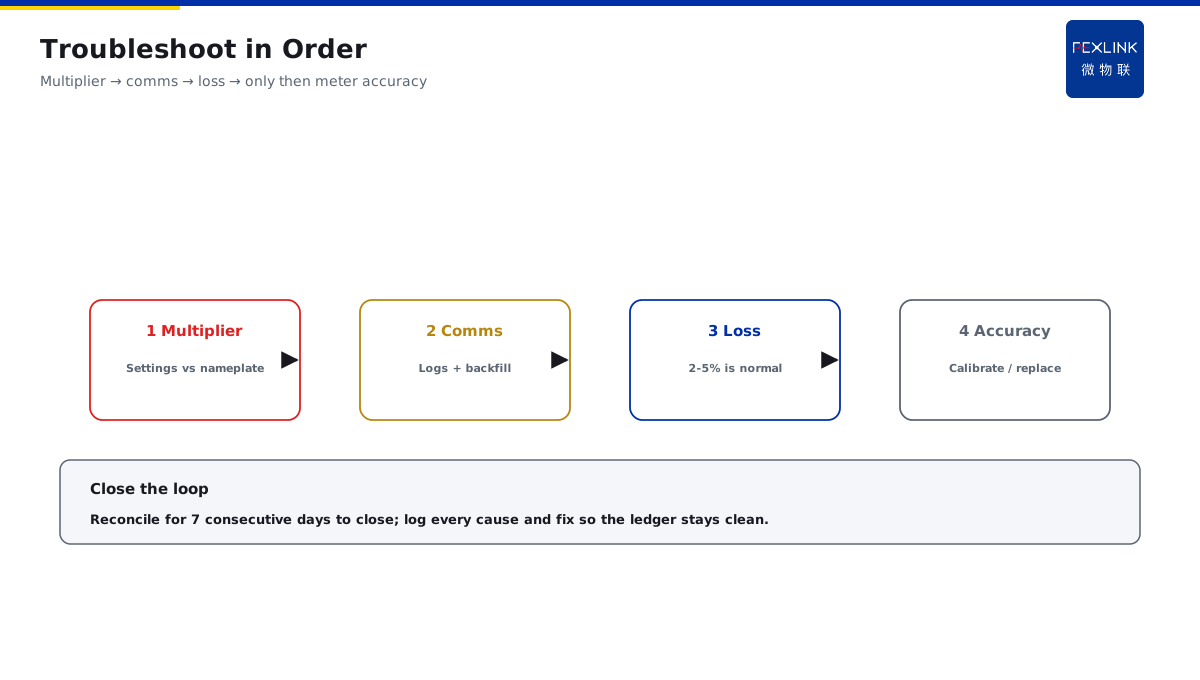
Why does the platform data not match the meters? The difference mostly comes from the CT ratio set wrong, the multiplier omitted, the time-of-use segments missing and the offline compensation — the multiplier first, then the communication and the line loss, and the meter precision last — the mismatch, nine out of ten, is not the meter but the setting and the link — by the order, the accounts balance.
A scenario: The platform total 950,000 kWh — the utility meter 1,000,000 — the 50,000 difference — the data useless — the problem not the meter but the multiplier or the link. The logic is that the mismatch is "the link problem" not "the meter problem" — the multiplier, the communication and the line loss first — the precision last.
The pain is common — the platform has been running for months and the accounts never balanced — the energy manager loses the confidence of the whole data — the management decisions stopped — the flow is the rescue.
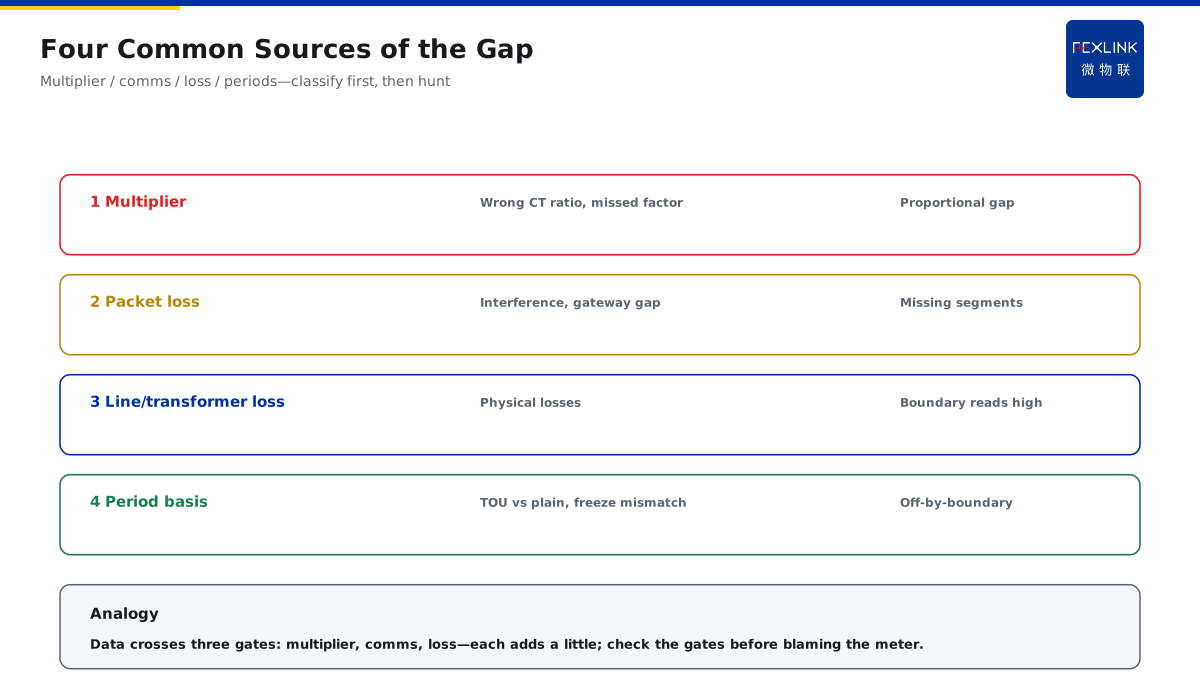
An analogy — The energy passes three gates: the multiplier gate (the reading conversion), the communication gate (the transfer) and the line loss gate (the physical) — each a part of the error — the mismatch, check the gates first, then the meter.
1. The Four Sources of the Difference
Source 1: the multiplier — the CT ratio wrong and the multiplier omitted — the proportional difference; Source 2: the communication — the RS485 interference and the gateway gap — the segments missing; Source 3: the line loss — the line and the transformer losses — the total higher; Source 4: the period — the time-of-use and the freezing inconsistent — the shift.
In one sentence: the four sources = the multiplier/communication/loss/period — the sources first, then one by one — the sources clear, no blind search.
The table:
| Source | Sign | Feature |
|---|---|---|
| Multiplier | Proportional | Fixed ratio |
| Communication | Segments missing | Periodic |
| Loss | Total higher | Long-term |
| Period | Shift | Boundary |
The quantification — the total difference rate = (the total - the sum) / the total — then by the source — the split, the located. An example — The total 1,000,000 and the sum 950,000 — the multiplier first: 3 meters omitted — after: 998,000 — the rest 2,000 the loss. The logic is that the sources first — the multiplier the most typical — the multiplier first, then the loss.
The period check — the settlement meter with the four rates and the platform with the total: the reconciliation by the same boundary — the freezing inconsistent, the boundary shifted.
2. The CT Ratio and the Multiplier
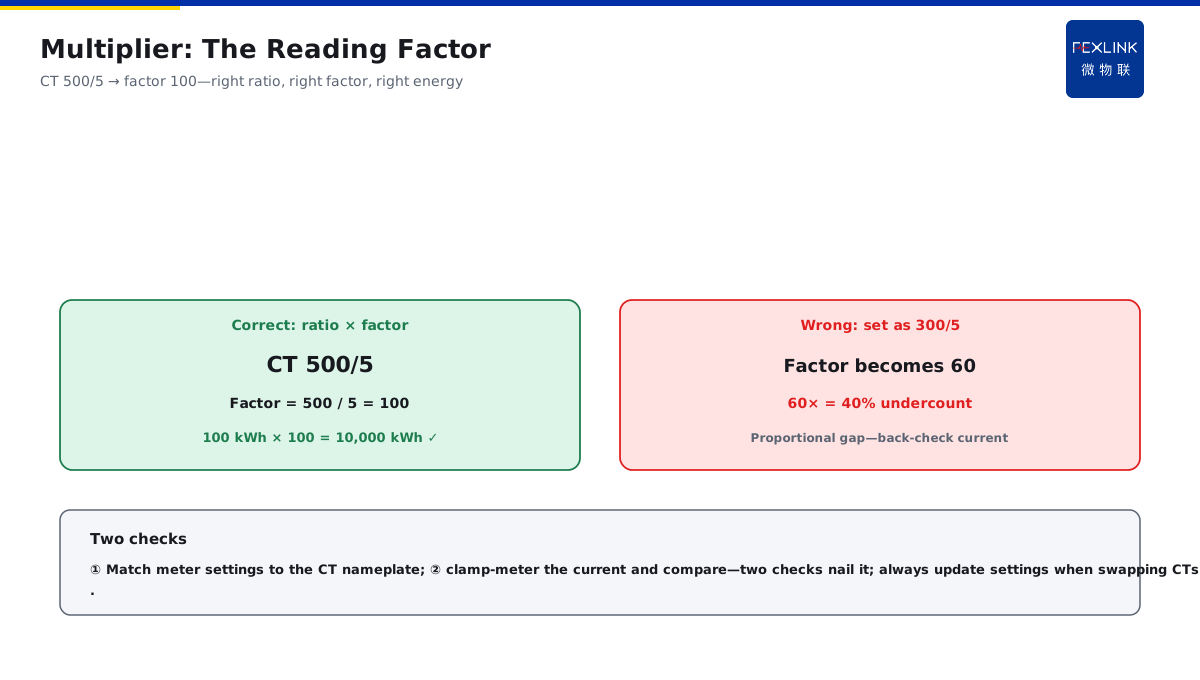
The multiplier — the reading × the multiplier = the actual: the CT ratio defines it; The setting — into the meter: 500/5 = 100; The errors — the wrong ratio, the omitted multiplier and the CT changed without the parameter — proportional; The check — the actual current: the meter reading vs the circuit.
In one sentence: the multiplier is "the amplification" — the ratio right and the multiplier multiplied — the reading equals the actual.
The check method — the parameter table vs the CT nameplate: consistent; the clamp meter on site: the reading matches — two steps, no error. The process — the CT changed, the parameter changed together: the nameplate first, the meter then and the reading after — three steps, the multiplier kept. An example — The CT 500/5 — the meter set 300/5 — 66% higher — after the correction, normal. The logic is that the multiplier error is "the proportional error" — the current back-calculation locates fast — the CT changed, the parameter changed.
The back-calculation — the daily energy / the hours / the rated voltage / 1.732 = the average current — compared with the CT ratio: the wrong ratio reveals — one calculation, the suspect located.
3. The Communication Loss and the Compensation
The loss — the RS485 interference, the baud mismatch and the gateway gap — the segments missing; The sign — the ladder missing, the daily lower and the freeze jump; The compensation — the local daily freeze, the gateway re-collect and the platform interpolation — the missing filled;
The sign of the loss — the daily curve with the sudden drops and the monthly total lower — the freeze values jumping — the sign clear, the check targeted;
The mark — the compensated marked: not mixed with the measured.
In one sentence: the loss needs "the marked compensation" — the local freeze backstop and the re-collect — the marked, the accounts clear.
The check — the gateway log for the gap period, the RS485 terminal resistor and the baud — three segments, located fast. The principle — the measured first: the local freeze priority — the interpolation only for the short — the marked separately. An example — The platform missing 3 hours — the log: the RS485 interference — the gateway re-collects — the marked, the accounts match. The logic is that the loss is "the gap" — the local freeze backstop and the re-collect — the marked, clear.
4. The Line Loss and the Transformer Loss
The line loss — the resistance of the line; The transformer loss — the no-load + the load; The handling — the sum < the total normal: the difference the loss; The calculation — the loss rate = (the total - the sum) / the total: 2%-5% normal.
In one sentence: the losses are "the physical" — the sum slightly lower normal — the rate calculated, the difference explained.
The abnormal — over 5%: the multiplier, the missing circuit and the suspicion of the theft — three first. The allocation — the loss to the sub by the energy proportion: the readings include the loss — the unified, consistent. An example — The total 1,000,000 and the sum 980,000 — the rate 2% — in the range — credible. The logic is that the loss is "the reasonable difference" — the sum slightly lower normal — the rate 2%-5% normal, over, then the check.
The practical habit — the daily reconciliation: the platform compares the total and the sum automatically and alarms over the threshold — the normalized, the early found.
5. The Checking Flow
The order — the multiplier, the communication, the loss and the precision — fixed, no skip;
The reason of the order — the multiplier error is the most common and the easiest to verify; the communication needs the log; the loss needs the calculation; the precision needs the standard meter — the cheap first, the expensive last;
The tools — the parameter table, the gateway log, the daily freeze and the clamp — the data speaks; The record — the source and the handling each time — the log; The verification — the re-check after the correction: 7 consecutive days, closed.
In one sentence: the flow — the multiplier to the communication to the loss to the precision — the tools and the records, the 7 days — the balance, the credible.
The flow table:
| Step | Action | Tool |
|---|---|---|
| 1 | The multiplier | The table/clamp |
| 2 | The communication | The log |
| 3 | The loss | The freeze |
| 4 | The precision | The standard |
The precision check — the standard meter: the temporary series comparison — within the class, the meter normal — the last, then the meter. A complete example — A building 8% — the multiplier (2 CTs wrong) → 3% — the communication (2 days re-collected) → 0.8% — the loss (0.7% reasonable) → matched — the four steps, the balance.
The summary — the mismatch is not the meter but the link — the multiplier the first suspect, the precision the last — with the order and the tools, the balance closed.
Back to the ESA/ESX family — the support: the ESA with the multiplier and the daily freeze, the ESX with the re-collect and the log — the tools complete, the balance closed.
Scope and Limitations
- The conclusions in this article are intended for LV distribution and electrical-safety sites. Standard numbers (DL/T 448, DL/T 645) refer to their currently effective editions, and product parameters follow the latest FEXLINK selection handbook and product knowledge base.
- Quantitative criteria (protection zone, discharge and residual voltage, earth resistance, thresholds and grading) hold under the preconditions stated in this article. Where the site voltage level, earthing arrangement, environmental category or load profile differs, the figures must be recalculated. Specific configurations involving ESA all-element smart meter, ESX intelligent edge computing gateway should be verified against actual circuit parameters.
- Specific product models and parameters are subject to the latest selection handbook and product knowledge base; this article does not constitute selection or procurement advice.
- Standard numbers cited here refer to the currently effective editions; when a standard is revised, the related quantitative conclusions must be re-checked.
- Deployment and implementation for specific projects must be carried out by qualified engineers based on site survey and design drawings.
Frequently Asked Questions
Why Does Your Energy Dashboard Disagree with the Utility
The difference mostly comes from the CT ratio set wrong, the multiplier omitted