 FEXLINK Research Institute
The short answer
ISO 14064-1 is the specification ISO wrote for one question: how should an organization count its own greenhouse gases? Full title: *Greenhouse gases — Part 1: Specification with guidance at the organization level for quantification and reporting of greenhouse gas emissions and removals*. This article refers to the 2018 edition. Note the wording — specification plus guidance, not a calculator. It supplies no emission factors and does none of your arithmetic. It fixes the boundary you settle before starting, the categories and principles you hold to while working, and what the report must contain.
The conclusion: it sets requirements and principles for organizational boundary, quantification, management and reporting, with completeness, consistency and traceability at the centre. Miss one and the inventory is not a compliant one. Precision is no substitute — if the boundary cannot be explained and a number cannot be traced, the figure is only talking to itself.
What it covers, and what it does not
It covers the organization: a company, group, plant or industrial park as a whole, for one year — how much it emitted and how much it removed. It covers quantification and reporting: how the boundary is drawn, how emissions are categorized, how they are calculated, how uncertainty is described, what the report must contain. It does not cover three things: a single product's carbon footprint (ISO 14067), the reductions one project achieves against a baseline (ISO 14064-2), or how a third party checks your claim (ISO 14064-3).
The specification is the hard requirement; the guidance only explains. The only threshold is whether you accept rules an outsider can re-perform.
The 2018 revision: from three scopes to six categories
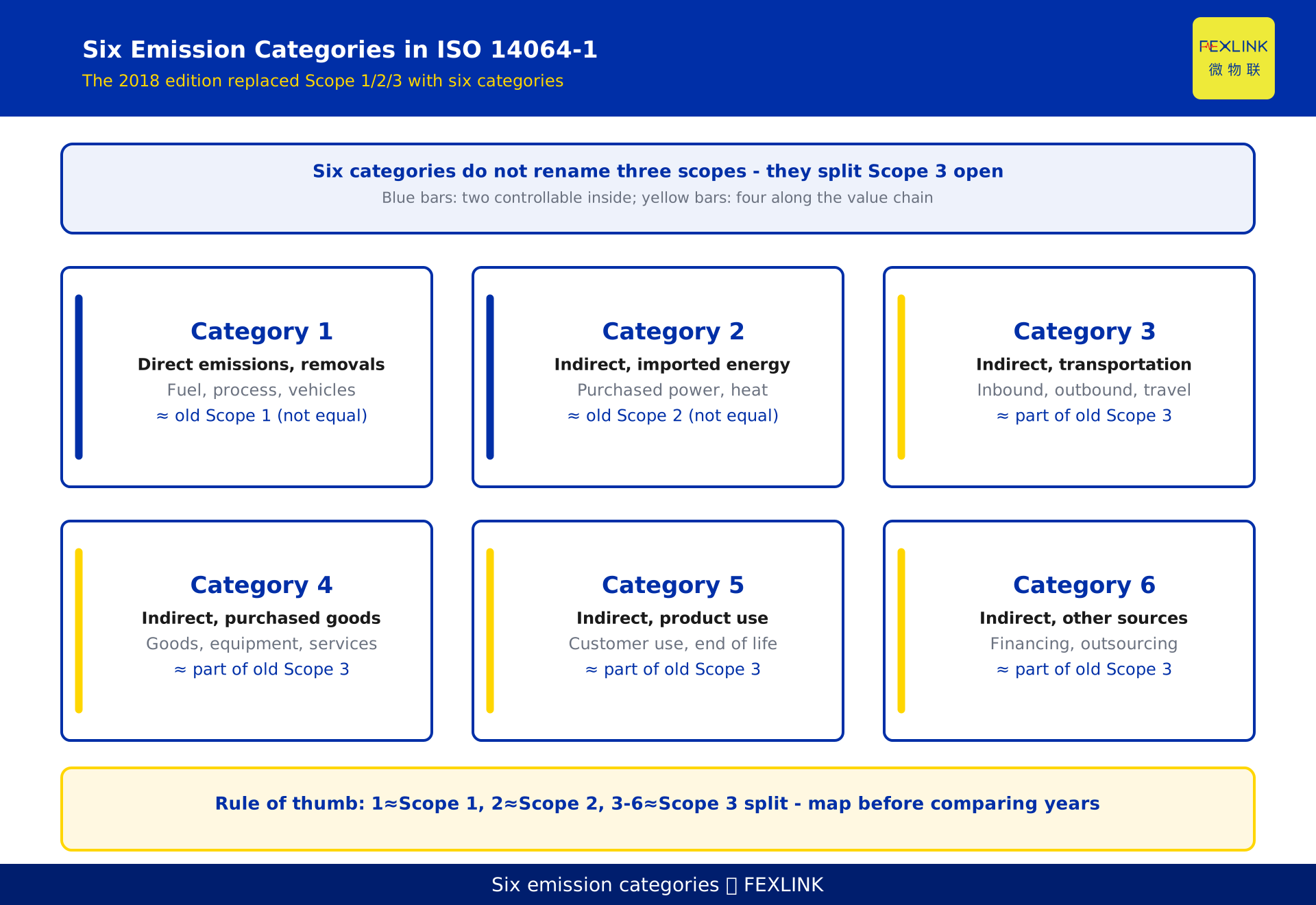
The 2006 edition used Scope 1, 2 and 3. The 2018 edition dropped that vocabulary and replaced it with Category 1 through Category 6. Scope 3 had become an ever-expanding sack — transport, purchasing, product use, waste — so a single "Scope 3 total" told the reader nothing.
| Category | Name | What sits inside |
|---|---|---|
| 1 | Direct GHG emissions and removals | Fuel burned, process emissions, owned vehicles, fugitive losses, removals in the boundary |
| 2 | Indirect GHG emissions from imported energy | Purchased electricity, heat, steam, cooling, as burned at the plant |
| 3 | Indirect GHG emissions from transportation | Inbound materials, outbound product, commuting, travel |
| 4 | Indirect GHG emissions from products used by the organization | Purchased materials, consumables, equipment, services |
| 5 | Indirect GHG emissions from use of the organization's products | What customers emit using what you sold, and at end of life |
| 6 | Indirect GHG emissions from other sources | What the first five do not hold, such as certain financing or outsourcing |
Be careful with the mapping. Category 1 roughly corresponds to the old Scope 1, Category 2 to Scope 2, and Categories 3 to 6 to a breakdown of Scope 3. Roughly, not identically: the same tonne may have sat in one Scope 3 line and now lands in Category 4 or 5. If earlier years were reported by scope and this year by category, build the mapping before comparing, or the trend line is fiction.
Organizational boundary: control or equity share, never both
Two methods exist — the control approach and the equity share approach — and you pick one, then apply it consistently across every reporting period.
Control approach. Any facility you financially or operationally control is consolidated at 100%, wholly owned or not. A subsidiary you hold at 51% and actually run contributes its entire plant; an associate you hold at 30% and do not operate contributes nothing. Control splits into financial control (who decides how money is spent) and operational control (who decides how equipment is run); state which you use.
Equity share approach. You take your share — hold 51% and you account for 51%. It lines up with financial consolidation, but management responsibility is diluted.
For external disclosure, assurance and management accountability, most organizations take the control approach, because it maps to who runs the asset. For investor-view consolidation that must match the financial statements, equity share is smoother. Either way, three rules hold. Choose once and stay consistent; a change must be explained and prior years restated. Push the method to facility level. And list the four ambiguous cases separately — leases, outsourcing, joint ventures, contracted operations — because those are what an assurer asks about first.
Operational boundary: mapping six categories onto your site
The organizational boundary decides which entities are in; the operational boundary decides which of their emissions are in. Build a list by Category 1 to 6 and test each line: does it occur here, and can it be quantified?
Category 1 reads off the asset register: boilers, kilns, on-site vehicles, shielding gas, refrigerant top-ups, SF6 switchgear. Category 2 reads off electricity bills and heat or steam settlements. Category 3 reads off logistics records and travel bookings. Category 4 reads off the procurement ledger. Category 5 reads off the product list and after-sales data. Category 6 reads off other contracts. Every line needs a source name, the gases involved, the activity data source and a named owner.
Settle exclusions early. The standard allows insignificant sources to be excluded, but "insignificant" cannot be a feeling: it needs a reproducible basis — share of emissions, data availability, relevance — written down as a rule, with excluded items, reasons and magnitude disclosed. "Other emissions are not material" with nothing behind it is a common reason a submission is sent back. Removals sit inside Category 1 and are reported alongside emissions, but shown separately, never netted.
Quantification and uncertainty
Emissions equal activity data multiplied by an emission factor and by the relevant GWP. What the standard regulates is where those three inputs come from.
Activity data has a hierarchy: a direct meter reading beats a settlement invoice, which beats an estimate. Emission factors need a publisher, a year and a scope written beside them; two vintages of grid factor in one report is the most common self-inflicted wound. GWP values must come from one version — IPCC reports disagree, and mixing them is like adding readings taken with different rulers.
Uncertainty is where this standard separates itself from hobby calculation: it requires an assessment of uncertainty in the results and an explanation in the report, at the data level (meter accuracy, reading cycles, treatment of missing data) and the method level (factor representativeness, model assumptions, allocation rules). The standard sets no pass mark for uncertainty. That belongs to assurance rules and regulators. Do not invent a threshold and present it as the standard's.
Six principles: what quality means in practice
Six principles apply across every reporting period, and each becomes a check.
Relevance. Sources and data support the intended user's decisions. Reporting to a customer means splitting by product; to a regulator, by facility. Completeness. Every category and significant source in the boundary is covered, exclusions disclosed. Test: lay the asset register and procurement ledger against the list and look for a missing category. Consistency. Methods, boundary and factor basis stay comparable over time. Test: compare last year's method description. Accuracy. Bias and error stay controlled and explainable. Test: re-perform a sample. Transparency. Assumptions, methods, sources and exclusions are documented well enough to reproduce. Test: hand the report to a colleague. Conservativeness. Where uncertain, take the side that does not overstate reductions or understate emissions.
Reporting: inventory, report, statement
The GHG inventory is the ledger: emissions and removals by category, with the activity data and factor source behind every figure. The GHG report is the explanation: organizational description, period, boundary and method, exclusions and reasons, base year and recalculation policy, uncertainty, data management. The GHG statement is the conclusion for outsiders: a standalone declaration stating that the inventory was prepared in accordance with ISO 14064-1.
The inventory is evidence, the report is explanation, the statement is commitment. An inventory without a statement gives outsiders no sentence to rely on; a statement without an inventory gives that sentence nothing to stand on. The base year, once set, is not casually changed: recalculation follows structural change — acquisition, divestment, significant process or methodology change — and nothing else.
How it divides work with 14064-2, 14064-3 and GB/T 32150
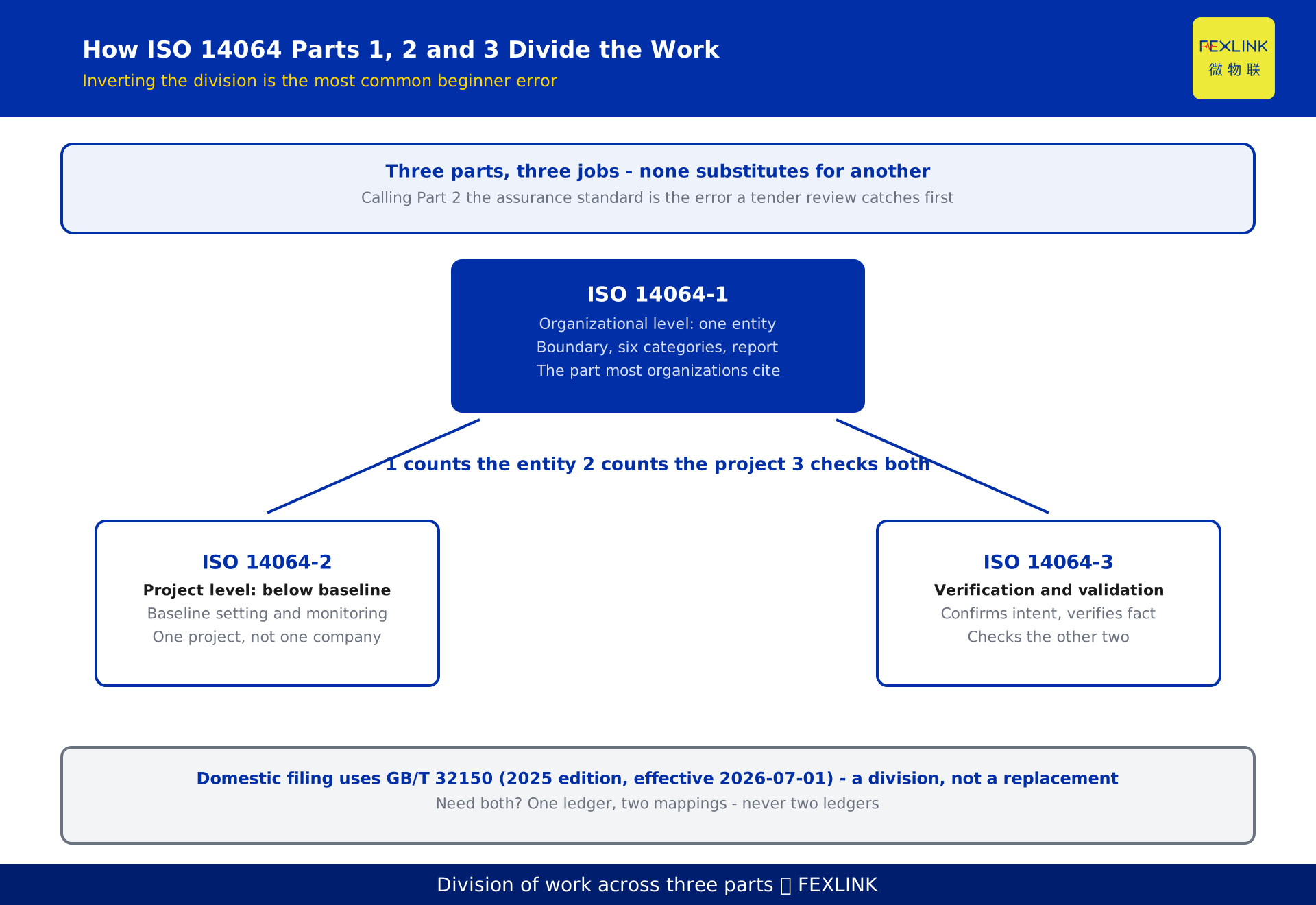
The three parts are one family, and the division is easy to invert. ISO 14064-1 works at organizational level. ISO 14064-2 works at project level: how much less a project emitted than its baseline. ISO 14064-3 covers verification and validation: how a third party confirms or verifies a GHG statement.
One-line aid: Part 1 counts the organization, Part 2 counts the project, Part 3 checks the first two. Inverting that is the most common beginner error.
On the domestic side, GB/T 32150, the Chinese general rule for GHG accounting and reporting in industrial enterprises, is currently the 2025 edition: published 2025-12-31, effective 2026-07-01, replacing the 2015 edition. The two divide the work: GB/T 32150 serves domestic reporting and compliance; ISO 14064-1 serves international disclosure, questionnaires and cross-border assurance. An organization needing both is best served by one ledger with two mappings — one set of activity data and factors, two category structures.
A constructed example: one manufacturer, five steps
Constructed to illustrate the process; it does not represent any real client.
A manufacturer has three plants. One is a joint venture in which the group holds 60% and which the group operates; one workshop is leased in full to an outside contractor.
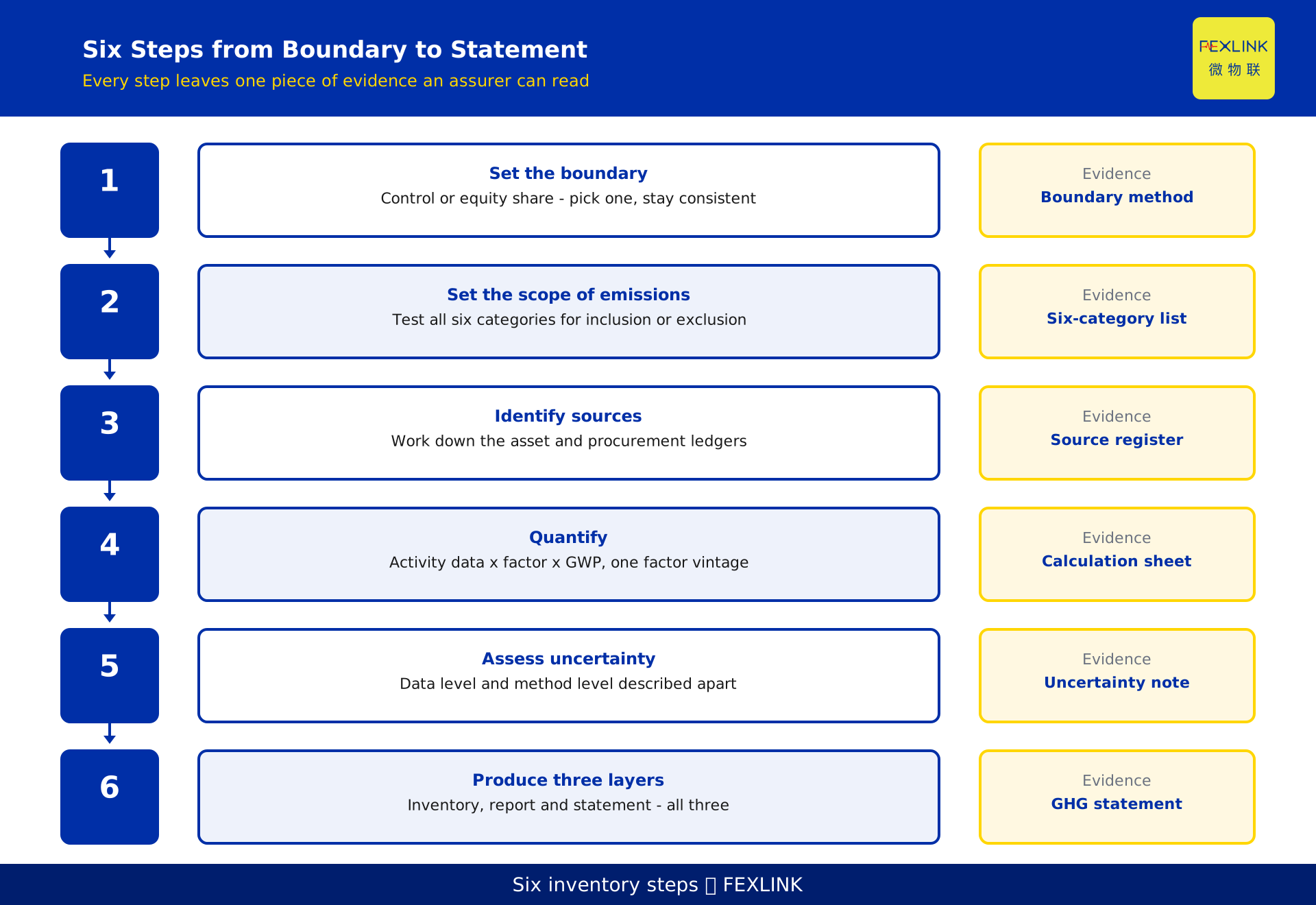
Step one, organizational boundary. Take the control approach and state operational control as the basis: the joint-venture plant is consolidated at 100%, the leased workshop is excluded, and both judgements are listed separately with reasoning. Step two, operational boundary. Category 1 is itemized boiler by boiler, kiln by kiln, including forklifts and refrigerant top-ups; Category 2 comes from electricity bills and steam settlements; Categories 3 and 4 start with transport and principal raw materials; 5 and 6 are marked unquantified in year one. Step three, quantification. Electricity, gas, steam and water are metered directly, activity data archived by point, one factor vintage locked. Step four, uncertainty. Meter accuracy, reading cycles and missing-data treatment each described. Step five, deliverables. Inventory, report, statement.
What the example shows is step one. Change the boundary method for the same company and the total moves materially, while both answers are compliant. On the collection side, sub-circuits can be fitted with the FEXLINK ESA full-parameter smart meter (models ESA-22111-R through ESA-22161-R, six current ratings, 3×220/380V, RS485 Modbus) so consumption becomes a remotely readable, archived record. A meter answers where a number came from, not how the boundary was drawn.
FAQ
Q: Can we do ISO 14064-1 or GB/T 32150, but not both?
It depends where the result goes. For domestic reporting alone, GB/T 32150 is the main line; for international questionnaires, cross-border assurance or global group disclosure, ISO 14064-1 is not optional. If you need both, do not build two ledgers: one set of activity data and factors, two mappings.
Q: We only did Categories 1 and 2. Can we say we conform?
Not in those words. The standard requires identification and assessment across all six: quantify what can be quantified, explain what cannot. Say instead: prepared in accordance with ISO 14064-1, Categories 3 to 6 not yet quantified for want of data, reasons and magnitude in a named section.
Q: Do Categories 3 to 6 have to be done at once?
No, but three moves must be there: identify, judge, disclose. Make 1 and 2 solid in year one, fix the list and data owners for 3 to 6 the same year, then start where data is obtainable. Forcing all six produces estimates layered on estimates.
Q: The 2018 edition dropped Scope. Should we still use scope language externally?
Yes, with a mapping table. Customer questionnaires and rating templates still largely use scopes. Show that Category 1 approximates Scope 1, Category 2 approximates Scope 2, and Categories 3 to 6 break Scope 3 apart, noting the correspondence is approximate.
Q: We have dozens of subsidiaries. Can we inventory headquarters only?
No. Once the boundary is set under the control approach, every facility inside it is covered; headquarters-only is a boundary that does not match the inventory, and among the easiest completeness defects to spot. A workable simplification is tiering by significance, with the rule in the methodology note.
Scope and limitations
- This article reads ISO 14064-1:2018, *Greenhouse gases — Part 1: Specification with guidance at the organization level for quantification and reporting of greenhouse gas emissions and removals*. Rely on the text in force.
- No clause numbers are cited and no clause text is reproduced. Wording, annexes and definitions belong to the standard. No emission factor values and no quantification thresholds are given — factors move with year, region and publisher; thresholds belong to assurance rules.
- The ninth-section example (three plants, a 60% joint venture, a leased workshop, six categories, four media) is constructed. It does not represent any real client and supports no conclusion about emission quantities.
- Model range, electrical parameters and interfaces of the FEXLINK ESA full-parameter smart meter follow the current selection manual; range, circuit count and supply method are customizable.
- Relation to the GB/T 32150 piece: it explains the Chinese rule's accounting basis; this covers the international principles, six categories, reporting and the division across the three parts.
Frequently Asked Questions
Can we do ISO 14064-1 or GB/T 32150, but not both?
It depends where the result goes. For domestic reporting alone, GB/T 32150 is the main line; for international questionnaires, cross-border assurance or global group disclosure, ISO 14064-1 is not optional. If you need both, do not build two ledgers: one set of activity data and factors, two mappings.
We only did Categories 1 and 2. Can we say we conform?
Not in those words. The standard requires identification and assessment across all six: quantify what can be quantified, explain what cannot. Say instead: prepared in accordance with ISO 14064-1, Categories 3 to 6 not yet quantified for want of data, reasons and magnitude in a named section.
Do Categories 3 to 6 have to be done at once?
No, but three moves must be there: identify, judge, disclose. Make 1 and 2 solid in year one, fix the list and data owners for 3 to 6 the same year, then start where data is obtainable. Forcing all six produces estimates layered on estimates.
The 2018 edition dropped Scope. Should we still use scope language externally?
Yes, with a mapping table. Customer questionnaires and rating templates still largely use scopes. Show that Category 1 approximates Scope 1, Category 2 approximates Scope 2, and Categories 3 to 6 break Scope 3 apart, noting the correspondence is approximate.
We have dozens of subsidiaries. Can we inventory headquarters only?
No. Once the boundary is set under the control approach, every facility inside it is covered; headquarters-only is a boundary that does not match the inventory, and among the easiest completeness defects to spot. A workable simplification is tiering by significance, with the rule in the methodology note.