 FEXLINK Research Institute
The short answer
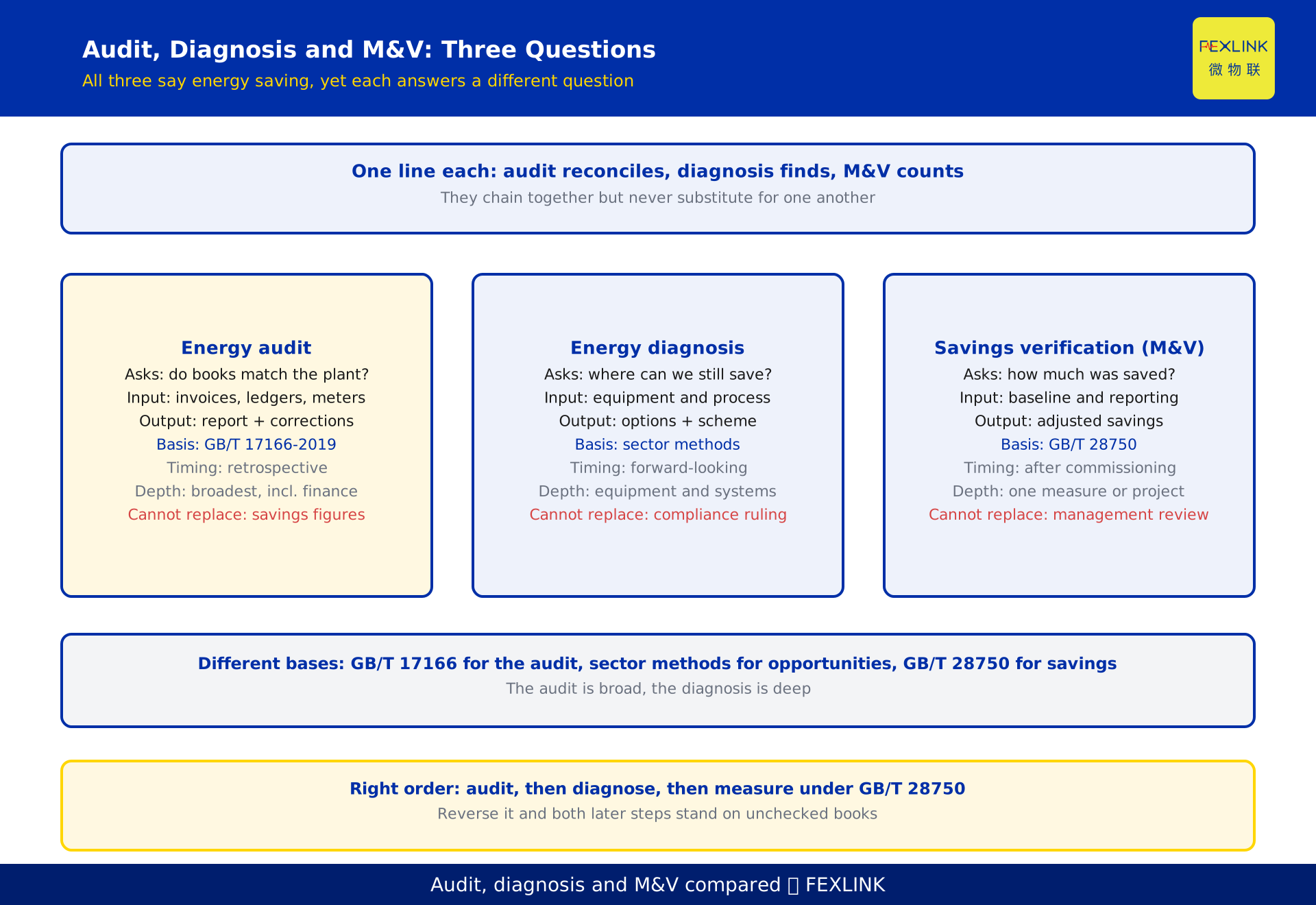
An energy audit puts the books and the plant side by side and asks: is the number you report real, and is the management behind it in place? An energy diagnosis puts the equipment and the opportunities side by side and asks: where can we still save, and is it worth changing? Both carry the words "energy saving", but their purpose, depth and basis differ. One cannot substitute for the other.
The governing standard is GB/T 17166-2019, General principle of energy audits, issued on 2019-10-18 and effective from 2020-05-01. It fully replaces GB/T 17166-1997, whose title carried the word "enterprise". The new title does not. That missing word is the most common citation error in this field.
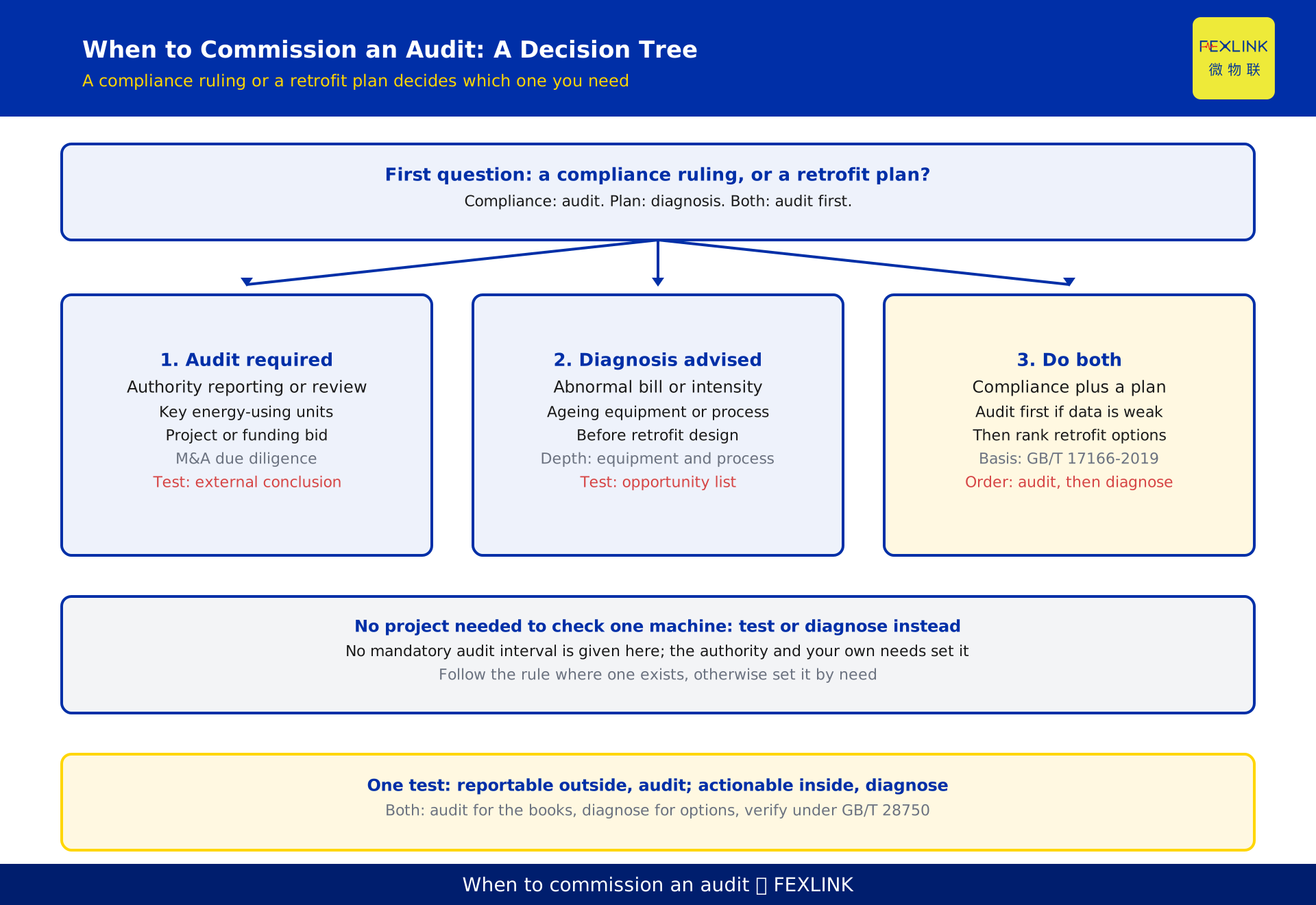
Need a compliance conclusion that survives scrutiny? Audit. Need a ranked list of retrofit options with paybacks? Diagnose. Need both? Audit first, diagnose second. Reverse the order and the diagnosis stands on books nobody has checked.
1. Checking the books versus writing a prescription
An audit is an accounting exercise; a diagnosis is the prescription written after a check-up.
Auditing reconciles four sets of numbers - statutory report, ledger, meter readings, invoices - and asks whether they agree. An audit promises no savings, only that the number holds up when questioned.
Diagnosis watches equipment: how far parameters sit from a reasonable band, what could change, what the payback looks like. It assumes the books are trustworthy.
Both are called "a report", hence the confusion. An audit produces a conclusion plus corrective requirements; a diagnosis produces opportunities plus technical options. One answers compliance, the other economics.
2. What an energy audit actually is
Under GB/T 17166 an energy audit is a systematic, documented verification of how an organisation uses energy.
Systematic. It does not sample one machine but covers purchase, conversion, distribution, end use and recovery, across management, metering, statistics and finance.
Documented. The process leaves a trail; every number traces to an invoice, a reading or a ledger entry.
Verification. It judges against a basis: do the books match the plant, is the data credible, is management evidenced.
Output: an audit report and corrective recommendations. The valuable part is not the headline figure in tonnes of coal equivalent but how it was built.
The subject is the organisation, not one machine. Hence the division of labour: the audit is broad, the diagnosis is deep.
3. GB/T 17166-2019: name, dates, what changed
Three facts to get exactly right:
- Number and title: GB/T 17166-2019, General principle of energy audits.
- Dates: issued 2019-10-18, effective 2020-05-01.
- Replacement: fully replaces GB/T 17166-1997, whose title carried the word "enterprise".
The title change is a signal: the 1997 edition was an *enterprise* standard, while the 2019 edition widens the scope to energy-using organisations in general.
Three citation errors recur: the 1997 number with 2019 content; the old enterprise title on the new standard; a recommended standard (GB/T) written as mandatory (GB).
The text covers terms and definitions, principles, content, procedure and report preparation. Clause numbers follow the current valid text; this article cites none, because a paraphrased clause number is the easiest way to be wrong.
On types, conservatively: audits are usually divided by depth into a preliminary audit and a detailed audit, with special-purpose audits as needed. Names vary by sector; classification and reporting requirements follow the body of GB/T 17166-2019.
4. Audit, diagnosis and M&V side by side
Three activities often sit in one contract. They answer three different questions.
| Dimension | Energy audit | Energy diagnosis | M&V |
|---|---|---|---|
| Question | Do the books match the plant? | Where can energy be saved? | How much was actually saved? |
| Input | Invoices, ledgers, metering, site checks | Equipment, process, conditions | Baseline and reporting-period data |
| Output | Report plus corrective requirements | Opportunities plus technical options | Adjusted savings |
| Basis | GB/T 17166-2019 | Sector methods, equipment manuals | GB/T 28750 |
| Timing | Retrospective | Forward-looking | After the fact |
| Coverage | Broad: management, metering, ledger | Deep: equipment and process | Deepest: one measure |
M&V answers only "how much was saved"; it does not judge management or find opportunities. None replaces another.
A common wrong sequence: diagnose, design, retrofit, then commission an audit to close the file. By then the data chain is broken; post-retrofit figures can only be back-calculated. The right order is audit to make the books solid, diagnose to find opportunities, then measure savings under GB/T 28750.
5. What an audit examines: seven classes, one chain
Audits examine seven classes of object. The grouping is this article's summary, not the chapter structure of the standard.
- Energy management: rules, roles, responsibilities, targets, and whether they reach people.
- Energy metering: coverage by carrier, stage and major facility; anything missing, uncalibrated or unrecorded.
- Energy statistics: whether ledger and report boundaries agree, and whether conversion factors have a source.
- Consumption indicators: comprehensive and unit-product consumption, against history, peers and quota limits.
- Equipment and systems: boilers, kilns, compressors, fans, pumps, transformers - selection and operation against load.
- Measures and projects: whether completed measures have recorded effects, whether live projects have clear baselines.
- Cost and compliance: tariff structure, penalty items, unmet reporting obligations.
The first three are the books; the last four are the plant, and their conclusions rest on the first three.
The data chain runs: meter, reading, ledger, report and bill, audit conclusion. Break any link and everything downstream is an estimate; the report should name which links have gaps.
Circuit-level metering earns its place here: a total meter yields one number, and back-calculated sub-items do not survive questioning. The ESA all-factor smart electricity meter, collecting by circuit and by carrier, lets the ledger reconcile with the meter.
6. Six steps and three choke points
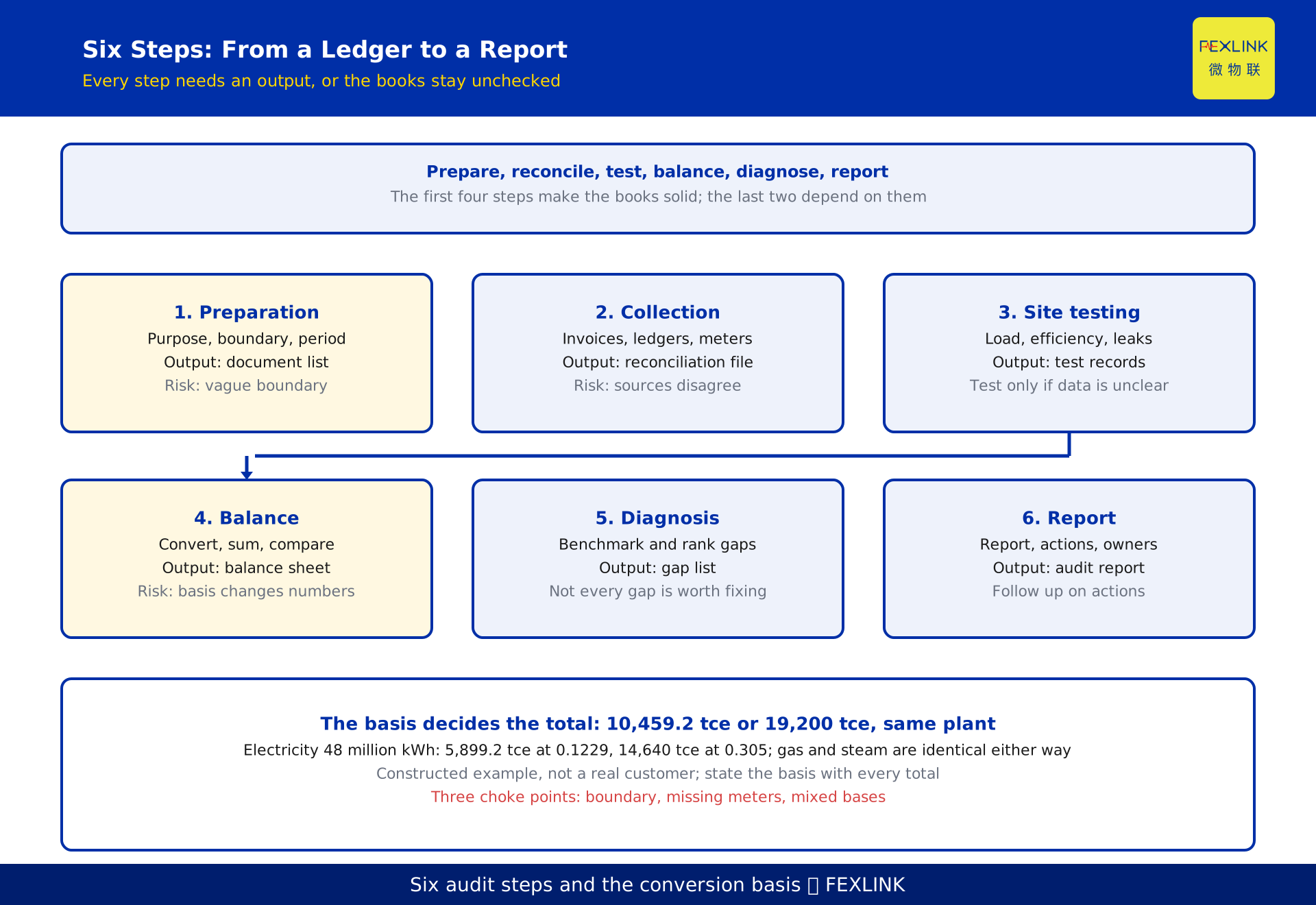
One, preparation. Fix purpose, boundary (sites, processes, carriers), period (usually one full year) and document list. A vague boundary means every number downstream is recalculated.
Two, data collection and reconciliation. Gather invoices, readings, ledgers, output figures and project files. The verb is "reconcile": invoice against bill, bill against ledger, ledger against reading, reading against meter.
Three, site testing. Measure only where data cannot speak: operating conditions, load factor, efficiency, leaks. Testing supplements rather than replaces; what to test follows the standard text.
Four, balance and indicators. Convert to coal equivalent, compute comprehensive and unit-product consumption, build the energy balance. Change the basis and every number changes.
Five, problem diagnosis. Benchmark against history, peers, quota limits and design values, then rank the gaps.
Six, report and corrective action. Issue the report, set recommendations, assign owners and deadlines, follow up.
Three choke points recur. Boundary: groups with several entities and sites buy energy centrally and allocate internally - is the boundary the entity or the physical site? Metering: without second- and third-tier meters, figures are back-calculated, usable but to be labelled with the error source. Conversion: the most technical link and the easiest to blur.
7. Conversion: one plant, two totals
Comprehensive consumption can only be summed after conversion to coal equivalent, and there are two bases.
The calorific equivalent converts by the energy content of the carrier itself. For electricity the factor is 0.1229 kgce/kWh, fixed in GB/T 2589-2020 and derived from 3.6 MJ divided by 29.3076 MJ/kgce - the same for every plant in every year.
The primary-energy equivalent converts by the primary energy consumed to produce that carrier. For electricity it uses the previous year's national average coal consumption of thermal power supply, recently around 0.30-0.31 kgce/kWh (indicative; the published value governs). It moves yearly, so state the year.
Other carriers: gas on a lower heating value basis, commonly 1.1-1.3 kgce/m³; steam on actual enthalpy, around 0.09-0.12 kgce/kg for saturated steam (about 0.094 at 0.3 MPa). Do not use a low rule of thumb such as 0.07. New water, compressed air, oxygen and nitrogen are carriers and must be counted, per the annexes of GB/T 2589.
A constructed example, not representing any real customer: a plant uses 48 million kWh of electricity, 1.8 million m³ of gas and 24,000 t of steam in a year.
- Calorific equivalent (gas 1.2, steam 0.10): 5,899.2 tce of electricity + 2,160 tce of gas + 2,400 tce of steam = 10,459.2 tce.
- Primary-energy equivalent at 0.305: 14,640 tce + 2,160 tce + 2,400 tce = 19,200 tce.
Same plant, same data: the totals differ by 8,740.8 tce, and the primary-energy figure is 83.6% higher. Ask which plant is "more advanced" by comparing the two bases and the answer is guaranteed wrong.
Hence the first discipline: every comprehensive consumption figure carries a one-line statement of basis - calorific or primary-energy, which year's electricity factor, whether compressed air was counted.
8. When to commission an audit: six triggers
Any one of these six situations justifies a project.
- The authority requires it. Key energy-using units reporting energy use, undergoing energy-saving supervision, or applying for green factory or efficiency benchmark status.
- A project application or funding bid. Retrofits, central budget investment and green credit all need a verifiable energy baseline.
- A merger, equity deal or asset transaction. Due diligence needs the true cost of energy and any latent compliance liability.
- Abnormal cost or a disputed bill. A jump in specific consumption, a tariff change, frequent demand penalties: make the books solid before discussing retrofit.
- Building an energy management system. The energy review under GB/T 23331 (identical to ISO 50001) needs real data, and an audit lays the foundation fastest.
- Preparing for savings trading or an energy performance contract. Without a clear baseline, savings measured under GB/T 28750 convince nobody.
If the only question is whether one machine is efficient, testing or diagnosis is faster; do not open a full audit for a local question.
On frequency, this article gives no number. The interval depends on the authority's requirements, the size of the organisation and its own needs. Where a rule exists, follow it.
9. Four standards, four different jobs
- GB/T 17166: how to run an audit - principles, content, procedure, report. The method standard.
- GB/T 2589: how to calculate comprehensive consumption and convert each carrier. The calculation standard; every conversion belongs here.
- GB/T 23331: energy management system requirements, identical to ISO 50001. The system standard.
- GB/T 28750: how to measure and verify savings. The verification standard.
The classic mix-up writes GB/T 17166 as the basis for conversion factors and GB/T 2589 for procedure. The method standard sets no factors; the calculation standard sets no procedure.
Frequently asked questions (FAQ)
Q: Can an audit and a diagnosis replace each other?
No. An audit concludes on whether data is credible and management evidenced; a diagnosis proposes where to save. Answering a compliance question with a diagnosis report leaves out the verification.
Q: Can we skip the audit and go straight to diagnosis?
Yes, at a price. Diagnosis assumes trustworthy data. Where metering is missing and the ledger does not reconcile with the bills, the opportunity list distorts.
Q: Must the report come from a third party?
The standard sets technical requirements, not an accreditation threshold. External reporting and due diligence usually call for an independent party; internal improvement can be done in house.
Q: Is site testing always required?
No. An audit is mainly a data and management verification; testing supplements. What to test depends on the data gap and follows the standard text.
Q: Calorific or primary-energy basis?
Both, but state which. The calorific factor is fixed (0.1229 kgce/kWh for electricity) and suits statistics and comparison; the primary-energy factor moves by year (previous year's national coal consumption of thermal power supply, recently around 0.30-0.31). Mixing the two is the most common defect.
Scope and limitations
- This article covers the energy audit as a standard method and its boundary with diagnosis and savings verification. The reasoning logic of diagnosis is in KD-0409; the increment here is the boundary and the key points of GB/T 17166.
- The current valid text governs. Clause numbers, classification, procedure and reporting requirements follow the body of GB/T 17166-2019; this article cites none. Version details are in section 3.
- This article gives no mandatory audit frequency, no savings threshold and no emission factors. For carbon accounting, follow the current version of GB/T 32150 (the 2025 edition, effective 2026-07-01, replacing the 2015 edition).
- Conversion factors: 0.1229 kgce/kWh is the fixed calorific value in GB/T 2589-2020; 0.305 and the 0.30-0.31 band are indicative, and the published value governs; gas at 1.1-1.3 kgce/m³ and steam at 0.09-0.12 kgce/kg are common bands.
- All figures in section 7 are a constructed example. They do not represent any real customer, sector average or assessment benchmark.
- On the product side: the ESA all-factor smart electricity meter collects electricity by circuit and by carrier, providing the metering basis for the audit data chain; the energy diagnosis solution and the energy supervision centre solution carry delivery and supervision. Ranges, circuit counts, power and communication options are configurable.
Frequently Asked Questions
What Does GB/T 17166 Energy Audit Cover
An energy audit puts the books and the plant side by side and asks: is the number you report real, and is the management behind it in place