 FEXLINK Research Institute
The short answer
When total energy use is converted to standard coal, electricity is the first trap. Electricity carries two legitimate coefficients: the energy-equivalent value, fixed at 0.1229 kgce/kWh (kgce is kilograms of coal equivalent), and the equivalence value, which follows the year's thermal-power coal consumption for generation and has recently sat near 0.31 kgce/kWh. Use the wrong one for the same kilowatt-hour and the whole plant's total energy can come out two and a half times too large. Gas and steam have their own rules too: gas is converted on its lower heating value, steam on its actual enthalpy — never by guesswork. The one rule that matters most: every conversion coefficient must carry its source standard, version and date in the report, or two reports built from the same raw data will never reconcile.
1. What "standard coal" actually is
Standard coal, written kgce, is the single yardstick that all energy carriers are reduced to. By definition, one kgce equals 29.3076 MJ of lower heating value — the same idea as the older 7000 kcal figure. Electricity, natural gas and steam are different physical things: electricity is a secondary energy carrier, gas is a fossil fuel, steam is an energy-bearing medium. To add them, compare them or benchmark them, you first express each in the same unit.
The conversion factor is simply "how many kgce one unit of this energy source equals." Get the factor wrong, or let the basis drift between two calculations, and every total downstream is wrong. GB/T 2589, the General Principles for Calculation of Comprehensive Energy Consumption, is the authoritative source for these factors in China.
There is a practical payoff to a single basis: the unit of comprehensive energy consumption is itself "tonnes of standard coal" (tce), which already assumes every source was converted before it entered the number. When a report shows "comprehensive energy consumption 1839 tce," that figure is the sum of electricity, gas and steam each multiplied by its own factor — move any one factor and the total moves with it. That is why the first question in any energy audit is always: which coefficients did you use.
2. Electricity: two coefficients, not one
Electricity is the single most error-prone source in conversion, because it legitimately has two coefficients with completely different purposes.
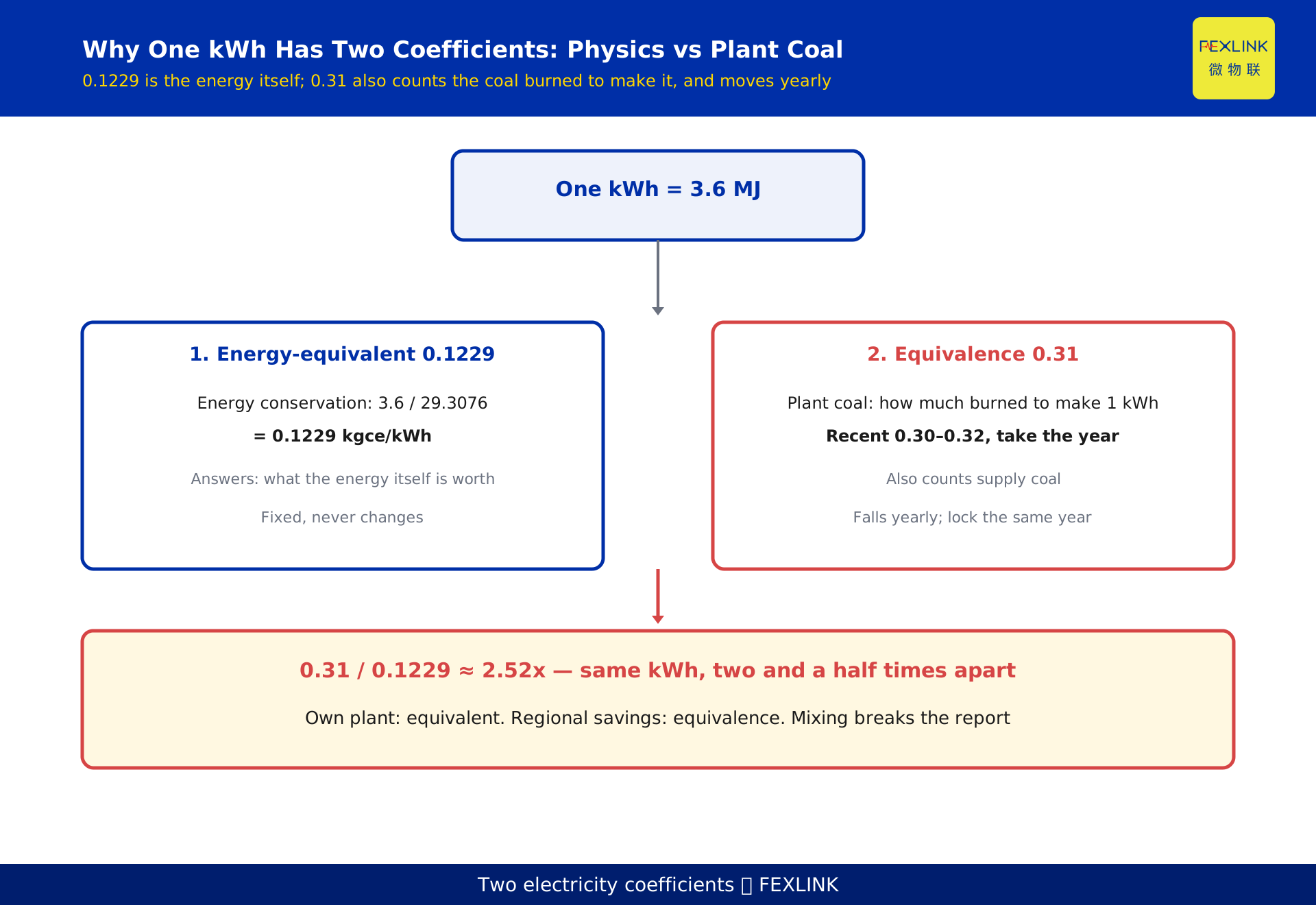
Energy-equivalent value, 0.1229 kgce/kWh. This is the energy-conservation view: one kWh equals 3.6 MJ, divided by the 29.3076 MJ in one kgce, gives 0.1229. It answers how much standard coal the high-grade energy of one kWh is worth in itself.
Equivalence value. This also counts the coal burned at the power plant to generate that kWh — how much standard coal a thermal plant actually consumed to deliver it. It is set by the national thermal-power supply coal consumption for the year, not a fixed number. In recent years it has sat around 0.30–0.31 kgce/kWh and moves every year, so the figure used must be the published value for the year being reported.
How far apart are the two? 0.31 divided by 0.1229 is about 2.52. The same plant, the same kilowatt-hour, comes out more than two and a half times larger on the equivalence basis than on the energy-equivalent basis.
Which to use when? GB/T 2589 defaults to the energy-equivalent value when an energy user calculates its own comprehensive energy consumption and energy intensity per unit of product. The equivalence value is used for regional energy balances and government energy-saving targets and savings verification. Mixing them is not a rounding error; it changes the order of magnitude of the whole report.
The equivalence value also drifts year to year. As thermal-plant efficiency climbs, the supply coal consumption per kWh slowly falls, so the equivalence coefficient falls with it. Run the same plant through 2020's equivalence value and 2010's, and the totals differ visibly. That means year-on-year comparisons must lock the same year's coefficient, or a "down this year versus last" result may be an artifact of a changed factor rather than real savings.
3. Gas and steam: measure, don't guess
Natural gas is converted on its lower heating value, and the factor depends on the gas composition, typically about 1.1–1.3 kgce/m³ (the example below uses 1.214). You cannot use a rough "one cubic metre equals one kilogram of coal" rule; change the composition and the factor changes. The lower heating value should come from the supplier's gas-quality analysis, or from an empirical range by source type. A plant with its own metering simply multiplies the metered cumulative volume by the factor; it does not need to convert the volume itself.
Steam is converted on its actual enthalpy, absolutely not "one tonne of steam equals one tonne of coal." Saturated steam at different pressures and temperatures has different enthalpy, so the factor differs too, commonly around 0.09–0.12 kgce/kg (the example below uses about 0.09 for 0.6 MPa saturated steam). The enthalpy can be read from steam tables using the supply pressure and temperature, or computed in real time from a flow meter plus temperature and pressure sensors. Rounding to 0.1 looks harmless, but at steam volumes of tens of thousands of tonnes the error multiplies into hundreds of tonnes of standard coal.
4. A worked example: one plant, two answers 2245 tce apart
The following is an illustrative scenario, constructed to show how the basis changes the result. It does not represent any real customer or project.
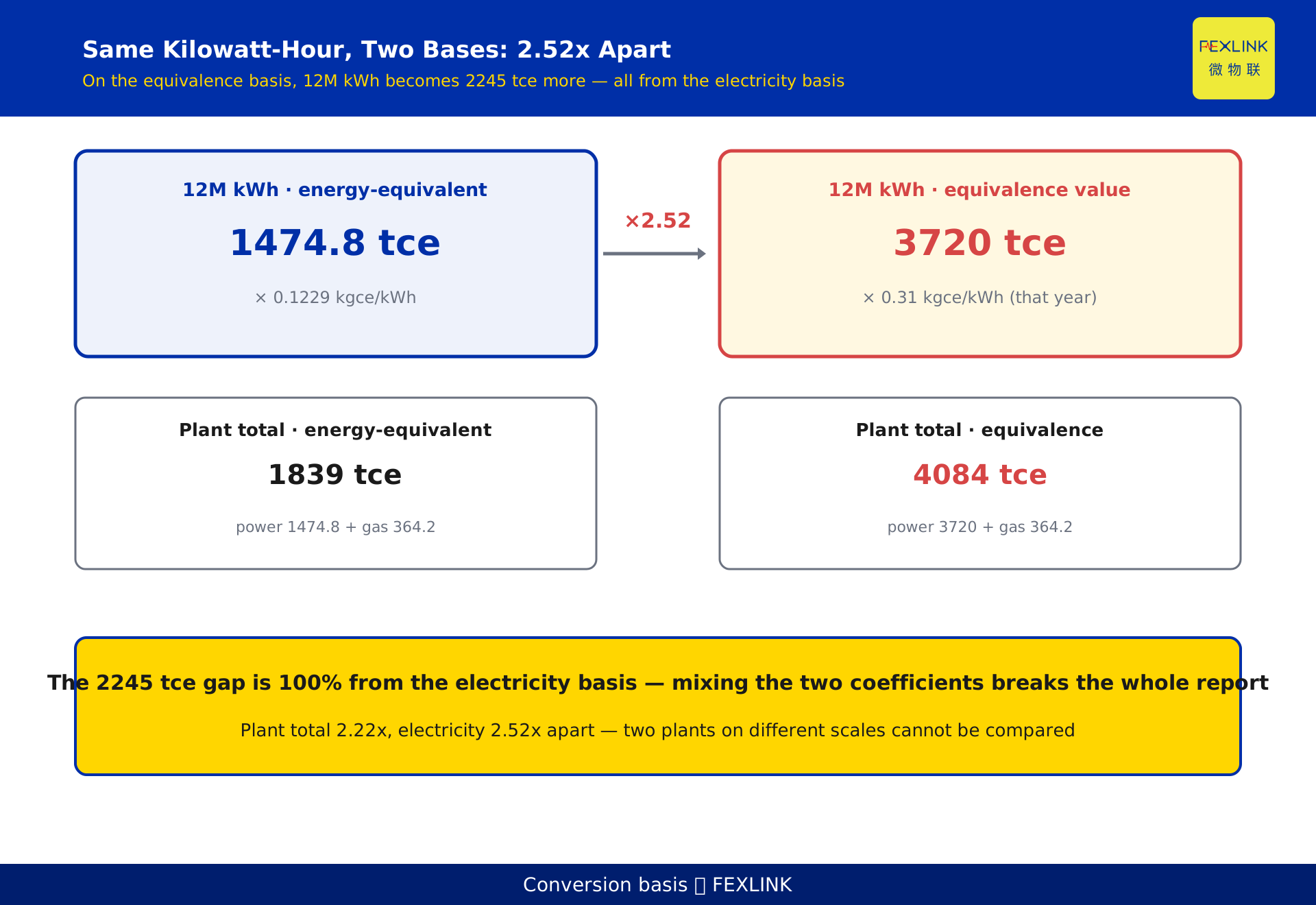
A plant uses 12 million kWh of electricity and 300,000 m³ of natural gas per year. Converted on each basis:
- Energy-equivalent basis: electricity 12 million × 0.1229 = 1474.8 tce; gas 300,000 × 1.214 = 364.2 tce; total 1839 tce.
- Equivalence-value basis: electricity 12 million × 0.31 = 3720 tce; gas 364.2 tce; total 4084 tce.
The gap of 2245 tce comes entirely from the electricity basis. Electricity alone differs 2.52 times; the whole-plant total differs 2.22 times. If this plant reports its energy benchmarking on the equivalence basis while its neighbour uses the energy-equivalent basis, the two are not on the same scale at all and cannot be compared. This is exactly why the first thing a third-party energy audit does on site is pin down which coefficient the electricity was converted with.
5. Leave a trail: four things every report must record
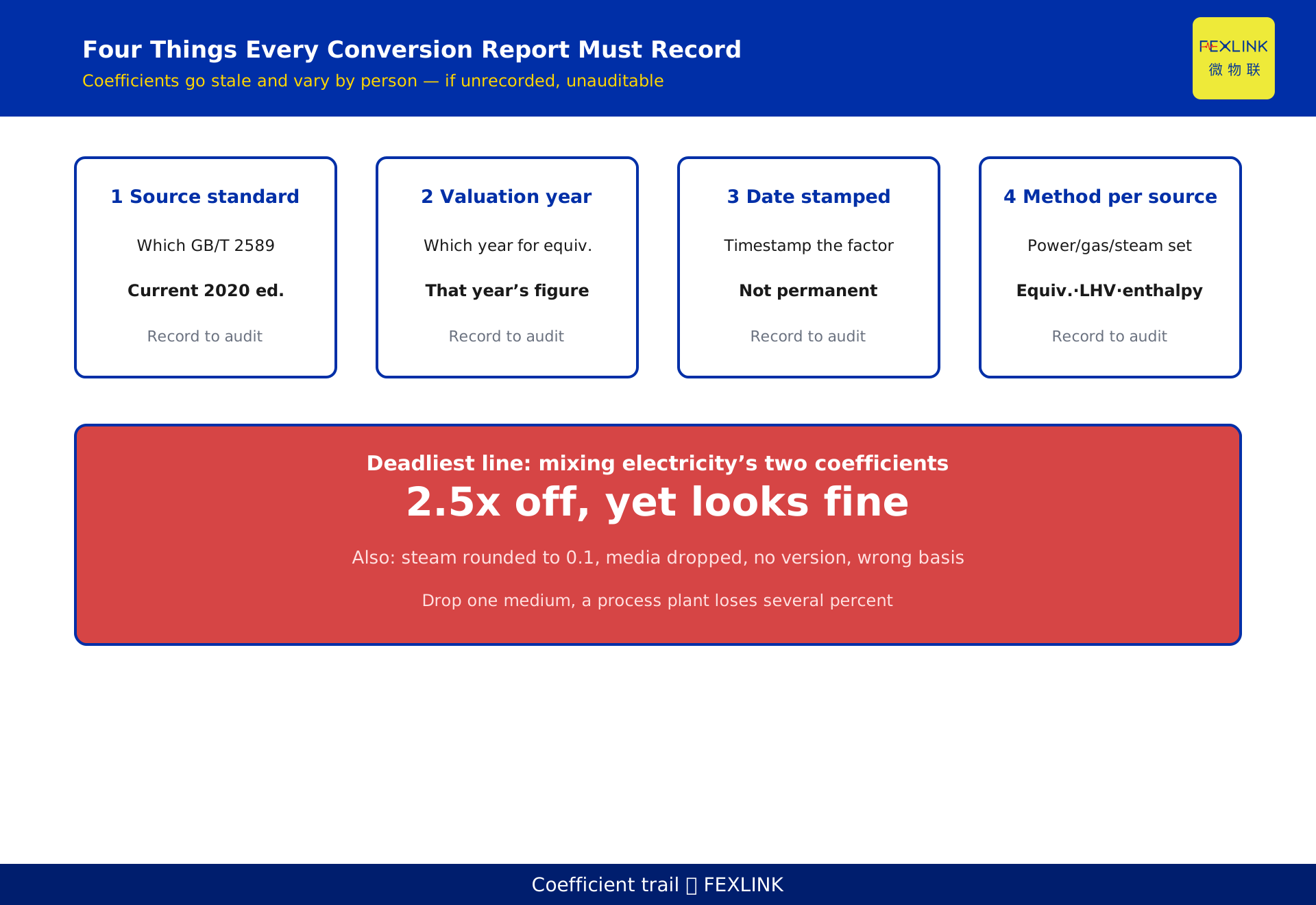
Coefficients go stale, change, and get picked differently by different people. For a report to be auditable and reconcilable, four things must be written down:
- Source standard — which edition of GB/T 2589 (the current 2020 edition).
- Version or year — which year's thermal-power supply coal consumption the equivalence value was taken from.
- Date of valuation — coefficients are not permanently valid; the timestamp must be kept.
- Conversion method per source — electricity on energy-equivalent or equivalence, gas on lower heating value, steam on actual enthalpy, item by item.
Drop any of these and next year, when someone else recomputes, the comprehensive energy consumption may differ from this year's by tens of percent, with nobody knowing why.
6. The five most common conversion errors
1. Mixing electricity's two coefficients. The most fatal: it can make comprehensive energy consumption wrong by 2.5 times and still look plausible.
2. Treating steam as "tonne ≈ tonne" or rounding to 0.1. The steam factor is a function of pressure and temperature; 0.6 MPa and 1.0 MPa differ noticeably, and the error is amplified at high steam volumes.
3. Dropping energy-bearing media. Compressed air, oxygen, fresh water and chilled water are all energy-bearing media that GB/T 2589 requires to be converted or counted as energy consumption; miss one and a block of consumption goes missing. These are high-volume, low-unit-cost streams most easily waved through as "free," yet they hide several percent of a process plant's total.
4. Not stating the source version. When the standard is revised or the coal-consumption figure updates, reports stop matching and the root cause cannot be traced.
5. Choosing the wrong basis for the question. Using the equivalence value for a plant's own energy management inflates it and misleads internal targets; using the energy-equivalent value to report regional energy savings omits supply coal consumption and understates true consumption.
7. Where products fit
The biggest risk in conversion is the basis drift that comes from manual data collection and hand calculation — the same number gets two coefficients from two people.
Circuit-level and source-by-source metering with the ESA all-element smart meter (for example ESA-22131-R, 3×400A, 3×220/380V, RS485 Modbus) brings electricity, gas and steam in on separate channels, applies the correct factors automatically, and produces comprehensive energy consumption and energy intensity per unit of product monthly, with a constant, traceable basis. Where phase and harmonic monitoring are needed, the ESB three-phase imbalance monitor or the ESE series applies.
8. Three things handover usually drops
At handover of a conversion report, what gets lost is usually not the equipment but the conversion basis.
Only the total is handed over, not the factor table. Whether energy-equivalent or equivalence, gas at 1.214 or 1.1, steam at which pressure — these are the details that decide whether numbers reconcile, and they are absent from the handover package. The successor can only recompute from scratch, and the historical data is already gone.
The electricity basis is not labelled in the report. A 4084 tce computed on the equivalence basis gets compared against a benchmark as if it were an energy-equivalent figure, and the conclusion is simply wrong.
The energy-bearing media list is incomplete. Compressed air and chilled water were never converted; nobody noticed at handover, and the energy baseline is short a block from then on.
9. FAQ
Q: For a company's own comprehensive energy consumption, should electricity use the energy-equivalent or the equivalence value?
An energy user calculating its comprehensive energy consumption and energy intensity per unit of product defaults to the energy-equivalent value under GB/T 2589. The equivalence value is for regional energy balances and savings verification. For internal benchmarking, just use the energy-equivalent value consistently.
Q: The equivalence value changes every year — which year do I take?
Take the published national thermal-power supply coal consumption for the year matching the reporting period, and state the year in the report. Do not use a figure from several years earlier, and do not mix years.
Q: Can I just use 0.1 for the steam factor?
Not as a blanket rule. Steam is converted on actual enthalpy, and 0.09–0.12 kgce/kg can all appear. High-volume users should set the factor from the actual supply pressure and temperature; rounding accumulates into a large error.
Q: Do compressed air and fresh water need conversion?
Yes. They are energy-bearing media and GB/T 2589 requires them to be converted or counted as energy consumption. Omitting them understates the plant's comprehensive energy consumption and biases benchmarking low.
Q: The coefficient was wrong and the report is already out — what now?
Keep the original report with its factor version and valuation date, recompute on the corrected basis, and issue a revised version; keep both on file. The point is to make the basis traceable, not to quietly change the numbers.
Scope and limitations
- The coefficient values discussed here apply to calculating a company's comprehensive energy consumption and energy intensity per unit of product under GB/T 2589; where another sector standard specifies otherwise, that standard governs.
- The electricity energy-equivalent value 0.1229 kgce/kWh is from GB/T 2589-2020. The equivalence value follows the national thermal-power supply coal consumption for the year; the recent range of about 0.30–0.31 kgce/kWh is illustrative only, and the actual value is the competent authority's published data.
- The natural-gas factor depends on the source lower heating value; the example value 1.214 kgce/m³ is for reference only. The steam factor depends on actual enthalpy; the example of about 0.09 kgce/kg for 0.6 MPa saturated steam is for reference only. Both should be set from measured heating value or enthalpy.
- The worked-example figures are constructed to illustrate the basis difference and do not represent any real customer or project; actual comprehensive energy consumption requires on-site metering and the year's coefficients.
- Model numbers and specifications for the ESA all-element smart meter and the ESB three-phase imbalance monitor are subject to the latest selection manual and product knowledge base. This article is not a selection or procurement recommendation.
Frequently Asked Questions
How to Pick Standard Coal Equivalence Factors
When total energy use is converted to standard coal, electricity is the first trap