 FEXLINK Research Institute
Direct Answer
How is the specific energy consumption (SEC) calculated to survive the benchmarking? The SEC = the comprehensive energy / the qualified output, with the unified conversion coefficient and the removed start-stop and trial production conditions — the numerator (the comprehensive energy) converted to the standard coal by the coefficient, and the denominator (the qualified output) by the qualified and the converted products — an inconsistent SEC is a useless one — with the coefficient and the condition correction right, the SEC survives the questioning of the peers.
A scenario: The superior comes to benchmark — the enterprise reports 58 kgce/t — the other side questions "your numerator contains the living energy and your denominator contains the defective" — the SEC distorted, the benchmark failed. The logic is that the SEC is "the ratio of the energy/the output" — the numerator and the denominator must be aligned — one wrong, the ratio distorted — the calculation starts with the alignment.
The pain is common — the statistics people calculate the SEC by the habit without the unified base: the report looks fine but fails the questioning — the alignment is the first step of the survival.
A benchmark example — Three enterprises report: A 58, B 52 and C 49 kgce/t — the check finds the inconsistent bases — after the unification: A 52, B 51 and C 50 — the gap from "9 points" to "2 points" — the aligned, the benchmark meaningful.
1. The Numerator (the Comprehensive Energy)
The numerator — the comprehensive energy: the production (the process + the power) + the auxiliary (the lighting + the AC) — converted to the standard coal (kgce); The boundary — the living energy not into the SEC: the canteen, the dormitory and the office measured separately; The period — the same as the output: the energy of the same report with the output of the same report; The quality — the meter precision and the reading consistency: the accurate, the numerator accurate.
The boundary is the key — the production energy and the living energy often share one meter: without the separate metering, the numerator cannot be clean — the separate metering is the prerequisite of the correct numerator.
In one sentence: the numerator is "the production-related comprehensive energy" — the living removed and the same period — the clean, the SEC credible.
The composition table:
| Component | Included | Note |
|---|---|---|
| Process | Yes | Direct |
| Power | Yes | Drive |
| Lighting/AC | Yes | Auxiliary |
| Living | No | Canteen/dorm |
| Office | No | Non-production |
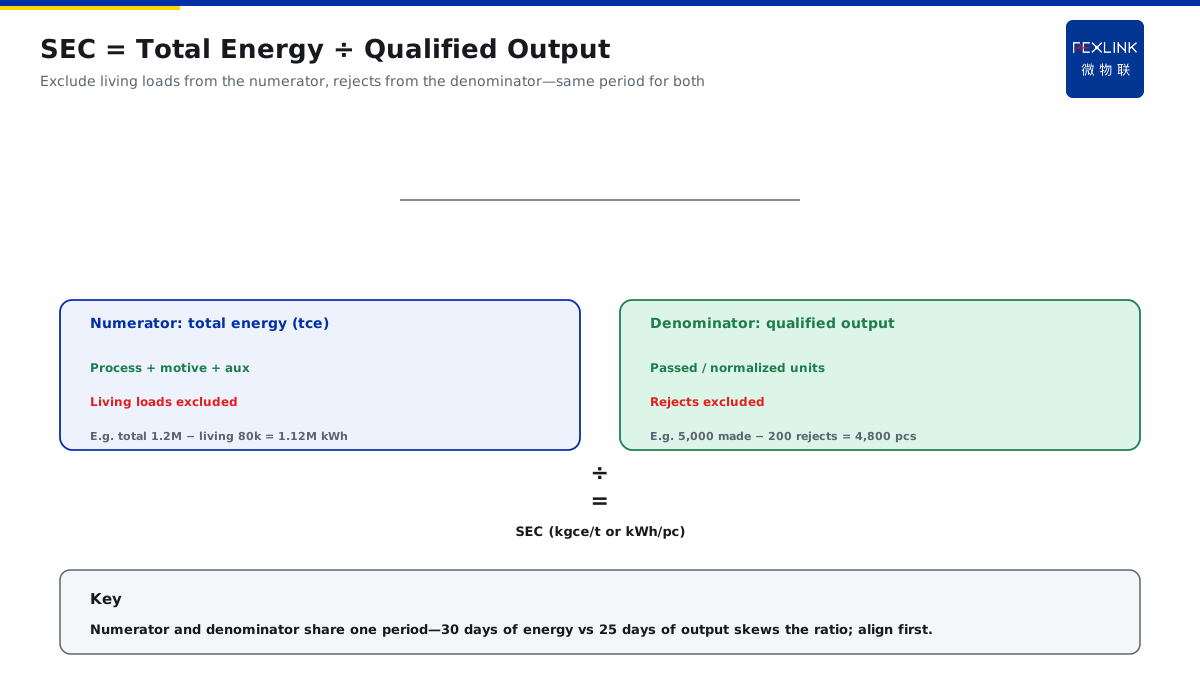
The complete formula — the SEC = (the comprehensive energy converted - the living energy converted) / the qualified output — the same period — one formula, the base all contained. An example — The monthly total 1.2 million kWh — the living 80,000 measured separately — the numerator 1.12 million (the production + the auxiliary) — correct. The logic is that the numerator = the total - the living — the unclear, the numerator higher — the separately measured, the clean.
2. The Denominator (the Qualified Output)
The denominator — the qualified output: the inspected qualified — the defective not into the denominator; The converted output — the different specifications converted to the standard: by the conversion coefficient; The statistics — by the shipment or the warehousing: the workshop and the warehousing match;
The output recording — the workshop records the produced while the warehouse records the shipped: the two must reconcile within the period — otherwise the denominator is either the produced or the shipped, inconsistent. The period — the same as the numerator: the same report.
In one sentence: the denominator is "the qualified output" — the defective removed and the specifications unified — the true, the SEC comparable.
The conversion principle — the same type by the energy weight: the unit coefficient = the actual SEC / the standard SEC — unified, comparable. An example — The monthly 5,000 pieces — 200 defective — the denominator 4,800 (the qualified) — correct. The logic is that the denominator = the qualified — the defective mixed lowers the SEC — the inspection into the statistics, the true.
3. The Conversion Coefficient
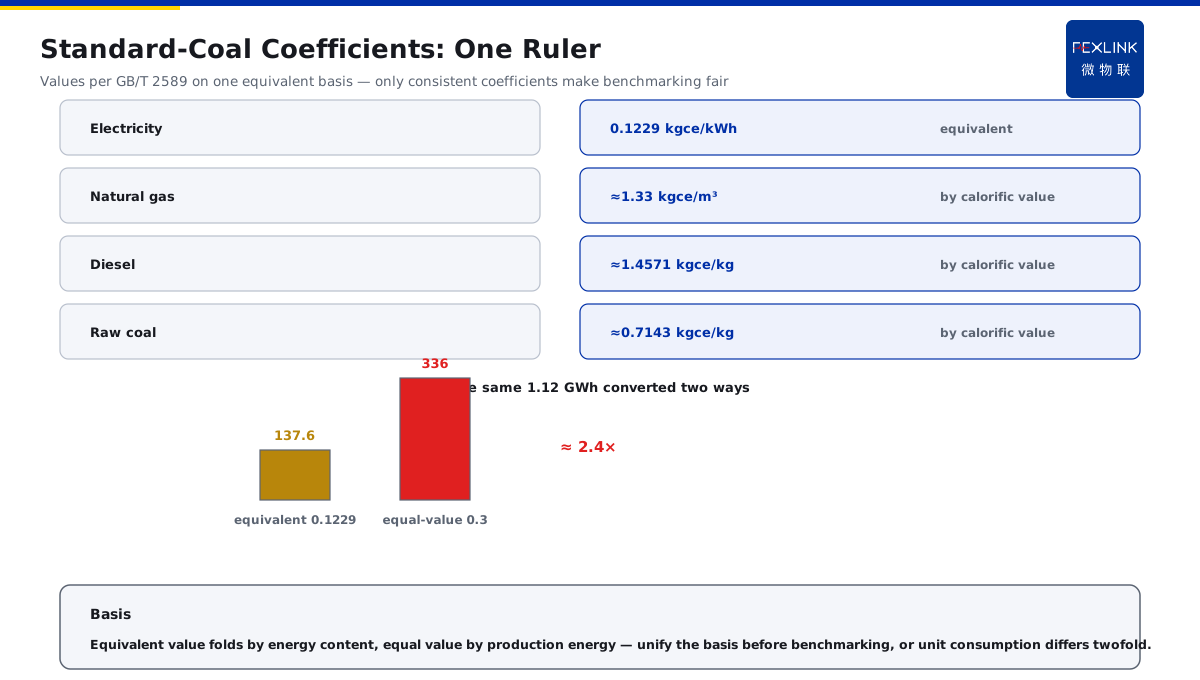
The meaning — the coefficient of different energies to the standard coal: the electricity 0.1229 kgce/kWh (the equivalent value); The source — the GB/T 2589 annex: the national unified coefficients; The basis — the equivalent vs the calorific: the benchmark unified (usually the equivalent); The consistency — the same enterprise and the same period with the same set: the unified, comparable.
In one sentence: the coefficient is "the ruler of the energies" — by the GB/T 2589 and the unified basis — the consistent, the fair.
The reference table:
| Energy | Coefficient | Note |
|---|---|---|
| Electricity | 0.1229 kgce/kWh | Equivalent |
| Gas | about 1.33 kgce/m³ | Calorific |
| Diesel | about 1.4571 kgce/kg | Calorific |
| Coal | about 0.7143 kgce/kg | Calorific |
The acquisition — the GB/T 2589 annex: the national; without, the industry — the sourced, the benchmark with the evidence. An example — The 1.12 million kWh × 0.1229 = 137.6 tce — another with the calorific 0.3 = 336 tce — the different bases, twice the difference. The logic is that the coefficient is "the unified ruler" — the equivalent vs the calorific twice — the unified first.
4. The Correction of the Utilization and the Fluctuation
The utilization — the actual production time / the planned: the capacity use; The start-stop — the abnormal energy of the start-stop (the high idle): removed or marked; The trial production — the high SEC of the trial: not into the official benchmark; The fluctuation — the fixed energy share rising when the output falls: the SEC read with the utilization.
In one sentence: "remove the conditions and see the utilization" — the start-stop and the trial removed and the fluctuation with the utilization — the unbiased.
The correction formula — the corrected SEC = the report SEC × (the base utilization / the actual utilization) — the normalized, comparable. The reading — the low utilization makes the fixed energy per piece higher: the rising SEC is not necessarily the worse efficiency — with the utilization, objective. An example — The 10-day maintenance — 50,000 kWh — without the removal, 8% higher — with, back to normal. The logic is that the condition is "the noise" — without the removal, distorted — the start-stop and the trial handled, accurate.
5. The Typical Error List
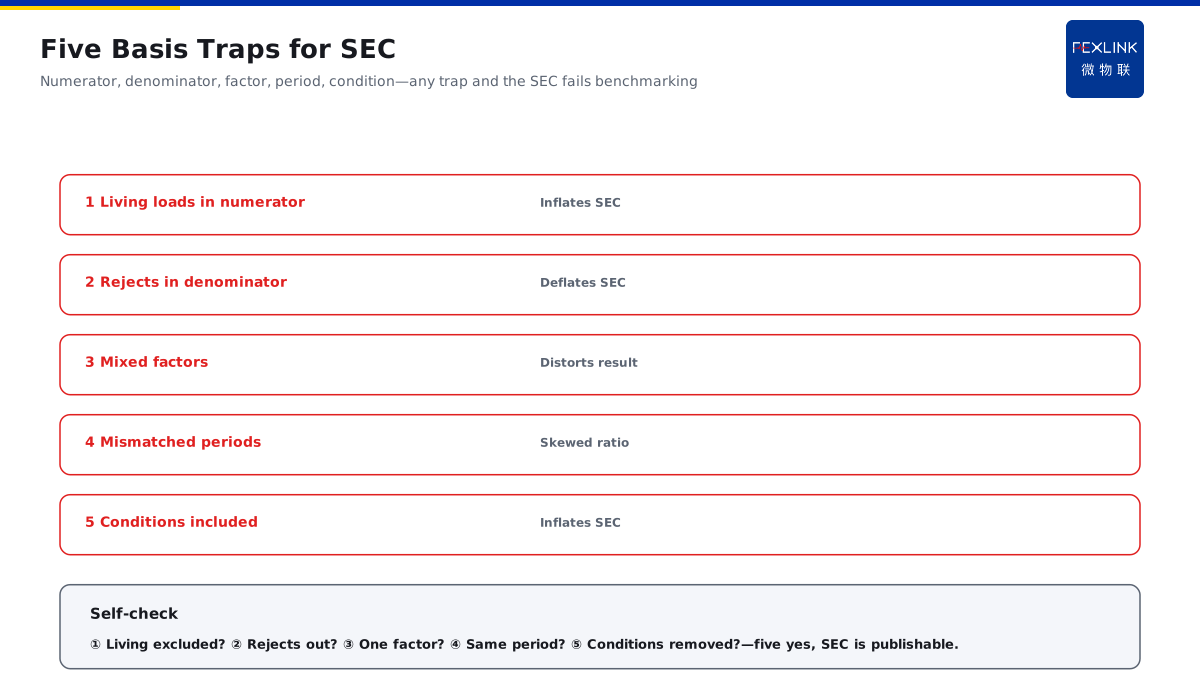
Error 1: the living in the numerator — the canteen and the dorm into the SEC — higher; Error 2: the defective in the denominator — the scrap into the output — lower; Error 3: the coefficients mixed — the equivalent and the calorific mixed — distorted; Error 4: the periods mismatched — the energy 30 days and the output 25 — shifted; Error 5: the conditions not removed — the maintenance and the trial mixed — higher.
In one sentence: the five errors, the five "pitfalls" — the numerator, the denominator, the coefficient, the period and the condition — any hit, the SEC fails the benchmark.
The checklist — ① the living removed? ② the defective out? ③ the coefficient unified? ④ the period matched? ⑤ the condition removed? — the five passed, the SEC reportable. An example — The report questioned — the self-check: the living not removed (1) + the scrap into the output (2) — after the correction: from 58 to 52 — the benchmark credible. The logic is that the error is "the root of the failure" — the five checked one by one, the SEC survives.
The routine suggestion — do the self-check before every report: one pass takes minutes but avoids the whole benchmark being questioned — the habit makes the SEC always reportable.
Back to the ESA and the benchmarking system — the foundation: the ESA measures the production/living/auxiliary separately and the system calculates and benchmarks — the base aligned at the data layer, the SEC accurate from the source.
Scope and Limitations
- The conclusions in this article are intended for LV distribution and electrical-safety sites. Standard numbers (GB/T 2589, GB/T 13234) refer to their currently effective editions, and product parameters follow the latest FEXLINK selection handbook and product knowledge base.
- Quantitative criteria (protection zone, discharge and residual voltage, earth resistance, thresholds and grading) hold under the preconditions stated in this article. Where the site voltage level, earthing arrangement, environmental category or load profile differs, the figures must be recalculated. Specific configurations involving ESA all-element smart meter should be verified against actual circuit parameters.
- Specific product models and parameters are subject to the latest selection handbook and product knowledge base; this article does not constitute selection or procurement advice.
- Standard numbers cited here refer to the currently effective editions; when a standard is revised, the related quantitative conclusions must be re-checked.
- Deployment and implementation for specific projects must be carried out by qualified engineers based on site survey and design drawings.
Frequently Asked Questions
How to Calculate Specific Energy Consumption So It
How is the specific energy consumption (SEC) calculated to survive the benchmarking