 FEXLINK Research Institute
Direct Answer
How to calculate the Scope 2 emissions? Scope 2 is the indirect emission of the purchased electricity and heat — two methods: the location-based method calculates by the average emission factor of the regional grid where the enterprise sits, and the market-based method calculates by the factor corresponding to the electricity contracts actually purchased (the green power and the certificates) — the two must be disclosed side by side: the location-based answers "how much you emit under the grid structure" and the market-based answers "how much your purchasing choice changed" — the green power procurement shows its reduction only under the market-based method — the external report gives both numbers and explains the difference.
A scenario: A company gets two numbers for its Scope 2 — which one should the external report use — the auditor says disclose both and the customer asks why the two differ — the problem: it does not know which question each method answers. The logic is that Scope 2 is not "choose one method" but "disclose both in parallel" — the location-based calculates the grid fact and the market-based calculates the purchasing choice — the two numbers each have a meaning, and missing one makes the report incomplete.
1. The Definition of Scope 2 (Purchased Electricity and Heat)
The meaning of Scope 2 — the indirect emission of the purchased electricity, steam and heat: the use of the electricity does not emit directly, but the generation side is emitting; The difference from Scope 1 — Scope 1 is the direct emission of the owned facilities (boiler combustion and vehicle fuel); Scope 2 is the upstream indirect emission of the purchased energy; The position of Scope 2 — inside the inventory boundary: the consumption × the factor, counted into the total emission; The status of Scope 2 — the largest share of the total for most companies: an accurate Scope 2 completes most of the inventory.
In one sentence: Scope 2 = the indirect emission of the purchased electricity/heat — not emitted by the company itself, but counted on it — the consumption × the factor, and Scope 2 is the big item of the carbon for most companies.
The position of Scope 2 in the total — for most manufacturers it takes 50%-80%: the largest single item of the inventory — an accurate Scope 2 means an accurate skeleton of the total — the method choice directly affects the reporting basis. An example: A manufacturer uses 50,000,000 kWh a year: the Scope 2 at 0.57 kg/kWh is about 28,500 tonnes — over 70% of the total — an accurate Scope 2 sets the skeleton of the inventory. The logic is that Scope 2 is "using others' electricity and counting your own carbon" — the emission of the generation side is counted on the consumer — the accuracy of Scope 2 directly decides the accuracy of the total.
2. The Calculation of the Location-Based Method
The definition of the location-based method — calculated by the average emission factor of the regional grid: reflecting "the grid structure decides your carbon"; The formula of the calculation — Scope 2 (location-based) = the consumption × the average factor of the regional grid; The choice of the factor — the average factor of the regional grid where the enterprise sits (not the national average): closer to the reality; The applicable scenarios — the regular inventory, the compliance report and the international benchmarking: the basic accounting under the unified basis.
In one sentence: the location-based = the consumption × the regional average factor — answering "how much you actually emit under the grid structure" — the baseline basis of Scope 2.
The calculation steps of the location-based method — first: fix the consumption (the actual inside the boundary); second: fix the regional average factor (the region, the latest publication); third: the consumption × the factor; fourth: record the factor source and the year
The applicable boundary of the location-based method — the regular inventory and compliance: use it; the multi-region plants: each by its own regional factor; an enterprise without the green power: the location-based equals the market-based — a clear boundary, no misused method.
An example: A company in the China Southern Power Grid: 10,000,000 kWh and the regional factor 0.48 — the Scope 2 = 4,800 tonnes — the same company in the North China grid: the regional factor 0.55 — the Scope 2 = 5,500 tonnes — different regions, different carbon. The logic is that the location-based reflects "the carbon content of the grid" — a hydro-rich region has a low carbon and a thermal-rich one a high carbon — the location-based is the "fair baseline" of the inventory, every enterprise calculated by its own grid.
3. The Market-Based Method and the Green Power/Certificates
The definition of the market-based method — calculated by the factor corresponding to the electricity actually purchased (including the green power and the certificates): reflecting "your purchasing choice decides your carbon"; The formula of the calculation — Scope 2 (market-based) = each purchasing source × its factor; The handling of the green power — the purchased green power is calculated as zero-carbon or by the green factor: the reduction appears under the market-based; The handling of the certificates — the electricity corresponding to the certificates is zero-carbon: the certificate is the carbon attribute voucher of the green power.
In one sentence: the market-based = each source × its factor — the green power as zero-carbon and the regular power by the grid factor — answering "how much your purchasing choice changed the carbon".
The calculation steps of the market-based method — first: split the consumption by the sources (regular/green/certificate); second: match each source with its factor (the grid factor/the green zero); third: sum the source × the factor; fourth: record the green vouchers (the contract, the settlement and the certificates)
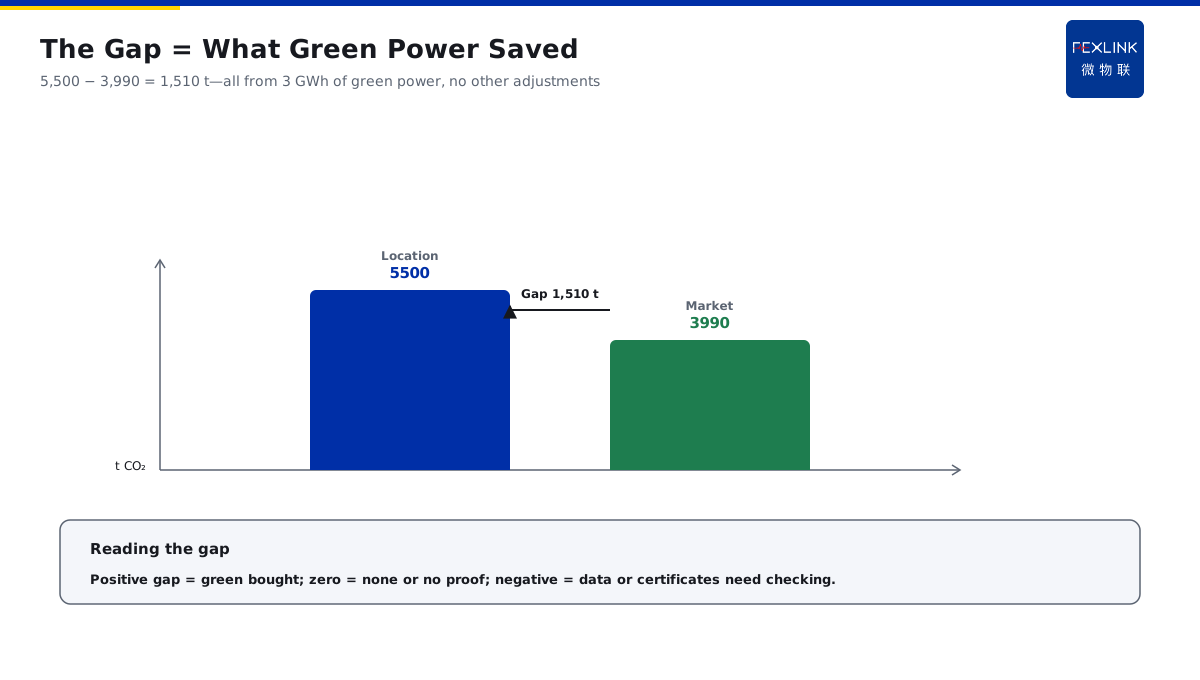
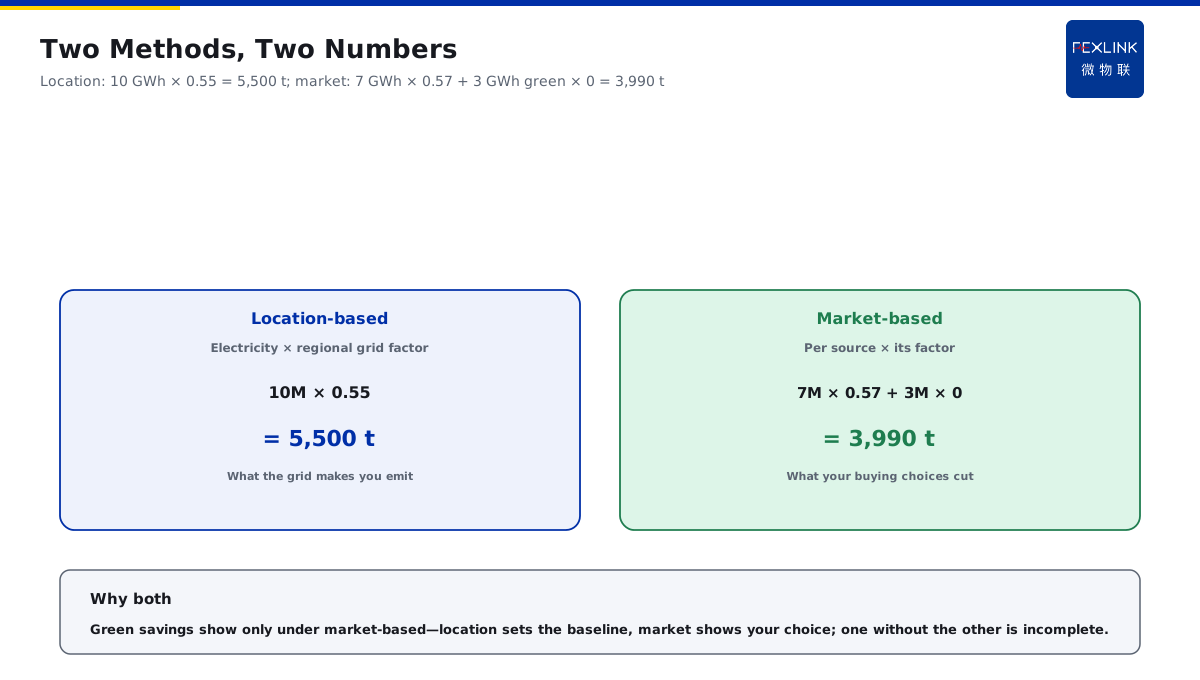
The applicable boundary of the market-based method — an enterprise with the green purchases: the method shows the effect; without the green power: the market-based equals the location-based; the cross-year carry-over: by the year of the vouchers — clear vouchers, compliant offset. An example: A company uses 10,000,000 kWh: 7,000,000 regular × 0.57 + 3,000,000 green × 0 — the market-based = 3,990 tonnes — the same company by the location-based (the regional factor 0.55) = 5,500 tonnes — the two differ by 1,510 tonnes, the reduction contribution of the green procurement. The logic is that the market-based quantifies the "purchasing choice" — the reduction of the green power appears only under the market-based — the location-based cannot see the green power, the market-based can — and that is exactly why the two must be disclosed in parallel.
4. Why the Two Methods Must Be Disclosed in Parallel
The reason of the parallel disclosure — the two answer different questions: the location-based sees the grid fact and the market-based sees the purchasing choice — missing one makes the report incomplete; The requirement of the international framework — the GHG Protocol requires both for Scope 2: the location-based and the market-based, both numbers given; The source of the difference — the difference of the two = the effect of the green procurement: the larger the difference, the more active the green purchase; The point of the explanation — the difference is explained clearly: why it differs, where it differs and how much green procurement it corresponds to.
In one sentence: the parallel disclosure is the international requirement of Scope 2 — the two numbers in parallel and the difference explainable — the location-based gives the baseline and the market-based gives the choice — the reduction effect of the green power is obvious in the difference.
The overall comparison table of the two methods:
| Dimension | Location-based | Market-based |
|---|---|---|
| Factor | Regional average | Per purchasing source |
| Question | Emission under the grid | Change by the choice |
| Green/certificate | Not shown | Zero-carbon |
| Scenario | Regular/compliance | External with green |
| Disclosure | Required | Required |
An example: A company's Scope 2 report: the location-based 5,500 tonnes and the market-based 3,990 tonnes — the difference 1,510 tonnes corresponds to the 3,000,000 kWh of green — the report states: the whole difference comes from the green power, no other adjustment — the auditor accepts it. The logic is that the two numbers are not contradictory but complementary — the location-based is "what it would be without the green" and the market-based is "what it is after buying the green" — in parallel, the value of the green is visible.
5. How to Explain It in the Carbon Report
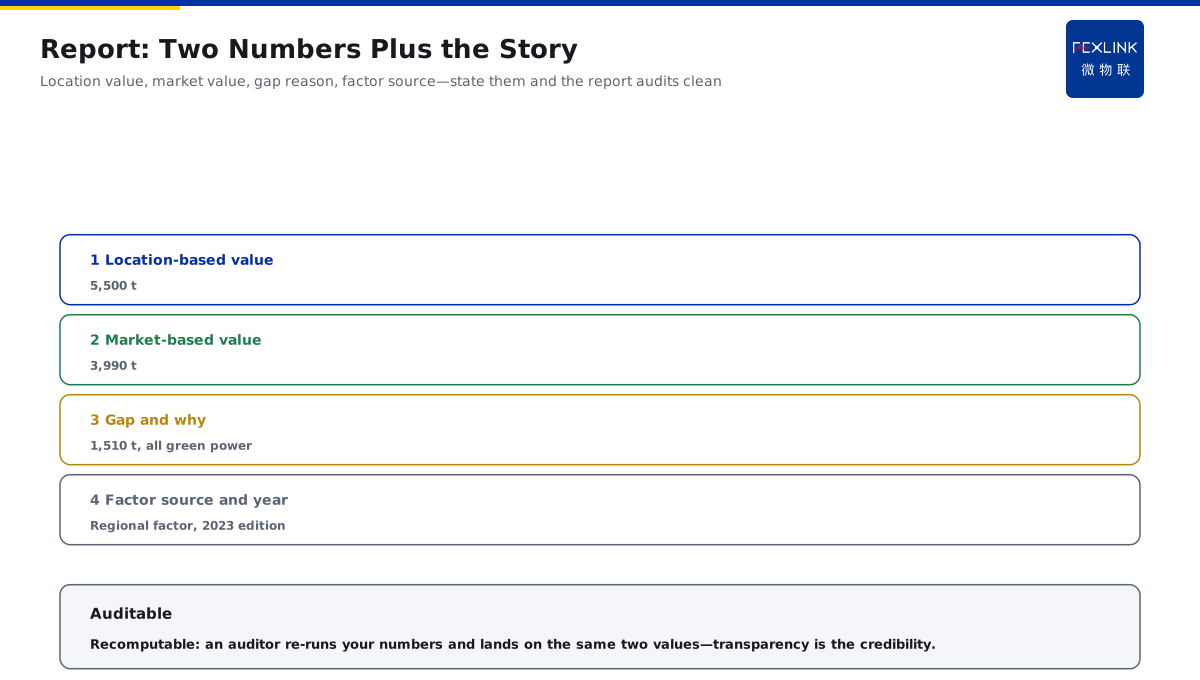
The structure of the report — the two methods of Scope 2 disclosed separately: the location-based value + the market-based value; What must be stated — the factor sources of the two methods, the green procurement and the difference with the reason; The explanation of the basis — the adopted framework (the GHG Protocol or the corresponding standard), the factor year and the green vouchers; The reviewability of the report — the data and the calculation reproducible: the auditor recalculates by the disclosed data and gets the same two numbers.
In one sentence: the report needs "two numbers + the explanation" — the location-based value, the market-based value, the reason of the difference and the factor source — written clearly, the Scope 2 report is reviewable.
The structure template of the Scope 2 report — 1. the boundary and the framework (the GHG Protocol/corresponding standard); 2. the location-based (the consumption, the regional factor, the result and the factor source); 3. the market-based (the purchasing split, the factors, the result and the green vouchers); 4. the difference explanation (the amount, the attribution and the green volume); 5. the reproducibility note (the original data kept) — the five sections, a complete report.
An example: A company's Scope 2 template: the location-based (the regional factor 0.55, 5,500 tonnes) + the market-based (the green 3,000,000 kWh zero-carbon, 3,990 tonnes) + the difference note (1,510 tonnes all from the green) — the auditor recalculates by the disclosed data and agrees — the report passes. The logic is that the difficulty of the Scope 2 report is not the calculation but the explanation — the two numbers, the difference, the reason and the basis, all written — the credibility comes from the transparency, not the beauty of the number.
Back to the smart energy-carbon IoT platform and the Tianyan Engine E-09 — the automatic accounting of the two Scope 2 methods: the platform calculates the location-based and the market-based in parallel, marks the green power and the certificates automatically as zero-carbon, attributes the difference automatically and generates the report with the two numbers disclosed side by side under the GHG Protocol — the parallel no longer needs the manual sorting — the Scope 2 report is automatically compliant.**
Scope and Limitations
- The conclusions in this article are intended for LV distribution and electrical-safety sites. Standard numbers (GB/T 32150) refer to their currently effective editions, and product parameters follow the latest FEXLINK selection handbook and product knowledge base.
- Quantitative criteria (protection zone, discharge and residual voltage, earth resistance, thresholds and grading) hold under the preconditions stated in this article. Where the site voltage level, earthing arrangement, environmental category or load profile differs, the figures must be recalculated. Specific configurations involving Tianyan engine E-09 (carbon accounting) should be verified against actual circuit parameters.
- Specific product models and parameters are subject to the latest selection handbook and product knowledge base; this article does not constitute selection or procurement advice.
- Standard numbers cited here refer to the currently effective editions; when a standard is revised, the related quantitative conclusions must be re-checked.
- Deployment and implementation for specific projects must be carried out by qualified engineers based on site survey and design drawings.
Frequently Asked Questions
How to Calculate Scope 2 Emissions—Location-Based or Market-Based Method?
Scope 2 is the indirect emission of the purchased electricity and heat — two methods: the location-based method calculates by the average emission factor of the regional grid where the enterprise sits