 FEXLINK Research Institute
Direct Answer
How to calculate saved energy beyond dispute? According to GB/T 13234, the Methods of Calculating Enterprise Energy Savings — the saved energy = the baseline energy before the retrofit − the adjusted energy after the retrofit — the key is "an evidence-based baseline, an adjustment for the changed working conditions and traceable data" — the baseline period must be representative, the changes (output/climate/shifts) must be adjusted and the measured data must be verifiable — only the saved energy calculated by the standard method survives the review of the declaration and the EMC settlement.
A scenario: A company reports its saved energy by its own algorithm in an EMC project — the owner does not accept it and the authority questions it — the problem: the baseline is decided on a whim, the working conditions are not adjusted and the data is not traceable. The logic is that the premise of an undisputed saved energy is "calculating by the standard" — GB/T 13234 gives the method framework: an evidence-based baseline, an adjustment for the changes and traceable data — with the three, the algorithm has credibility.
1. The Basic Formula Required by the Standard
The basic formula of the standard — the saved energy = the baseline-period energy − the adjusted energy of the reporting period: the before-and-after comparison logic; The baseline-period energy — the actual energy of a period before the retrofit (usually 12 months): the basis of "what level it was before"; The reporting-period energy — the actual energy of a period after the retrofit (usually 12 months): the fact of "what level it is after"; The necessity of the adjustment — the changes of output, climate and shifts directly affect the energy: without an adjustment, the comparison is unfair.
In one sentence: the formula has only three elements — the baseline-period energy, the reporting-period energy and the adjustment — but every element has a standard requirement — it cannot be taken as one likes.
The table of the formula elements:
| Element | Definition | Data source |
|---|---|---|
| Baseline-period energy | Actual energy of the 12 months before | Meter records |
| Reporting-period energy | Actual energy of the 12 months after | Meter records |
| Adjustment | Impact of output/climate/structure | Output ledger/weather |
| Saved energy | Baseline − adjusted reporting energy | Calculated by the standard |
The time basis of the calculation — the baseline and the reporting periods should both be 12 months (covering the full production cycle): cross-season comparison must be explained; special projects (retrofitted less than a year) follow the permitted handling of the standard — with a compliant time basis, the comparison is fair. An example: A company uses 10,000,000 kWh in the 12 months before and 8,200,000 in the 12 months after — the saved energy = 1000 − 820 = 1,800,000 kWh — it looks simple — but if the output dropped 20% after the retrofit, without adjusting the output factor, the 1.8 million mixes in "the electricity saved by the reduced production". The logic is that the saved energy is not a simple subtraction — when the output changes, the energy should be adjusted by the output — without the adjustment, the saved energy is an "estimate", not a "calculated number".
2. The Establishment and Choice of the Baseline
The choice of the baseline period — a representative period before the retrofit (usually 12 months): covering the full production cycle including the seasons; The basis of the baseline — the baseline-period energy + the corresponding output + the working conditions: the baseline = the SEC × the reporting-period output + the fixed-item adjustment; The requirements of the baseline data — complete and traceable metering: the meter records, the output ledger and the condition records; The role of the baseline — "how much it would consume without the retrofit" — comparing with the reporting-period actual, the difference is the saved energy.
In one sentence: the baseline answers "what would happen without the retrofit" — the baseline SEC × the reporting-period output gives "the energy if not retrofitted" — comparing with the reporting-period actual, the difference is the true saved energy.
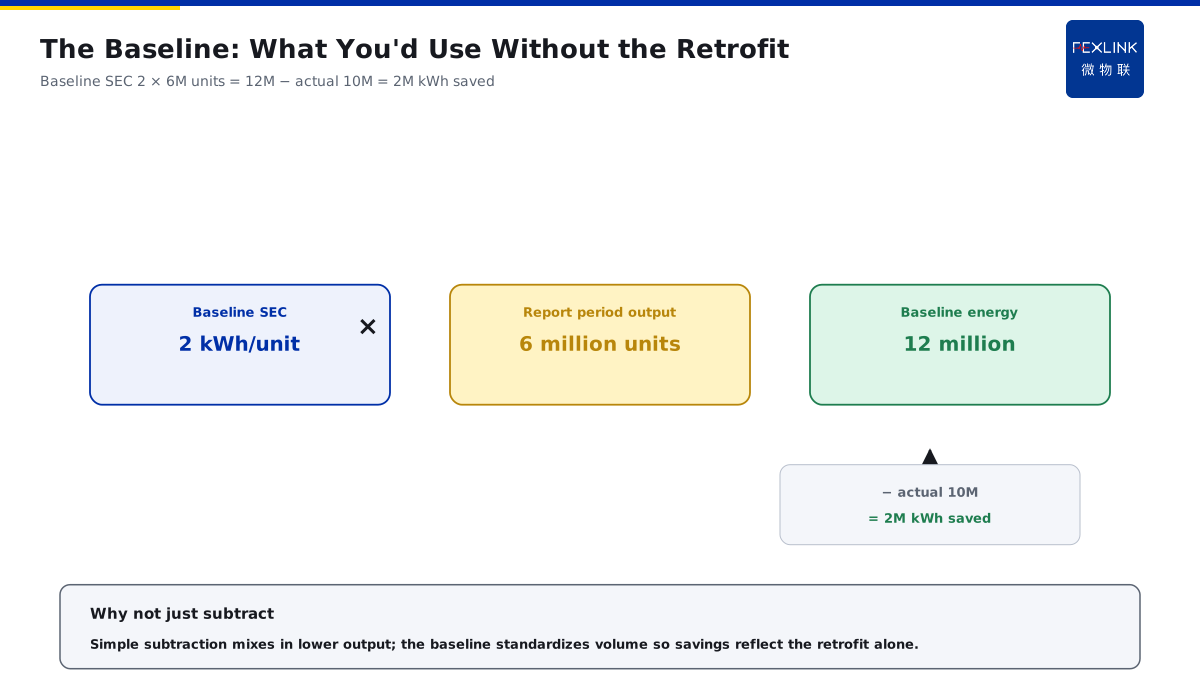
The check list of the baseline choice — does the baseline period cover the full production cycle (including the seasons)? Are the baseline data complete and traceable (no gap in 12 months)? Does the baseline SEC match the reporting-period basis (the boundary and output basis of KD-0395)? Is the baseline calculation reproducible (the data and the method public)? — the four checks, the baseline stands. An example: A company's baseline period: 10,000,000 kWh and 5,000,000 pieces — the baseline SEC = 2 kWh/piece — after the retrofit the output is 6,000,000 — the baseline energy = 2 × 6,000,000 = 12,000,000 kWh — the reporting-period actual is 10,000,000 — the saved energy = 12 − 10 = 2,000,000 kWh — more than the simple subtraction (1000−820) is the part the output growth should add. The logic is that the baseline peels the "output change" out of the saved energy — SEC × the reporting-period output standardizes the output factor — the calculated saving neither contains "the electricity saved by the reduced production" nor misses "the electricity consumed by the increased production".
3. The Adjustment Requirements for the Changed Working Conditions
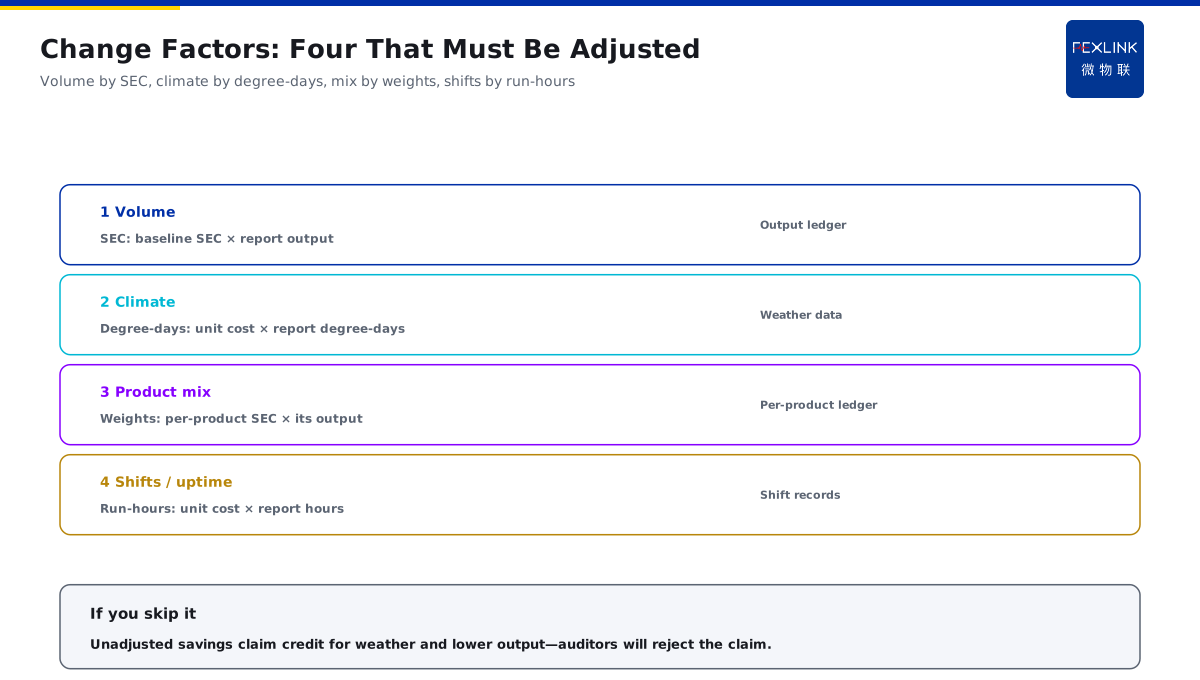
The variables that must be adjusted — output, product structure, climate (heating/cooling), shifts and the utilization rate: the variables directly affecting the energy; The methods of the adjustment — the output uses the SEC method (the baseline SEC × the reporting-period output); the climate uses the degree-day method; the structure uses the weight method; The consequence of no adjustment — the saving mixes in the impact of the working conditions: the owner does not accept it and the review fails; The record of the adjustment — the adjustment basis is written into a document: the method, the data and the reason — verifiable.
In one sentence: the adjustment is the "fairness device" of the saved-energy calculation — output changes adjust the output, climate changes adjust the climate and structure changes adjust the structure — the adjustment has a method, a record and verifiability.
The comparison table of the adjustment variables and methods:
| Variable | Method | Data source |
|---|---|---|
| Output | SEC method (baseline SEC × reporting output) | Output ledger |
| Climate | Degree-day method (energy per degree-day × reporting degree-days) | Weather data |
| Product structure | Weight method (each product's baseline SEC × its output) | Product ledger |
| Shifts/utilization | Runtime adjustment (energy per hour × reporting hours) | Shift records |
The documentation of the adjustment — the adjusted-variable list, the method choice, the used data and the calculation process are all written into the adjustment note — "why adjusted this way" must have a basis in the review. An example: A company meets a warm winter after the retrofit: the heating energy is lower than the normal year — without the climate adjustment, the saving is inflated — adjust by the degree days: the baseline degree-days × the energy per degree-day standardizes the climate impact — after the adjustment, the saving returns to the true level. The logic is that the climate is an "uncontrollable variable" — the electricity saved by the warm winter is not the credit of the retrofit — adjusting by the degree days peels the climate factor out — the saving is then all "the credit of the retrofit".
4. The Data Requirements of Measurement and Verification (M&V)
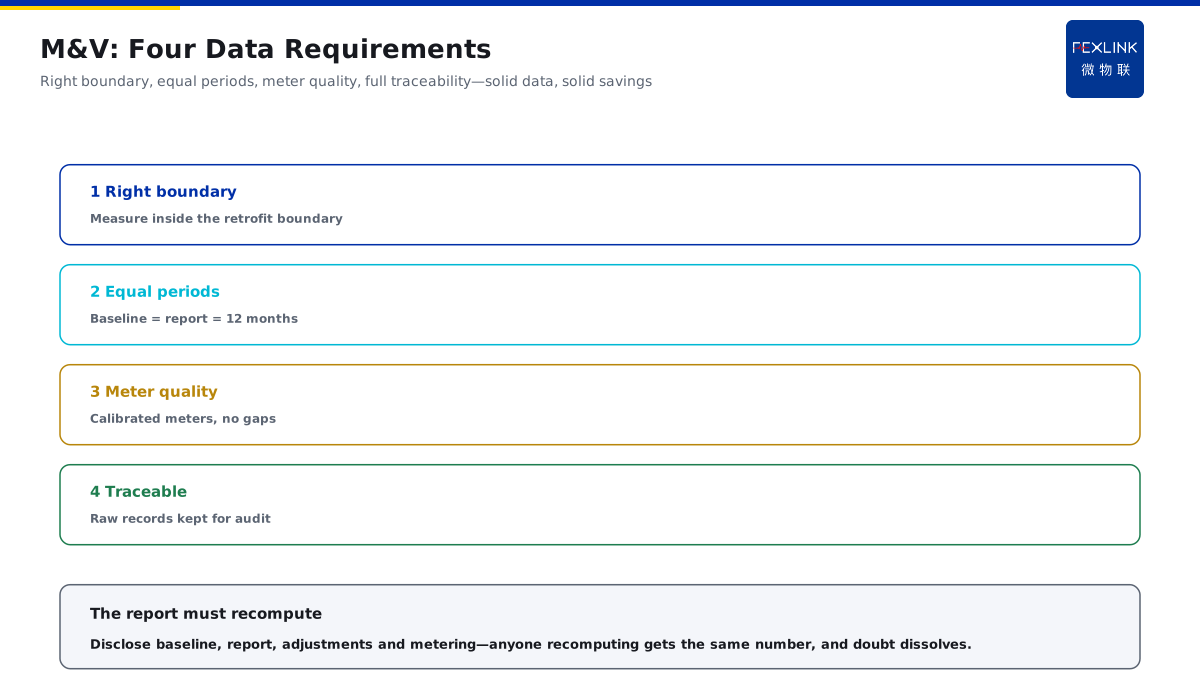
The position of the measurement — measured at the boundary of the retrofit: only the energy inside the boundary, no boundary-out mixing; The period of the measurement — the baseline and the reporting periods are equal (12 months each): only then the comparison is meaningful; The quality of the data — the meters are verified and the data is continuous and complete: the missing data is explained and corrected; The traceability of the data — the original records are kept: the meter readings, the transcription records and the output ledger — checkable in the review.
In one sentence: the four requirements of the M&V data — measure the right position (inside the boundary), measure the full period (equal 12 months), data quality (verified meters, continuous and complete) and data traceability (original records kept) — when the data stands, the saving stands.
The measurement plan of M&V — the boundary diagram: marking the retrofit boundary and the measurement points; the instruments: verified and with the required accuracy; the data recording: the transcription frequency, the storage and the exception handling — fix the plan first, then the data is compliant.
The correction of the data quality — missing metering: explain the missing period and correct by the required method; abnormal metering: keep the original record and mark the cause; meter replacement: explain the connection before and after — the correction has a basis and the data survives the check. An example: A company's saving declaration is questioned: it declared with only 6 months of post-retrofit data — the standard requires the reporting period to equal the baseline — after completing the 12-month data, the saving is recalculated and the declaration passes. The logic is that an incomplete data period means an incomplete saving — 12 months for the baseline and 12 months for the reporting, an equal comparison — the data period is a hard requirement of the compliance, not a detail to be discounted.
5. What the Saved-Energy Report Should Disclose
The structure of the report — the project overview, the boundary description, the baseline data, the reporting data, the adjustment method and the saving result; What must be disclosed — the output, the energy and the working-condition data of the baseline and the reporting periods; the adjusted variables, the method and the data; the metering and measurement plan; The reproducibility of the report — anyone with the disclosed data recalculates the same saving by the standard method; The archiving of the report — the report + the original data + the adjustment basis are archived together for the review: the evidence is available when checked.
In one sentence: the report must be "reproducible" — disclose the baseline and reporting data, the adjustment method and data and the metering plan — others recalculate by the standard method and get the same number — only then the report has credibility.
An example: In an EMC settlement, the report discloses the 12-month baseline data, the 12-month reporting data, the output adjustment method (SEC) and the adjustment data — the owner rechecks: recalculating by the disclosed data gives the same saving — the settlement passes smoothly. The logic is that reproducibility is the gold standard of the report — sufficient disclosure, standard method and checkable data — when others calculate the same number, the doubt naturally disappears.
Back to the energy-carbon autonomy system 4×3×2 — the digital tools of the saved-energy accounting: the platform automatically collects the energy inside the boundary, the output and the working-condition data monthly, automatically generates the baseline and the adjustment by GB/T 13234 and the report is automatically generated and reproducible — the data of the baseline, the adjustment and the reporting are all kept in the system — the saved energy changes from "calculated" to "reviewable".**
Scope and Limitations
- The conclusions in this article are intended for LV distribution and electrical-safety sites. Standard numbers (GB/T 13234) refer to their currently effective editions, and product parameters follow the latest FEXLINK selection handbook and product knowledge base.
- Quantitative criteria (protection zone, discharge and residual voltage, earth resistance, thresholds and grading) hold under the preconditions stated in this article. Where the site voltage level, earthing arrangement, environmental category or load profile differs, the figures must be recalculated.
- Specific product models and parameters are subject to the latest selection handbook and product knowledge base; this article does not constitute selection or procurement advice.
- Standard numbers cited here refer to the currently effective editions; when a standard is revised, the related quantitative conclusions must be re-checked.
- Deployment and implementation for specific projects must be carried out by qualified engineers based on site survey and design drawings.
Frequently Asked Questions
How to Calculate Saved Energy Beyond Dispute
According to GB/T 13234