 FEXLINK Research Institute
Direct Answer
How to calculate the unit product energy consumption (SEC) fairly? SEC = the energy consumption of a system ÷ the corresponding output — the premise of a fair comparison is that "the energy boundary matches the output boundary" — do not allocate all the utility power to one product — the output basis must be unified (qualified output or total output, how the work-in-progress is counted) — an SEC with an unclear boundary has no comparability — align the numerator and the denominator with the boundary first, then talk about the assessment and the improvement.
A scenario: Two workshops each calculate their own SEC — one uses the total output, the other the qualified output; one allocates all the shared compressor power in, the other only its own meter — the numbers speak differently and cannot be assessed. The logic is that the fairness of SEC is not in the formula but in the basis — when the boundaries of the numerator and the denominator are consistent, the SEC is comparable — with an inconsistent basis, the calculated numbers are only self-claims.
1. The Definition and Calculation of SEC
The definition of SEC — the unit product energy consumption: the electricity consumed to produce one unit of qualified product — the benchmark indicator of energy efficiency; The formula of SEC — SEC = the electricity of a system (workshop/process/product) ÷ the corresponding output — the numerator and the denominator must correspond one to one; The basis of SEC — GB/T 2589, the General Rules for Calculation of Comprehensive Energy Consumption: defining the boundary and the scope of the calculation; The use of SEC — workshop assessment, benchmarking and the energy audit: comparable only under the same basis.
In one sentence: SEC is "electricity ÷ output" — the numerator is the electricity and the denominator is the output — everyone writes the formula, the key is aligning the boundaries of the numerator and the denominator.
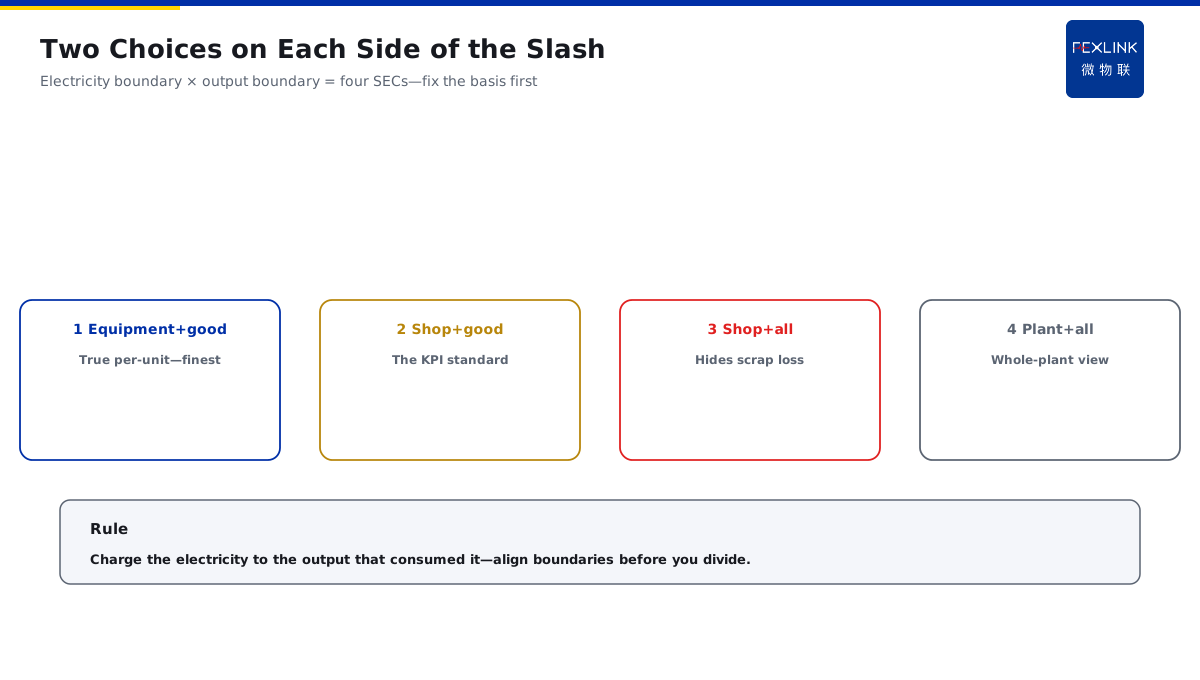
The comparison table of the four SEC bases:
| Combination | Energy boundary | Output basis | Meaning of SEC |
|---|---|---|---|
| Equipment + qualified | One device | Its qualified output | Real unit consumption of the device |
| Workshop + qualified | Direct load of the workshop | Qualified output | For the workshop assessment |
| Workshop + total | Direct load | Including rejects | Hides the reject loss |
| Plant + all | All the plant load | All products | Overall reference |
The calculation steps of SEC — step one: fix the energy boundary, clarify which loads are counted; step two: fix the output basis, clarify which outputs are counted; step three: allocate the utility energy to the products by the rule; step four: divide the corresponding numerator by the denominator — four steps, one consistent basis. An example: A workshop uses 1,000,000 kWh per month and produces 100,000 pieces — SEC = 100 ÷ 10 = 10 kWh/piece — it looks simple — the question is: are the 1,000,000 kWh all the loads of the workshop or only the production line? Are the 100,000 pieces the qualified output or the total?**
2. The Energy Boundary Must Match the Output Boundary
The types of the energy boundary — the single-device boundary (only this device), the workshop boundary (all the direct loads) and the system boundary (the whole production system); The types of the output basis — the qualified output, the total output (including rejects), the warehoused output and the fed-in output; The matching principle — the electricity for producing product A corresponds to the output of product A: whichever device produces, count its electricity; The consequence of mismatching — counting the electricity of line A into product B: the SEC is distorted and the assessment fails.
In one sentence: the matching principle — "whoever consumes the electricity, count the output of whom" — the loads of the energy boundary correspond to the output of the output boundary — without alignment, the SEC is a wrong account.
The steps to fix the energy boundary — step one: draw the equipment list and mark which system each device belongs to (line/public); step two: attribute the electricity to the devices and the systems by the sub-metering; step three: fix the boundary scope (device/workshop/system) and write it into the accounting rule; step four: update the rule synchronously when the boundary changes (new line added) — four steps, the boundary is fixed.
The common boundary errors — counting the public load into a production line (the direct-load boundary is polluted); attributing the electricity of line A to line B (wrong attribution); missing the auxiliary equipment (incomplete boundary); different boundaries between months (basis drift) — the four errors distort the whole SEC. An example: A workshop has two lines — line A uses 600,000 kWh and line B 400,000 kWh per month — if B's electricity is wrongly attributed to A — A's SEC rises by 40% — assessing A as "inefficient" when the account is wrong.**
3. The Output Basis: Qualified Output, Work-in-Progress and Joint-Product Allocation
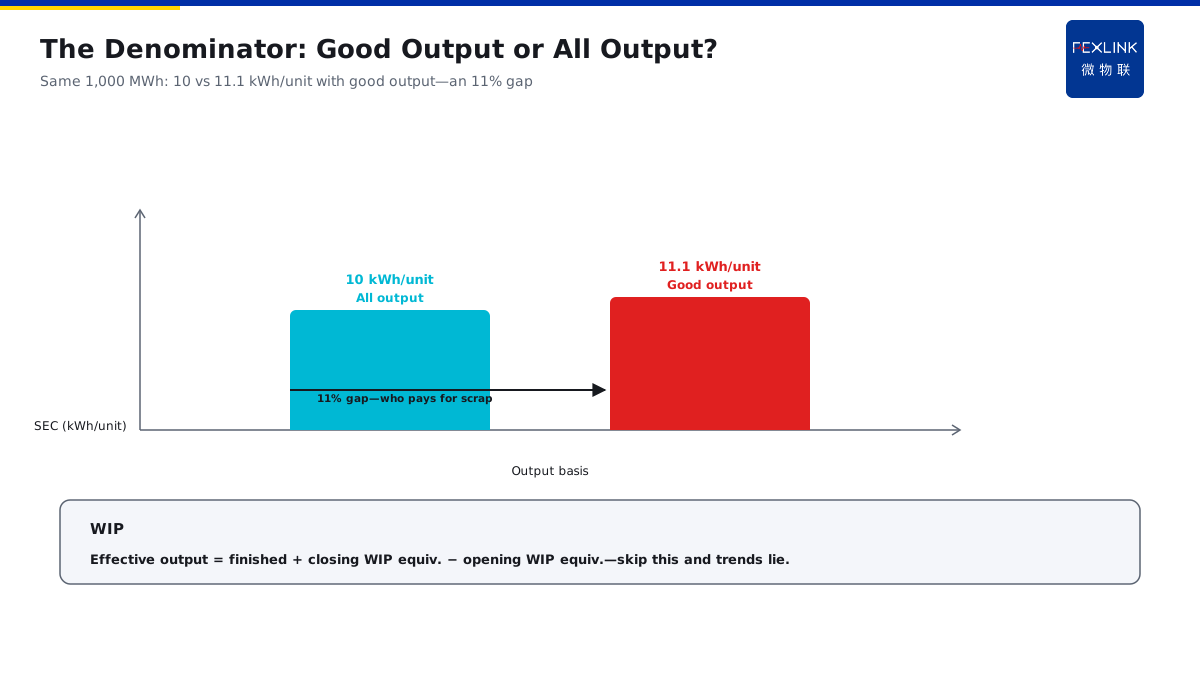
Qualified vs total output — the rejects also consume electricity: with the total output, the SEC is low (hiding the reject loss); with the qualified output, the SEC reflects the real effective output; How the work-in-progress is counted — the opening WIP and the closing WIP: with an inconsistent cross-period basis, the SEC is distorted; The joint-product allocation — one process outputs multiple products: by which weight is the electricity allocated to each product; The allocation weights — by output, by value or by man-hour: a wrong weight makes all the product SECs wrong.
In one sentence: the output basis has three gates — the qualified output (rejects also consume), the work-in-progress (calibrated across periods) and the joint products (allocated by the weight) — after the three gates, the denominator is accurate.
The calibration formula of the work-in-progress — the current effective output = the finished output + the closing WIP equivalent − the opening WIP equivalent — the WIP is converted into the "equivalent output" by the completion degree — without calibration, the monthly SEC fluctuates and no trend can be analyzed.
The comparison table of the allocation weights:
| Weight | By output | By value | By man-hour |
|---|---|---|---|
| Suitable | Similar product forms | Large value difference | Complex processes |
| Advantage | Simple and intuitive | Reflects the value contribution | Reflects the time occupation |
| Risk | Value difference hidden | High-value products bear more | Needs accurate man-hour statistics |
The principle of choosing the weight — look at the product difference first: similar forms use the output, large value difference uses the value and complex processes use the man-hour — when the weight matches the product feature, the allocation is reasonable. An example: A workshop has 100,000 pieces in total and 10,000 rejects — with the total output, SEC = 10 kWh/piece — with the qualified output, SEC = 11.1 kWh/piece — an 11% difference — assessing the efficiency must use the qualified output (the real effective output), otherwise the reject loss is hidden.**
4. How to Allocate the Utility Energy Reasonably
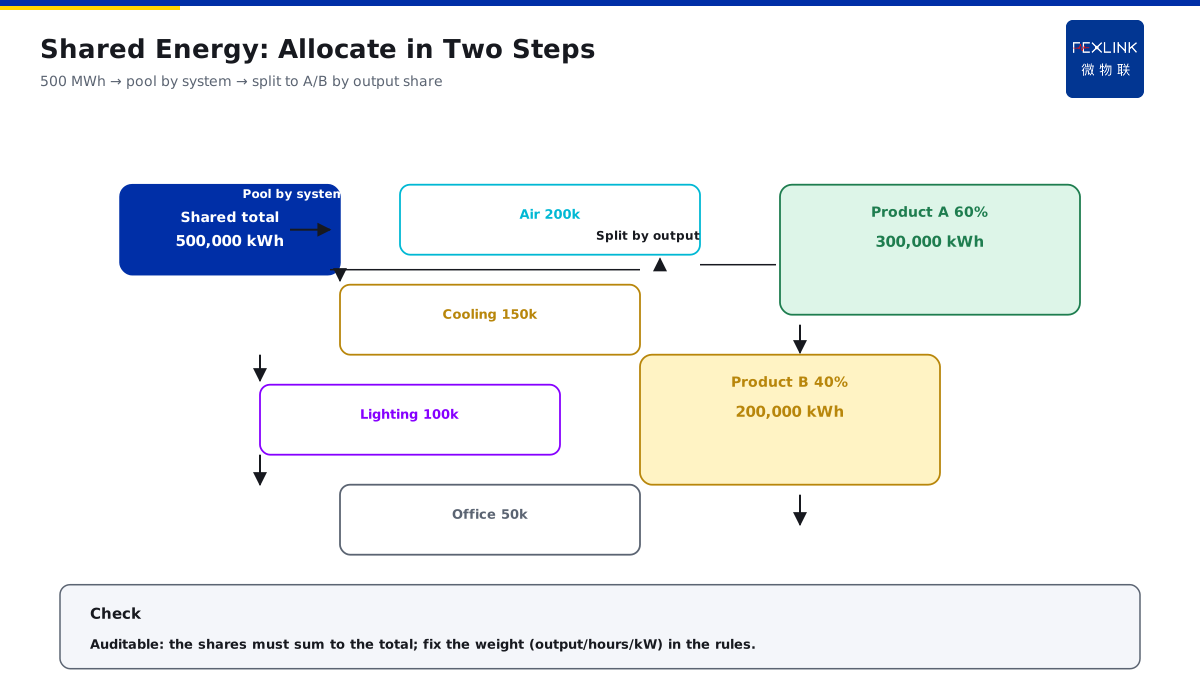
The types of the utility energy — compressed air, cooling, lighting and office: not directly belonging to one product, but used by every product; The wrong allocation — allocating all of it to one product: that product's SEC is inflated and the others' are low; The reasonable allocation — by output (the larger output bears more), by man-hour (the longer process bears more) and by power (the higher consumption bears more); The allocation principle — first by system (the compressor system, the lighting system), then by weight (output/man-hour/power) — two-step allocation, the responsibility reaches the product.
In one sentence: the utility energy is allocated in two steps — first by system (compressor to compressor, lighting to lighting), then by weight to the products (output/man-hour/power) — do not throw everything to one product.
An allocation example — a plant's public system uses 500,000 kWh per month: first by system (compressor 200,000, cooling 150,000, lighting 100,000, office 50,000) — then by output to products A/B (A 60%, B 40%) — A bears 300,000 and B 200,000 — each product then adds its own direct electricity to get the complete boundary — two-step allocation, clear responsibility.
The check list of the allocation — is it first collected by system (not mixed together)? Is the allocation weight written (output/man-hour/power)? Does the weight match the product feature? Is the result verifiable (the sum of the product allocations equals the public total)? — the four checks, no omission. An example: The compressor system of a park uses 200,000 kWh per month — if all of it is allocated to product A — A's SEC is inflated and B's is low — if allocated by output (A 60%, B 40%) — A bears 120,000 and B 80,000 — both SECs are close to the truth.**
5. The Premises of Cross-Workshop SEC Comparability
Premise one: unified basis — all the workshops use the same output basis (qualified) and the same energy boundary (direct load); Premise two: consistent boundary — the allocation rule of the utility energy is consistent: if one uses the output allocation, all use it; Premise three: excluded differences — the automation degree and the shift structure differ: explain the background difference when comparing; The value of comparability — under the same basis, the SEC difference is the real efficiency difference: the method of the low-SEC workshop can be copied.
In one sentence: the three premises of cross-workshop comparability — the unified basis, the consistent allocation rule and the explained differences — with the three premises, the SEC difference is the efficiency difference.
The check table of the comparability premises:
| Premise | Check | Consequence if unmet |
|---|---|---|
| Unified output basis | Qualified or total for all | SEC inflated or low |
| Consistent energy boundary | Direct load or with utilities | Not comparable |
| Consistent allocation rule | Same output weight | Misplaced responsibility |
| Explained background | Shifts/automation stated | Misread difference |
The application scenarios of comparability — the monthly trend of the same workshop (the same basis shows the improvement), the cross-workshop comparison of the same product (finding the efficiency gap) and the industry benchmarking (looking at the overall level) — with the consistent premises, SEC has decision value. An example: Two workshops make the same product — workshop A has 9 kWh/piece and B 12 kWh/piece — under the same basis, an 33% gap — B investigates: high air leakage and damper-regulated motors — after copying A's method, B drops to 9.5.**
Back to the digital electrical intelligent supervision system — the digital tools of SEC accounting: the sub-metering separates the energy boundary by device/workshop/system, the output data is entered monthly with the WIP calibration and the platform automatically calculates the SEC of each workshop by the unified basis and benchmarks it automatically — when the basis rule is fixed in the system, nobody counts in his own way — SEC changes from "each speaks his own words" to "the same ruler".**
Scope and Limitations
- The conclusions in this article are intended for LV distribution and electrical-safety sites. Standard numbers (GB/T 2589、GB/T 3484) refer to their currently effective editions, and product parameters follow the latest FEXLINK selection handbook and product knowledge base.
- Quantitative criteria (protection zone, discharge and residual voltage, earth resistance, thresholds and grading) hold under the preconditions stated in this article. Where the site voltage level, earthing arrangement, environmental category or load profile differs, the figures must be recalculated.
- Specific product models and parameters are subject to the latest selection handbook and product knowledge base; this article does not constitute selection or procurement advice.
- Standard numbers cited here refer to the currently effective editions; when a standard is revised, the related quantitative conclusions must be re-checked.
- Deployment and implementation for specific projects must be carried out by qualified engineers based on site survey and design drawings.
Frequently Asked Questions
How to Calculate Unit Product Energy Consumption (SEC)
SEC = the energy consumption of a system ÷ the corresponding output — the premise of a fair comparison is that "the energy boundary matches the output