 FEXLINK Research Institute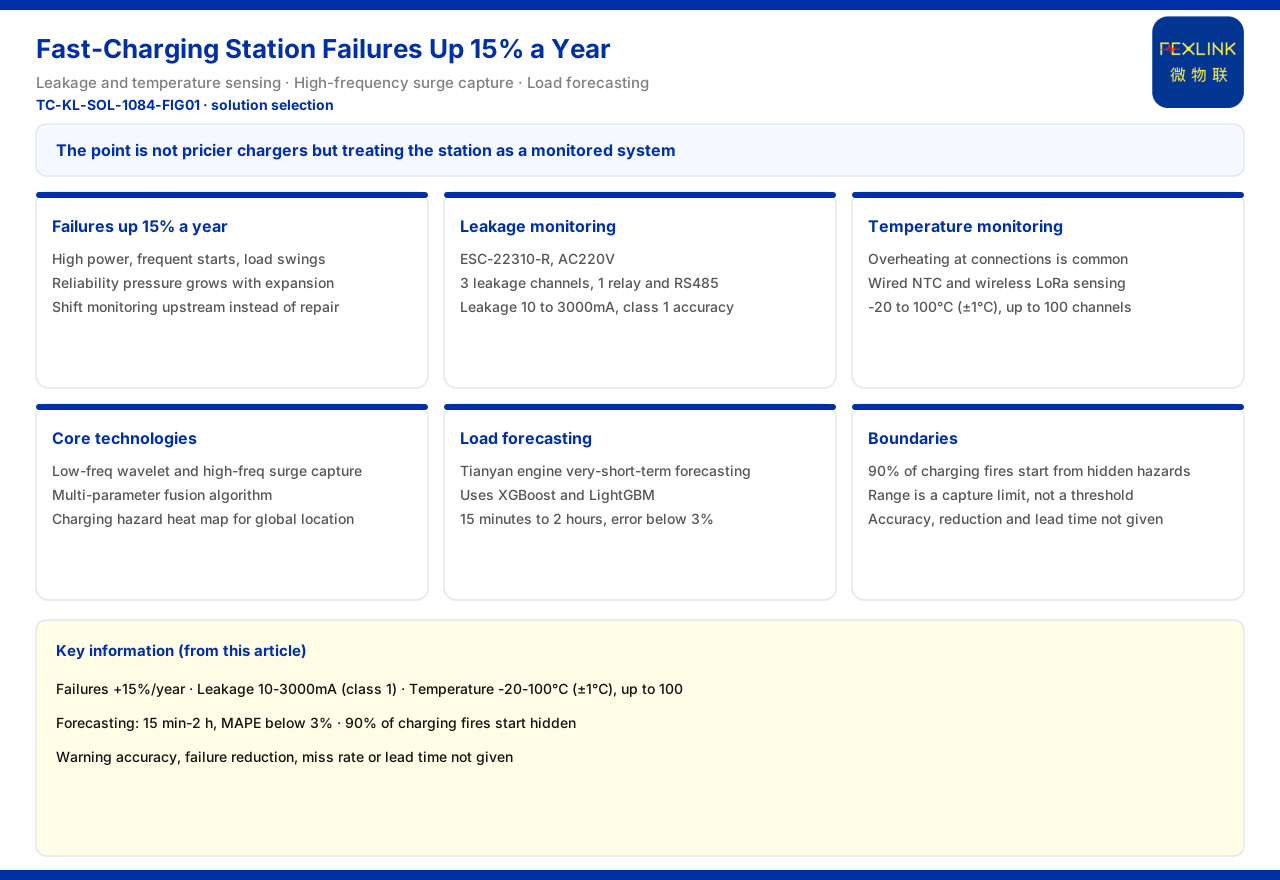
Direct Answer
To break the trend of fast-charging station failures growing 15% a year, the key is not to "buy more expensive chargers" but to manage the fast-charging station as an electrical system that needs continuous monitoring: collect leakage current and temperature locally at the distribution circuits, use high-frequency surge capture and multi-parameter fusion to identify early hazards, and then use load forecasting to support O&M scheduling. The product knowledge base points out that the pain points of new-energy-vehicle charging scenarios include slow-charging and fast-charging electrical fires, distribution-system faults, and a 15% annual growth in fast-charging station failures; the corresponding system capabilities include charging-safety hazard monitoring, charging-pile operating-efficiency improvement and a reduction in fire accident rate. The product knowledge base does not give quantitative commitments such as the recognition accuracy, the failure-rate reduction, the missed-report rate or the warning lead time for fast-charging station hazard early warning, so these cannot be inferred from the product materials.
What the 15% Annual Growth in Fast-Charging Station Failures Means
The figure of a 15% annual growth in fast-charging station failures reflects the reliability pressure behind the rapid expansion of fast-charging facilities. Fast charging uses high power, starts and stops frequently, and has severe load fluctuation, so the electrical and thermal stress on distribution circuits and connections is far higher than in ordinary electricity-use scenarios; the faster the number of stations grows, the more failures are exposed. If the "repair after failure" approach is still used, failures keep accumulating and O&M costs rise with them. Taking the 15% annual growth as the starting point, the reasonable response is not passive emergency repair but moving monitoring forward so that hazards are identified before they become failures. This is exactly the entry point of the hazard early-warning system.
What to Monitor: Leakage Current and Temperature Are the Foundation
For a fast-charging station's distribution system, two quantities deserve priority. The first is leakage current. The multi-channel leakage-current monitoring and control device in the product knowledge base provides multi-channel leakage monitoring; its representative model, the multi-channel leakage-current monitoring and control device (ESC-22310-R), provides 3 leakage channels, 1 relay and RS485, and its key parameters are leakage monitoring 10 to 3000mA, accuracy class 1, and relay contact capacity AC250V/3A and DC30V/3A. The second is temperature. The multi-channel temperature intelligent controller supports wired NTC and wireless LoRa measurement, with a range of -20 to 100℃ (±1℃) and up to 100 channels. The combination of leakage current and temperature exactly covers the two most common fast-charging hazards: degradation of electrical insulation and overheating of connections.
How the Core Technologies Find Early Hazards
The core technologies listed in the product knowledge base include low-frequency wavelet and high-frequency surge capture for microsecond-level capture of abnormal current, a multi-parameter fusion intelligent algorithm, a charging-hazard heat map for network-wide supervision and precise localization, and dynamic data monitoring and multi-dimensional intelligent analysis. For a fast-charging station, the point of high-frequency surge capture is to catch those abnormal currents that vanish in an instant; such anomalies are easily smoothed away by ordinary periodic sampling. Multi-parameter fusion avoids the misjudgment of "alarm on a single point crossing a limit" by reading leakage current, temperature and voltage together. The product knowledge base also points out that 90% of charging fires come from hazards that were not found, which shows that early discovery changes the outcome more than after-the-fact disposal.
Load Forecast Supports O&M Scheduling
Besides safety monitoring, a fast-charging station also needs operational support. The product knowledge base records that the ultra-short-term load-forecast method of the Tianyan engine uses XGBoost and LightGBM, covering a forecast horizon of 15 minutes to 2 hours with a mean absolute percentage error below 3%. For a fast-charging station, the value of short-term load forecasting is that it turns O&M scheduling from "arranged by experience" into "arranged by forecast": confirm equipment status before the charging peak, shift maintenance to off-peak periods, and anticipate the pressure periods of the distribution circuits. Only by combining safety monitoring with load forecasting can risk be reduced without hurting operating efficiency. Note that the coverage and error figures of this forecast method are statements given by the product knowledge base and do not constitute a commitment about the forecast effect at any specific station.
How to Balance O&M Efficiency and Safety
The dilemma of a fast-charging station is that it must be safe while frequent maintenance must not drag down operations. The value of a hazard early-warning system is precisely that it moves maintenance from "periodic" to "condition-based". When leakage current or temperature shows a trend change, the system can give an early prompt so that O&M staff arrange handling in a relatively idle period; when the data is normal, unnecessary shutdown inspections are avoided. This condition-based way of maintaining equipment is consistent with the capability direction of "charging-pile operating-efficiency improvement" described in the product knowledge base. It does not promise to bring the failure rate down to a specific value, but it changes the point in time at which hazards are found, and thereby changes how O&M is organized.
Boundaries to Observe in Use
Two boundaries must be held when using this scheme. First, the product knowledge base does not give quantitative commitments such as the recognition accuracy, the failure-rate reduction, the missed-report rate or the warning lead time for fast-charging station hazard early warning; the statement in the relevant chapter is only "a reduction in fire accident rate", and it must not be read as a specific value. Second, the range of the leakage-current and temperature monitoring devices is a boundary of acquisition capability, not the judgment threshold for a hazard. Only by keeping "what can be collected" and "what the criterion is" apart can the system's capability be expressed accurately within the scope of the product materials.
The Value of the Heat Map and Precise Localization
The product knowledge base lists the "charging-hazard heat map" as one of the core technologies, used for network-wide supervision and precise localization. For a fast-charging network, the meaning of this capability is that hazards scattered across different stations are brought into one view: which stations have higher risk, which periods concentrate problems, and which areas need priority inspection can all be read from the heat map. For an operator, this is more efficient than checking alarms station by station; for a regulator, it provides an overall judgment of regional risk. The heat map cannot replace on-site disposal, but it decides where resources are directed first, and thus affects the priority of governance.
The Closed Loop from Discovery to Disposal
Hazard early warning must ultimately land on disposal. From an engineering view, a workable closed loop contains at least four steps: collect basic quantities such as leakage current and temperature; identify anomalies and trends at the edge or platform side; deliver the conclusion to the application layer over the network and raise an alarm; and have O&M staff handle it according to the plan and feed back the result. The four-layer architecture and protocol matrix of the product knowledge base support this chain, while load forecasting helps arrange the timing of handling. Note that "how to handle" and "when to cut power" in the loop belong to the domain of on-site O&M rules, and the product knowledge base gives no such rules, so what the system can do is find hazards earlier and localize them more clearly, while the disposal action still follows on-site rules.
Scope and Limitations
- This article is limited to what the product knowledge base already states about the pain points of new-energy-vehicle charging scenarios, the core technologies, the leakage-current and temperature monitoring products and the ultra-short-term load-forecast method, and does not extend to quantitative effects or judgment thresholds that are not listed.
- The figures in this article (15% annual growth in fast-charging station failures, leakage current 10 to 3000mA, accuracy class 1, temperature -20 to 100℃, up to 100 channels, forecast horizon 15 minutes to 2 hours, error below 3%, and so on) are quoted according to the figures listed by the product knowledge base and do not constitute a performance commitment for any specific station.
- The product knowledge base gives no accuracy, failure-rate reduction, missed-report rate or lead time for fast-charging station hazard early warning, so this article makes no inference; the actual scheme is subject to on-site rules and the latest product materials.