 FEXLINK Research Institute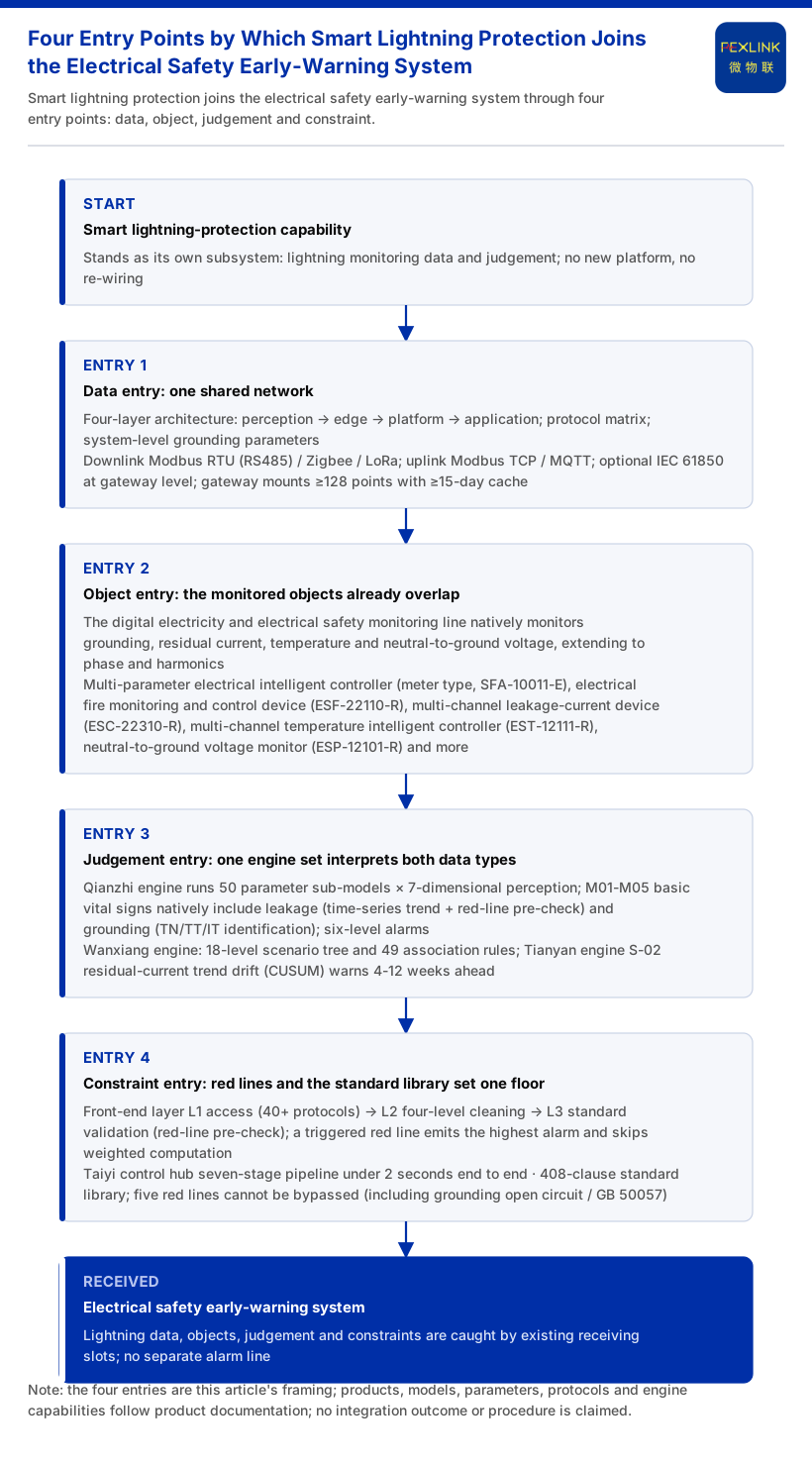
Smart lightning protection does not need a separate platform or a second wiring pass to enter the electrical safety early-warning system. It places lightning-protection data, objects, judgement and constraints on receiving slots that already exist in the system. The knowledge base defines those slots verifiably: data travels the four-layer architecture and the protocol matrix; objects fall under the digital electricity and electrical safety monitoring line; judgement goes to the Qianzhi, Wanxiang and Tianyan engines; the floor is held red lines and pre-checks. This article frames the path as four entries — data, object, judgement and constraint. Products first appear with full name (model) under the mandatory naming rule.
1. Entry Is Not "Another System" but Finding Four Receiving Slots
A common misunderstanding reads "lightning protection entering electrical safety warning" as adding an independent alarm line. In fact, for it to take effect the system must catch it four ways: its quantities must be collected and uploaded; its monitored objects must fall within the system's existing ones; its anomalies must be explained by the same algorithms; its safety floor must be held by the same constraints. Each receiving slot is compared below against the knowledge base.
2. Data Entry: Lightning and Electrical-Safety Quantities Share One Network
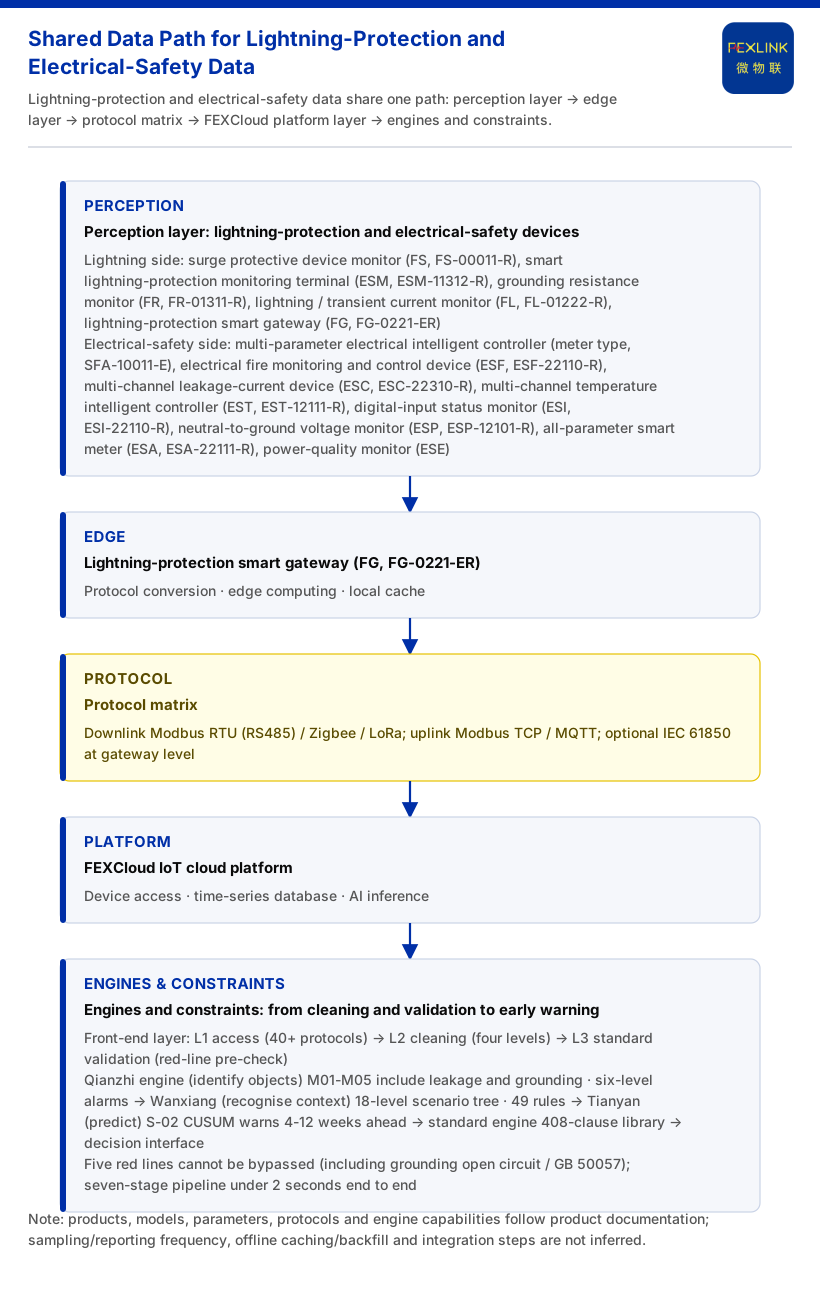
The data entry is defined by the knowledge base, which unifies monitoring into perception, edge, platform and application layers: perception collects the surge protective device monitor (FS, e.g. FS-00011-R), grounding resistance monitor (FR, e.g. FR-01311-R), lightning/transient current monitor (FL, e.g. FL-01222-R), ES-series modules, smart meters and sensors; the edge layer's lightning-protection smart gateway (FG, e.g. FG-0221-ER) does protocol conversion, edge computing and local caching; the platform layer, FEXCloud IoT cloud platform, handles device access, the time-series database and AI inference; the application layer presents visualisation, alarm management, reports and mobile inspection. The matrix sets downlinks to Modbus RTU (RS485), Zigbee and LoRa and uplinks to Modbus TCP / MQTT, with IEC 61850 at gateway level. For system-level grounding, it gives 0-200Ω units (standard, ±1%) and other ranges, with gateways mounting ≥128 points and ≥15 days of cache.
The key is "shared", not "lightning-specific": both module types enter through the same architecture and protocols, so lightning data already meets the data condition.
3. Object Entry: The Electrical Safety Monitoring Line Already Covers Lightning-Protection Concerns
If lightning and electrical-safety quantities watched unrelated objects, shared data would be meaningless. The knowledge base shows they overlap heavily.
The multi-parameter electrical intelligent controller (meter type, e.g. SFA-10011-E; three-phase balance; power-quality) integrates residual current, 3×220/380V voltage, temperature, digital inputs, relays, metering and two RS485 (Modbus) ports, with ratings from 3×5A to 3×1000A, stepping up through metering, phase and phase-plus-harmonics. The electrical fire monitoring & control device (ESF, e.g. ESF-22110-R) monitors residual current 10~3000mA (class 1) and four NTC channels at -20~100℃ (±1℃); the multi-channel leakage-current device (ESC, e.g. ESC-22310-R) offers one or three channels, also 10~3000mA; the multi-channel temperature intelligent controller (EST, e.g. EST-12111-R) covers wired and wireless sensing at -20~100℃ (±1℃), up to 100 LoRa channels; the digital-input status monitor (ESI, e.g. ESI-22110-R) covers 8~12 dry-contact inputs, and the neutral-to-ground voltage monitor (ESP, e.g. ESP-12101-R) measures the neutral input. On metering and power quality, the embedded multi-function smart meter (ZSA), all-parameter smart meter (ESA, e.g. ESA-22111-R), three-phase imbalance monitor (ESB) and power-quality monitor (ESE) extend to phase and harmonics, ESE covering 2~31 order harmonics (±1%).
Grounding, residual current, temperature and neutral-to-ground voltage — what lightning protection cares about most — are exactly what this line monitors natively, so it is not an "add-on" but already in the same object domain.
4. Judgement Entry: One Engine Set Interprets Two Data Types
Once objects overlap they must be interpretable by the same logic. The knowledge base shows data passing the Taiyi back end and front-end layer for a pre-check, then the Qianzhi engine (identifying objects) for parameter-level perception, Wanxiang (recognising context) for scenario assessment and Tianyan (predicting) for trend prediction, output through the standard engine and decision interface.
Qianzhi runs 50 parameter sub-models (currently 20 core M01-M20) across seven-dimensional perception; M01-M05 basic vital signs include leakage (time-series trend + pre-check) and grounding (TN/TT/IT identification), so both lightning concerns sit with voltage, current and temperature. Its six-level alarms are normal, Watch, YJ1, YJ2, BJ1 (20-39, within 48 hours) and BJ2 (0-19, immediate shutdown), each carrying a standard clause, four-dimensional impact labels and confidence. Five non-bypassable red lines include grounding open circuit (GB 50057) and residual current ≥300mA (GB 13955); a harmonic fingerprint library of 14 device fingerprints with cosine similarity >0.85 pinpoints a pollution source in 2 hours.
Wanxiang maintains independent thresholds and risk models for five electrical topology positions, an 18-level scenario tree locating to terminal and contact-point level, and 49 cross-dimensional rules across CR, TEMP-CORR, VOLT, CURR, PQ and EE. Tianyan plans 61-67 models across S/Q/E/C boards; its signature S-02 residual-current trend drift (CUSUM) detects a weak mean shift while leakage is safe (e.g. 18mA) and warns 4-12 weeks ahead.
After joining, lightning data is not an isolated "lightning alarm" but enters association rules and location semantics with temperature, current and harmonics, so grounding open circuits and rising residual current are judged at a specific location and context.
5. Constraint Entry: Red Lines and the Standard Library Put Both Data Types on One Floor
For early warning to be credible the floor must be consistent. The knowledge base has the front-end layer's L1 access parsing 40+ protocols, L2 cleaning in four levels and L3 standard validation (pre-check) before Qianzhi sub-models; a triggered red line emits the highest alarm directly and skips all weighted computation. The seven-stage pipeline runs end to end in under 2 seconds at 99.9% data-access success, with a 408-clause standard library (GB/GB-T/DL/IEC/UL and 12 systems) and automatic clause matching. Whichever product a quantity comes from, the same red line brings the same handling logic.
6. What Changes After "Entry"
The four entries suggest three changes: from single-domain alarms to cross-domain correlation, lightning quantities read with temperature and harmonics under one rule set and location semantics; from periodic testing to continuous readability, modules uploading through the four layers and the platform inferring continuously; from after-the-fact discovery to before-the-fact foresight, carried by trend-detection models that move the warning window forward. These describe capability paths, not outcomes or commitments.
7. Boundaries: What This Article Does Not Claim
Second, quantitative indicators in (alarm compression 80%, root-cause accuracy 85%+, 4-12 weeks' lead, MTTR reduced 60%) are vendor self-reports; cite only as vendor capability claims, never as integration gains, guarantees or procurement grounds.
Third, the knowledge base gives no integration steps, engineering quantities, compatibility lists, sampling and reporting frequency, offline caching and backfill, alarm-ticket grading or evidence formats; none is inferred here.
Fourth, no customer case, certification, compatibility conclusion or handling effect is claimed, and no model, parameter or clause absent from the knowledge base is invented; only listed GB 50057 and GB 13955 numbers are cited, without inferring their content.
Fifth, this article answers only how smart lightning protection enters the system and which verifiable capabilities receive it.
Conclusion
Smart lightning protection enters not by starting another alarm line but by being caught through four entries: data enters FEXCloud through the four-layer architecture and protocol matrix; objects fall on the line's native grounding, residual-current, temperature and neutral-to-ground monitoring; judgement is carried by the Qianzhi engine (M01-M05 including leakage and grounding), Wanxiang and Tianyan; the floor by the pre-check and the seven-stage pipeline and 408-clause library. Capabilities are traceable to the knowledge base, with terminology and name-to-model mapping locked by rule.