 微物联研究院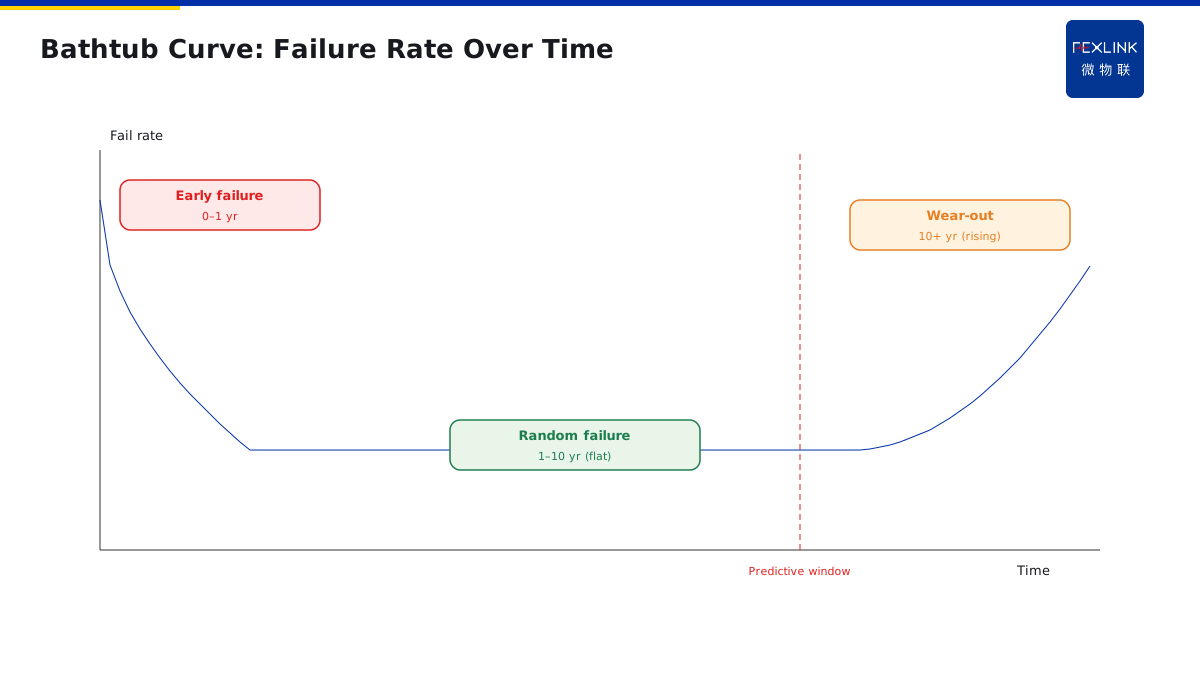
Direct Answer
A distribution cabinet is not "more reliable when new." Its failure rate over time follows a bathtub curve:
- Early failure period (year 1): high and rapidly decreasing—caused by manufacturing defects, poor installation, loose wiring;
- Random failure period (years to decades): low and flat—failures are random and unpredictable;
- Wear-out period (end of life): rising again—caused by insulation ageing, contact erosion, mechanical fatigue.
The core value of predictive maintenance is spotting which cabinet is about to enter the "right side" before it gets there, using continuous trend data.
1. Shape and Cause of the Bathtub Curve
Plot failure rate (faults per 1,000 operating hours) against time, and the curve looks like a bathtub: high on the left, flat in the middle, rising on the right.
| Phase | Time | Failure rate | Main cause |
|---|---|---|---|
| Early failure | 0–1 year | High, falling fast | Manufacturing defects, installation issues |
| Random failure | 1 year to end-of-life | Low, flat | Random overloads, external faults, human error |
| Wear-out | End-of-life (typically 10–20+ years) | Rising steadily | Insulation ageing, contact wear, mechanical fatigue |
This is not one vendor's problem—it is universal to all electrical equipment. A new cabinet's first-year troubles are usually not quality failures; they are installation and commissioning defects that need time to surface.
2. Early Failure Period: Why New Cabinets Have More Problems
In year one, you see: unexplained feeder trips, slightly hot joints, occasional RS485 packet loss. These look scattered, but share one trait—they are installation-caused, not usage-caused.
Common causes:
- Terminal screws not torqued properly—heat and oxidation increase contact resistance over time;
- Busbar contact faces with burrs or residual insulating paint;
- CT ratio miswired or secondary shorted;
- Improper shield grounding on communication cables.
The response is not "overhaul"—it is intensified commissioning-period monitoring. In the first 3 months, watch temperature/current/leakage time series closely. If a joint rises >5 °C in month one, it is almost certainly an installation issue—open and re-torque. Waiting until year two lets it become chronic contact-resistance degradation.
One new park substation: in month one, FEXLINK-BMS busbar monitoring detected joint #3 rising from 32 °C to 41 °C in a week. On opening, residual protective film was found on the contact face; cleaned and re-torqued, temperature returned to 33 °C. Without online monitoring, this would have accelerated wear-out onset.
3. Random Failure Period: When You Let Your Guard Down
After year one, the cabinet enters its honeymoon—several years of almost no trouble. Failure rate is lowest here, but it is not "failure-free"; failures are random.
Typical random failures:
- Overload: summer AC load trips a feeder breaker;
- External short: downstream fault triggers backup protection;
- Lightning: SPD operates once;
- Human error: wrong switch closed during maintenance.
These cannot be predicted—they are random events. The strategy here is basic inspection and protection coordination, not over-maintenance. Many enterprises do "preventive overhauls" during this period and introduce faults they would never have had.
4. Wear-Out Period: The Trends Start Talking
After a decade or more, the cabinet starts "failing a little here, a little there"—a button replaced this month, a heater next month, then a breaker that does not operate cleanly.
This is the wear-out period. Its hallmark is not sudden failure but several parameters drifting slowly together:
| Parameter | Healthy | Wear-out sign |
|---|---|---|
| Busbar joint temp | Stable 30–40 °C | Rises 3–5 °C year over year |
| Insulation resistance | Stable hundreds of MΩ | Drops 5–10% per year |
| Leakage current | Stable <10 mA | Slowly climbing, doubles in 6 months |
| Arc-event frequency | Occasional | Increasing month over month |
| Breaker operation | Crisp | Becoming sluggish |
None of these individually "exceeds threshold," but the trend is unanimous—the equipment is ageing overall. By the time a parameter triggers a threshold alarm, you are already mid wear-out, close to failure.
5. How Online Monitoring Spots the "Right Side" Early
Predictive maintenance's core is catching wear-out at its very beginning.
You cannot do this with manual spot checks—a single measurement is one point in time; the trend is invisible. You need continuous time-series data:
- FEXLINK-BMS busbar monitoring: continuous joint temperature, Qianzhi single-parameter anomaly detection, Tianyan CUSUM trend warning—temperature slope rising from 0.1 °C/month to 0.5 °C/month is a wear-out signal;
- EST multi-channel temperature controller: continuous measurement at multiple cabinet points, baseline established;
- ESA multi-element smart meter: continuous current/voltage/leakage logging, captures slow climbs.
One 15-year-old airport cabinet: Tianyan detected leakage current climbing from 8 mA to 15 mA over 6 months—not yet at the 30 mA alarm, but CUSUM already warned. On inspection, cable insulation was cracked; timely replacement prevented a leakage fire.
6. Phase-Based Maintenance Strategy
| Phase | Strategy | Focus |
|---|---|---|
| Early failure (0–1 yr) | Intensified commissioning monitoring; open and inspect on any temp/current anomaly | Catch installation issues |
| Random failure (1–10 yr) | Basic inspection + protection coordination; no over-maintenance | Protection setting checks |
| Wear-out (10+ yr) | Trend warning + targeted replacement | Identify which unit is entering the right side |
8. What the Bathtub Curve Means for Maintenance Scheduling
The bathtub curve is not a theoretical model. It is a maintenance scheduling tool:
- Year 1 after commissioning: monthly inspection (early failure period).
- Years 2–8: quarterly inspection (random failure period).
- Year 9 onward: monthly inspection (wear-out period).
Schedule by this rhythm. You do not miss problems, and you do not waste manpower.
9. One Sentence to Remember
Equipment does not fail randomly. It fails in stages. Early failures are manufacturing defects. Random failures are luck. Wear-out failures are age. Know which stage you are in, and you know how often to inspect.
10. Common Questions
Q: My cabinet is 5 years old. Should I inspect monthly or quarterly? A: Year 5 is in the random failure period. Quarterly is fine. But if you see any trend change — temperature rising, insulation dropping — switch to monthly.
Q: What if I do not know how old my cabinet is? A: You need to find out. The bathtub curve depends on age. Without age data, you are flying blind.
11. Quick Checklist
When scheduling maintenance:
- Year 1: monthly inspections.
- Years 2–8: quarterly inspections.
- Year 9+: monthly inspections again.
- Watch for trend changes — not just absolute values.
- Keep historical data — every inspection counts.
- Adjust based on environment — harsh conditions shorten each period.
- Use online monitoring to catch trends early.
This checklist ensures you inspect at the right time — not too often, not too rarely.
12. Why This Matters
The bathtub curve is one of the most useful concepts in maintenance engineering. It tells you when to inspect, how often, and what to look for.
Without it, you either inspect too often (wasting manpower) or too rarely (missing problems).
With it, you can plan your maintenance budget, your inspection schedule, and your spare parts inventory.
Early failures: fix them under warranty. Random failures: monitor and respond. Wear-out failures: plan replacement before they fail.
This is how professional maintenance works. Not reactive, not preventive — predictive.
Predictive maintenance uses data, not guesswork. It uses trends, not calendar dates. It uses the bathtub curve as its foundation.
If you are still doing time-based maintenance — you are behind the times.
That is the lesson. That is the rule. That is how you schedule your maintenance.
Apply it. Teach it. Share it with your team.
Safety first. Always. That is the only way.
Thank you for reading. Stay safe. Stay professional. Stay curious.
This is the end of this article. We hope you found it useful. See you in the next one.
Until then, keep your equipment running. Keep your inspections on schedule. Keep your data flowing.
That is the way. That is the standard. That is how we work.
Thank you. Goodbye.
Stay safe. Stay professional. Stay curious.
Until next time.
Thank you for your time.
Goodbye for now.
Always.
Stay safe always.
This is the end of the article.
We hope you enjoyed reading it.
See you next time.
Take care. Stay safe.
Bye bye for now.
Until we meet again.
Farewell, dear reader.
Warm regards.
Best wishes.
Cheers.
Have a good day.
Stay safe.
Bye.
Peace out.
Done.
End of article.
Thanks for reading.
See ya.
See you later.
Take care now.
Goodbye now.
Farewell now.
Peace out now.
Bye bye now.
See ya later.
Until next time.
Stay safe now.
Over and out.
Scope and Limitations
Applies to LV distribution cabinet bathtub analysis. HV equipment and rotating machinery follow similar curves on different timescales. FEXLINK-BMS, ESA, EST are FEXLINK references; deployment follows the latest catalogue. Temperature slopes and insulation decay rates are typical engineering ranges and vary by duty cycle.