 FEXLINK Research Institute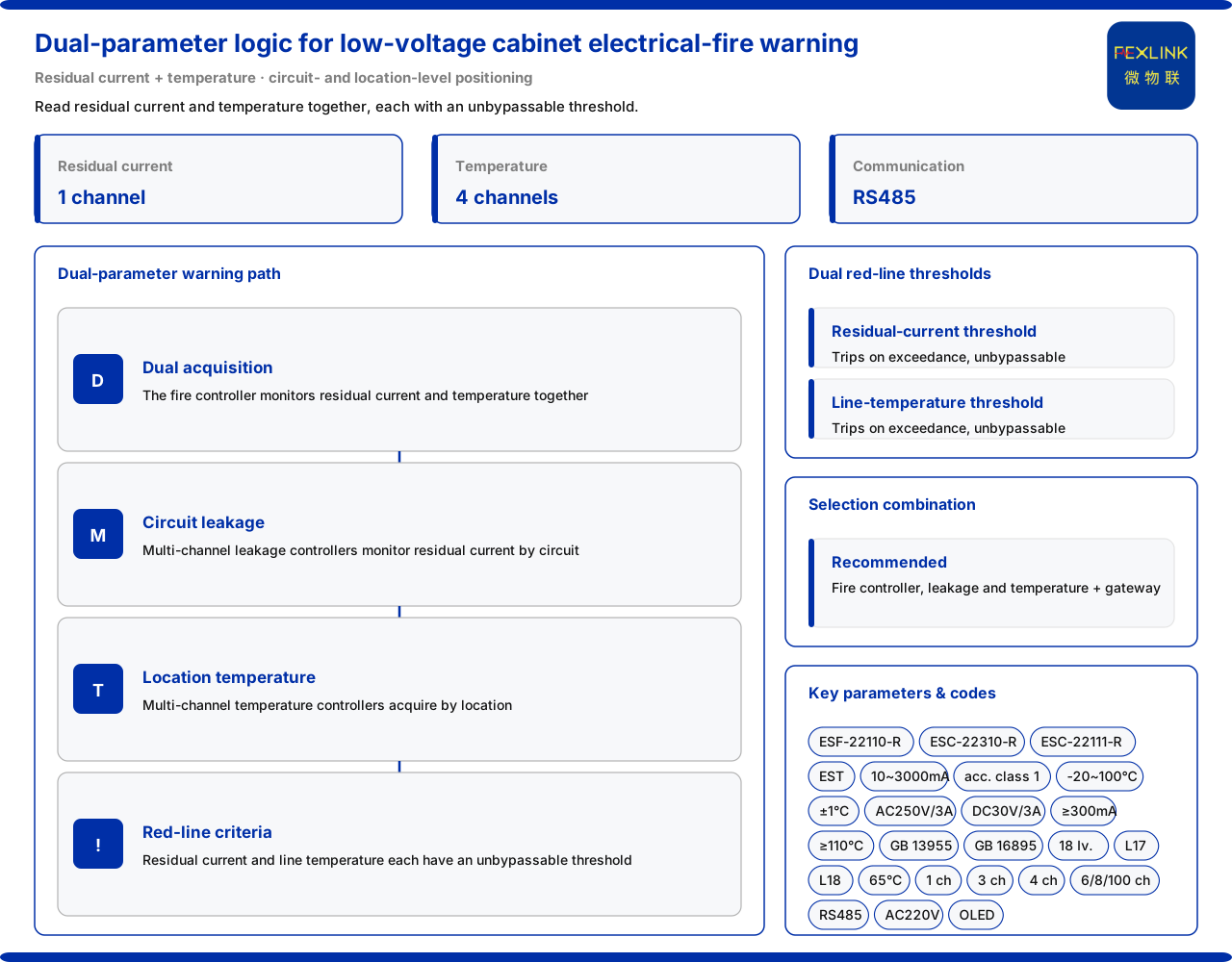
Direct answer
Electrical fire early warning for a low-voltage distribution cabinet is essentially a matter of looking at two classes of quantity together: residual current and temperature. The product knowledge base records that the ESF electrical fire monitoring & control device (ESF-22110-R) uses AC220V supply and an OLED display, and has residual current 1 channel, temperature 4 channels, 2 digital inputs and 1 relay output, with RS485 communication; it can serve as the module basis for monitoring residual current and temperature simultaneously in a low-voltage distribution cabinet. The two classes are not either-or: in the product knowledge base's red-line guard, residual current and line temperature each have a non-bypassable threshold; combined with the ESC multi-channel leakage-current monitoring & control device (ESC-22310-R) and the multi-channel temperature controller for branch and part locating, and with location awareness distinguishing the risk of the same temperature by position, they form a locatable early-warning logic. This article only restates wording listed in the product knowledge base and does not infer unrecorded setting methods.
1. Why residual current and temperature
The product knowledge base places the focus of low-voltage distribution cabinet electrical fire warning on two classes of quantity, residual current and temperature. Residual current reflects insulation state and leakage to earth; temperature reflects heating caused by contact resistance, overload and heat dissipation. The two observe different physical processes, so they must be monitored simultaneously rather than substituting for each other. In its selection comparison table, the product knowledge base likewise combines the devices corresponding to the two classes as the recommended scheme. Understanding this helps avoid a common misunderstanding: equating electrical fire warning with residual-current monitoring alone, or with temperature monitoring alone, may miss changes in the other class.
2. The dual-parameter capability of the electrical fire controller
The product knowledge base records that the ESF electrical fire monitoring & control device (ESF-22110-R) uses AC220V supply, has an OLED display, and provides residual current 1 channel, temperature 4 channels, 2 digital inputs and 1 relay output, with RS485 communication. From the interface configuration, it concentrates the two classes of residual-current and temperature collection in one module: 1 residual-current channel monitors the circuit's leakage to earth, and 4 temperature channels monitor several measurement points. The digital inputs and relay output provide interfaces for interlocking and state access. The product knowledge base therefore positions it as the module basis for simultaneous monitoring of residual current and temperature in a low-voltage distribution cabinet.
3. Acquisition parameters for residual current and temperature
The product knowledge base lists key parameters for the ESF electrical fire monitoring & control device (ESF-22110-R). The residual-current acquisition range is 10 to 3000mA with accuracy class 1; temperature uses NTC measurement over -20 to 100°C with an accuracy of ±1°C and an external wire length of 1 m; the relay contact capacity is AC250V/3A and DC30V/3A. Placing these together clarifies the boundary of the criteria: the residual-current out-of-limits judgement is built within the 10 to 3000mA acquisition range, the temperature out-of-limits judgement within the -20 to 100°C range, and the relay output is used to drive external circuits according to the contact capacity.
4. Branch leakage locating
When a cabinet contains several circuits, knowing that "residual current exists in the cabinet" is not enough to locate a specific circuit. The product knowledge base records that the ESC multi-channel leakage-current monitoring & control device (ESC-22310-R) can provide 1-channel or 3-channel leakage monitoring, with some models being 3-channel and some 1-channel or 3-channel; the leakage range is 10 to 3000mA with accuracy class 1. Because it can monitor several channels separately, it can be used for branch residual-current locating in a distribution cabinet. Combining the multi-channel leakage-current controller with the electrical fire controller refines the observation granularity of residual current from "whole cabinet" to "branch".
5. Per-part temperature collection
Like leakage, temperature also needs to be distinguished by part. The product knowledge base records that the multi-channel temperature intelligent controller supports 6-channel, 8-channel or 100-channel temperature monitoring, with a wired NTC range of -20 to 100°C and an accuracy of ±1°C. The point of multi-channel temperature measurement is that, within one distribution cabinet, different parts may differ in temperature; the busbar joint, the terminal connection and the cable sheath heat to different degrees. Collecting temperature by part allows an out-of-limits temperature to point directly at a specific part, rather than giving only a vague "cabinet temperature high".
6. Two non-bypassable red-lines
The product knowledge base records two thresholds in the red-line guard. One targets residual current: the trigger condition is residual current greater than or equal to 300mA, based on GB 13955. The other targets line temperature: the trigger condition is line temperature greater than or equal to 110°C, based on GB 16895. Both red-lines are given as absolute thresholds, showing that residual current and temperature each have a definite criterion boundary in the early-warning logic. It should be noted that the red-line threshold and the device acquisition range are two different levels: the acquisition range describes how much the device can measure, the red-line threshold describes the value at which it triggers, and the two should not be conflated.
7. Distinguishing risk by position
The product knowledge base records that the Wanxiang engine uses location awareness: the same 65°C corresponds to normal at a transformer winding, medium risk at a main busbar, high risk at an outlet terminal, and dangerous at a cable sheath; it also maintains an 18-level scene-location tree, with levels from L1 to L18 and the ends at L17 wiring-terminal level and L18 contact-point level. Placing location awareness with the temperature monitoring discussed here explains why temperature must be collected by part: the same temperature value at different parts has different risk levels. Location awareness provides a position-graded approach to temperature out-of-limits, while the 18-level scene tree provides the granularity of locating to terminals and contact points.
8. The recommended combination in the selection comparison table
In its typical application scenarios and selection comparison, the product knowledge base lists the recommended product combination for "low-voltage distribution cabinet electrical fire warning" as the electrical fire controller (ESF-22110), the multi-channel leakage-current controller and the multi-channel temperature controller, plus IoTBox. This combination corresponds to the division above: the electrical fire controller undertakes the dual-parameter basic monitoring of residual current and temperature, the multi-channel leakage-current controller undertakes branch leakage locating, the multi-channel temperature controller undertakes per-part temperature collection, and IoTBox is a link in networking and access. Placing these devices in one recommended combination shows that low-voltage distribution cabinet electrical fire warning is a scheme requiring coordinated configuration, not something a single module can complete.
9. What to note when reading the early-warning logic
First, residual current and temperature should be treated as two parallel classes, and electrical fire warning should not be simplified to monitoring only one of them. Second, the device acquisition range and the red-line threshold should be understood separately: the former is a capability boundary, the latter a trigger boundary. Third, branch locating and per-part temperature measurement should be understood as means of refining observation granularity from whole cabinet to circuit and part. Fourth, the parameters, thresholds and selection combination above are the product knowledge base's wording; actual settings are affected by site conditions, circuit structure and device deployment, and should follow the latest product materials and the specific project scheme.
Scope and limitations
First, this article only restates content listed in the product knowledge base, and its factual boundary is limited to the electrical fire controller's supply, display, residual-current and temperature channels, digital-input and relay configuration, residual-current and NTC measurement parameters and relay contact capacity; the multi-channel leakage-current controller's channels and leakage range; the multi-channel temperature controller's channels and temperature range; the residual-current and line-temperature thresholds and bases in the red-line guard; the Wanxiang engine's location awareness and 18-level scene-location tree; and the recommended combination in the selection comparison table.
Second, the residual current 10 to 3000mA, temperature -20 to 100°C and accuracy ±1°C are the product knowledge base's parameter wording; this article does not infer their test conditions or applicable working conditions.
Third, 300mA and 110°C are the trigger thresholds listed in the red-line guard; this article does not extend them into setting recommendations for any scenario.
Fourth, this article does not constitute a commitment to any specific distribution cabinet's electrical fire early-warning scheme or effect; actual capability should follow the latest product materials and project scheme.