 FEXLINK Research Institute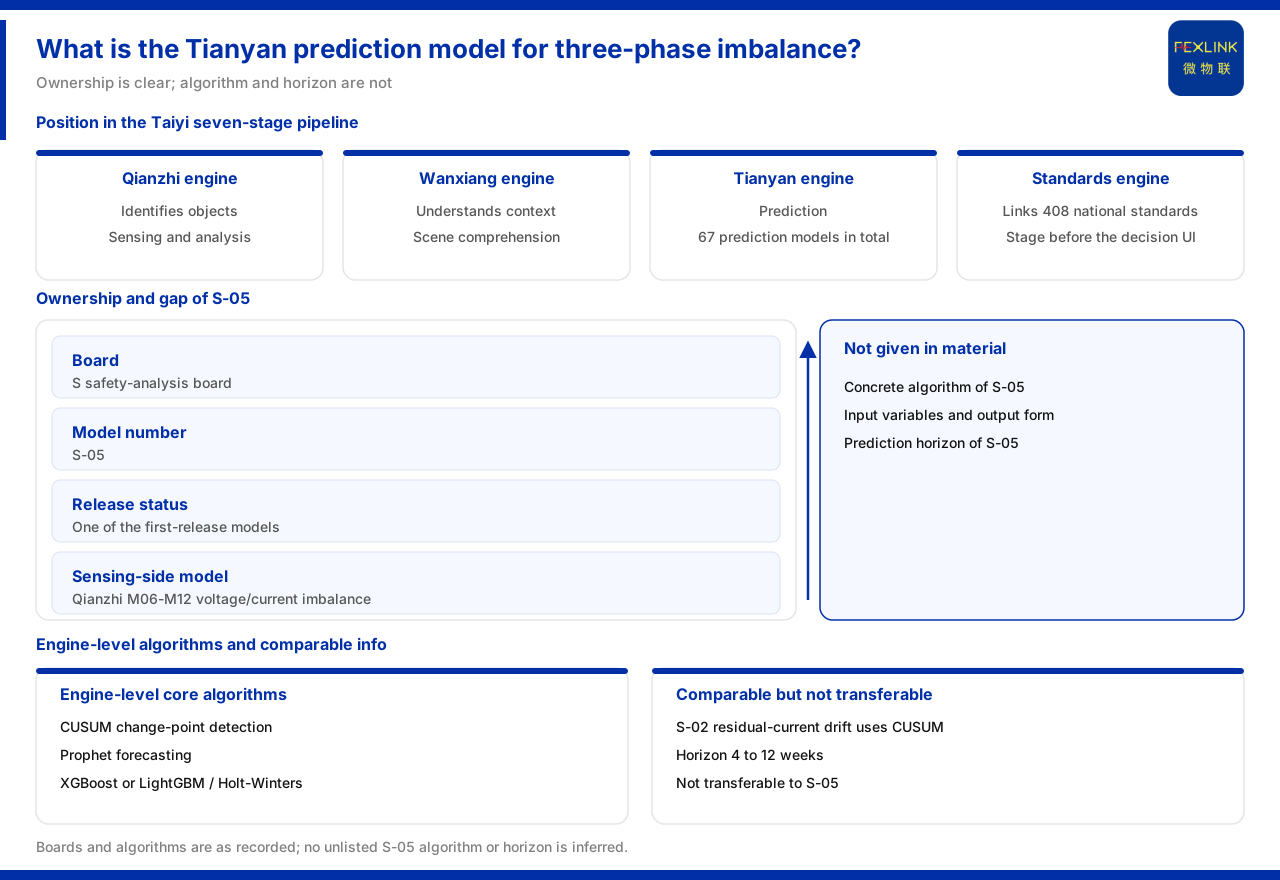
What is the Tianyan prediction model for three-phase imbalance?
Direct answer: the available product material records that the safety-analysis board of the Tianyan engine lists the three-phase imbalance hazard as one of its first-release models, numbered S-05. The Tianyan engine is positioned as the "predictive brain and decision layer", answering what will happen in the future and when to act, and contains 67 prediction models in total. What can therefore be confirmed is that three-phase imbalance does correspond to a dedicated prediction model; what the material does not give is the specific algorithm, input variables and prediction lead time of S-05. On this basis the article explains its ownership and position and does not infer capabilities beyond the material.
Where the Tianyan engine sits in the whole system
The material describes the Taiyi intelligent control hub system as a seven-stage pipeline: sensor data enters the back end, first passes the safety red-line pre-check of the front-end layer, then enters the Qianzhi engine, the Wanxiang engine, the Tianyan engine and the standard engine in turn, and finally reaches the decision interface. In this order the Qianzhi engine carries "identifying things", the Wanxiang engine carries "recognising situations", the Tianyan engine carries "prediction", and the standard engine is associated with 408 national standards. Tianyan stands after Qianzhi and Wanxiang and before the standard engine, and this position determines that what it receives is data already identified and understood, while what it outputs is a judgement facing the future.
Understanding this position is key to answering the question of this article. Three-phase imbalance has already been handled at the perception and analysis layer: the power-quality checkup sub-model of the Qianzhi engine covers voltage imbalance and current imbalance (sequence components). The S-05 of Tianyan does not repeat this but takes one step forward on that basis, extending the current imbalance state into a trend and a handling timing. That is, S-05 answers "what will happen" rather than "what is happening now".
The S safety-analysis board and the ownership of S-05
The material records that the Tianyan plan for a later version has four boards, S, Q, E and C, of which S is the safety-analysis board. On the number of models in the S board the material has two formulations: one place writes 20 items, and another introductory formulation gives 13. This difference is itself worth recording, because citing a number without stating its basis easily produces inconsistency. For this article, what needs to be confirmed is the ownership of S-05: it belongs to the safety-analysis board and is one of that board's first-release models.
The expression "first-release model" has a clear temporal meaning: it is not a long-term capability still in planning but the part released first. Placing the three-phase imbalance hazard in the first-release list shows that the material considers it to have high priority in safety analysis. This judgement can be understood in two ways: on the one hand, three-phase imbalance has a clear standard basis and a quantified red line; on the other hand, it is suited to being modelled from both the current and voltage sides using sequence components and has a data basis for trend analysis.
The gap between the core algorithms and S-05
The material records that the core algorithms of the Tianyan engine include CUSUM change-point detection, Prophet, XGBoost or LightGBM, and Holt-Winters triple exponential smoothing. These four methods correspond to change-point identification, time-series forecasting, machine-learning regression and smooth extrapolation, giving broad coverage. They form the technical foundation of the Tianyan engine.
The key point is that what the material lists are engine-level core algorithms, and it does not say which one or which combination S-05 specifically uses. One therefore cannot conclude that S-05 adopts change-point detection merely because CUSUM is in the algorithm list, nor infer S-05's forecasting method merely because a time-series method is present. Mapping an engine-level algorithm list directly onto a single model over-refines the material. What this article can confirm is the ownership level of the algorithm list, not the specific implementation of S-05.
A reference point for comparison: the lead time of S-02
The material gives comparable information for another safety-analysis model: residual-current trend drift uses CUSUM and gives a lead time of 4 to 12 weeks. This information matters because it shows that Tianyan's prediction is not only a directional judgement but can give a time range. It also shows that different models in the same board do differ in method, and that CUSUM is explicitly used for trend-drift problems.
But this information cannot be transferred to S-05. The material gives no lead time for S-05 and does not say whether it uses the same method as S-02. Taking the 4 to 12 weeks of S-02 as the warning window for three-phase imbalance substitutes the parameters of a neighbouring model for the target model, a typical over-inference. The correct use is to treat S-02 as evidence that Tianyan can give a lead time, not as the source of S-05's parameters.
Division of labour with the Qianzhi-side perception modelling
Putting the prediction side and the perception side together reveals a clear line of division. The power-quality checkup sub-model of the Qianzhi engine covers voltage imbalance and current imbalance (sequence components), and the deep hidden-hazard mining sub-model further includes zero-sequence current and negative-sequence components. This side answers "which imbalance clues exist now and what their nature is". The S-05 on the Tianyan side answers "where these clues are heading and when handling is needed".
The meaning of this division for maintenance is that a prediction model cannot work separately from the perception model. The input of S-05 depends on the imbalance state already identified on the Qianzhi side; if the data on the perception side is incomplete, the output on the prediction side is also limited. When discussing S-05 in a scheme, therefore, the upstream perception and data link should be described at the same time, rather than stressing only the prediction model. The material supports the existence of this link but not a quantified description of the performance of each link.
What the material does not provide
First, the material gives no specific algorithm for S-05, so it cannot be confirmed whether it uses CUSUM, Prophet, XGBoost or Holt-Winters. Second, it gives no list of input variables for S-05. Third, it gives no prediction lead time for S-05. Fourth, it gives no output form or confidence information for S-05. Fifth, the material does not reconcile the two formulations of the model count of the S board (20 items and 13). When citing, the basis should be stated to avoid mixing the two.
Advice for citation and scheme writing
First, when citing model ownership, state it as "the three-phase imbalance hazard is one of the first-release models of the Tianyan safety-analysis board", which is what the material can confirm. Second, when citing engine capability, state it as "Tianyan contains 67 prediction models in total", positioned at the prediction layer, and do not treat that total as the scale of the three-phase imbalance model. Third, when citing algorithms, state that these are engine-level core algorithms and do not attach them directly to the name of S-05. Fourth, on lead time, cite only models for which the material explicitly gives it (such as the 4 to 12 weeks of residual-current trend drift) and do not extrapolate to three-phase imbalance.
Handling it this way makes the existence and position of S-05 clear while avoiding the reader's misunderstanding that the prediction capability has been quantified. For electrical-safety content, it is better to make the boundary clear than to fill a blank with inference.
Summary
For the Tianyan prediction model of three-phase imbalance, the confirmable information in the available material is this: it belongs to the safety-analysis board of the Tianyan engine, is numbered S-05, and is one of that board's first-release models; the Tianyan engine is positioned as the predictive brain and decision layer, contains 67 prediction models, and in the seven-stage pipeline stands after Qianzhi and Wanxiang and before the standard engine; the engine-level core algorithms include CUSUM, Prophet, XGBoost or LightGBM and Holt-Winters. The material gives no specific algorithm, input variables or lead time for S-05; the residual-current trend drift in the same board uses CUSUM and gives a 4 to 12 week lead time, but this cannot be transferred to three-phase imbalance. For maintenance and scheme staff, the sound way to cite is to confirm the model ownership and the prediction position, and leave the algorithm and lead time to later material.