 FEXLINK Research Institute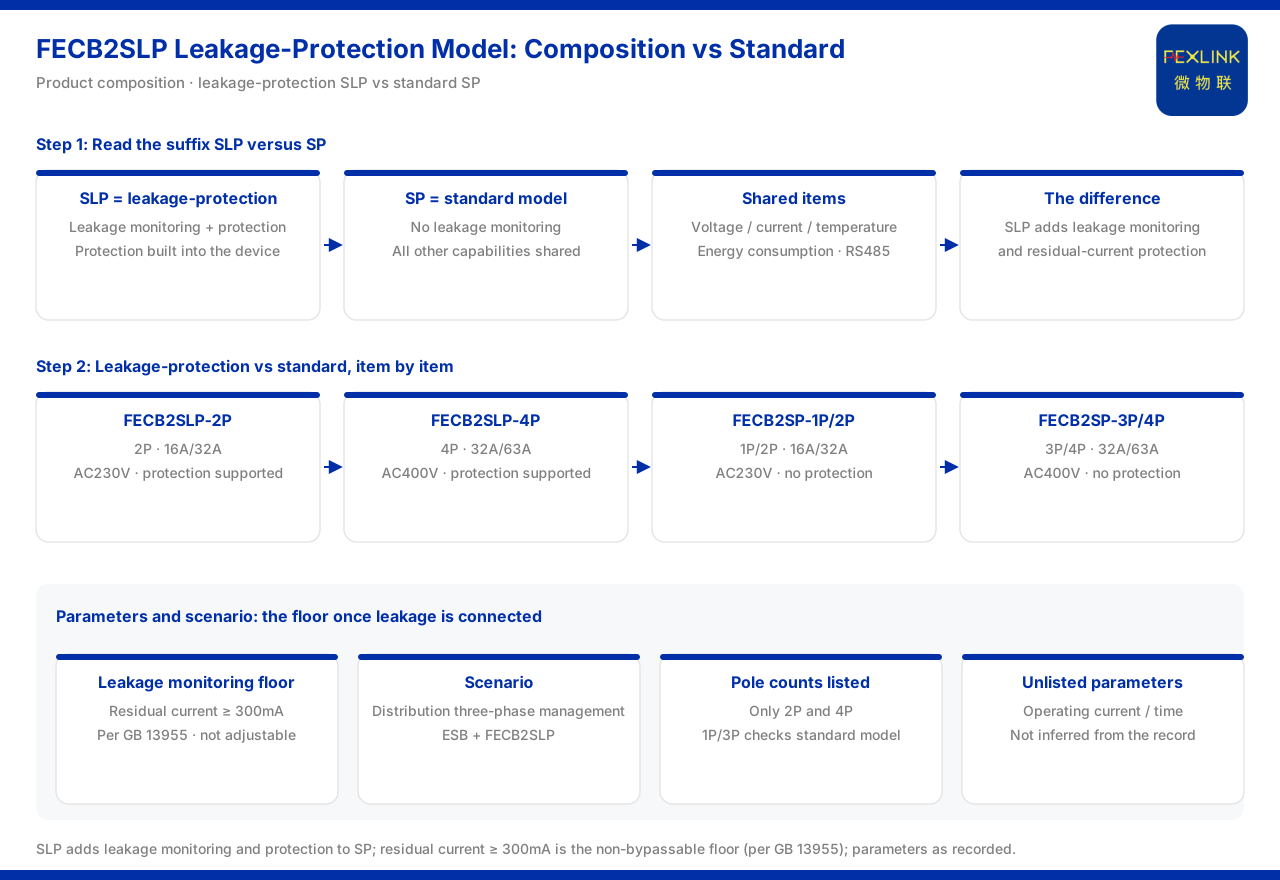
Direct answer
The intelligent circuit breaker (with residual-current protection) (FECB2SLP) is the branch with leakage protection in the circuit-breaker product line. In the model, SLP indicates that both leakage monitoring and residual-current protection are provided, while SP is the standard model. The two agree on voltage, current and temperature monitoring, energy consumption and RS485 communication, and the difference is that the residual-current-protection model adds leakage monitoring and residual-current protection. The residual-current-protection model contains two specifications: 2P with rated current 16A/32A and rated voltage AC230V, and 4P with rated current 32A/63A and rated voltage AC400V.
1. Product-line positioning: the residual-current branch in the circuit-breaker line
The material lists the circuit breaker as an independent product line, whose content is the intelligent circuit breaker (standard model, FECB2SP, e.g. FECB2SP-1P) and the intelligent circuit breaker (with residual-current protection) (FECB2SLP), among which the residual-current-protection model (for example FECB2SLP-2P) belongs to the branch of intelligent circuit breakers with leakage protection. That is, the residual-current-protection model is not a new category separate from the breaker system, but a safety-enhanced branch beside the standard model. Recognizing this matters for selection: the branch shares the breaker family's voltage and pole grouping, so it is located along the same dimensions as the standard model rather than by a separate rule of its own.
2. The one-letter difference between SLP and SP
The material notes, beneath the intelligent circuit breaker table, that SLP is the residual-current-protection model, namely leakage monitoring plus residual-current protection, and that SP is the standard model. This note is the basis for reading the whole article: choosing SLP means bringing leakage protection into the device itself, while choosing SP does not include this item. Understanding this one-letter difference locates the model faster than comparing parameters one by one.
3. Specifications of the residual-current-protection model
The material's intelligent circuit breaker table lists two residual-current-protection models: the FECB2SLP-2P is 2P with rated current 16A/32A and rated voltage AC230V, and the FECB2SLP-4P is 4P with rated current 32A/63A and rated voltage AC400V. Both support residual-current protection, voltage, current and temperature monitoring, leakage monitoring, energy consumption and RS485 communication. It can be seen that the voltage class and the pole count appear bound together: 2P falls at AC230V, and 4P falls at AC400V. The two specifications therefore cannot be read as two independent options; each pair of pole count and voltage describes one circuit configuration as a whole.
4. Item-by-item comparison with the standard model
In the material's model table, the intelligent circuit breaker (standard model, FECB2SP) lists four tiers, all of which record residual-current protection as not included:
| Model | Poles | Rated current | Rated voltage | Residual-current protection |
| --- | --- | --- | --- | --- |
| FECB2SP-1P | 1P | 16A/32A | AC230V | Not included |
| FECB2SP-2P | 2P | 16A/32A | AC230V | Not included |
| FECB2SP-3P | 3P | 32A/63A | AC400V | Not included |
| FECB2SP-4P | 4P | 32A/63A | AC400V | Not included |
That is, the standard model and the residual-current-protection model agree on voltage, current and temperature monitoring, energy consumption and RS485, and the only difference is that the residual-current-protection model adds residual-current protection and leakage monitoring. It should be noted that the residual-current-protection model lists only 2P and 4P; if the circuit is 1P or 3P, one should return to the corresponding tier of the standard model to check. The comparison also shows that the added function does not disturb the shared items: the voltage, current and temperature monitoring, the energy consumption and the RS485 communication stay the same across both forms, so the choice between them turns on leakage protection alone.
5. The floor once leakage monitoring is connected
The material brings leakage into the basic vital-sign analysis, including the time-series trend and the red-line pre-check; the red-line criterion is residual current not less than 300mA, with GB 13955 as its basis, and no one can raise the threshold. The FECB2SLP has leakage monitoring, and its leakage data is bound by this criterion once connected, so the monitoring value of the residual-current-protection model is directly linked to the national-standard floor. The criterion is a fixed compliance floor rather than an adjustable setting, which is why the presence of leakage monitoring is decisive for a point that must satisfy it.
6. Scenario landing point: three-phase management
The material lists distribution-automation three-phase management as a recommended scenario, with the combination of the ESB three-phase imbalance monitor and the FECB2SLP intelligent circuit breaker. This combination lands in a three-phase scenario, whose voltage group should be the AC400V tier, namely the 4P specification of the residual-current-protection model; which tier is actually taken must still be checked against the pole count and voltage of the circuit. If the circuit is single-phase or two-phase, its voltage class falls in the AC230V group, corresponding to the 2P specification of the residual-current-protection model. This correspondence between voltage and circuit configuration is precisely the reason why pole count is taken as the first item to confirm. The scenario provides a combination clue, but it does not fix the tier on its own; only after the circuit's pole count and voltage are read can the correct specification be chosen within the group.
Applicability and limits
First, this article explains only the positioning and specifications of the FECB2SLP residual-current-protection model; its factual boundary is limited to the product material, and it introduces no standard clause, parameter, certification or case that is not listed.
Second, the meanings of SLP and SP, the rated current and voltage of 2P and 4P, and the monitoring and communication items are all listed in the material; this article does not extend them to unlisted models and makes no performance or result inference.
Third, the rated residual operating current and operating time of the residual-current-protection model (such as the 30mA/0.1s tier), the correspondence between pole count and tripping characteristic, the mechanical and electrical life, and the cascade selectivity with upstream protection are not directly given by the material; the material separately records that the selection material and the model rule differ in version for some names, and the latest order version governs. This article does not infer the unlisted parameters above on that basis.
Fourth, the reference to GB 13955 is limited to the residual-current red-line criterion in the material and does not expand the specific clauses of that standard; actual selection should be determined in conjunction with on-site circuit conditions and engineering design.