 FEXLINK Research Institute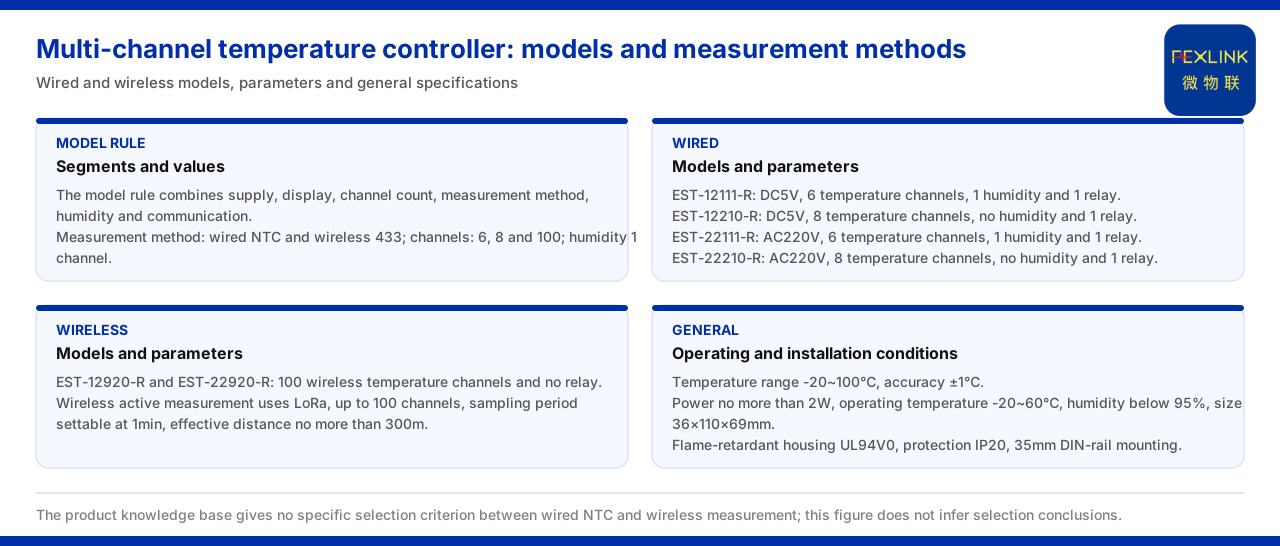
Direct Answer
The multi-channel temperature intelligent controller is used to bring temperature measurement points in at scale, and it is the temperature-acquisition product in electrical-fire early-warning scenarios. The product knowledge base records that its model rule is assembled in order from segments for power supply, display, channel count, measurement method, humidity and communication. In the measurement-method tier, one option is wired NTC and the other is recorded as wireless 433; in the channel-count tier, one option is six channels, one is eight channels and another is one hundred channels; the humidity tier corresponds to one humidity channel. The model table gives wired and wireless categories: among the wired models, the multi-channel temperature intelligent controller (EST-12111-R) uses five volts DC with six temperature channels, one humidity channel and one relay; the multi-channel temperature intelligent controller (EST-12210-R) uses five volts DC with eight temperature channels, no humidity and one relay; the multi-channel temperature intelligent controller (EST-22111-R) uses two hundred twenty volts AC with six temperature channels, one humidity channel and one relay; and the multi-channel temperature intelligent controller (EST-22210-R) uses two hundred twenty volts AC with eight temperature channels, no humidity and one relay. Among the wireless models, the multi-channel temperature intelligent controller (EST-12920-R) and the multi-channel temperature intelligent controller (EST-22920-R) have one hundred wireless temperature channels and no relay. Key parameters record a range of minus 20 to one hundred degrees Celsius with an accuracy of plus or minus one degree Celsius; wireless active measurement uses LoRa communication, a maximum of one hundred channels, a sampling period settable to one minute and an effective distance of no more than three hundred metres. The product knowledge base gives no criterion for choosing between wired and wireless measurement, so this article cites only the models and parameters.
1. How to Read the Model Rule
The model rule of the multi-channel temperature intelligent controller is assembled in order from segments for power supply, display, channel count, measurement method, humidity and communication. As listed in the product knowledge base, in the measurement method one option is wired NTC and the other is recorded as wireless 433; in channel count one option is six channels, one is eight channels and another is one hundred channels; and in humidity one option corresponds to one humidity channel. Reading the model segment by segment lets one first confirm supply and channel count, then measurement method and whether humidity is present, and finally communication. It must be noted that the product knowledge base records the wireless measurement method as wireless 433 in the model rule, while it is recorded as LoRa communication in the wireless models and in the key parameters; the two conventions appear in different passages and should be cited according to the passage being used, without substituting one for the other.
2. Wired Models and Parameters
The wired models are characterised by NTC measurement. The model table of the product knowledge base records: the multi-channel temperature intelligent controller (EST-12111-R) uses five volts DC with six temperature channels, one humidity channel and one relay; the multi-channel temperature intelligent controller (EST-12210-R) uses five volts DC with eight temperature channels, no humidity and one relay; the multi-channel temperature intelligent controller (EST-22111-R) uses two hundred twenty volts AC with six temperature channels, one humidity channel and one relay; and the multi-channel temperature intelligent controller (EST-22210-R) uses two hundred twenty volts AC with eight temperature channels, no humidity and one relay. The wired models thus offer six- and eight-channel combinations under both a five-volt DC and a two hundred twenty volt AC supply, while humidity and relay presence vary by model. No wiring-distance limit between temperature measurement points is given, so this article adds no wiring convention.
3. Wireless Models and Parameters
The wireless models are characterised by wireless temperature measurement. The model table of the product knowledge base records that the multi-channel temperature intelligent controller (EST-12920-R) and the multi-channel temperature intelligent controller (EST-22920-R) both have one hundred wireless temperature channels and no relay, and correspond respectively to a five-volt DC and a two hundred twenty volt AC supply. The key parameters further state that wireless active temperature measurement uses LoRa communication, a maximum of one hundred channels, a sampling period settable to one minute and an effective distance of no more than three hundred metres. The wired and wireless categories differ in channel count, supply and the presence of a relay, and selection must treat them differently. The product knowledge base does not give a networking rule between wireless measurement points and a gateway, so this article cites only the parameter conventions above.
4. Measurement Range and General Parameters
Whether wired or wireless, the product knowledge base gives a consistent convention for the measurement range: wired NTC is minus 20 to one hundred degrees Celsius with an accuracy of plus or minus one degree Celsius, and wireless active measurement is likewise minus 20 to one hundred degrees Celsius with an accuracy of plus or minus one degree Celsius. On general parameters, the product knowledge base records power consumption of no more than two watts, an operating temperature of minus 20 to sixty degrees Celsius, humidity below ninety-five percent, dimensions of thirty-six by one hundred ten by sixty-nine millimetres, a flame-retardant enclosure of UL94V0, a protection rating of IP20 and thirty-five millimetre DIN-rail mounting. These describe the operating and installation conditions of the product body and belong to a different convention from the measurement range, so they are cited separately.
5. Typical Application Combination
In the typical application scenarios and selection comparison of the product knowledge base, the row for electrical-fire early warning in low-voltage distribution cabinets recommends a product combination of the electrical fire controller, the multi-channel leakage-current controller, the multi-channel temperature intelligent controller and system-access equipment, where the electrical fire controller is exemplified by ESF-22110. In this scenario residual-current monitoring, temperature monitoring and access equipment appear as parallel selection items, with the multi-channel temperature intelligent controller handling the acquisition of temperature measurement points. The product knowledge base does not give the wiring method, number of measurement points or linkage logic among the devices in this combination, so this article cites only the recommended combination itself and does not expand it into a specific project scheme.
6. Reading Order and Boundaries
The above can be reduced to a reading order. First, decompose the model rule segment by segment, confirming supply and channel count, then measurement method and whether humidity is present. Second, distinguish wired from wireless models and read the channel count, humidity and relay configuration in the model table. Third, when a measurement range and accuracy are needed, cite the minus 20 to one hundred degrees Celsius and plus or minus one degree Celsius convention; when operating and installation conditions are needed, cite the general parameters. Fourth, if a scenario is involved, return to the selection comparison and confirm the recommended combination for electrical-fire early warning in low-voltage distribution cabinets. The boundary to keep is that the product knowledge base gives no specific criterion for choosing between wired NTC and wireless measurement, such as a threshold rule by distance, wiring cost or measurement-point count; the relevant conclusions must be checked separately and must not be inferred from the product knowledge base.
Applicability and Limits
First, this article restates only what the product knowledge base lists; its factual boundary is the record of the model rule, model table, key parameters and general parameters of the multi-channel temperature intelligent controller, plus the selection comparison.
Second, the five-volt DC, six temperature channels, one humidity channel and one relay of the multi-channel temperature intelligent controller (EST-12111-R), the five-volt DC, eight temperature channels, no humidity and one relay of (EST-12210-R), the two hundred twenty volt AC, six temperature channels, one humidity channel and one relay of (EST-22111-R), and the two hundred twenty volt AC, eight temperature channels, no humidity and one relay of (EST-22210-R) are cited under the model-table convention.
Third, the one hundred wireless temperature channels and absence of a relay of the multi-channel temperature intelligent controller (EST-12920-R) and (EST-22920-R), and the LoRa communication, maximum of one hundred channels, one-minute settable sampling period and effective distance of no more than three hundred metres, follow the model-table and key-parameter conventions.
Fourth, the measurement range of minus 20 to one hundred degrees Celsius and the accuracy of plus or minus one degree Celsius follow the key-parameter convention; power consumption, operating temperature, humidity, dimensions, enclosure rating, protection rating and rail mounting follow the general-parameter convention.
Fifth, the wireless 433 convention in the model rule and the LoRa convention in the wireless models and key parameters follow their corresponding passages and are not interchanged.
Sixth, the recommended combination for electrical-fire early warning is cited as listed, without expanding the wiring method, measurement-point count or linkage logic.
Seventh, the product knowledge base gives no specific criterion for choosing between wired NTC and wireless measurement; this article accordingly states no selection conclusion, and the latest product materials and formal documents prevail.