 FEXLINK Research Institute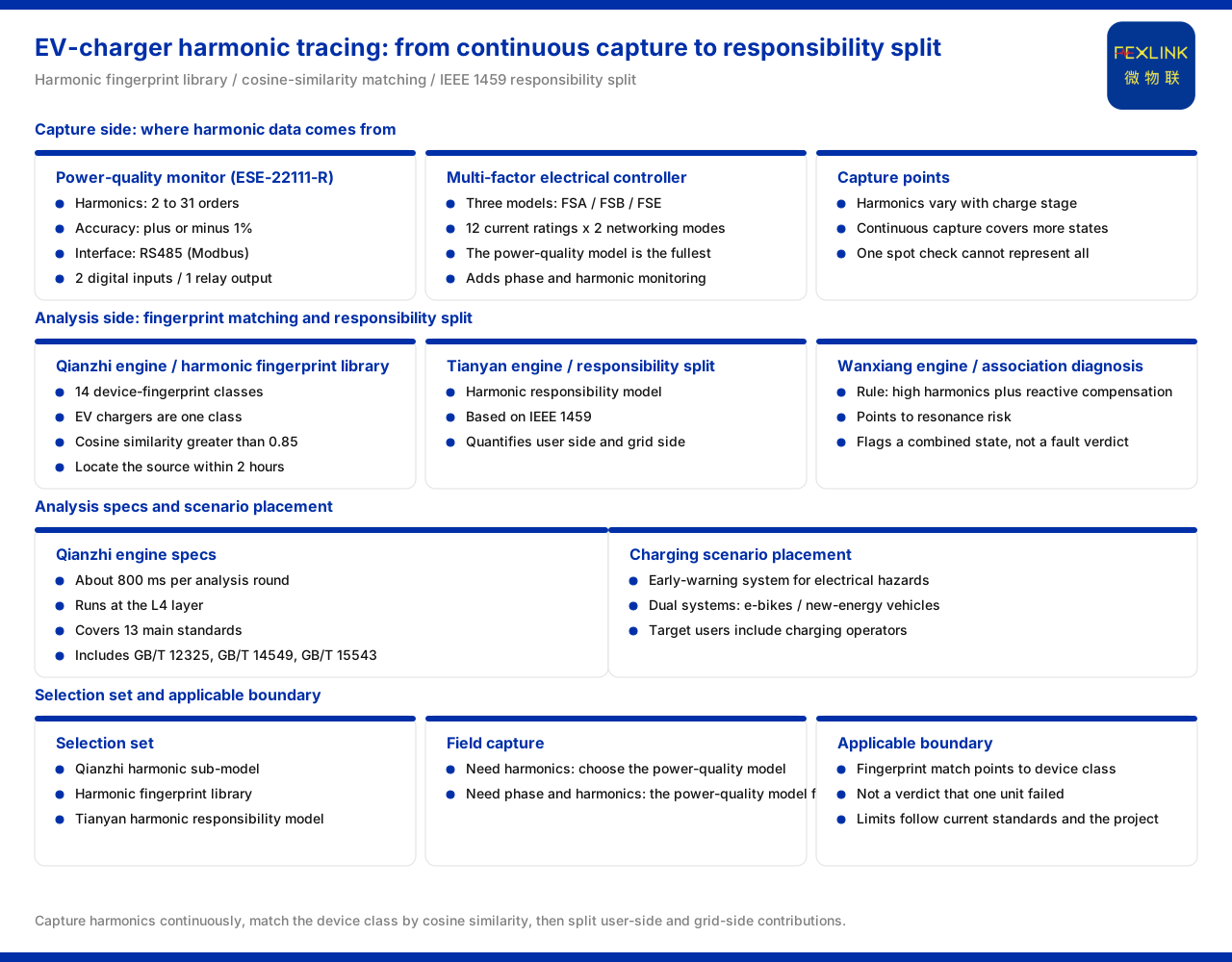
Direct answer
The harmonic problem caused by adding charging piles is often not produced by a single device alone but is the result of several charging devices and the existing load superposing in time. To locate the pollution source against such a background, the approach is not to draw a conclusion from one manual measurement but to compare continuous harmonic data with equipment fingerprint features: first the power-quality monitor obtains the harmonic order and content, then the harmonic fingerprint library of the Qianzhi engine matches the equipment type by feature similarity, and where necessary the harmonic responsibility-allocation model of the Tianyan engine quantifies the respective contributions of the user side and the grid side. What the product material gives is exactly such a combination of capabilities from acquisition to judgement, not a fixed decision threshold. This article explains these capabilities and their relationships according to the product material and does not derive additional field criteria.
Why the problem is difficult
Harmonics in charging scenarios have several features that make judgement harder. First, the harmonic sources are not isolated: charging piles, reactive-power compensation devices and other non-linear loads may work at the same time and superpose on the spectrum, so the total harmonic content alone can hardly indicate who contributed. Second, harmonics are dynamic: the power of a charging pile changes with the charging stage of the vehicle, and the pollution is intermittent in time, so one instantaneous measurement can hardly cover all operating conditions. Third, responsibility allocation is difficult: user-side devices and grid-side background harmonics both appear in the same set of measurement data, and without distinguishing them it is hard to clarify the object of mitigation.
The prerequisite for locating the pollution source is therefore to have continuous, comparable harmonic data first, and then an analysis method that can map the data to equipment type and responsibility. The monitoring products and intelligent engines in the product material are organised around these two prerequisites.
On the acquisition side: what the power-quality monitor can capture
On the acquisition side, the ESE power-quality monitor (for example ESE-22111-R) adds harmonic monitoring on the basis of phase monitoring, with a harmonic order range of 2 to 31 and an accuracy of ±1%. Besides harmonics, it provides 2 digital inputs and 1 relay output, and communication uses an RS485 interface with Modbus support. For a charging scenario, this set of capabilities provides continuous harmonic order and content data rather than a one-off sample; the digital inputs and relay provide interfaces for linkage or alarm.
In the multi-parameter electrical intelligent controller series, the power-quality type is the most fully featured, providing phase monitoring and harmonic monitoring in addition to the common monitoring. The series includes the meter type, the three-phase balance type and the power-quality type, and the three together provide 12 current specifications and 2 networking methods. Note that harmonic monitoring capability is concentrated in the power-quality type, so selection should distinguish the tiers by whether harmonic data is required.
On the analysis side: how the fingerprint library matches equipment types
Turning acquired harmonic data into the conclusion "what kind of equipment is polluting" relies on the harmonic fingerprint library of the Qianzhi engine. The material states that this fingerprint library contains 14 categories of equipment fingerprints, one of which is the charging pile. Matching uses cosine similarity, and a similarity greater than 0.85 is judged to be the corresponding equipment type. Based on such feature comparison, the material gives the result that the pollution source can be locked within 2 hours.
The key lies in the word "fingerprint": harmonic features of different devices differ in order distribution and phase relationship, and the fingerprint library fixes this difference into comparable features, thereby advancing a vague description such as "harmonics are high" to an operable judgement of "which equipment type the feature matches".
Responsibility allocation and associated diagnosis
After the equipment type is determined, it is still necessary to answer "who should be responsible for mitigating this harmonic". The Tianyan engine in the material has a harmonic responsibility-allocation model, which quantifies the harmonic contributions of the user side and the grid side according to IEEE 1459. That is, the same set of measurement data can be used both to identify the equipment type and to distinguish responsibility, and only by combining the two clues is the mitigation direction clearer.
In associated diagnosis, one rule in the association rules of the Wanxiang engine relates to harmonics: when high harmonics and reactive-power compensation being switched in occur together, it points to resonance risk. It suggests that the site should observe harmonics and the compensation action together rather than judging each in isolation.
Specifications of the analysis capability and standard coverage
In terms of technical specifications, a single analysis round of the Qianzhi engine takes about 800 milliseconds and runs at the L4 layer; its analysis covers GB/T 12325, GB/T 14549, GB/T 15543 and 13 other main standards. For harmonic problems, the meaning of standard coverage is that discussion of harmonic content and responsibility allocation can return to an existing standard formulation rather than remaining at empirical judgement.
The overall landing point for charging scenarios
The material also lists the charging scenario separately as an application direction of the electrical hazard early-warning system: the system uses a dual architecture covering two-wheeled e-bike charging and new-energy vehicle charging respectively, with target customers including charging operators. Linking this landing point with the capabilities above gives a path: the power-quality monitor continuously acquires harmonic data, the harmonic fingerprint library matches the equipment type, and the responsibility-allocation model distinguishes the user-side and grid-side contributions, serving pollution-source location and mitigation decisions in charging-operation scenarios.
Selection combination
According to the product selection table in the material, the combination corresponding to harmonic tracing and responsibility allocation is: the harmonic-related sub-models of the Qianzhi engine, the harmonic fingerprint library, and the harmonic responsibility-allocation model of the Tianyan engine. On the field-acquisition side, a site that needs harmonic data should choose the power-quality controller or the power-quality monitor; if both phase and harmonics are needed, the power-quality type is more suitable.
Several links from data to conclusion
Breaking the harmonic location of a charging scenario into parts, it roughly passes through four links. The first is continuous acquisition, where the power-quality monitor obtains the harmonic order and content. The second is feature extraction, arranging the raw measurement into a form comparable with the fingerprint library. The third is type matching, where the Qianzhi engine judges the equipment category by cosine similarity. The fourth is responsibility quantification, where the Tianyan engine distinguishes the user-side and grid-side contributions according to IEEE 1459. Of the four links, the first two determine data quality and the last two determine conclusion quality.
It is worth noting that fingerprint matching gives "which equipment type the feature matches" and does not directly conclude that a particular device is faulty. The site should still cross-check against the equipment list and operating records, avoiding equating statistical similarity with causal certainty.
Points to note in deployment and use
- Continuity of acquisition matters more than the accuracy of a single measurement: harmonics change with the charging stage, and only continuous data can cover multiple operating conditions.
- The acquisition point should represent the equipment and circuit to be judged, otherwise the input to fingerprint matching does not correspond to the target.
- An association rule indicates a combined state and is not equal to a fault conclusion; when harmonics and compensation are abnormal at the same time, the data should be verified before judging.
- Standard coverage provides a unified formulation for analysis, but specific limits should still follow the current standards and project requirements.
Scope and limitations
- The content of this article is limited to the existing statements in the product material regarding the harmonic fingerprint library of the Qianzhi engine, the association rules of the Wanxiang engine, the responsibility-allocation model of the Tianyan engine, and the power-quality monitor and the multi-parameter electrical intelligent controller series.
- The fingerprint category count, similarity threshold, lock time, harmonic order and accuracy, interface and digital-input configuration, current-specification and networking counts, single-round analysis time, and standard-coverage count are all formulations listed in the material.
- This article explains the capability combination and judgement path for locating harmonic pollution sources in charging scenarios; it gives no fixed mitigation threshold or mitigation scheme, and actual mitigation should be determined together with field conditions, equipment specifications and the project scheme.
- Other field conditions, installation methods and maintenance cycles not listed in the material are not inferred or promised here.