 FEXLINK Research Institute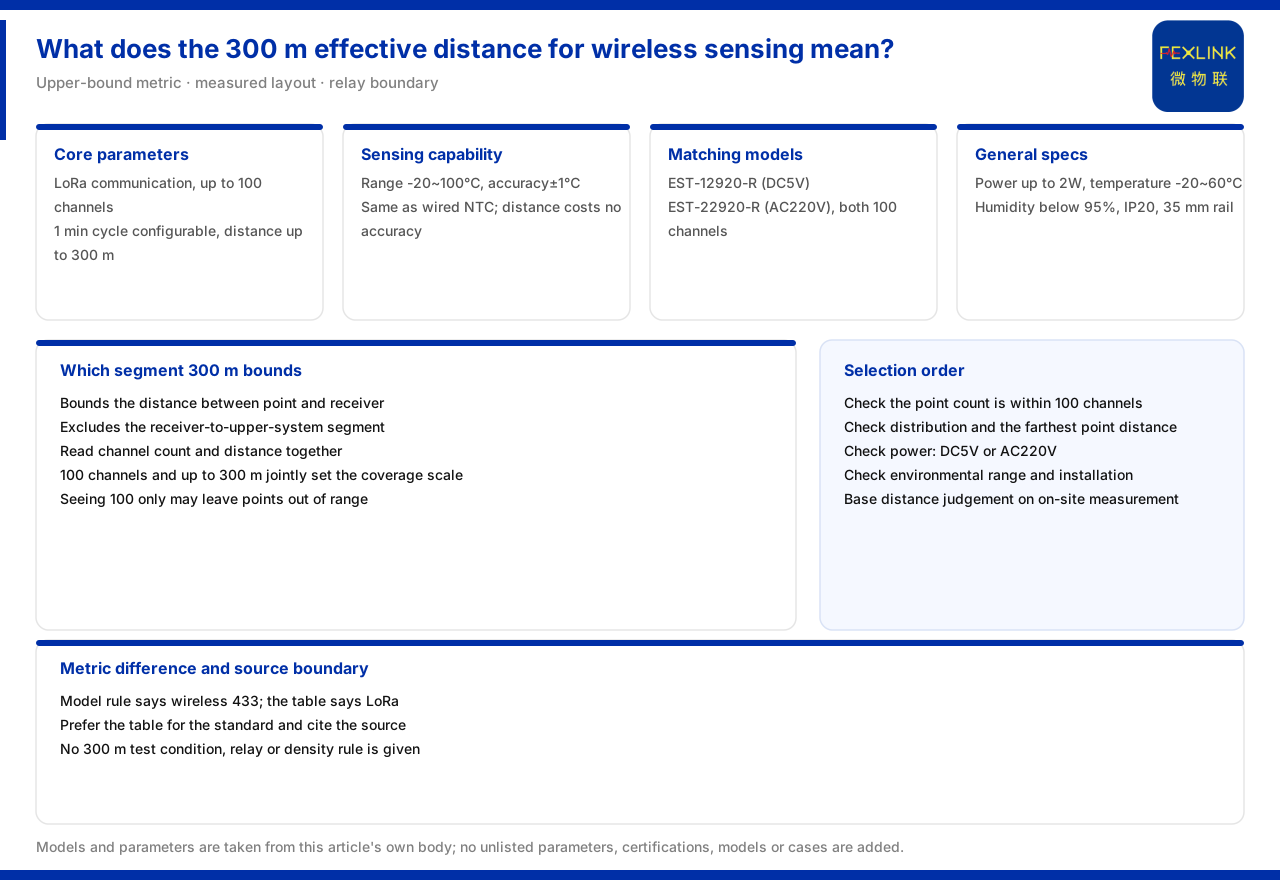
What does the 300 m effective distance of wireless temperature measurement in the multi-channel temperature intelligent controller mean?
Direct answer: from the existing product material it can be confirmed that the wireless active temperature measurement of the multi-channel temperature intelligent controller (a model such as EST-12920-R) uses LoRa communication, has an effective distance not exceeding 300 m, supports up to 100 channels, and has a sampling period configurable at 1 minute. The 300 m is a constraint used between the measuring point and the receiving end: it limits the range in which wireless points can be placed, and beyond this distance usability can no longer be inferred directly from the device parameters. The material gives no test conditions for the 300 m (open field, obstruction, antenna gain, etc.) and no relay-extension rule beyond the distance. The 300 m should therefore be understood as an upper-bound definition given by the material, not a guaranteed value achievable at any site; the actual point spacing still needs on-site measurement.
Putting this constraint into a scheme, the safest wording is "no more than 300 m, with the specific spacing subject to on-site measurement", rather than writing "covers 300 m". The former matches the material definition; the latter turns an upper bound into a guaranteed value, which is different in nature.
Which distance the 300 m constrains
The spatial relation of a wireless temperature-measurement system can be split into two segments: between the measuring point and the receiving end, and between the receiving end and the upper system. The 300 m constrains the former, that is, the distance over which the signal from a wireless point reaches the receiving end. The more scattered the points and the larger the span, the more easily this upper bound is reached.
This also explains why channel count and distance must be seen together. Wireless active temperature measurement supports up to 100 channels, showing it faces occasions with many measuring points; and an effective distance not exceeding 300 m shows those points cannot be spread without limit in space. Together they determine the point scale and distribution range one device can cover. If at selection one sees only "100 channels" and ignores "300 m", one may end up with enough points overall but some beyond the distance.
Other wireless parameters bound to the 300 m
The wireless active temperature measurement range is -20~100 °C at ±1 °C, the same as wired NTC measurement. In other words, the distance constraint does not come at the cost of accuracy: within the effective range, wireless measurement gives the same measurement capability as wired.
A sampling period configurable at 1 minute means the acquisition frequency can be adjusted as needed. The material gives no finer sampling-scheduling rule, so if a scheme is to state the specific behaviour of "polling at a certain period", it should first confirm where that behaviour comes from.
On supply, wireless LoRa measurement corresponds to EST-12920-R (DC5V) and EST-22920-R (AC220V), both with 100 temperature channels. The suffix and model segment distinguish the two typical supplies, and selection should first confirm the power form available on site. The two wireless models share one set of general specifications: power consumption not exceeding 2 W, operating temperature -20~60 °C, humidity below 95%, IP20 protection and 35 mm rail mounting. The general specifications are the same, showing the wireless grade and the whole device have the same environmental-adaptability requirement, with the difference concentrated in the wireless communication part.
A definition difference to note
In its model rule, the material marks temperature-measurement method code 2 as "wireless 433", while in the model table the wireless grade is marked as LoRa communication. There is a difference between the two in the definition of the wireless standard. For an engineer this means one cannot simply treat "wireless" in the model rule and "LoRa" in the model table as the same expression and ignore the difference; where the standard must be explicit, the communication method given by the model table should prevail, and the source of the definition should be noted in the scheme.
The definition difference itself does not change the 300 m parameter, but it reminds us that different parts of the material may use different terms for the same thing. Checking the model rule and the model table separately at selection and review avoids misreading caused by inconsistent terms.
Returning from the distance constraint to the selection order
Putting the 300 m into the selection order forms a clear decision chain. First look at the number of points: wireless active temperature measurement supports up to 100 channels, so first confirm whether the scale is within capability. Second look at point distribution: pick out the furthest point and judge whether its distance to the receiving end is within the effective range. Third look at supply: choose between EST-12920-R (DC5V) and EST-22920-R (AC220V) according to the site power. Fourth look at the environment: check whether the -20~100 °C measurement range covers the site condition and whether general specifications such as IP20 and 35 mm rail mounting meet the in-cabinet conditions.
The meaning of this order is to place distance after quantity and before supply. However many the points, if the furthest exceeds the effective distance the scheme still fails; however correct the supply, if the point span is too large it must also be replanned. Conversely, fixing distance and quantity first and then supply and model makes selection less repetitive. It must be stressed that the material gives only the 300 m upper-bound definition, not test conditions or relay rules, so the distance judgement at each step should follow on-site measurement and not be replaced by model parameters.
Test conditions and relay rules the material does not give
First, no test conditions. Under what environment the 300 m was measured, whether obstruction was considered, and what the antenna gain was are all unstated. Walls, metal cabinets and equipment density affect wireless distance, so the 300 m is only the upper bound of the material definition.
Second, no relay-extension rule. When a point must be placed beyond the 300 m, whether it can be extended by a relay or an extra receiving end is not given by the material. How to network beyond the effective distance needs separate confirmation.
Third, no point-density rule. How the 100 channels are distributed in space and what the minimum spacing is are not stated by the material.
Fourth, no statement linking supply and distance. Whether the two supplies DC5V and AC220V differ in communication distance is not compared in the material.
These four points directly affect point-planning design. Treating them as settled conclusions in a scheme would exceed the product factual boundary.
A checklist to complete before implementation
- Measure the distance between points and the receiving end. Use the 300 m as the upper-bound definition, with the specific spacing subject to on-site measurement and obstruction.
- Count points and distribution. Confirm whether 100 channels meet the scale need and check whether the furthest point is within the effective range.
- Confirm the supply form. Choose between EST-12920-R (DC5V) and EST-22920-R (AC220V) according to the site power.
- Unify the wireless-standard definition. Note in the scheme that the communication method follows the model table, avoiding ambiguity between "wireless 433" and "LoRa".
- Review relay and over-distance schemes separately. The material has no relay rule, and over-distance point placement should be confirmed separately on site and recorded.
Summary
The core constraints of wireless active temperature measurement can be summarised in a group of parameters: LoRa communication, up to 100 channels, sampling period configurable at 1 minute, effective distance not exceeding 300 m, measurement range -20~100 °C at ±1 °C; the corresponding models are EST-12920-R (DC5V) and EST-22920-R (AC220V), both with 100 temperature channels, sharing general specifications such as low power, IP20 and 35 mm rail mounting. What the material can support is these definite parameters; what it cannot support is the test conditions for the 300 m, the over-distance relay rule and the point-density rule.
For an engineer, the safe approach is to treat the 300 m as an upper-bound definition rather than a guaranteed value, and to measure before planning; for review and delivery, one should check whether a scheme contains conclusions the material does not give, such as "guaranteed coverage of 300 m" or "automatic relay beyond distance". Keeping "material definition" and "on-site measurement" apart prevents a distance gap from appearing at the implementation stage of a wireless temperature scheme.