 FEXLINK Research Institute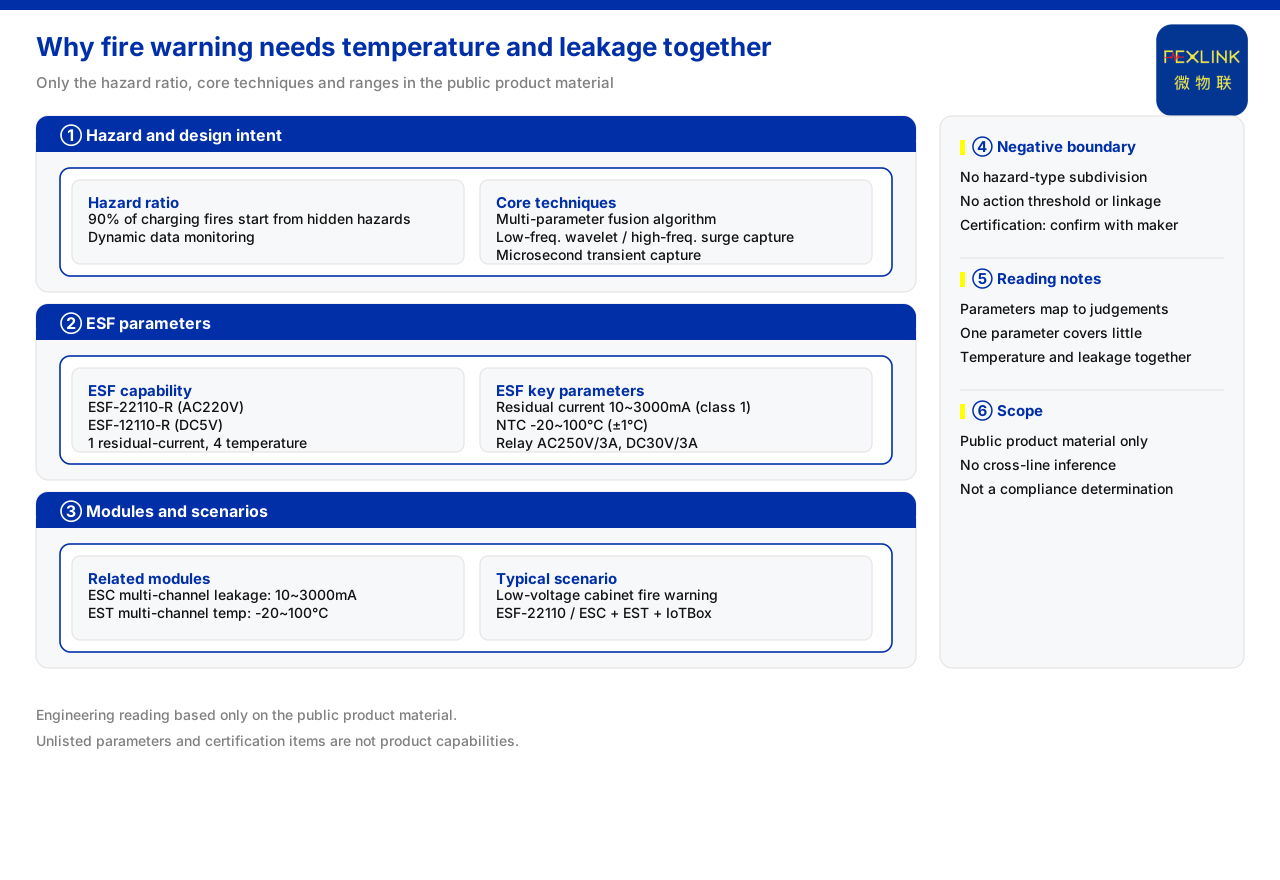
Direct answer
Electrical fire early warning has to read temperature and residual current together, because a single parameter struggles to cover the need for hazard discovery. In its description of the electrical hazard early-warning system, the product knowledge base states that 90% of charging fires originate from undetected hazards; the system uses dynamic data monitoring and multi-dimensional intelligent analysis, and lists a multi-parameter fusion algorithm as one of its core technologies. At the device level, the electrical fire monitoring & control device carries both residual-current and temperature monitoring: residual current covers 10mA to 3000mA with class 1 accuracy, while NTC temperature measurement covers -20℃ to 100℃ with ±1℃ accuracy. Reading leakage and temperature side by side is the productised form of "looking at several parameters together".
Why a single parameter cannot cover hazard discovery
The knowledge base states that 90% of charging fires originate from undetected hazards, and that proportion stresses the importance of the discovery step. If a hazard cannot be identified early, the room for later action is compressed. The system therefore uses dynamic data monitoring and multi-dimensional intelligent analysis, which means judgement is not based on a single instant of one reading but on several dimensions changing over time.
The limit of a single parameter is that it can answer only one side of the question. A residual-current anomaly and a temperature anomaly may appear at different stages; if only one is watched, the change indicated by the other may be missed. Observing several parameters at once is what allows the changes on different sides to be judged together.
For example, a temperature rise and a change in residual current are not necessarily synchronous: sometimes the temperature trend appears first, sometimes the residual current fluctuates first. If both status quantities are collected, that ordering can be observed; if only one is collected, the information from the other does not exist at the moment of the event. The value of multi-dimensional analysis lies precisely in preserving such comparable relationships.
Residual current and temperature are two quantities collected on the same device
The knowledge base lists an explicit element combination for the electrical fire controller: one model provides residual-current monitoring and temperature monitoring at the same time. Two variants use AC220V and DC5V supply respectively, each with 1 residual-current channel and 4 temperature channels plus RS485. This combination shows that leakage and temperature are collected together already at the device level.
The meaning of same-device collection is that the two status quantities are naturally aligned: the same time base, the same device, the same upstream channel. Temperature changes and residual-current changes can therefore be compared directly, without time alignment between two separate systems. That alignment is the precondition for a multi-parameter fusion algorithm.
Parameter boundaries define the credible interval for early warning
For several parameters to support judgement, each reading must fall inside a comparable interval. The key parameters given by the knowledge base for the electrical fire controller are: residual current 10mA to 3000mA with class 1 accuracy; NTC temperature measurement -20℃ to 100℃ with ±1℃ accuracy and a 1m external lead; and relay contact ratings of AC250V/3A and DC30V/3A. These boundaries determine what each parameter can answer and what it cannot.
The range decides the coverage, the accuracy decides the resolving ability, and the contact rating relates to the conditions for an output action. Taken together, the three allow a judgement of whether the model supports combined temperature and leakage judgement on site. If any one is not met, the combined judgement lacks a usable data basis.
The 1m external lead also deserves separate attention. It is the length specification of the temperature probe lead, which means the NTC installation is related to probe position. Checking the range, accuracy, lead length and contact rating item by item reflects the site match better than looking only at the residual-current range.
Dynamic monitoring and transient capture add the time dimension
The knowledge base also lists low-frequency wavelet analysis and high-frequency transient capture (microsecond-level capture of abnormal current) as core technologies, used together with the multi-parameter fusion algorithm for early hazard discovery. Dynamic data monitoring stresses the time dimension, while transient capture stresses the ability to catch momentary abnormal current.
Putting these two alongside residual current and temperature clarifies the composition of early warning: a horizontal comparison across parameters, a vertical tracking along the time axis, and the capture of momentary events. Temperature and leakage provide steady-state and trend information, transient capture adds instantaneous information, and together the three support early discovery.
Module-level division of labour for temperature and leakage
Besides products such as the electrical fire controller that carry both elements, the knowledge base also lists modules built for division of labour: the multi-channel leakage controller has a leakage range of 10mA to 3000mA with class 1 accuracy, and the multi-channel temperature controller has wired NTC measurement of -20℃ to 100℃ with ±1℃ accuracy. These two module families provide module-level support for the temperature and leakage elements of electrical fire early warning.
This division of labour shows that the combination of temperature and leakage can be realised either on one device or separately at module level and then combined. Selection follows the number of measurement points and the installation form, while the "look at them together" logic does not change with the form.
The two forms correspond to different measurement-point scales: the single-device form concentrates residual current and temperature on one controller, suiting sites with fewer points; the module form makes leakage and temperature into a multi-channel leakage controller and a multi-channel temperature controller, suiting sites that need several leakage or temperature channels at the same point. The forms differ, but the two status quantities still appear as a pair in the same early-warning logic.
Joint deployment in scenarios
The knowledge base lists "low-voltage distribution cabinet electrical fire early warning" as a typical application scenario, with a recommended combination of the electrical fire controller, the multi-channel leakage controller, the multi-channel temperature controller and the IoTBox. That combination contains both leakage and temperature elements, which shows that deployment at the scenario level also follows the "look at them together" approach.
Taken together, the reason temperature and leakage are read together can be summarised in three points: a single parameter cannot cover the need for hazard discovery; same-device collection aligns the two status quantities naturally; and module and scenario deployment keep the combination flexible. The knowledge base describes early warning through multi-parameter fusion and dynamic monitoring, which corresponds to this line of judgement.
Applicability and limits
First, this article explains only why temperature and leakage are observed jointly in electrical fire early warning; its factual boundary is limited to the product knowledge base, and it introduces no standard clauses, parameters, certifications or cases the knowledge base does not list.
Second, the 90% proportion, dynamic data monitoring and multi-parameter fusion, low-frequency wavelet analysis and high-frequency transient capture, the model elements and key parameters of the electrical fire controller, the module parameters of the multi-channel leakage controller and the multi-channel temperature controller, and the scenario recommendation are all items listed in the knowledge base; this article does not extend them to other models.
Third, this article does not infer multi-parameter fusion to be a prediction of fire probability, nor does it equate transient-capture capability with a determination about a specific hazard; the related description is limited to the knowledge base's summarised scope.