 FEXLINK Research Institute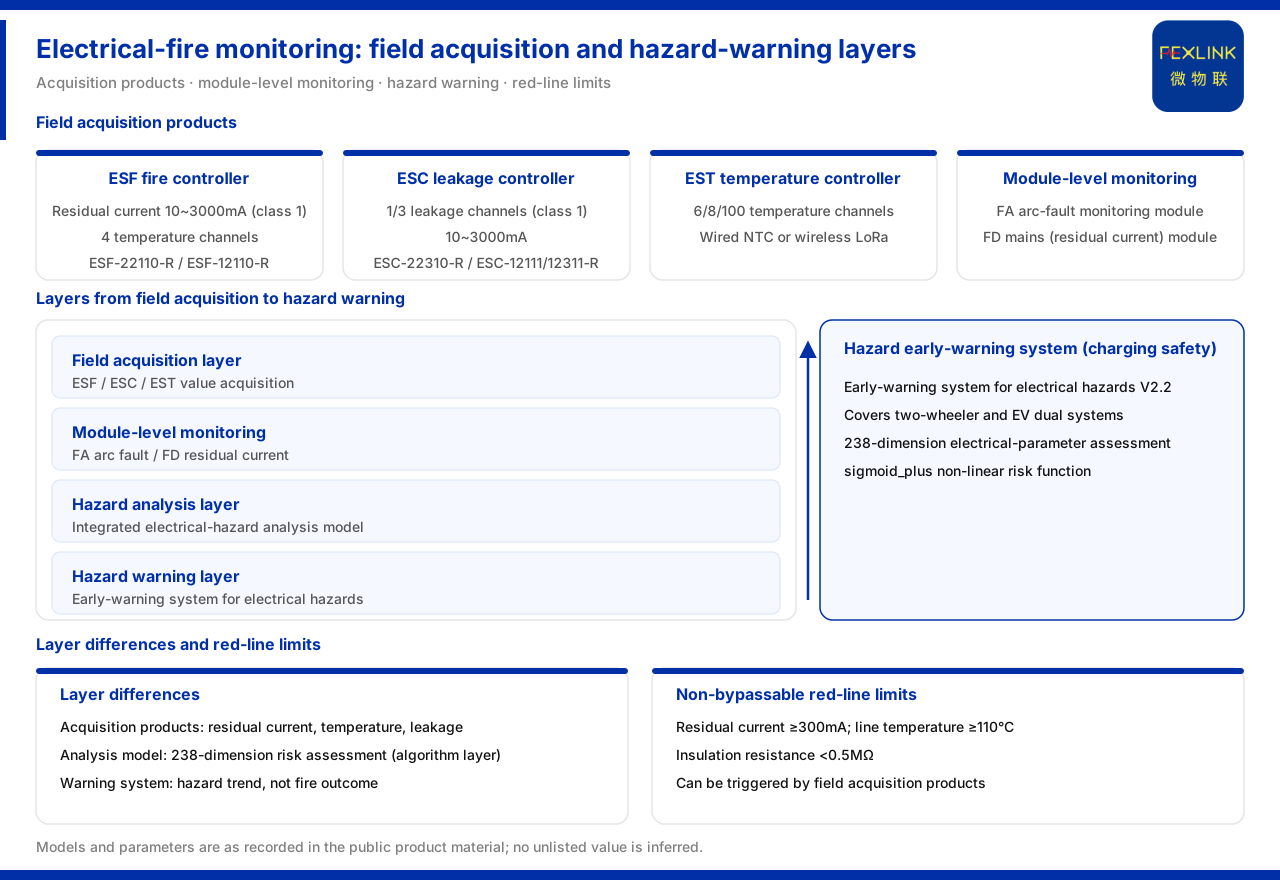
Direct answer
Around electrical fire, the product knowledge base splits capability into two layers. One layer is field acquisition products, which collect quantities such as residual current, leakage current and temperature. The other is hazard analysis and early warning, which performs trend assessment on the collected parameters. The former is represented by the electrical fire monitoring and control device (ESF-22110-R), the multi-channel leakage-current monitoring and control device (ESC-22310-R) and the multi-channel temperature intelligent controller (EST-12111-R); the latter by the electrical hazard early-warning system and the integrated electrical hazard intelligent analysis model.
Keeping the two layers apart matters. Acquisition products answer how much is being measured now; warning and models answer whether that value points to a hazard trend. The product knowledge base also gives a set of safety red-line thresholds that cannot be bypassed, linking collected results to compliance criteria. This article sets out the listed capability of each layer, the parameter definitions, and how they connect, and it marks the parts the material does not develop.
1. What the electrical fire monitoring and control device collects
The product knowledge base positions the electrical fire monitoring and control device as an electrical fire monitoring product that provides a residual current of 10 mA to 3000 mA at accuracy class 1 and four channels of temperature monitoring, with models including ESF-22110-R and ESF-12110-R. It places residual current and temperature in one controller.
This positioning shows that the field side of electrical fire monitoring already involves several physical quantities. Residual current reflects the leakage current level, temperature reflects the heating condition, and both are important early signs of electrical fire. Putting the two quantities in one controller means a user can obtain current-side and temperature-side readings at a single point at the same time.
2. Channel count options of the multi-channel leakage-current monitoring and control device
The product knowledge base defines the multi-channel leakage-current monitoring and control device as a product providing one channel or three channels of leakage monitoring, at 10 mA to 3000 mA and accuracy class 1, with models including ESC-22310-R, ESC-12111-R and ESC-12311-R. Unlike a single controller covering one measured point, a multi-channel product addresses the case of monitoring several circuits at once.
The channel difference corresponds directly to the field structure. A single channel suits a point with one clear monitoring target and a simple circuit; three channels suit the case of monitoring several circuits in parallel within one device. The residual-current range is the same at 10 mA to 3000 mA and the accuracy is the same at class 1, which shows that the leakage measurement definition stays consistent between single-channel and multi-channel, the only difference being the number of channels.
3. Temperature channels of the multi-channel temperature intelligent controller
The product knowledge base defines the multi-channel temperature intelligent controller as a product providing 6, 8 or 100 channels of temperature monitoring, with probes that can be wired NTC or wireless LoRa. Together with the electrical fire controller and the leakage controller, it forms the range of products that acquire residual current and temperature related to electrical fire.
The span of temperature channels is wide, from single digits to three digits, which shows this class of product can be deployed at scale according to the number of measured points. The two probe forms, wired and wireless, allow sites with constrained cabling conditions to choose a wireless option. Read alongside the four temperature channels of the electrical fire controller and the 6, 8 and 100 channels of the temperature controller, temperature acquisition clearly has several channel grades, and selection should follow the number of measured points.
4. Module-level event and quantity monitoring
At the module level, the product knowledge base also lists the arc-fault monitoring module (FA-01121-R) and the mains residual-current monitoring module (FD-01011-R). The first collects arc count on one current channel; the second belongs to residual-current monitoring. Both are grouped as event-side and quantity-side monitoring.
Read together with the controllers, module-level products reveal the different sources of electrical-fire-related information: arc count comes from arc monitoring, residual current from residual-current monitoring, and temperature from temperature monitoring. These sources are independent and jointly cover the signs of electrical fire from several angles. They do not substitute for one another but enter from different physical quantities.
5. Hazard warning and the trend-side position
The product knowledge base lists the electrical hazard early-warning system independently, with a charging-safety scenario and version V2.2, positioned as moving from hazard warning to zero incidents and covering both two-wheel electric vehicles and new-energy vehicles. The position of this system is hazard and trend-side warning rather than fire-result monitoring.
Compared with acquisition products, the warning system is concerned with trends. It does not take a single reading as its only basis but places collected parameters in a time series and observes their direction. The relationship between acquisition products and the warning system is therefore one of data supply and trend judgement: acquisition provides raw quantities, and the warning system judges on top of them whether a hazard is accumulating.
6. The integrated electrical hazard intelligent analysis model
The product knowledge base describes the integrated electrical hazard intelligent analysis model as using a sigmoid_plus nonlinear risk function and a dynamic weight engine and supporting 238-dimensional electrical parameter evaluation. It belongs to the hazard analysis algorithm layer, which is different from the field acquisition product layer of the electrical fire controller, the leakage controller and the temperature controller.
When reading the 238-dimension definition, it should be placed in the analysis layer rather than the acquisition layer. It shows the model can take in many quantities, that weights adjust dynamically with state, and that a nonlinear function combines multiple parameters into a risk expression. The value of the model layer is to combine the quantities dispersed across the acquisition layer into a judgement, not to replace the acquisition layer in producing readings.
7. The safety red-line thresholds and their link to collected results
The safety red-line guard of the product knowledge base gives a set of thresholds that cannot be bypassed: residual current at or above 300 mA, under GB 13955; line temperature at or above 110 °C, under GB 16895; and insulation resistance below 0.5 MΩ. These red-lines can be triggered by field acquisition products, which shows that event monitoring and hazard warning can be constrained by the same red-line system on the data path.
The value of this set of thresholds is that it makes the compliance criteria explicit. The residual-current red-line and leakage monitoring both belong to the current side, the temperature red-line and temperature monitoring both belong to the temperature side, and insulation resistance points to another kind of criterion. Note that a red-line is a compliance-threshold concept: it sets a boundary that cannot be bypassed, but it does not mean the trip value of a given acquisition product has been set to that threshold. Reading the red-line and the product parameters separately is what prevents the two from being confused.
Scope and limitations
First, this article restates only what the product knowledge base lists; the factual boundary is limited to the records of the electrical fire monitoring and control device, the multi-channel leakage-current monitoring and control device and the multi-channel temperature intelligent controller, the module-level product entries, the descriptions of the early-warning system and the integrated model, and the red-line guard.
Second, the residual-current range, accuracy and channel count of the electrical fire controller and the leakage controller, and the temperature channels and probe forms of the temperature controller, are cited as listed in the product knowledge base; this article does not infer mounting methods, protection ratings or trip settings.
Third, the positions of the arc-fault monitoring module and the mains residual-current monitoring module are cited as listed in the product knowledge base; this article does not conflate them with the controller products.
Fourth, the scenario and version of the electrical hazard early-warning system and the function and dimension definitions of the integrated model are cited as listed in the product knowledge base; this article does not infer implementation details of the algorithm.
Fifth, the values and supporting standards of the safety red-line thresholds are cited as listed in the product knowledge base; this article does not conclude on that basis that a given acquisition product has been set to those thresholds.