 FEXLINK Research Institute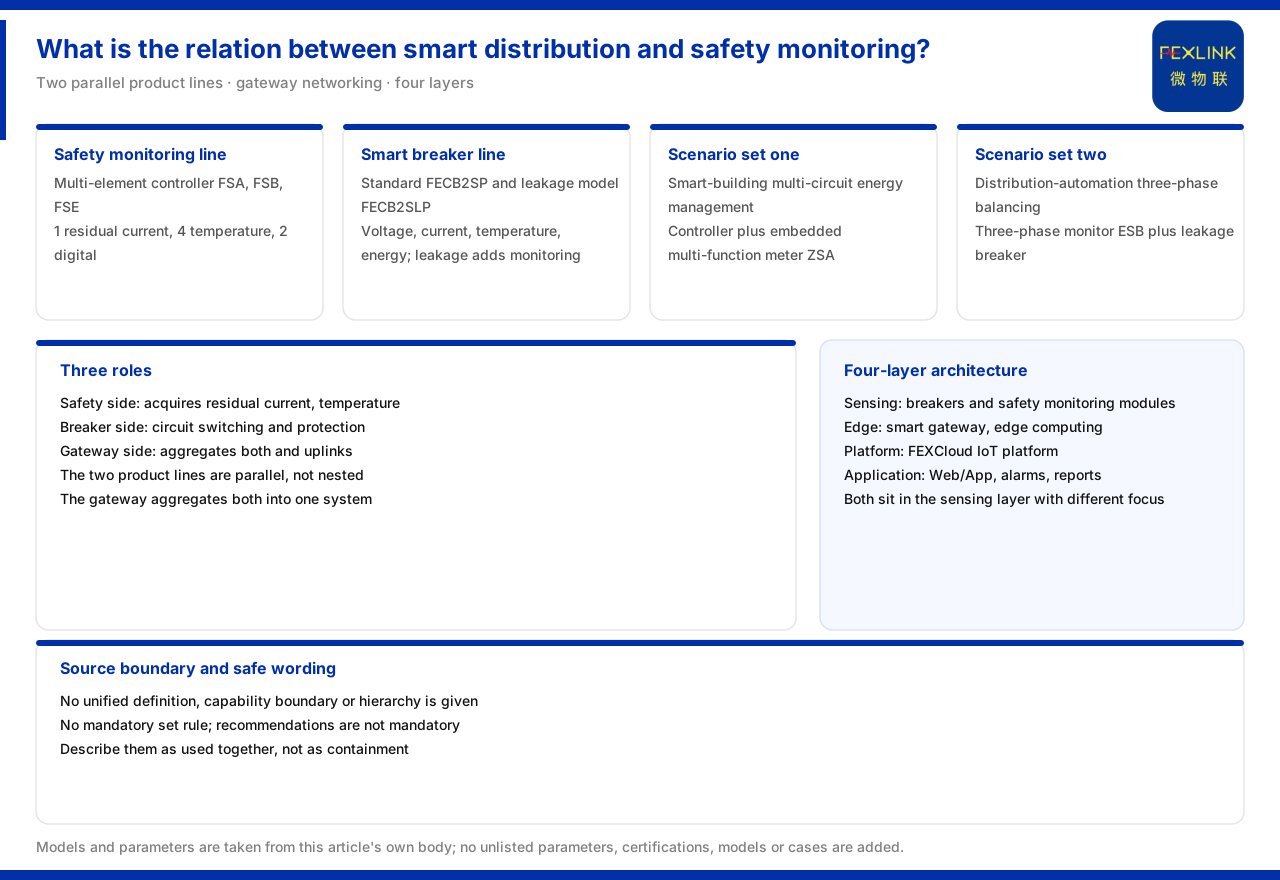
What is the relationship between smart power distribution and electrical-safety monitoring?
Direct answer: from the existing product material it can be seen that smart power distribution and electrical-safety monitoring are two parallel product lines in the product-line overview - one is "digital power-consumption and electrical-safety monitoring", the other is "intelligent circuit breaker" - and the two are networked by smart gateways and edge computing. The material gives no unified definition, capability boundary or subordination relationship for the two concepts; they appear mainly as parallel product lines and typical scenario combinations. What can therefore be confirmed is "how they are combined for use", and what cannot be confirmed is who contains whom and who belongs to whom. If an engineering scheme writes the two as a superior-subordinate relationship, it exceeds what the material can support.
The key to understanding this relationship lies not in the concepts themselves but in their division of labour: the electrical-safety monitoring side acquires safety elements such as residual current and temperature, the intelligent circuit breaker side performs circuit switching and protection, and the gateway side aggregates and sends up the data of both sides. All the evidence the material gives revolves around how these three roles cooperate in the same scenario, not around a definition of the concepts.
The roles of the two parallel product lines
On the "digital power-consumption and electrical-safety monitoring" side, the typical product is the multi-parameter electrical intelligent controller (FSA/FSB/FSE), whose common functions include one residual-current channel, 4 temperature-monitoring channels, 2 switching-value inputs, 2 relay outputs, meter monitoring and two RS485 (Modbus) channels. Its positioning leans towards "monitoring" and "measuring", continuously acquiring the electrical-safety elements of a circuit.
On the "intelligent circuit breaker" side, there are the standard intelligent circuit breaker (FECB2SP) and the intelligent circuit breaker with residual-current protection (FECB2SLP). The standard model provides voltage, current and temperature monitoring and energy metering; the residual-current model adds leakage monitoring and residual-current protection. The communication of the whole breaker series is RS485. Its positioning leans towards "breaking" and "protecting", that is, executing switching and protection at the circuit level while providing electrical quantities such as voltage and current.
Both product lines are networked by smart gateways and edge computing. The existence of this intermediate layer shows the two classes of device do not form networks independently but are aggregated through a gateway and then sent up in a unified way. The material's description of the networking role is the main clue linking the two.
The division of labour revealed by scenario combinations
In its typical application scenarios and selection comparison, the material gives two combinations that precisely reflect the division of labour. One combination corresponds to "smart-building multi-circuit power management", pairing the multi-parameter electrical intelligent controller with the embedded multi-function smart meter (ZSA), focusing on the monitoring and management of multi-circuit power. The other corresponds to "distribution-automation three-phase treatment", pairing the three-phase imbalance monitor (ESB) with the intelligent circuit breaker with residual-current protection, focusing on three-phase imbalance monitoring and circuit protection.
These two pairings show that electrical-safety monitoring devices and intelligent circuit breakers often appear in the same scheme but take different responsibilities. The former provides observation of safety and electrical parameters, the latter provides circuit protection and execution. The material presents the two as parallel product lines and scenario combinations without grouping them into one product line or one level, which also confirms a relationship of "used together" rather than "subordinate inclusion".
Position in the four-layer architecture
The general four-layer architecture of the monitoring system given by the material is: perception layer (surge protective device monitor, grounding resistance monitor, lightning current monitor, electrical-safety monitoring series, meters, sensors, etc.) to edge layer (smart gateway, edge-computing gateway, cloud PLC, etc.) to platform layer (FEXCloud) to application layer (Web/App, alerts, reports).
In this architecture, the smart distribution breaker and the electrical-safety monitoring modules sit on the same perception layer. This positional relation is more concrete than a "concept relation": both are primary-side acquisition and execution devices facing the field, passing upward through the edge layer and platform layer in turn. From the system layering, they are on the same layer and take different emphases within it; from the product-line view, they are two parallel lines. The material gives no statement that either contains the other.
Boundary questions the material does not answer
First, no unified definition. The material does not use one sentence to state the strict definitions of "smart power distribution" and "electrical-safety monitoring", nor does it give a criterion for their boundary.
Second, no capability boundary. The material does not say which functions belong to smart power distribution and which to electrical-safety monitoring, nor does it give an attribution rule for their overlap.
Third, no subordination relationship. The material presents the two as parallel product lines and scenario combinations and does not say who contains whom or who takes priority.
Fourth, no mandatory rule for the combination. The combinations in the scenario table are recommended comparisons; the material does not say under what conditions which combination must be used, nor the consequence of not using a combination. Treating a recommended combination as a mandatory requirement also exceeds the material boundary.
A checklist to complete before implementation
- Sort requirements by role. First clarify whether the site needs "monitoring of safety and electrical parameters", or "circuit switching and protection", or both.
- Compare selection by scenario. Refer to the scenario combinations in the material, such as multi-circuit power management and three-phase imbalance treatment, to determine the pairing of the monitoring side and the breaker side.
- Clarify the gateway position. Confirm who undertakes the smart gateway or edge computing and which devices it aggregates, avoiding the two classes of device forming separate networks.
- Do not conclude on the concept relationship. A scheme should describe "used together", not write a subordinate relationship such as "smart power distribution contains electrical-safety monitoring".
- Review the mandatory nature and exceptions of the combination separately. The material gives no mandatory rule, and the relevant constraints should be confirmed separately on site and recorded.
Summary
In the material, smart power distribution and electrical-safety monitoring are two parallel product lines: one represented by the multi-parameter electrical intelligent controller, stressing acquisition of safety and electrical parameters; one represented by the intelligent circuit breaker, stressing circuit protection and switching execution; the two are networked by smart gateways and edge computing and sit on the same perception layer in the four-layer architecture. What the material can support is this division of labour and way of combining; what it cannot support is a unified definition, capability boundary or subordination relationship of the two.
For an engineer, the safe approach is to split requirements by role, choose combinations by scenario, and fix the gateway position by the four-layer architecture; for review and delivery, one should check whether a scheme mistakenly writes a parallel relationship as an inclusion relationship, or treats a recommended combination as a mandatory requirement. Keeping "confirmable division of labour" and "undefined concepts" apart makes a scheme stand.