 FEXLINK Research Institute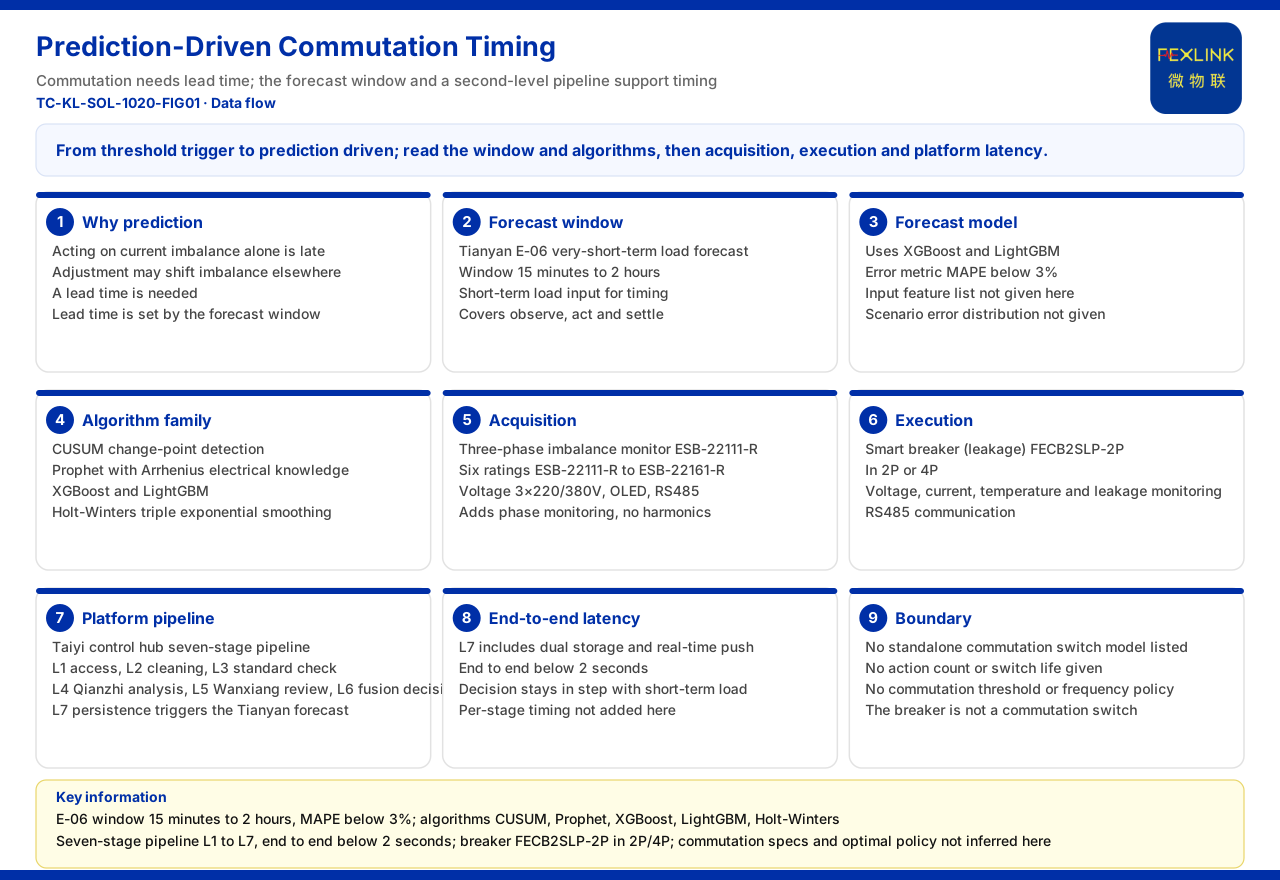
Direct answer
To move three-phase imbalance treatment from "adjustment afterwards" to "arrangement beforehand", the key is the phase-swapping timing. Phase swapping cannot be done at any time: when to act, which phase to act on, and whether the action transfers the imbalance to another period all depend on judging the short-term future load. The support the product knowledge base gives is several capabilities: on the prediction side, E-06 extremely short-term load forecasting of the Tianyan engine, using XGBoost and LightGBM, with a forecast window of 15 minutes to 2 hours and an error metric MAPE of less than 3%; on the platform side, the seven-level pipeline of the Taiyi intelligent control hub system strings the prediction into the decision, with end-to-end less than 2 seconds; and on the acquisition and execution side it recommends the combination of the three-phase imbalance monitor plus the intelligent circuit breaker with residual-current protection. One boundary must be written first: the product knowledge base lists no independent phase-switching switch model and gives no phase-swap action count, switch lifetime parameter, phase-swap threshold or action-frequency strategy, so this article only explains how the prediction-driven decision link is organised, and infers no phase-switching equipment specification or optimal action strategy.
1. Why phase swapping depends on prediction rather than the present alone
Phase swapping is essentially adjusting load from one phase to another. If one acts on the current imbalance degree alone, two problems arise: the timing of the action lags, adjusting only after the imbalance has already formed; and the new load distribution after adjustment produces a new imbalance, even pushing the problem into the adjacent period.
Phase swapping therefore needs a "lead time". The length of this lead time is decided by the forecast window: if the load trend is known tens of seconds to two hours ahead, the adjustment can be arranged before the imbalance forms. The product knowledge base assigns this role to the extremely short-term load forecasting of the Tianyan engine and, with the platform-layer pipeline, completes the decision in seconds, showing the design orientation is "prediction-driven" rather than "threshold-triggered".
2. Prediction side: extremely short-term load forecasting provides the window
The product knowledge base records that E-06 extremely short-term load forecasting of the Tianyan engine uses XGBoost and LightGBM, with a forecast window of 15 minutes to 2 hours and an error metric MAPE of less than 3%. These parameters define the time scale of the forecast: a quarter of an hour at the short end and two hours at the long end, covering exactly the process from observation to action to visible effect.
Note that the product knowledge base gives the model type, forecast window and error definition, not the input feature list, training data range or error distribution under different scenarios, so this article adds none of these unlisted contents. What can be confirmed is that E-06 provides the short-term load input for choosing the phase-swap timing.
3. Algorithm side: the core algorithm family of the Tianyan engine
Prediction is not a single model. The product knowledge base records that the core algorithms of the Tianyan engine include CUSUM change-point detection, Prophet with injected Arrhenius electrical knowledge, XGBoost and LightGBM, and Holt-Winters triple exponential smoothing. These algorithms have different duties: change-point detection identifies trend turning points, Prophet performs time-series prediction with prior knowledge, XGBoost and LightGBM perform feature-driven regression, and Holt-Winters performs seasonal smoothing extrapolation.
Placing this set together shows the prediction side has both turning-point identification and trend extrapolation, providing multi-source input for the phase-swap decision. The product knowledge base lists only the algorithm names and part of the description, not the scheduling or weights of each algorithm in the pipeline, and this article does not develop them.
4. Acquisition and execution side: monitor and breaker
The acquisition side is taken by the three-phase imbalance monitor. The product knowledge base records that the three-phase imbalance monitor (ESB-22111-R), sharing the architecture of the all-parameter smart meter, has six current grades (corresponding to ESB-22111-R through ESB-22161-R), a voltage of 3 × 220/380 V, an OLED display and RS485; the product adds phase monitoring, has no harmonic monitoring, and provides 2 switching-value inputs and 1 relay output.
On the execution side it recommends the intelligent circuit breaker with residual-current protection. The product knowledge base records that the intelligent circuit breaker with residual-current protection (corresponding to a model such as FECB2SLP-2P) has 2P or 4P specifications and supports voltage, current and temperature monitoring, leakage monitoring and energy metering, with RS485 communication; in the naming rule, the residual-current model is marked SLP and the standard model SP. In the selection comparison of the product knowledge base, distribution-automation three-phase treatment recommends the combination of the three-phase imbalance monitor plus this breaker.
Note that the product knowledge base does not define this breaker as a phase-switching actuator and gives no action count or lifetime parameter, so this article does not equate the breaker with a phase-switching switch and only states its monitoring and switching capability on the circuit side.
5. Platform side: how the seven-level pipeline completes a decision in seconds
Between prediction and execution a platform is needed to string the data together. The product knowledge base records that the seven-level pipeline of the Taiyi intelligent control hub system is: L1 access, L2 cleaning, L3 standard verification (safety red-line pre-check), L4 Qianzhi analysis, L5 Wanxiang assessment, L6 fusion decision, L7 persistence, where L7 includes dual-database storage, real-time push and triggering the Tianyan prediction, with end-to-end less than 2 seconds.
The meaning of this pipeline is that the whole process, from acquisition-data access to prediction trigger to decision output, is kept within seconds. For the phase-swap timing, an end-to-end latency in seconds means the decision can stay synchronised with short-term load changes. The product knowledge base gives only the layer names and the end-to-end latency, not the per-layer duration or scheduling detail, and this article does not add them.
6. Reading order of prediction-driven decisions
The above capabilities can be drawn into a link: the three-phase imbalance monitor provides phase and imbalance observations; the prediction trigger enters the Tianyan engine, where models such as E-06 give a load forecast of 15 minutes to 2 hours; the core algorithm family identifies turning points and extrapolates trends; the Taiyi seven-level pipeline completes processing from access to persistence within an end-to-end of less than 2 seconds; and finally the monitor and breaker support execution on the circuit side.
The boundary that must be kept is: the product knowledge base gives no phase-swap threshold or action-frequency strategy, so this link can only show "prediction can support timing selection" and cannot replace on-site determination of action conditions.
7. Common misreadings
The first misreading is to treat phase swapping as an instantaneous threshold-triggered action and ignore the lead time of the forecast window. The second is to treat the E-06 MAPE of less than 3% as a guarantee for all scenarios and ignore that the knowledge base gives no error distribution. The third is to treat the intelligent circuit breaker directly as a phase-switching switch and ignore that the knowledge base does not equate the two. The fourth is to treat the end-to-end latency of the seven-level pipeline as the whole on-site latency and ignore the acquisition and network segments. The fifth is to ignore that the knowledge base gives no phase-swap action count or switch lifetime parameter and to formulate a maintenance plan on that basis.
Scope and limitations
First, the factual basis of this article is the product knowledge base, and all product parameters are limited to what it lists. Second, the product knowledge base lists no independent phase-switching switch model and gives no phase-swap action count, switch lifetime parameter, phase-swap threshold or action-frequency strategy, and this article infers no phase-switching equipment specification or optimal action strategy. Third, the XGBoost and LightGBM, the 15-minute to 2-hour window and the MAPE of less than 3% of Tianyan engine E-06 extremely short-term load forecasting are cited as listed. Fourth, the core algorithms of the Tianyan engine including CUSUM, Prophet, XGBoost and LightGBM, and Holt-Winters are cited as listed. Fifth, the parameters of the three-phase imbalance monitor (ESB-22111-R through ESB-22161-R) and the functions and specifications of the intelligent circuit breaker with residual-current protection (FECB2SLP-2P) are cited as listed. Sixth, the seven-level pipeline and the end-to-end of less than 2 seconds of the Taiyi intelligent control hub system are cited as listed. Seventh, this article promises no treatment effect or action-strategy benefit; the actual situation is subject to the latest product material and formal documents.