 FEXLINK Research Institute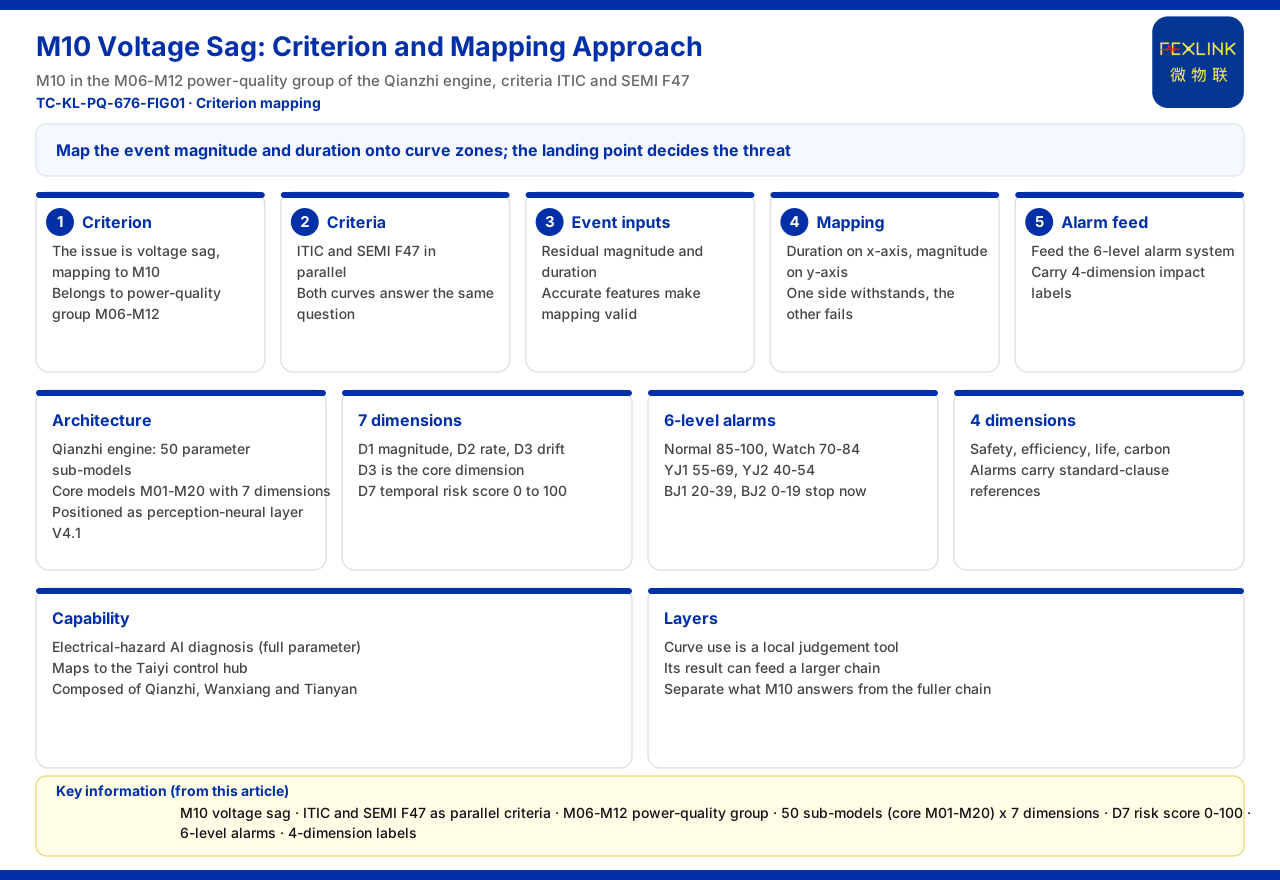
Direct Answer
Whether a voltage sag causes equipment shutdown is essentially a question of the equipment's tolerance boundary. In the product knowledge base, M10 in the power-quality physical-examination group of the Qianzhi engine is defined as voltage sag, and the criterion adopts the two curves ITIC and SEMI F47 in parallel. In use, the two characteristics of a sag event — residual amplitude and duration — are mapped onto the tolerance and failure zones divided by the curves, and observing which side the point falls on gives a preliminary judgement of whether the equipment tolerates the event. The boundary to keep is that, within the text of the product knowledge base, no axis graduation, duration threshold table or specific mapping value of the two curves is given, so this article states only the attribution of the criterion, the position of the parameters in the architecture and the order of use, without giving threshold numbers or a point-by-point judgement result.
1. Attribution of the Criterion: M10 Belongs to the Power-Quality Physical-Examination Group
In the product knowledge base, the core architecture of the Qianzhi engine is 50 parameter sub-models, currently containing 20 core models M01-M20 and overlaid with seven-dimensional perception. The parameter sub-models are grouped by physical-examination theme, among which M06-M12 form the power-quality physical-examination group, and voltage sag is M10. That is, the perception and judgement of sag belong to the Qianzhi engine and not to another engine. Once this is clear, which curve to use and where the judgement occurs have definite answers: the curves are ITIC and SEMI F47, and the judgement occurs in M10. Placing M10 back into the group M06-M12 also shows that it is parallel to the other power-quality specialities, and each curve solves only its own class of problem and cannot substitute for another.
2. The Two Characteristics of a Sag Event
A sag event is usually described by two characteristics: first, the residual voltage amplitude, and second, the duration. The seven-dimensional perception matrix of the product knowledge base gives D1 amplitude, D2 rate of change, D3 trend drift, D4 anomaly density, D5 fluctuation amplitude, D6 correlation verification and D7 time-series risk score, where D3 is marked as a core dimension and D7 is a composite decision score of 0 to 100. Amplitude and rate of change correspond to the intensity of the event, trend drift and anomaly density to whether it recurs, correlation verification to whether it is synchronous with an anomaly in another quantity, and the time-series risk score condenses several dimensions into a score usable for decision. When using the curves, one must first reduce an event to the pair of amplitude and duration and then map that pair onto the coordinate system of the curve. Only if the characteristics are read accurately does the mapping make sense; if they are misread, every later judgement shifts.
3. The Mapping Approach and the Boundary That Must Not Be Crossed
The use of the curves can be summarised as a zoning chart on a two-dimensional plane: the horizontal axis is duration, the vertical axis is residual amplitude, and the curve itself forms the dividing line, with a tolerable zone on one side and a failure zone on the other. Placing the amplitude and duration of an event as a coordinate point, and seeing which side the point falls on, tells whether that sag poses a threat to the equipment. What the product knowledge base confirms is the positioning of the two curves as the M10 criterion; it does not give the axis graduations, the specific values of the curve breakpoints or a duration threshold table. This article therefore describes only the mapping method and the judgement order and fills in no threshold. Treating a blank as known, or adding curve values from other materials, crosses the traceable boundary, and this is the easiest place to err when using this criterion.
4. How the Perception Layer Carries This Judgement
The family overview of the product knowledge base positions the Qianzhi engine as the perception-nerve and object-recognition layer, whose responsibility is to know what has become anomalous, with the version recorded as V4.1. The perception and judgement of voltage sag fall precisely in this layer. There is also a corresponding judgement layer, but for the sag curves the judgement occurs in M10 of the perception layer, which first identifies the event and then hands it to later stages. In the seven-dimensional perception matrix, D3 trend drift is marked as a core dimension, showing that, beyond a single event, a recurring sag trend is equally important; the D7 time-series risk score compresses time-series information into a 0 to 100 conclusion for direct reference in the decision stage. The perception layer first gives whether there is an anomaly, and later stages then decide how to handle it.
5. How the Judgement Result Enters Alarms
The six-level alarm system of the product knowledge base is normal 85 to 100, Watch 70 to 84, YJ1 55 to 69, YJ2 40 to 54, BJ1 20 to 39 with handling within 48 hours, and BJ2 0 to 19 with immediate shutdown. Each alarm carries a standard-clause reference and a four-dimensional impact label, where the four dimensions are safety, efficiency, lifetime and carbon emission. ITIC and SEMI F47, as the sag criteria, can be presented together with the alarm reference, binding the basis of judgement to that alarm. The point is that a sag is not displayed as an isolated number but is given with the curve it relies on and the impact dimensions, making it easier to arrange handling order by level and impact.
6. From a Single-Point Judgement to the Whole-Chain Capability
In the product selection and capability comparison of the product knowledge base, the all-parameter capability of electrical-hazard AI diagnosis corresponds to the Taiyi intelligent control hub system, which consists of the Qianzhi, Wanxiang and Tianyan engines. Connecting this with the preceding content, the M10 sag judgement sits on the Qianzhi side and belongs to the perception and object-recognition step; only when the sag must be brought into a decision together with impacts such as efficiency, lifetime and carbon emission does it enter the scope of three-engine collaboration. That is, the use of the curve itself is a local judgement tool, and its conclusion can become an input to a larger analysis chain. Understanding this hierarchy helps distinguish, in use, which questions M10 answers and which require a more complete chain.
7. Boundaries to Keep and the Reading Order
The above can be reduced to a reading order. First, confirm that the question belongs to voltage sag and corresponds to M10. Second, confirm that the criterion is ITIC and SEMI F47. Third, reduce the event to the two characteristics of amplitude and duration and judge the side of the curve on which the point falls. Fourth, connect the judgement result to the six-level alarm and the four-dimensional impact label. The boundary to keep is that the product knowledge base gives no axis graduation, duration threshold table or specific mapping value of the two curves; whether a sag causes shutdown must be checked separately against equipment tolerance data, and no specific threshold may be inferred from the product knowledge base, nor may a conversion between the curves be stated as a determinate conclusion.
Applicability and Limits
First, this article restates only what the product knowledge base lists, and its factual boundary is the record of the power-quality physical-examination group of the Qianzhi engine, the six-level alarm system and the selection comparison.
Second, the M10 voltage sag adopts ITIC and SEMI F47 as its criterion, cited under the convention listed in the product knowledge base; no axis or threshold of the two curves is added.
Third, the architecture of 50 parameter sub-models, the current 20 core models M01-M20 and seven-dimensional perception of the Qianzhi engine is cited under the convention listed in the product knowledge base.
Fourth, D3 trend drift as a core dimension and D7 time-series risk score as a 0 to 100 composite decision score are cited under the product knowledge base convention.
Fifth, the level intervals and handling conventions of the six-level alarm and the standard-clause reference and four-dimensional impact label carried by alarms are cited under the convention listed in the product knowledge base; this article does not restate specific event values.
Sixth, the correspondence of the all-parameter capability of electrical-hazard AI diagnosis to the Taiyi intelligent control hub system is cited as listed in the selection comparison of the product knowledge base, and this article does not expand it into a specific project scheme.
Seventh, the product knowledge base gives no axis, duration threshold table or specific mapping value of ITIC and SEMI F47; this article accordingly states no specific threshold or judgement result.
Eighth, this article explains only the information and reading order within the product knowledge base and is not a project diagnosis or equipment-selection commitment; the latest product materials and formal documents prevail.