 FEXLINK Research Institute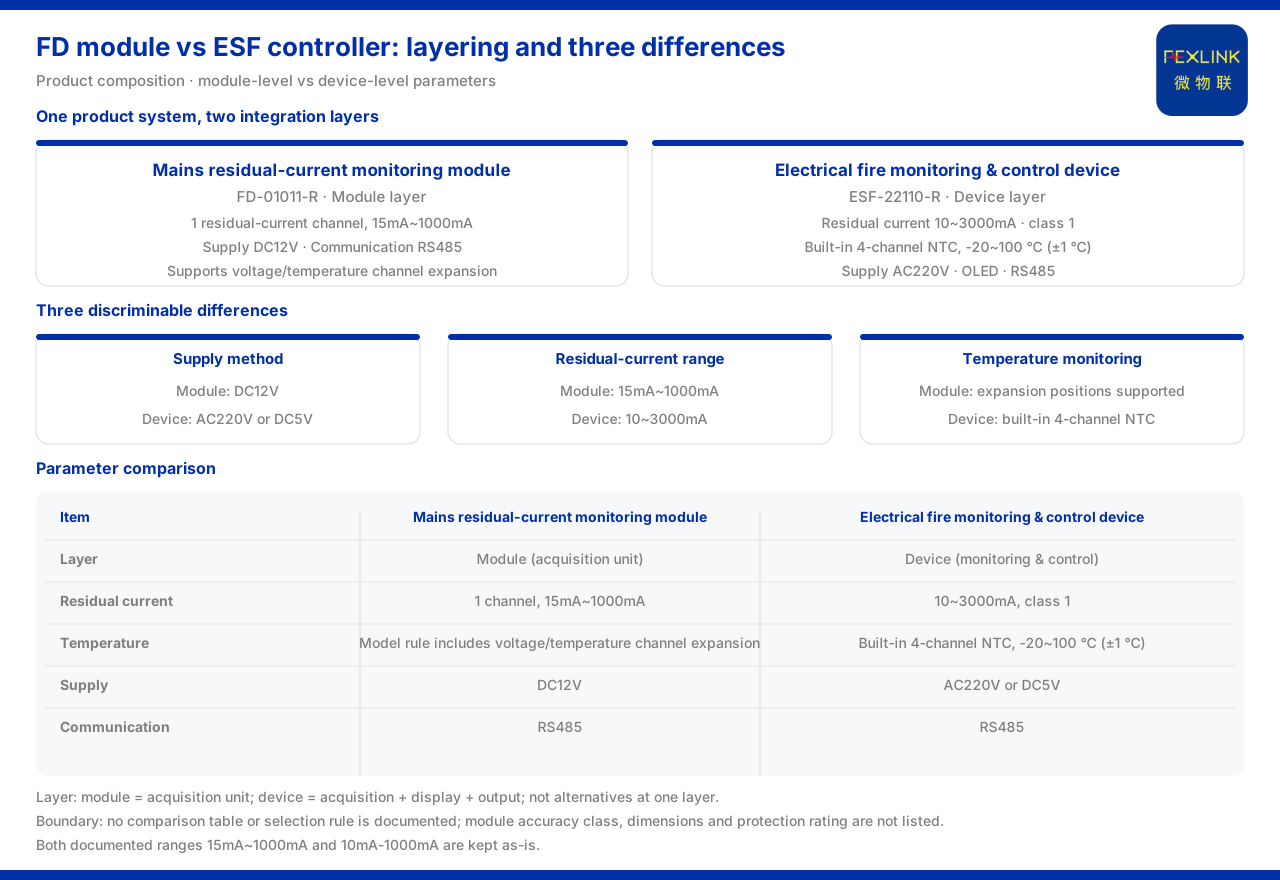
Direct answer
The mains residual-current monitoring module (e.g. FD-01011-R) and the electrical fire monitoring & control device (e.g. ESF-22110-R) sit at different integration layers: the former is a module, the latter a complete device. The module provides 1 residual-current monitoring channel with an acquisition range of 15mA~1000mA, a DC12V supply and RS485 communication; the device covers a residual-current range of 10~3000mA and integrates 4 temperature monitoring channels, with supply selectable as AC220V or DC5V. The three discriminable differences are the supply method, the residual-current range, and whether temperature monitoring is integrated.
Product-line position: one at the module layer, one at the device layer
The knowledge base lists the electrical fire monitoring & control device and the multi-channel leakage-current monitoring & control device (e.g. ESC-22310-R) under the "digital power-use and electrical-safety monitoring" product line, records the mains residual-current monitoring module as a residual-current monitoring module, and documents it in the same section as the arc-fault monitoring module (e.g. FA-01121-R). In other words, the residual-current monitoring module is an acquisition unit inside the same product system, while the electrical fire monitoring & control device is a complete device that carries acquisition, display and output. Because the whole device also owns the interfaces and output stages that a module does not, the two are not alternative options at one layer but stand in a module-to-device relationship.
This layering matters before any parameter is compared. A module answers "how do I acquire a residual current and put it onto a bus"; a complete device answers "how do I acquire, watch, display and act on multiple physical quantities within one enclosure". Reading the two as substitutes at the same level usually leads to a category error: the comparison then focuses on which value is larger, while the real question is which integration layer the project needs.
Residual-current acquisition: range and supply
The mains residual-current monitoring module provides 1 residual-current monitoring channel, with the acquisition range recorded as 15mA~1000mA (that is, the 10mA~1000mA tier); in the model rule, the current-acquisition-range code 1 corresponds to 15mA~1000mA, and the model also supports expansion positions for voltage and temperature channel counts; the product outline positions the module as a "residual-current monitoring module (10mA-1000mA)". Its supply is DC12V and its communication is RS485.
The electrical fire monitoring & control device has a residual-current range of 10~3000mA with accuracy class 1, and its supply method has two options, AC220V and DC5V. Because the range and the supply differ, the module cannot directly adopt the supply and range basis of the device. Keeping the two parameter sets separate is the precondition for a correct selection: the supply feeds the acquisition front end, and the accuracy class is only meaningful for the range within which it was specified, so neither item can be borrowed across the two layers.
Integrated temperature: the complete device carries one more capability
The electrical fire monitoring & control device integrates 4 temperature monitoring channels and gives NTC measurement of -20~100 °C (±1 °C, external lead length 1m). Taking the AC220V supply version as an example, its configuration is 1 residual-current channel, 4 temperature channels, 2 digital inputs, 1 relay output and RS485; the DC5V supply version is 1 residual-current channel, 4 temperature channels, 1 relay output and RS485. The relay contact rating is AC250V/3A, DC30V/3A. On the module side, the documentation only mentions support for temperature channel-count expansion positions; it does not give built-in temperature monitoring, nor does it list complete-device interfaces such as relay outputs or digital inputs. Integration of temperature monitoring is therefore an attribute of the complete device, not something the module provides by default.
Parameter comparison
The following table places the two side by side so that the layer, range, temperature, supply and communication correspondences can be checked at a glance.
| Comparison item | Mains residual-current monitoring module | Electrical fire monitoring & control device |
| --- | --- | --- |
| Layer | Acquisition module | Complete device |
| Residual current | 1 channel, 15mA~1000mA | 10~3000mA, accuracy class 1 |
| Temperature | Model rule includes voltage/temperature channel-count expansion positions | Built-in 4-channel NTC, -20~100 °C (±1 °C) |
| Supply | DC12V | AC220V or DC5V |
| Communication | RS485 | RS485 |
Scenario placement and evidence boundary
In the typical application scenarios and selection comparison table, the knowledge base lists the recommended combination for "low-voltage distribution cabinet electrical fire warning" as the electrical fire monitoring & control device and the multi-channel leakage-current monitoring & control device, further combined with the multi-channel temperature intelligent controller (e.g. EST-12111-R) and IoTBox; the recommended combination for "charging station / charging shed hazard warning" is the electrical hazard early-warning system, the multi-channel leakage-current monitoring & control device, the multi-channel temperature intelligent controller and FEXCloud. The comparison table does not list the mains residual-current monitoring module as an independent scenario combination; the recommended combinations in the table are all made up of complete devices and monitors. That is a statement about how the documented combinations are built, not a judgment that the module has no use of its own.
Scope and limitations
First, this article only explains the layering and parameters of the mains residual-current monitoring module and the electrical fire monitoring & control device. The factual boundary is limited to the product documentation, and no standard clause, certification or case not listed there is introduced.
Second, the documentation gives neither a comparison table nor a selection-boundary decision rule for the two, nor does it give the module's accuracy class, installation dimensions or protection rating; the differences summarized here are derived entirely from the three listed parameters — supply, range and temperature.
Third, the module's acquisition range appears in the documentation in two coexisting expressions, "15mA~1000mA" and "10mA-1000mA"; this article keeps them as they are and does not merge them.
Fourth, the documentation also does not state as a factual proposition the conclusion that "the module is better suited to modular embedded acquisition"; that judgment is an editorial framing, and this article does not present it as a product fact.
Fifth, actual selection should be determined by engineering design in conjunction with on-site supply conditions and circuit form; this article does not infer wiring details not listed in the documentation.