 FEXLINK Research Institute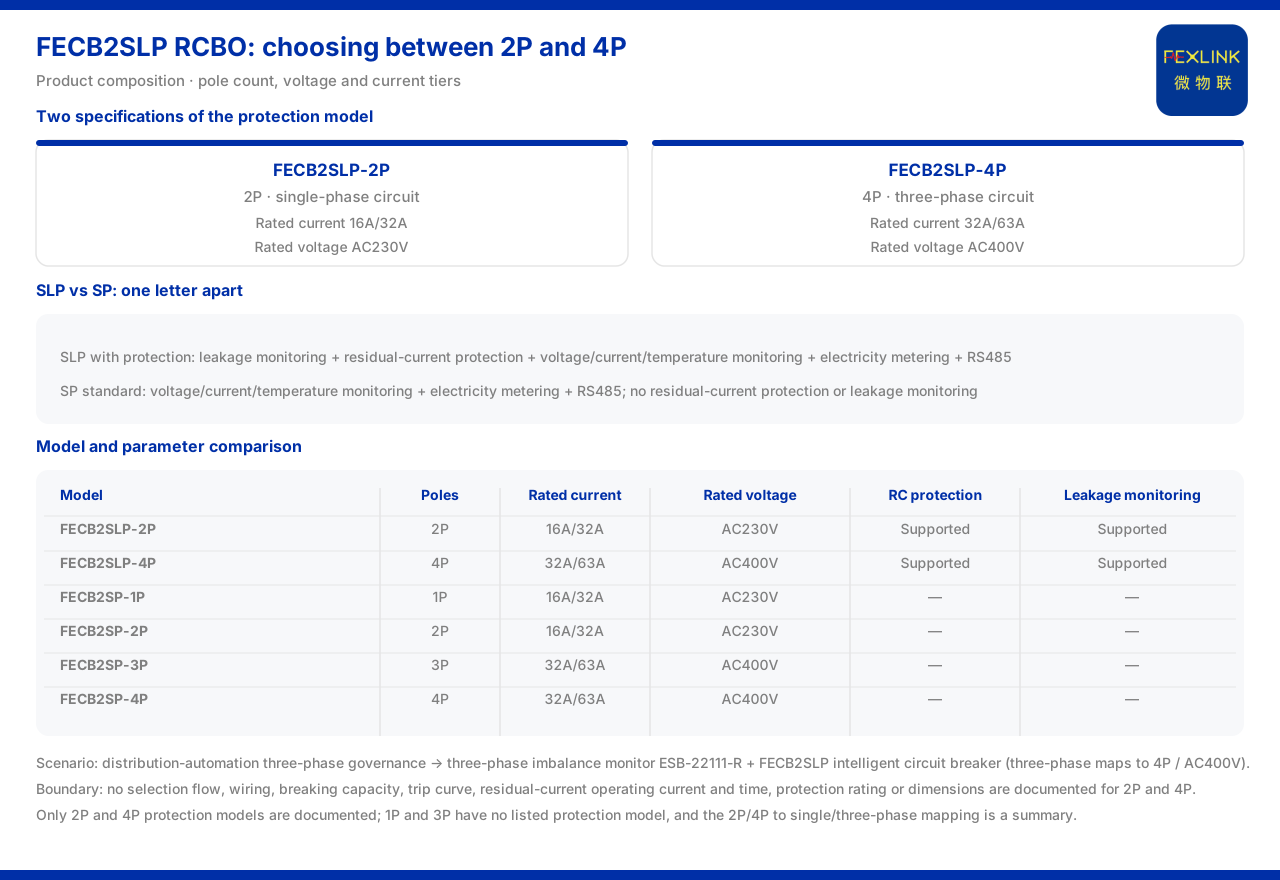
Direct answer
The intelligent circuit breaker (with residual-current protection) (e.g. FECB2SLP-2P) has two specifications: the 2P specification is rated 16A/32A at AC230V, and the 4P specification is rated 32A/63A at AC400V. The two differ in voltage level and rated-current tier, while their monitoring and communication capabilities are identical. During selection, the pole count of the circuit is the first item to confirm, and the corresponding voltage and current tier then follows from the pole count. The difference between the residual-current-protection model and the standard model is that the former brings leakage monitoring and residual-current protection into the device itself.
One letter between the residual-current-protection model and the standard model
The knowledge base notes under the intelligent circuit breaker table that SLP is the model with residual-current protection, that is, leakage monitoring plus residual-current protection, while SP is the standard model. The product-model quick reference records the product as "intelligent circuit breaker (standard / residual-current protection)". The residual-current-protection model is therefore not a separate category but a safety-enhanced branch alongside the standard model: choosing SLP means bringing leakage protection into the device, while choosing SP omits that item. The knowledge base also records that the intelligent air switch is one of the outsourced categories.
Voltage and current of the two protection specifications
The residual-current-protection model is listed in two specifications: the 2P specification is rated 16A/32A at AC230V, and the 4P specification is rated 32A/63A at AC400V. Both support leakage monitoring and residual-current protection, voltage / current / temperature monitoring and electricity metering, with RS485 communication. It can be seen that the pole count and the voltage level appear as a bound pair — 2P falls at AC230V, 4P falls at AC400V. The current tiers of the two specifications also move up with the pole count: 2P is 16A/32A, and 4P is 32A/63A. This binding is not coincidental: in the model rule the pole count and the voltage class advance together, which is why fixing the pole count already constrains which voltage class and current tier remain available.
Monitoring capability shared by the standard and protection models
Whether it is the standard model or the residual-current-protection model, the intelligent circuit breaker supports voltage, current and temperature monitoring, provides electricity metering, and its communication interface is RS485. The residual-current-protection model adds leakage monitoring and residual-current protection on top of this. That is, the monitoring and communication part of the intelligent circuit breaker is common to both models; the two diverge only in the leakage-related functions. This is why the practical order is to select the pole count and current tier correctly first, and only then decide whether leakage protection needs to be included. The shared base also means that adding leakage protection does not change the monitoring and communication behaviour already present; the increment is confined to the leakage functions.
Model and parameter comparison
The table below places the intelligent circuit breaker (with residual-current protection, e.g. FECB2SLP-2P) and the intelligent circuit breaker (standard model, e.g. FECB2SP-1P) side by side, so that the correspondence between pole count, current and voltage can be checked.
| Model | Poles | Rated current | Rated voltage | Residual-current protection | Leakage monitoring |
| --- | --- | --- | --- | --- | --- |
| FECB2SLP-2P | 2P | 16A/32A | AC230V | Supported | Supported |
| FECB2SLP-4P | 4P | 32A/63A | AC400V | Supported | Supported |
| FECB2SP-1P | 1P | 16A/32A | AC230V | — | — |
| FECB2SP-2P | 2P | 16A/32A | AC230V | — | — |
| FECB2SP-3P | 3P | 32A/63A | AC400V | — | — |
| FECB2SP-4P | 4P | 32A/63A | AC400V | — | — |
Item-by-item comparison with the standard model
The standard model (intelligent circuit breaker (standard model), e.g. FECB2SP-1P) has four tiers: 1P and 2P correspond to 16A/32A at AC230V, while 3P and 4P correspond to 32A/63A at AC400V; both its "residual-current protection" and "leakage monitoring" columns are recorded as not included, while it likewise supports voltage / current / temperature monitoring and electricity metering, with RS485 communication. In other words, the standard model and the residual-current-protection model are identical in monitoring and communication, and differ only in leakage monitoring and residual-current protection. It should be noted that the documentation gives residual-current-protection models for 2P and 4P only; if the circuit is 1P or 3P, the table lists no corresponding residual-current-protection model. The absence of a 1P or 3P protection model is a documentation boundary rather than a statement that such circuits cannot be protected; it means the table does not list a corresponding model.
Scenario placement: three-phase governance
The knowledge base lists the recommended combination for "distribution-automation three-phase governance" as the three-phase imbalance monitor (e.g. ESB-22111-R) together with the intelligent circuit breaker (residual-current-protection model). This combination falls in a three-phase scenario, so its voltage level should be the AC400V tier, that is, the 4P specification of the residual-current-protection model. Conversely, a single-phase circuit falls in the AC230V group, corresponding to the 2P specification of the residual-current-protection model. This correspondence between pole count and voltage is exactly why the pole count is taken as the first item to confirm. Read in this order, the scenario row is not a separate selection rule but a confirmation that the pole-count-first method reproduces the combination the table recommends.
Scope and limitations
First, this article only explains the positioning and the two specifications of the intelligent circuit breaker (residual-current-protection model); the factual boundary is limited to the product documentation, and no standard clause, parameter, certification or case not listed there is introduced.
Second, the documentation gives no selection-decision flow, wiring topology, breaking capacity, trip curve, residual-current operating current and time, protection rating or installation dimensions for the 2P and 4P residual-current-protection models; the correspondence between 2P/4P and single-phase/three-phase circuits is an editorial generalization drawn from the AC230V and AC400V voltage tiers and the differences in current tiers, and is not stated as a factual proposition by the documentation.
Third, the documentation gives residual-current-protection models for 2P and 4P only, and gives no 1P or 3P residual-current-protection model; this article does not extend to models that are not listed.
Fourth, actual selection should be determined by engineering design in conjunction with the on-site circuit system, and this article does not infer residual-current operating parameters or wiring details not listed in the documentation.