 FEXLINK Research Institute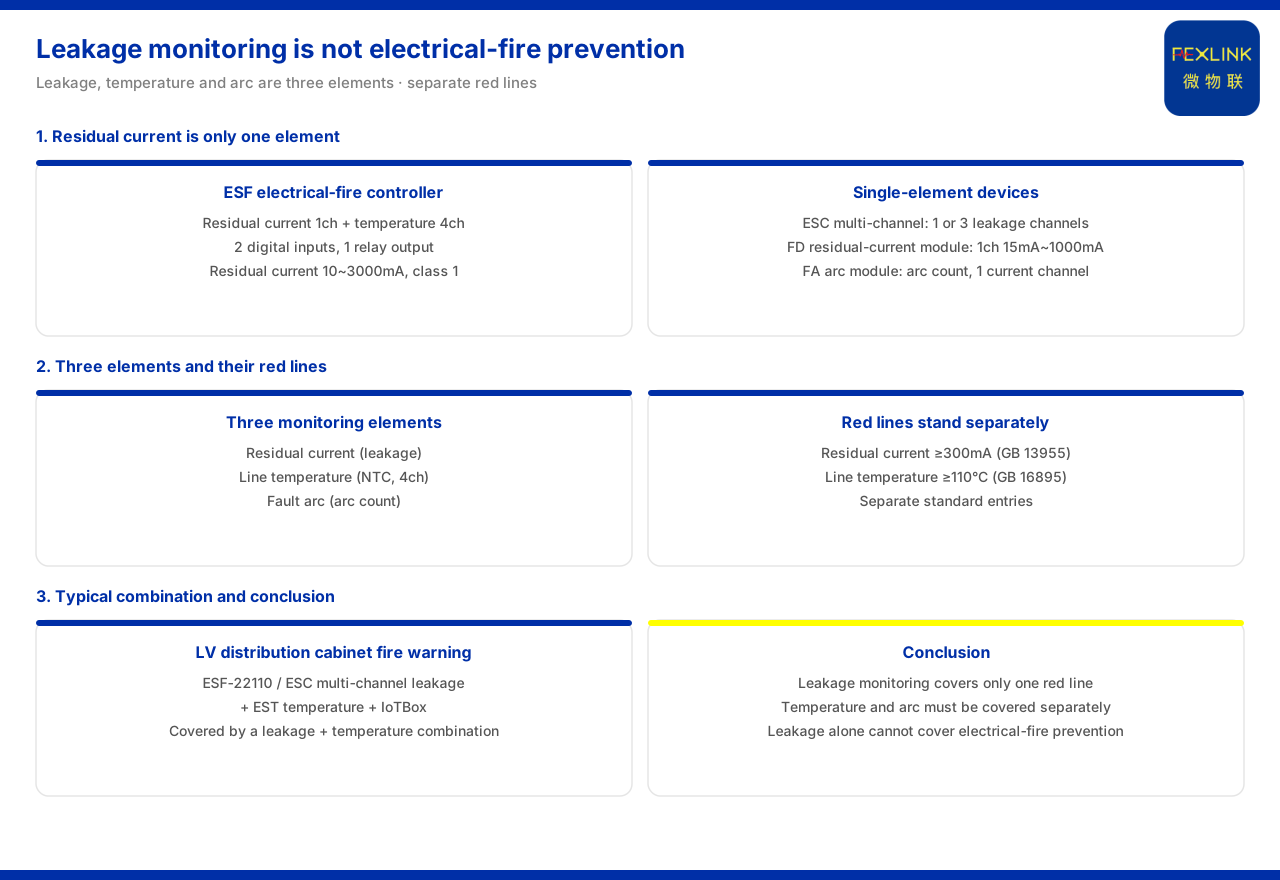
Direct answer
Doing leakage monitoring well does not mean electrical-fire early warning is complete. The monitoring products listed in the product knowledge base show that residual current is only one element among the causes of electrical fire: the ESF electrical fire monitoring & control device (e.g. ESF-22110) monitors one residual-current channel while also monitoring four temperature channels; the ESC multi-channel leakage-current monitoring & control device is positioned on multi-loop leakage monitoring and does not cover temperature or arcing; the FD mains residual-current monitoring module and the FA arc-fault monitoring module correspond respectively to the single leakage element and to arc counts. More directly, the standard red lines in the product knowledge base list residual current and line temperature as two independent items, each based on a different standard. "Leakage is handled" therefore covers only one of the red lines; to answer whether electrical fire is guarded against, leakage, temperature and arcing must be viewed together.
Residual current is only one element of electrical-fire early warning
The product knowledge base specifies that the ESF electrical fire controller monitors residual current and temperature at the same time, with one residual-current channel and four temperature channels, and additionally provides two digital inputs and one relay output. This configuration itself shows that an electrical fire controller acquires more than leakage. Its residual-current range is 10 to 3000 mA at class 1 accuracy; temperature is measured by NTC over -20 to 100 °C at ±1 °C, with a 1 m external lead. The two elements have different dimensions and different objects of concern, showing that they are not redundant acquisition but answer different questions. Leakage monitoring answers "is there leakage current", while temperature monitoring answers "is there abnormal overheating"—they are not two ways of asking the same question and cannot substitute for each other.
Temperature is the second, parallel element
Temperature stands alongside residual current because it corresponds to another independent red line. Among the standard red lines in the product knowledge base, line temperature reaching 110 °C triggers an alarm, on the basis of GB 16895, whereas the residual-current red line is based on GB 13955. The two red lines differ in both threshold and standard basis, showing that normal leakage does not prove normal temperature. The ESF electrical fire controller lists temperature separately as four monitoring channels precisely so that this temperature red line has an independent acquisition channel; if only leakage monitoring is done, the temperature quantity falls entirely into a blind spot.
Arc fault forms the third category of cause
Besides leakage and temperature, arc fault is another cause that needs separate monitoring. The product knowledge base specifies that the FA arc-fault monitoring module monitors arc counts, with a single current channel as its acquisition object. What it observes is entirely different from residual-current monitoring: residual current looks at the magnitude of leakage current, while arc counts look at the number of arcing events that occur. Leakage monitoring alone does not cover the arcing element; the product knowledge base therefore lists it as a separate monitoring module instead of merging it into a leakage controller.
The three red lines each govern one thing
Comparing the three elements with the standard red lines yields a clearer boundary. The product knowledge base makes the residual-current red line and the line-temperature red line each independent, showing that the standard does not merge them into one combined criterion. Mapped onto products, this means leakage, temperature and arcing each need a corresponding acquisition unit: residual current corresponds to the controller's leakage monitoring, temperature to temperature monitoring, and arcing to arc-fault monitoring. The problem with the idea that "if leakage is handled, there will be no electrical fire" is that it treats one element's compliance as compliance with all the red lines.
Why "leakage only" leaves a blind spot
From the product positioning, the boundary of a single-leakage monitoring product is clear. The ESC multi-channel leakage controller provides one or three leakage monitoring channels, with the same leakage range of 10 to 3000 mA at class 1 accuracy, positioned on multi-loop leakage monitoring rather than all-element electrical-fire coverage; the FD mains residual-current monitoring module monitors one residual-current channel over 15 to 1000 mA, corresponding to the single leakage element. Both products concentrate their capability on leakage, so when temperature or arcing risk also exists on site, looking only at the leakage result will miss the other causes. Conversely, the ESF electrical fire controller includes temperature precisely to reduce this kind of blind spot.
The multi-element combination recommended by scenarios
In its typical scenarios the product knowledge base gives a reference combination: for low-voltage distribution-cabinet electrical-fire early warning, it recommends ESF-22110 or the ESC multi-channel leakage controller, together with the EST multi-channel temperature controller and IoTBox. This combination places both leakage and temperature elements into the scheme, showing that the product knowledge base itself does not treat leakage monitoring as the whole of electrical-fire early warning. It follows that wherever the question "is electrical fire guarded against" is to be answered, the scheme should cover multiple elements rather than configuring only one leakage product. The multi-channel leakage controller and the temperature monitoring appearing side by side, each with its own role, again confirms that leakage and temperature are two different acquisition objects at the product level.
Checking sequence
Gathering the clues above into a sequence, four steps can be followed. First, confirm whether the protected object carries leakage, temperature and arcing risks at the same time. Second, configure the corresponding control product for residual current, choosing single-channel or multi-channel by the number of loops. Third, configure temperature monitoring separately, confirming that the measurement range and accuracy meet the site. Fourth, if arcing risk exists, add the arc-fault monitoring module and check that all three red lines have corresponding acquisition. In this order, the answer is "are all the red lines covered", not "is this one leakage item compliant".
Applicability and limits
First, this article only restates content listed in the product knowledge base; its factual boundary is limited to the monitoring elements and key parameters of the ESF electrical fire monitoring & control device, the ESC multi-channel leakage-current monitoring & control device, the FD mains residual-current monitoring module and the FA arc-fault monitoring module, the two standard red lines for residual current and line temperature, and the recommended combination for low-voltage distribution-cabinet electrical-fire early warning, and it introduces no unlisted parameters, certifications or cases.
Second, the residual-current and temperature monitoring channel counts, ranges and accuracy of the ESF electrical fire controller are cited on the terms listed in the product knowledge base; this article does not infer unlisted configurations from them.
Third, the leakage monitoring channel counts and ranges of the ESC multi-channel leakage-current monitoring & control device and the FD mains residual-current monitoring module are cited on the terms listed in the product knowledge base.
Fourth, the thresholds and standard bases of the residual-current red line and the line-temperature red line are cited on the terms listed in the product knowledge base; this article draws no conclusion on the criterion value or number of points for a specific project.
Fifth, this article only explains the relationship between leakage monitoring and electrical-fire early warning and provides no selection, setting or configuration calculation for a specific project.
Sixth, this article does not commit to any specific project's selection result or on-site performance, which remain subject to the latest product documentation and project scheme.