 FEXLINK Research Institute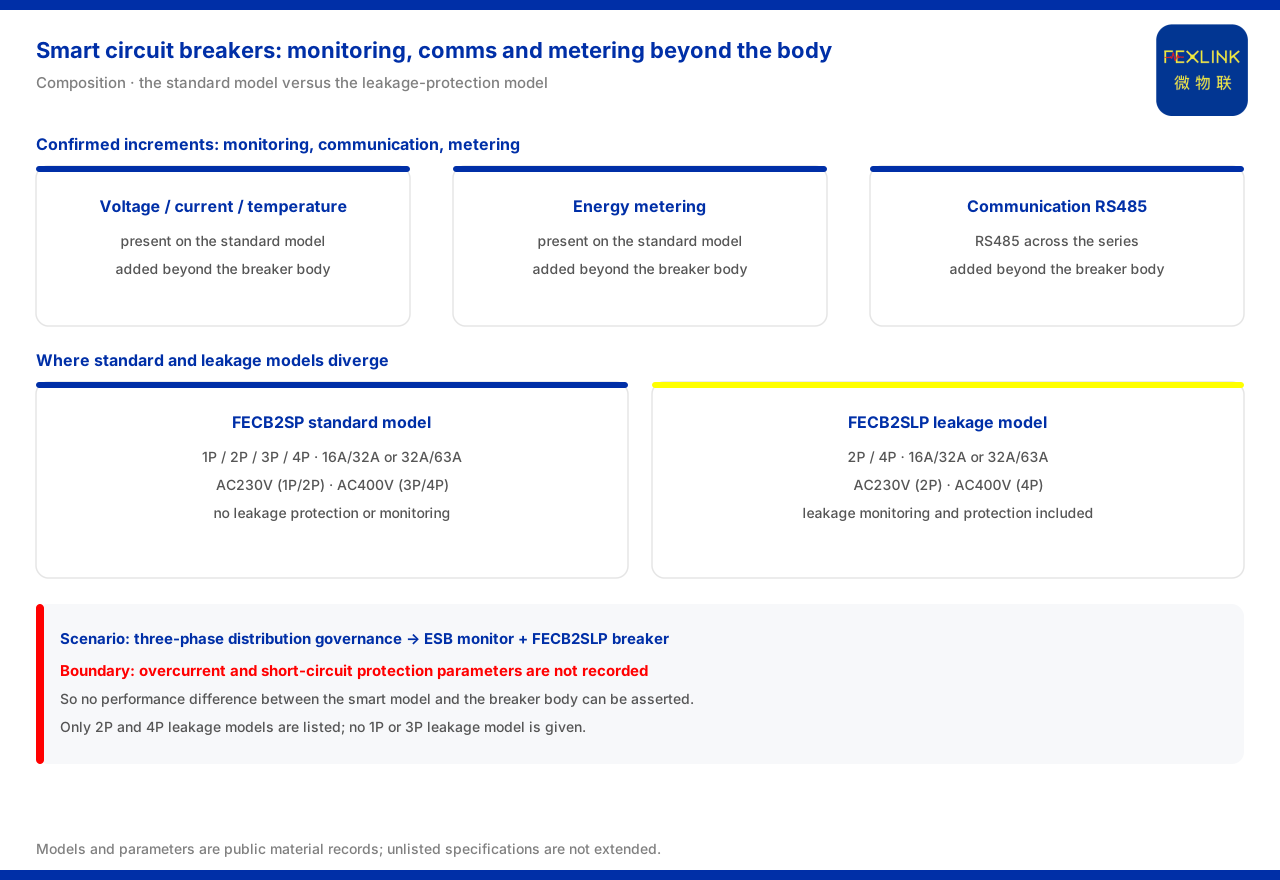
Direct answer
According to the product material, the intelligent circuit breaker (standard model, e.g. FECB2SP-1P) and the intelligent circuit breaker (with residual-current protection, e.g. FECB2SLP-2P) add monitoring, communication and metering capability on top of the circuit-breaker body: voltage/current/temperature monitoring and energy-consumption metering are present in the standard model, and communication is RS485; the residual-current model additionally includes leakage monitoring and residual-current protection. The material does not record any difference between the intelligent models and the circuit-breaker body in protection parameters such as overcurrent and short circuit, so it cannot be asserted from the material that the two differ in protection performance.
1. The confirmable increment: monitoring, communication and metering
The intelligent circuit breaker (standard model) supports voltage, current and temperature monitoring on top of the circuit-breaker body and provides energy-consumption metering; its leakage protection and leakage monitoring columns are "no". That is, the increment of the standard model is concentrated in the three items of monitoring, communication and metering, not in the protection function itself.
The material records the product as "intelligent circuit breaker (standard / residual-current)", and the communication of the whole series is RS485. The standard model does not include residual-current protection or leakage monitoring, and this point should be distinguished during selection. The increment is additive rather than substitutive: the intelligent capability sits beside the breaker function, it does not replace it.
2. The divergence between the standard model and the residual-current model
The product material notes under the intelligent circuit-breaker table that SLP is the residual-current model, meaning leakage monitoring plus residual-current protection, while SP is the standard model. On top of the monitoring, communication and metering shared with the standard model, the residual-current model adds leakage monitoring and residual-current protection.
The divergence between the two models therefore lies only in the leakage-related capability: first select the pole count and current tier, then decide whether residual-current protection is to be included. Reading the suffix in this way avoids treating the residual-current model as a separate product family. The suffix is a switch on one capability, not a different product class.
3. Poles, rated current and rated voltage
The product material lists the poles, rated current and rated voltage of the standard model: 1P and 2P are 16A/32A at AC230V; 3P and 4P are 32A/63A at AC400V. Pole count and voltage level appear bound together, and the current tier also rises with the pole count. During selection the circuit pole count is the first item to confirm, after which the corresponding voltage and current tier follows.
4. The two specifications of the residual-current model
The residual-current model lists two specifications: the 2P specification is 16A/32A at AC230V, and the 4P specification is 32A/63A at AC400V; both support residual-current protection, leakage monitoring, voltage/current/temperature monitoring, energy-consumption metering and RS485. It should be noted that the material gives residual-current models only for 2P and 4P; if the circuit is 1P or 3P, the material does not list a corresponding residual-current model. The two specifications inherit the same pole-to-voltage binding as the standard model, so the 2P form stays at AC230V and the 4P form at AC400V.
| Model | Poles | Rated current | Rated voltage | Residual-current protection | Leakage monitoring |
| --- | --- | --- | --- | --- | --- |
| FECB2SLP-2P | 2P | 16A/32A | AC230V | Supported | Supported |
| FECB2SLP-4P | 4P | 32A/63A | AC400V | Supported | Supported |
| FECB2SP-1P | 1P | 16A/32A | AC230V | — | — |
| FECB2SP-4P | 4P | 32A/63A | AC400V | — | — |
5. Scenario placement: three-phase governance in distribution automation
The product material lists the recommended combination for "three-phase governance in distribution automation" as the ESB three-phase imbalance monitor (e.g. ESB-22111-R) and the intelligent circuit breaker (with residual-current protection). This combination falls in the three-phase scenario and corresponds to the 4P specification (AC400V) of the residual-current model; a single-phase circuit corresponds to the 2P specification (AC230V). This correspondence is precisely why the pole count is taken as the first item to confirm. It also shows why the residual-current model, rather than the standard model, appears in this combination: the scenario is one in which leakage-related capability is part of the requirement.
6. Protection-function differences cannot be asserted from the material
The boundary to be made clear is this: the product material records only the increment of the intelligent models in monitoring, communication and metering, and does not record any difference in protection parameters such as overcurrent and short circuit relative to the circuit-breaker body. This article can therefore only confirm that the intelligent models add monitoring and communication capability on top of the circuit-breaker body; it cannot on this basis assert that their protection performance differs from that of a conventional circuit breaker. The absence of a recorded difference is not evidence of equality, and partial data on monitoring capability must not be read as complete data on protection parameters.
Scope and limitations
First, this article explains only the increment of the intelligent circuit breaker over the circuit-breaker body in monitoring, communication and metering; the factual boundary is limited to the product material, and no standard clause, parameter, certification or case not listed there is introduced. The confirmable increment and the unrecorded protection parameters are kept apart throughout, because the former is what the material states and the latter is what it does not.
Second, the product material does not record differences in protection parameters such as overcurrent and short circuit, nor does it give breaking capacity, trip curves, residual-current operating current and time, protection rating or installation dimensions; this article does not assert a protection-performance difference on this basis.
Third, the material gives residual-current models only for 2P and 4P, and does not give 1P or 3P residual-current models; this article does not extend them to unlisted models.
Fourth, actual selection should be determined in conjunction with the on-site circuit configuration and engineering design; this article does not infer wiring or operating parameters not listed in the material.