 微物联研究院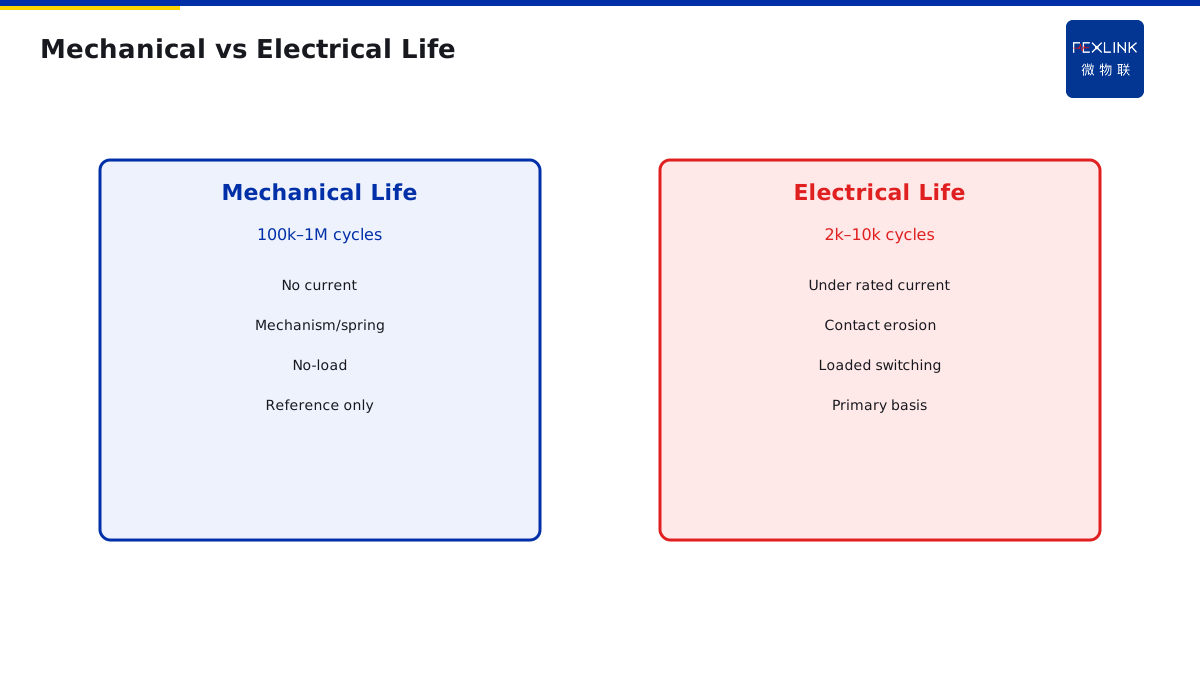
Direct Answer
A breaker's life is tracked in two separate accounts:
- Mechanical life: no-current mechanical operations—hundreds of thousands of cycles; it is the operating mechanism, spring and linkage lifetime.
- Electrical life: operations under rated current—only thousands of cycles; it is determined by contact erosion.
What actually decides when you replace a breaker is electrical life, not mechanical life. And the larger the interrupted current, the faster electrical life is consumed—a single short-circuit interruption can equal hundreds of rated-current operations.
1. The Two Accounts
| Mechanical life | Electrical life | |
|---|---|---|
| Condition | No current, mechanical only | Under rated current |
| Determined by | Mechanism, spring, linkage | Contact erosion, arc chute |
| Typical magnitude | 100k–1M cycles | 2,000–10,000 cycles |
| What wears | Mechanism fatigue | Contact material vaporisation |
| Replacement basis | Reference | Primary |
Datasheets list both numbers. Mechanical life looks huge, but it is "no-load operation"—a breaker sitting in a cabinet untouched for ten years will not fail. But if you switch a loaded circuit a dozen times daily, it reaches the end of its electrical life in a few thousand cycles.
2. Why Electrical Life Is Consumed So Fast
Every loaded make/break produces an arc between contacts at several thousand degrees. Copper/silver alloy on the contact surface erodes and vaporises.
- Rated current: small arc energy, light erosion, many cycles;
- Overload current: arc energy several times rated, visible erosion;
- Short-circuit current: enormous arc energy, one interruption consumes major contact life;
- Earth fault: current small but arc unstable, erosion may still be significant.
Electrical life is not a fixed number—it is a curve against interrupted current. The datasheet "6,000 operations" usually means at rated current. If you routinely interrupt several times rated current, real life may be a few hundred.
3. Circuits That Switch Often Need Separate Attention
Which circuits consume electrical life fastest? Those with many daily operations at large interrupted currents.
Typical cases:
- Capacitor banks: a dozen switching cycles daily, each with inrush;
- Direct-on-line pumps/fans: starting current 5–7× rated;
- Frequent production lines: hundreds of operations daily;
- Emergency power transfer: few operations, but each interrupts load current.
A lighting feeder might switch a few dozen times in ten years—mechanical life is never touched. But a capacitor circuit switching 20 times daily reaches 7,300 operations in a year—electrical life essentially exhausted.
4. How to Know a Breaker Is Near End-of-Life
You cannot count it directly. Mechanical life has a counter; electrical life does not. You need indirect signals:
- Contact temperature rise: erosion increases contact resistance; FECB2SLP smart breaker has built-in temperature sensing, and rising temperature is the direct signal of electrical-life consumption.
- Longer operate time: as contacts wear, mechanism travel increases; ESI digital state monitor captures open/close timing.
- Overcurrent interruption count: every loaded interruption should be logged, weighted by interrupted current magnitude.
FEXLINK FECB2SLP records operations, interrupted current and timing on every make/break. ESI digital state monitor aggregates auxiliary contact signals. Only with this data can you estimate remaining electrical life.
5. Engineering Practice: When to Replace
Do not replace at the datasheet number. A better approach:
- Log operations: how many per day, at what current;
- Monitor contact temperature: accelerating rise means accelerating erosion;
- Count protection operations: each short-circuit interruption has the largest weight;
- Plan replacement: high-frequency circuits—inspect contacts every 3–5 years; low-frequency—review after 10+ years.
One port loading equipment cabinet switched motor circuits hundreds of times daily. A year of FECB2SLP monitoring found breaker #3 had 28,000 operations, of which 4,200 were under rated current—near electrical life. It was replaced in a scheduled shutdown window, avoiding an unplanned outage.
Scope and Limitations
Applies to LV breaker mechanical vs electrical life. HV, vacuum and air circuit breakers follow similar definitions at different magnitudes. FECB2SLP and ESI are FEXLINK references; parameters follow the latest catalogue. Cycle counts are typical engineering ranges and vary by model.