 FEXLINK Research Institute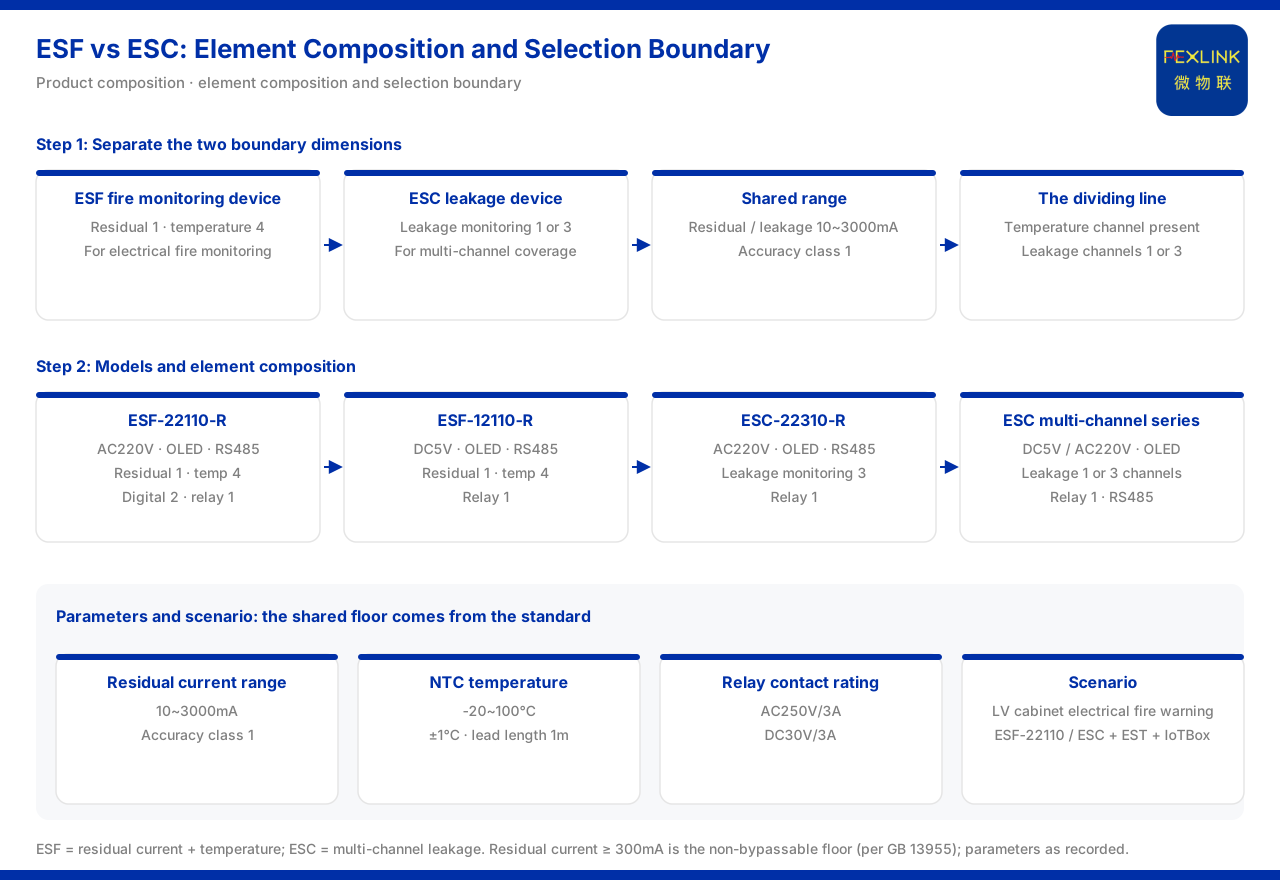
Direct answer
The boundary between the ESF electrical fire monitoring & control device and the ESC multi-channel leakage-current monitoring & control device can be drawn along two dimensions: whether a temperature channel is carried, and the number of leakage circuits. The ESF takes residual current on 1 channel plus temperature on 4 channels as its core and is positioned as an electrical fire monitoring & control device; the ESC takes leakage monitoring on 1 or 3 channels as its core and is positioned as a multi-channel leakage-current monitoring & control device. The two agree on residual and leakage range, accuracy and relay parameters, and the difference lies in element composition: the ESF treats temperature measurement and digital inputs as fixed elements of the model, whereas the ESC lists only the number of leakage circuits and the relay output, without temperature or digital inputs.
1. The positioning revealed by the model rule
The model rule of the ESF electrical fire monitoring & control device (for example ESF-22110-R) encodes supply, display, output, current parameter and reserved into field positions, with the current parameter given as 10~3000mA, 5A/0.5mA; the ESC multi-channel leakage-current monitoring & control device (for example ESC-22310-R), by contrast, combines models around the number of leakage monitoring channels. The naming structure itself suggests the division of work between the two: one emphasizes control output and multiple elements, the other emphasizes coverage of leakage circuits.
2. ESF: residual current plus temperature as the core
The material's model table lists the ESF-22110-R (AC220V, OLED, residual current 1 channel, temperature 4 channels, digital inputs 2, relay output 1, RS485) and the ESF-12110-R (DC5V, OLED, residual current 1 channel, temperature 4 channels, relay output 1, RS485). The key parameters are residual current 10~3000mA (accuracy class 1), NTC temperature measurement -20~100℃ (±1℃, external wire length 1m), and relay contact rating AC250V/3A and DC30V/3A. It can be seen that 4 temperature channels are a fixed element of the ESF, which also carries digital inputs.
3. ESC: aimed at multi-channel leakage coverage
The material's model table lists the configurations of the multi-channel leakage-current monitoring & control device, distinguished by supply and number of leakage monitoring channels:
| Model | Supply | Display | Leakage monitoring | Relay output | Communication |
| --- | --- | --- | --- | --- | --- |
| ESC-22310-R | AC220V | OLED | 3 channels | 1 | RS485 |
| ESC-12111 | DC5V | OLED | 1 channel | 1 | RS485 |
| ESC-12311-R | DC5V | OLED | 3 channels | 1 | RS485 |
| ESC-22111 | AC220V | OLED | 1 channel | 1 | RS485 |
| ESC-22311-R | AC220V | OLED | 3 channels | 1 | RS485 |
The key parameters are leakage 10~3000mA (accuracy class 1), and relay AC250V/3A and DC30V/3A. The difference items of the ESC concentrate on the number of leakage monitoring channels, and the model table lists no temperature or digital inputs.
4. Item-by-item comparison: temperature and channel count are the dividing line
Placing the two tables side by side, the common items are the residual and leakage range 10~3000mA, accuracy class 1, and the optional AC220V or DC5V supply, OLED display and RS485 communication. The difference item is element composition: the ESF model table lists temperature as a fixed 4 channels and includes digital inputs, while the ESC model table lists only leakage monitoring on 1 or 3 channels and one relay output. The conclusion is therefore clear: where electrical-fire monitoring with temperature measurement is needed, choose the ESF; where pure multi-channel leakage monitoring is needed, choose the ESC.
5. Shared floor: leakage compliance comes from the national standard
The material lists residual current not less than 300mA as a non-bypassable safety red line, with GB 13955 as its basis, and no one can raise the threshold. The upper limits of the residual and leakage ranges of the ESF and the ESC are both 3000mA, so both cover this threshold. This shows that the compliance floor of leakage monitoring comes from the standard, not from an adjustable parameter on the device.
6. Scenario landing points
The material lists low-voltage distribution cabinet electrical fire warning as a recommended scenario, with the combination of the ESF-22110 or the multi-channel leakage of the ESC, together with the EST multi-channel temperature intelligent controller and IoTBox. In this combination the temperature element is borne separately by the EST, showing that the ESF and the ESC can serve as parallel selectable multi-circuit schemes rather than replacing each other. For selection, this combination clue suggests: if the site already has an independent temperature monitoring arrangement, the multi-channel leakage coverage of the ESC fits better; if residual current and temperature measurement are to be concentrated on the same monitoring & control device, one should return to the ESF side and check the number of temperature channels. The two orientations correspond to a difference in element composition, not a difference in quantity or quality.
Applicability and limits
First, this article only distinguishes the functional positioning boundary between the ESF electrical fire monitoring & control device and the ESC multi-channel leakage-current monitoring & control device; its factual boundary is limited to the product material, and it introduces no standard clause, parameter, certification or case that is not listed.
Second, the residual and leakage 10~3000mA (accuracy class 1), the NTC temperature -20~100℃, the relay contact rating, and the supply, display, circuit and communication items of each model are all listed in the material; this article does not infer the specifications of unlisted models on that basis.
Third, the differences between the ESF and the ESC in leakage-protection operating time (such as the 30mA/0.1s tier), channel cascade expansion method, installation type and protection selectivity are not directly given by the material; this article explicitly lists them as material gaps and does not cite them as facts, nor does it infer the coordination requirements of the two products from them.
Fourth, the reference to GB 13955 is limited to the residual-current red-line criterion in the material and does not expand the specific clauses of that standard; actual thresholds and deployment should be subject to on-site conditions and the applicable standards.