 FEXLINK Research Institute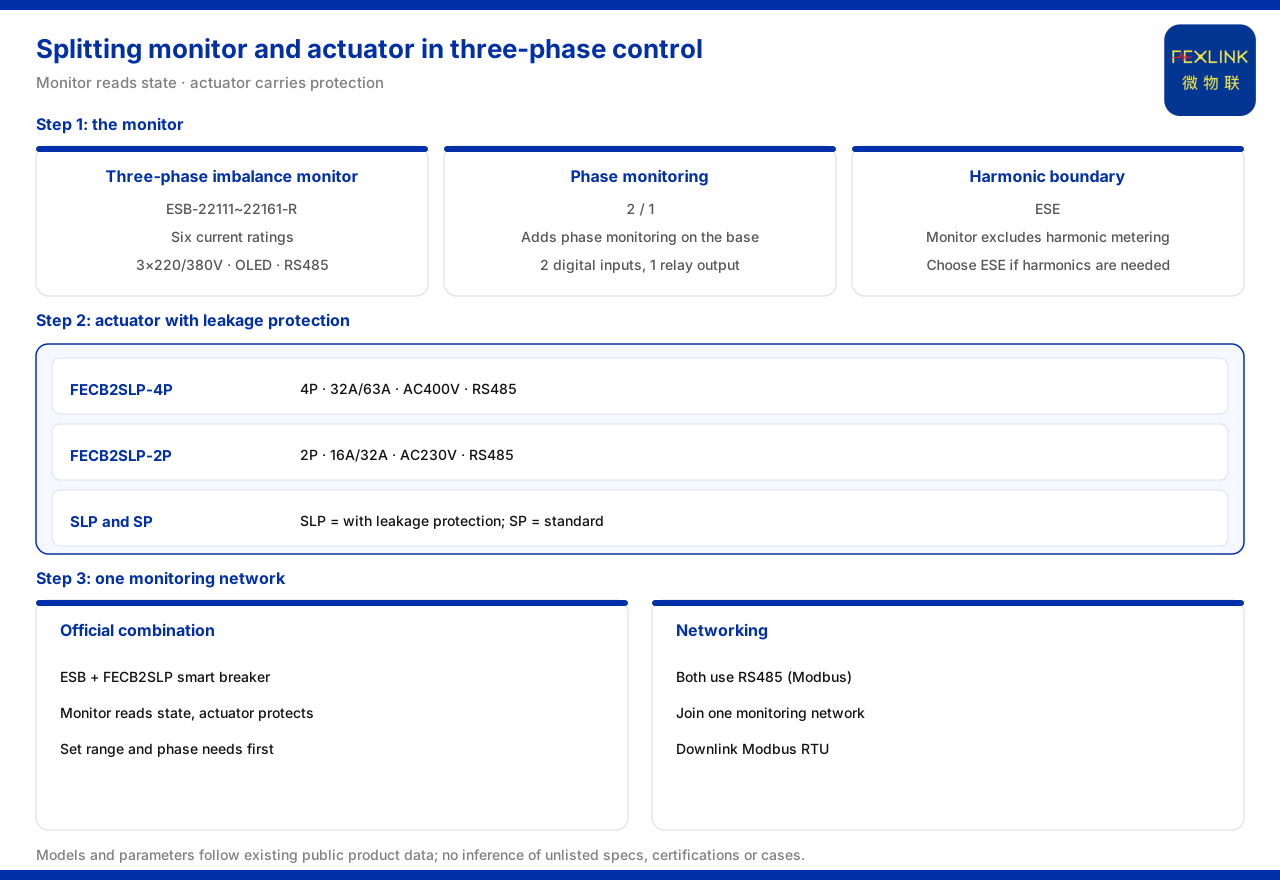
Direct answer
For three-phase management in distribution automation, the combination recommended by the product knowledge base is the ESB three-phase imbalance monitor with the FECB2SLP intelligent circuit breaker (with residual-current protection): the former monitors three-phase imbalance and phase, the latter performs residual-current protection and circuit control on the execution side. The product knowledge base records that the ESB three-phase imbalance monitor shares an architecture with the ESA all-parameter smart meter and offers 6 current levels (ESB-22111 to 22161-R), 3×220/380V, OLED and RS485, adding phase monitoring on the same architecture, with 2 digital inputs and 1 relay output; it does not include harmonic monitoring, and when harmonics are needed the ESE power-quality monitor should be chosen. The FECB2SLP intelligent circuit breaker splits into 2P and 4P: the 2P model has a rated current of 16A/32A and a rated voltage of AC230V, while the 4P model has a rated current of 32A/63A and a rated voltage of AC400V; both support residual-current protection, voltage/current/temperature monitoring, leakage monitoring and energy use, with RS485 communication. Because both use RS485 (Modbus), they can join the same monitoring network. The division of labour in this combination is that the monitoring side watches the state and the execution side carries the protection; selection should fix the monitoring range and phase need first, then take the breaker by pole count and current level.
1. Division of labour: one monitors, one executes
In the scenario mapping of the product knowledge base, distribution-automation three-phase management recommends the ESB three-phase imbalance monitor with the FECB2SLP intelligent circuit breaker. The two are not interchangeable substitutes but a division of labour: the three-phase imbalance monitor takes the monitoring-side duty of acquiring and judging three-phase imbalance, phase and similar states; the intelligent circuit breaker (with residual-current protection) takes the execution-side duty of circuit control and residual-current protection. Selection taking only the monitor lacks the means to act; taking only the breaker lacks dedicated three-phase imbalance monitoring. Only seen as one set do they match the combination given by the scenario mapping.
2. Monitoring side: what it adds over the same-architecture meter
The three-phase imbalance monitor builds on an existing meter architecture. The product knowledge base records that the ESB three-phase imbalance monitor shares an architecture with the ESA all-parameter smart meter, with 6 current levels from ESB-22111 to 22161-R, 3×220/380V, OLED and RS485. Its difference is added phase monitoring plus 2 digital inputs and 1 relay output. That is, on the three-phase voltage and current provided by the meter architecture it brings phase information into monitoring and provides a small number of digital and relay interfaces. If the phase dimension is what is needed, take this model rather than an ordinary meter.
3. Monitoring-side boundary: no harmonics
One boundary must be made clear: the three-phase imbalance monitor does not undertake harmonic monitoring. The product knowledge base records that the ESB three-phase imbalance monitor has no harmonic monitoring and that the ESE power-quality monitor should be chosen when harmonics are needed. The harmonic dimension in a three-phase management combination is therefore not carried by the monitor and must be configured as needed. Selection should treat whether harmonics are wanted as a separate question: for three-phase imbalance and phase only, take the three-phase imbalance monitor; when harmonics are also needed, add a power-quality monitor to the combination. Making this boundary clear avoids assuming that one monitor can cover every power-quality dimension.
4. Execution side: split by pole count and current level
The intelligent circuit breaker (with residual-current protection) is split by pole count and rating. The product knowledge base records that FECB2SLP-2P is 2P with a rated current of 16A/32A and a rated voltage of AC230V, and FECB2SLP-4P is 4P with a rated current of 32A/63A and a rated voltage of AC400V. Both support residual-current protection, voltage/current/temperature monitoring, leakage monitoring and energy use, with RS485 communication. Selection takes the model matching the pole count and current level of the controlled circuit: a single-phase circuit takes the 2P model, a three-phase circuit the 4P model, while the current level is chosen from the available values by the actual circuit load. This echoes the monitoring side, which fixes the range before discussing function.
5. How the residual-current model differs from the standard model
The letters in the model carry the functional distinction. The product knowledge base records that SLP stands for the residual-current version, meaning it has leakage monitoring and residual-current protection, while SP stands for the standard model. Accordingly, FECB2SLP models carry residual-current protection and complement the phase monitoring of the three-phase imbalance monitor: the monitoring side watches imbalance and phase, the execution side carries leakage monitoring and residual-current protection. Selection should first confirm whether the scenario needs residual-current protection: take the residual-current version when it does, and the standard model when only standard breaking and monitoring are needed. Reading the suffix correctly avoids mixing the residual-current version with the standard model.
6. Communication: why the two join one network
For the combination to hold, the two must join the same monitoring network. The product knowledge base records that in the communication protocol matrix the device downlink protocols are Modbus RTU (RS485), Zigbee (Modbus) and LoRa, and that the ESB three-phase imbalance monitor and the FECB2SLP intelligent circuit breaker both use RS485 (Modbus). It is precisely because they share the same communication term that the scenario mapping lists them as a combinable pair. Selection should check whether the on-site networking supports RS485 (Modbus); if downlink RS485 dominates, the combination can network directly without an extra protocol-conversion stage.
7. The closing sequence of combination selection
The points above reduce to a sequence: first, confirm whether the circuit is three-phase or single-phase, deciding the applicable object of the monitoring and execution sides. Second, on the monitoring side confirm whether harmonics are needed: if not, take the three-phase imbalance monitor; if so, add a power-quality monitor. Third, on the execution side confirm whether residual-current protection is needed: take the residual-current version if so, the standard model if not. Fourth, take the intelligent circuit breaker by pole count and current level, with 2P matching AC230V and 4P matching AC400V. Fifth, check that both use RS485 (Modbus) and can join the same network. In this order, the combination answers which dimension to monitor, whether the execution side carries residual-current protection, the pole count and amperage of the circuit, and how to network.
Scope and limitations
First, this article only restates what the product knowledge base lists; its factual boundary is limited to the architecture, specifications and interfaces of the ESB three-phase imbalance monitor, the model split and parameters of the FECB2SLP intelligent circuit breaker, the suffix meanings, and the scenario mapping and communication protocol matrix, and it introduces no unlisted parameter, certification or case.
Second, the ESB three-phase imbalance monitor sharing an architecture with the ESA all-parameter smart meter, its 6 current levels, 3×220/380V, OLED, RS485, phase monitoring, 2 digital inputs and 1 relay output, and its lack of harmonic monitoring requiring the ESE power-quality monitor instead, together with the pole count, rated current, rated voltage, residual-current protection and monitoring functions, communication and the SLP and SP suffix meanings of FECB2SLP-2P and FECB2SLP-4P, and the downlink protocols of the communication protocol matrix and the fact that both use RS485 (Modbus), are all quoted on the terms listed in the product knowledge base.
Third, the combination described here is a pairing listed in the scenario mapping of the product knowledge base and does not represent a commitment to any on-site effect; the on-site configuration should follow the verified result of the project scheme. This article only explains the selection and division of labour of a distribution-automation three-phase management combination; it provides no specific engineering setting, protection coordination or harmonic treatment calculation, and the related conclusions must be verified against the on-site circuits and operating conditions, subject to the latest product materials and the project scheme.