 FEXLINK Research Institute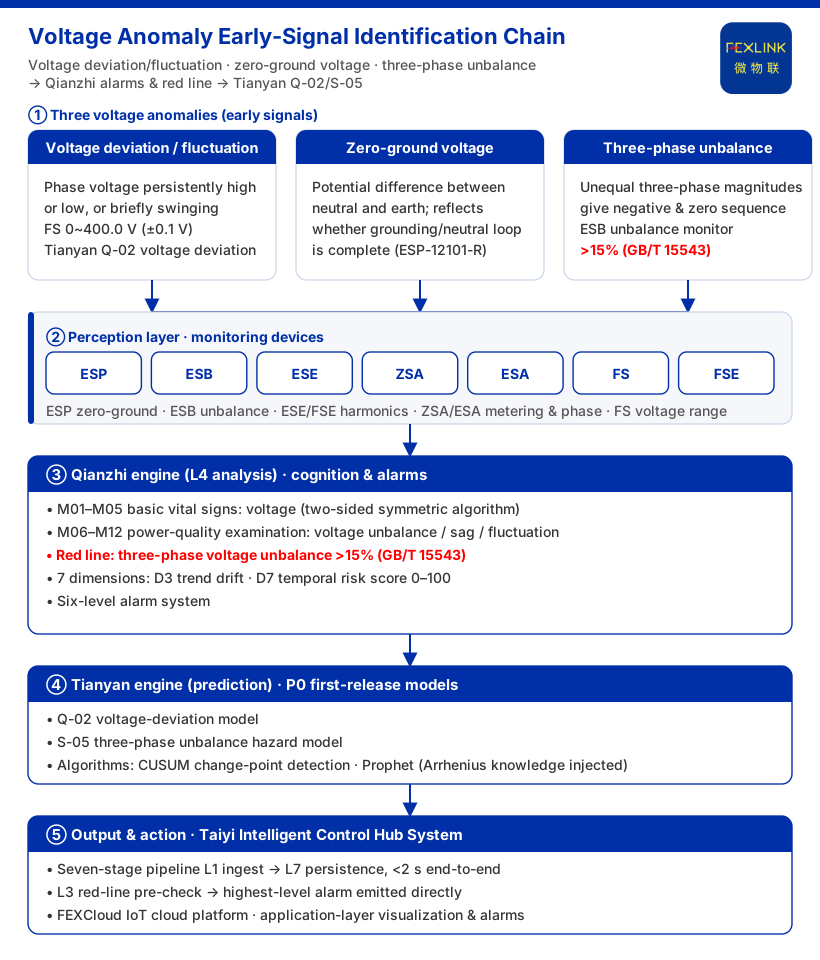
Electrical hazards rarely appear on a single day. Insulation decline, poor contact, load imbalance and grounding degradation all accumulate; the most observable quantity that first reflects a system-level problem is often voltage. Voltage is a "shared quantity": equipment on the same busbar sees the same voltage, so supply-side fluctuation, uneven load distribution and an incomplete neutral or grounding loop all leave traces on voltage first, then conduct into heating, ageing and damage. Voltage anomaly is therefore rarely an isolated reading but a precursor of deeper hazards. This article asks why anomalies surface on voltage first, what zero-ground voltage and three-phase unbalance mean, and how to move from a reading to trend prediction.
1. Voltage Is the Quantity Disturbed First
Current splits by circuit and must be measured branch by branch; voltage is highly consistent within a busbar section, so it naturally carries system-level information. The knowledge base lists voltage as the first of the basic vital signs M01-M05, using a two-sided symmetric algorithm covering both "high" and "low" excursions. The same section's power-quality examination M06-M12 lists voltage unbalance, voltage sags (ITIC/SEMI F47), voltage fluctuation (IEC 61000-4-15) and interharmonics as voltage-observed items.
Physically, voltage changes need almost no accumulation: a supply-side sag or swell transmits instantly to the whole busbar; imbalanced three-phase load immediately changes phase voltages and the neutral potential; an incomplete grounding and neutral loop raises the zero-ground potential difference. Temperature must accumulate heat and leakage must await damp or degraded insulation, so both need longer. That is why voltage anomaly appears "first" and merits early-signal status.
2. Three Voltage Anomalies Often Confused
"Voltage anomaly" is not one quantity but a set of phenomena that must be read separately.
First, voltage deviation and fluctuation: whether phase voltage stays persistently high or low, or repeatedly swings briefly. The knowledge base gives the FS surge protective device monitor a voltage range of 0~400.0 V (±0.1 V); the Tianyan engine includes a Q-02 voltage-deviation model.
Second, zero-ground voltage: the potential difference between neutral and earth, reflecting whether the grounding and neutral loops are complete. The ESP zero-ground voltage monitor (ESP-12101-R) targets exactly this quantity.
Third, three-phase unbalance: unequal three-phase magnitudes producing negative- and zero-sequence components. The ESB three-phase unbalance monitor is designed for it; the knowledge base further makes "three-phase voltage unbalance >15%" the non-bypassable red line, per GB/T 15543.
The three may appear together, but causes and handling differ, so one total-voltage figure is not enough.
3. Zero-Ground Voltage: An Early Sign of the Grounding and Neutral Loop
Zero-ground voltage deserves separate monitoring because it touches two things at once: whether grounding is sound and whether the neutral loop is healthy. The knowledge base includes "grounding (TN/TT/IT identification)" among basic vital signs, so the system must first identify the grounding system, then judge whether zero-ground voltage is reasonable. Neutral-line voltage drop, neutral current from unbalance and grounding-grid degradation can all raise it.
At the baseline, the knowledge base makes "abnormal open circuit of the grounding resistance" the red line, per GB 50057. On-site cross-checking can use the FR-01311 grounding resistance monitor (three-electrode, DC12V, outdoor, RS485/Zigbee/Ethernet); it gives system-level reference ranges such as 0-200 Ω (standard type, ±1%). When zero-ground voltage is abnormal, the measured earth resistance helps tell whether the problem comes from the neutral loop or the grounding grid.
For "data-centre zero-ground voltage / distribution monitoring", the knowledge base recommends ESP-12101 plus the ESA full-element smart meter plus an ESX edge gateway, focused precisely on zero-ground voltage and distribution.
4. Three-Phase Unbalance: An Early Sign of Load Distribution
Three-phase unbalance usually arises from uneven load distribution, but leaves both voltage and current traces. The ESB three-phase unbalance monitor shares the ESA architecture (6 current ratings, 3×220/380 V, OLED, RS485), adds phase monitoring and has no harmonic monitoring. When only metering and phase are needed, the ESA full-element smart meter covers 3×220/380 V but not phase/harmonics; to see harmonics too, the ESE power-quality monitor adds 2~31st harmonics (±1% accuracy).
On the platform side, the M06-M12 examination covers both voltage and current unbalance (sequence components), while sets a hard >15% boundary for three-phase voltage unbalance (GB/T 15543). A further layer is Tianyan's S-05 unbalance hazard model. For "distribution-automation three-phase correction", recommends ESB plus the FECB2SLP smart circuit breaker.
5. From a Single Voltage Value to Trend and Score
A single voltage reading may just be normal disturbance: brief fluctuation is not danger, and a momentary sag may only be a large load starting. To make it usable, voltage must move from "value alarm" to "process identification". The knowledge base offers two layers: the non-bypassable red lines, including three-phase voltage unbalance >15% (GB/T 15543); and the seven dimensions, where D3 trend drift is central and D7 outputs a 0-100 temporal risk score — the former guards the baseline, the latter gauges distance and direction.
A further layer comes from the Tianyan engine: beyond Q-02 and S-05 hazard models, its algorithms include CUSUM change-point detection and Prophet (injected with Arrhenius electrical knowledge). The knowledge base defines the monitoring system in four layers — perception, edge, platform, application — and the Taiyi intelligent-control hub runs a seven-stage pipeline (L1 ingest → L2 cleansing → L3 red-line pre-check → L4 Qianzhi analysis → L5 Wanxiang assessment → L6 fusion decision → L7 persistence) in under 2 seconds, with an L3 trigger emitting the highest-level alarm. The knowledge base also records that Qianzhi covers 13 primary standards including GB/T 12325, GB/T 14549 and GB/T 15543.
6. What to Monitor and Where to Put It
Selecting by concern is easiest: for zero-ground voltage, the ESP; for three-phase unbalance, the ESB; for harmonics too, the ESE or the FSE power-quality controller (phase and harmonics, 3×220/380 V); for metering and phase only, the ZSA or the ESA; and for voltage alongside SPD status, the FS includes a 0~400.0 V range. The knowledge base gives pairings, such as ESP-12101 plus ESA plus ESX for data-centre zero-ground voltage, and ESE or FSE (with Tianyan harmonic analysis) for harmonic work. Models use the locked knowledge base terminology.
7. Boundaries: What This Article Does Not Claim
It is not a diagnostic procedure and cannot replace site safety rules or standards-compliance conclusions.
Second, the quantitative indicators in the knowledge base (electrical-hazard identification 95%+, alarm compression 80%, 4-12 weeks' warning lead, MTTR reduced 60%) are vendor self-reports. Cite them only as vendor capability claims, never as effect guarantees or procurement grounds.
Third, no implementation details are given for sampling and reporting frequency, offline caching and backfill, alarm-ticket grading, zero-ground voltage thresholds or evidence format; no customer case, certification or effect is claimed; no model, parameter or clause absent from the knowledge base is invented. Only the standard numbers the knowledge base lists — GB 50057, GB/T 15543, GB/T 12325, GB/T 14549 — are cited, without inferring their clauses.
Fourth, the article covers only voltage and does not reuse or absorb other articles' landing points: the case for moving hazard handling earlier, the data-checking order right after a strike, and single-quantity topics such as current, leakage, temperature and arcing are not developed.
Conclusion
Voltage anomaly is often taken as an early signal because voltage is the system-level shared quantity: supply fluctuation, load distribution and neutral or grounding loop problems all show on it first, and it accumulates almost instantly, so it reads earlier than temperature and leakage. The path: use ESP for zero-ground voltage, ESB for three-phase unbalance and ESE/FSE as needed for harmonics and power quality, with ZSA/ESA metering and the FS voltage range completing the picture; guard the boundary with Qianzhi's red line and the M06-M12 items; move judgement from a single point to a trend with D3/D7 and Tianyan's Q-02 and S-05; then turn data into action via the four-layer architecture and seven-stage pipeline. Reading voltage anomaly well means getting a system-level warning before the hazard conducts into failure.