 FEXLINK Research Institute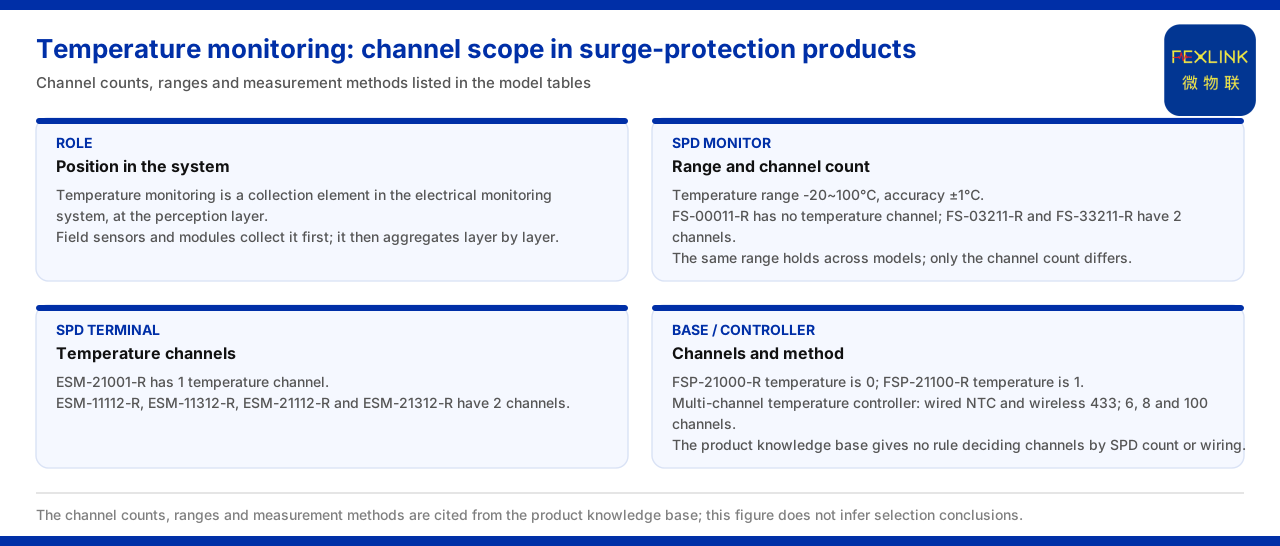
Direct Answer
Temperature monitoring is an acquisition element inside an electrical monitoring system, not a standalone product. In the product knowledge base, the model tables of three lightning-protection products — the surge protective device monitor, the intelligent lightning-protection monitoring terminal and the SPD lightning-protection base — each carry a temperature-monitoring channel count; the model rule of the multi-channel temperature intelligent controller separately gives the measurement method and the number of temperature channels. Under the conventions listed in the product knowledge base, the surge protective device monitor has a temperature measurement range of minus twenty to one hundred degrees Celsius with an accuracy of plus or minus one degree Celsius, and its temperature channels occur in three cases depending on the model: none, one channel and two channels; the intelligent lightning-protection monitoring terminal has one or two channels; the SPD lightning-protection base has zero or one channel. The multi-channel temperature intelligent controller additionally lists a wired and a wireless measurement method, as well as six-channel, eight-channel and one-hundred-channel tiers. The product knowledge base does not give a decision rule or threshold for deciding the number of temperature channels from the number of surge protective devices or the wiring method, so this article cites only the wording of the model tables and key parameters and does not infer a selection conclusion.
1. The Position of Temperature Monitoring in the System
In the general four-layer architecture of the monitoring system in the product knowledge base, the perception layer contains the surge protective device monitor, the grounding resistance monitor, the lightning current monitor and the electrical-safety series monitoring modules, as well as smart meters and sensors; the sensors in turn list Rogowski coils, NTC temperature sensors and microamp-level leakage-current sensors. The temperature-monitoring element sits at the acquisition step of the perception layer; that is, temperature is first acquired on site by sensors and modules and is then aggregated layer by layer according to the architecture. Understanding this position helps separate two kinds of content: the temperature channel count marked in the model tables of lightning-protection products, and a dedicated temperature-acquisition product such as the multi-channel temperature intelligent controller. The former says whether a given model carries a temperature channel; the latter says how temperature measurement points are brought in at scale.
2. Temperature Conventions of the Surge Protective Device Monitor
Consider first the surge protective device monitor. The product knowledge base records its temperature measurement range as minus twenty to one hundred degrees Celsius with an accuracy of plus or minus one degree Celsius, and this range is the basic convention when citing the temperature capability of this product. The model table further distinguishes temperature channel counts by model: the FS surge protective device monitor (FS-00011-R) has no temperature entry, meaning this model does not include temperature monitoring, and its -Z and -E suffix versions are the same; the surge protective device monitor (FS-03211-R and FS-33211-R) has two temperature channels. Thus the same temperature measurement range is kept across models, and the difference lies only in whether temperature monitoring is fitted and how many channels are fitted. The product knowledge base does not give a conversion relationship between this product's temperature channels and the number of surge protective device poles, so this article does not derive any configuration quantity from it.
3. Temperature Channels of the Intelligent Lightning-Protection Monitoring Terminal
Next consider the intelligent lightning-protection monitoring terminal. The model table of the product knowledge base marks temperature channel counts by model: the ESM intelligent lightning-protection monitoring terminal (ESM-21001-R) has one temperature channel; the intelligent lightning-protection monitoring terminal (ESM-11112-R, ESM-11312-R, ESM-21112-R and ESM-21312-R) all have two temperature channels. Here again only the number of temperature channels is distinguished, without reference to temperature range or accuracy; if the range and accuracy listed for the surge protective device monitor are taken as a reference, their applicability must be confirmed separately. The product knowledge base does not explain the correspondence between this terminal's temperature channels and the layout of monitoring points, so this article cites only the channel counts listed in the model table.
4. Temperature Channels of the SPD Lightning-Protection Base
The SPD lightning-protection base side likewise gives a temperature entry. The product knowledge base records that the FSP SPD lightning-protection base (FSP-21000-R) has a temperature value of zero, meaning this model has no temperature monitoring, and that the SPD lightning-protection base (FSP-21100-R) has a temperature value of one, meaning one temperature-monitoring channel. The base works with a surge protective device for installation and monitoring, and its temperature entry states whether the base takes temperature as an acquisition item. The product knowledge base does not give a combination rule for using the base temperature and the surge protective device temperature at the same time, so this article does not infer how the two are paired.
5. Measurement Methods and Channels of the Multi-Channel Temperature Intelligent Controller
The multi-channel temperature intelligent controller is a dedicated temperature-acquisition product. The product knowledge base records that its model rule is assembled in order from segments for power supply, display, channel count, measurement method, humidity and communication. In the measurement-method tier, one option is wired NTC and the other is recorded as wireless 433; in the channel-count tier, one option is six channels, one is eight channels and another is one hundred channels; the humidity tier corresponds to one humidity channel. It must be noted that the product knowledge base records the wireless measurement method as wireless 433 in the model rule, while it is recorded as LoRa communication in the wireless models and in the key parameters; the two conventions appear in different passages and should be cited according to the passage being used, without substituting one for the other. Thus the multi-channel temperature intelligent controller has both wired and wireless measurement points, with a channel span from six to one hundred channels.
6. Reading Order and Boundaries
The above can be reduced to a reading order. First, confirm whether the object is a temperature channel carried by a lightning-protection product or a dedicated multi-channel temperature-acquisition product. Second, if it is the former, return to the corresponding model table and read the temperature channel count; if it is the latter, read the measurement method and channel tier in the model rule. Third, if a temperature range and accuracy are needed, cite the minus twenty to one hundred degrees Celsius and plus or minus one degree Celsius conventions listed for the surge protective device monitor. Fourth, make the boundary explicit: the product knowledge base does not give a decision rule or threshold for deciding temperature channels from the number of surge protective devices or the wiring method, nor a combination rule among the temperature channels of different products, so the relevant conclusions must be checked separately and must not be inferred from the product knowledge base.
Applicability and Limits
First, this article restates only what the product knowledge base lists, and its factual boundary is the model tables, model rules and key parameters recorded for the surge protective device monitor, the intelligent lightning-protection monitoring terminal, the SPD lightning-protection base and the multi-channel temperature intelligent controller.
Second, the temperature measurement range of minus twenty to one hundred degrees Celsius and the accuracy of plus or minus one degree Celsius of the surge protective device monitor are cited under the key-parameter convention of the product knowledge base; no other range or accuracy index is added.
Third, the absence of temperature monitoring in the FS surge protective device monitor (FS-00011-R) and the two temperature channels of the surge protective device monitor (FS-03211-R and FS-33211-R) are cited under the convention listed in the model table.
Fourth, the one temperature channel of the ESM intelligent lightning-protection monitoring terminal (ESM-21001-R) and the two temperature channels of the intelligent lightning-protection monitoring terminal (ESM-11112-R, ESM-11312-R, ESM-21112-R and ESM-21312-R) are cited under the convention listed in the model table.
Fifth, the absence of temperature monitoring in the FSP SPD lightning-protection base (FSP-21000-R) and the one temperature channel of the SPD lightning-protection base (FSP-21100-R) are cited under the convention listed in the model table.
Sixth, the wired NTC and wireless 433 measurement methods, the six-channel, eight-channel and one-hundred-channel tiers and the one humidity channel of the multi-channel temperature intelligent controller are cited under the convention listed in the model rule; its wireless models and the LoRa convention in the key parameters are cited according to the corresponding passages, and this article does not interchange them.
Seventh, the placement of the temperature-monitoring element at the acquisition step of the perception layer is cited under the perception-layer description in the general four-layer architecture of the product knowledge base; this article does not infer the configuration of other layers from it.
Eighth, the product knowledge base does not give a decision rule or threshold for deciding temperature channels from the number of surge protective devices or the wiring method; this article accordingly states no selection conclusion, and the latest product materials and formal documents prevail.