 FEXLINK Research Institute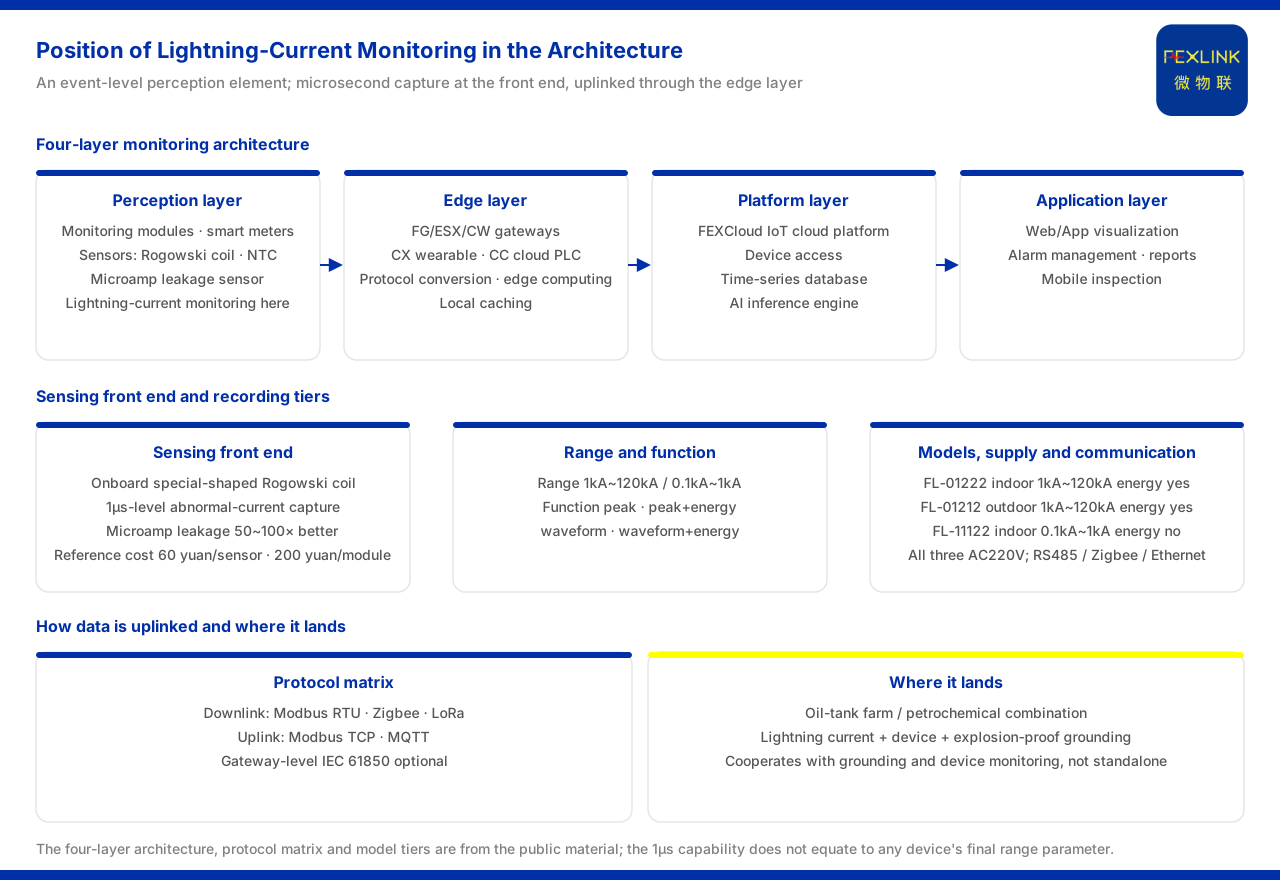
Direct answer
In the four-layer monitoring architecture, lightning-current monitoring belongs to the perception layer and is an event-level perception element parallel to surge protective device monitoring and grounding monitoring, with the acquired data uplinked through the edge-layer gateway to the platform layer. The front-end sensing technology supporting this monitoring is the onboard special-shaped Rogowski coil, whose capability is to capture abnormal current on a microsecond time scale. Because lightning current is itself a transient quantity, whether the front end can catch it in time determines whether the subsequent peak, energy and waveform recording has a usable raw signal.
1. Sensing front end: microsecond-level capture decides whether there is a signal
The material lists the onboard special-shaped Rogowski coil alongside microamp-level leakage-current acquisition as core sensor technologies, and describes its time-resolution capability as 1μs-level abnormal-current capture; it also records that microamp-level leakage-current acquisition accuracy is 50 to 100 times better than comparable products, and that the reference cost of the onboard scheme is about 60 yuan per sensor and 200 yuan per module. This position shows that the Rogowski coil sits at the very front of the acquisition chain: it answers whether this transient can be sensed in time, rather than the final range parameters of a finished device.
2. Four-layer architecture: lightning-current monitoring falls at the perception layer
The material organizes the monitoring system into a perception layer, an edge layer, a platform layer and an application layer. The perception layer is composed of various monitoring modules, smart meters and sensors (including the Rogowski coil, the NTC and the microamp-level leakage-current sensor); the edge layer uses gateways, the industrial wearable and the cloud PLC to perform protocol conversion, edge computing and local caching; the platform layer is responsible for device access, the time-series database and AI inference; and the application layer carries visualization, alarms, reports and mobile inspection. Lightning-current monitoring therefore sits at the perception layer together with surge protective device monitoring and grounding monitoring, at the very front of the data chain.
3. Recording is carried by the lightning current / transient current monitor
Acquisition of lightning current at the perception layer is carried by the FL lightning current / transient current monitor (for example FL-01222). Its model rule encodes the detection range, channel count, function, installation method and supply into field positions: the detection range is divided into two tiers, 1kA~120kA and 0.1kA~1kA, and the function into peak, peak plus energy, waveform and waveform plus energy. The material's model table gives three configurations under this name:
| Model | Installation | Peak range | Energy support |
| --- | --- | --- | --- |
| FL-01222 | Indoor | 1kA~120kA | Supported |
| FL-01212 | Outdoor | 1kA~120kA | Supported |
| FL-11122 | Indoor | 0.1kA~1kA | Not included |
All three are AC220V supplied, with RS485, Zigbee and Ethernet selectable for communication. Capture solves whether a signal is obtained; the model tiers decide which parameters of the event are kept.
4. How data is uplinked: the protocol matrix
In the communication protocol matrix given by the material, the device downlink includes Modbus RTU, Zigbee and LoRa, the device uplink includes Modbus TCP and MQTT, and IEC 61850 can be optionally selected at the gateway level. As a perception-layer device, the data of the lightning-current monitoring module must be uplinked to the platform layer through this protocol matrix, rather than being written directly to the database. This layer decides whether the dispersed event records can be sent out steadily from the site.
5. Position at the platform layer: data finally reaches FEXCloud
The material records that the cloud platform is the FEXCloud IoT cloud platform, and the platform layer carries device access, the time-series database and AI inference. The path of lightning-current monitoring data in the system is therefore: perception layer (the lightning-current monitor and the Rogowski coil) through the edge-layer gateway, uplinked to the platform layer, and finally used by the application layer. It should be noted that the material does not define the electrical installation position of the Rogowski coil inside the monitor, nor does it bind the coil to any model tier; the two cannot be inferred from each other.
6. Extension of the same capability and scenario landing points
Microsecond-level capture does not appear only in the sensor entry. The material lists low-frequency wavelet and high-frequency surge capture (microsecond-level capture of abnormal current) together with a multi-parameter fusion intelligent algorithm as core technologies of the electrical hazard early-warning system, on the same time scale as the microsecond-level capture of the Rogowski coil. At the scenario level, the material lists oil-tank farm and petrochemical lightning and explosion protection as a recommended combination, including lightning-current monitoring, lightning-protection device monitoring and explosion-proof grounding monitoring, showing that in typical configurations lightning-current monitoring cooperates with grounding and lightning-protection device monitoring rather than being deployed independently.
Applicability and limits
First, this article explains only the position of lightning-current monitoring in the monitoring architecture and the role of the Rogowski coil within it; its factual boundary is limited to the product material, and it introduces no standard clause, parameter, certification or case that is not listed.
Second, the 1μs, the 50 to 100 times and the 60 yuan and 200 yuan cited here are core-technology statements listed in the material; this article does not infer the sampling rate, accuracy or other unlisted indicators of a specific model on that basis, nor does it equate them with the range parameters of any monitor.
Third, the detection-range tiers, the function tiers and the peak range and energy support of each model of the lightning current / transient current monitor, as well as the four-layer architecture and the communication protocol matrix, are all existing records of the material; this article does not extend them to unlisted models and makes no performance or result inference.
Fourth, the material does not define the specific installation position of the Rogowski coil inside the monitor, nor establish a binding relationship with model tiers; this article makes no such inference, and actual integration schemes should be determined in conjunction with the site and the engineering design.