 FEXLINK Research Institute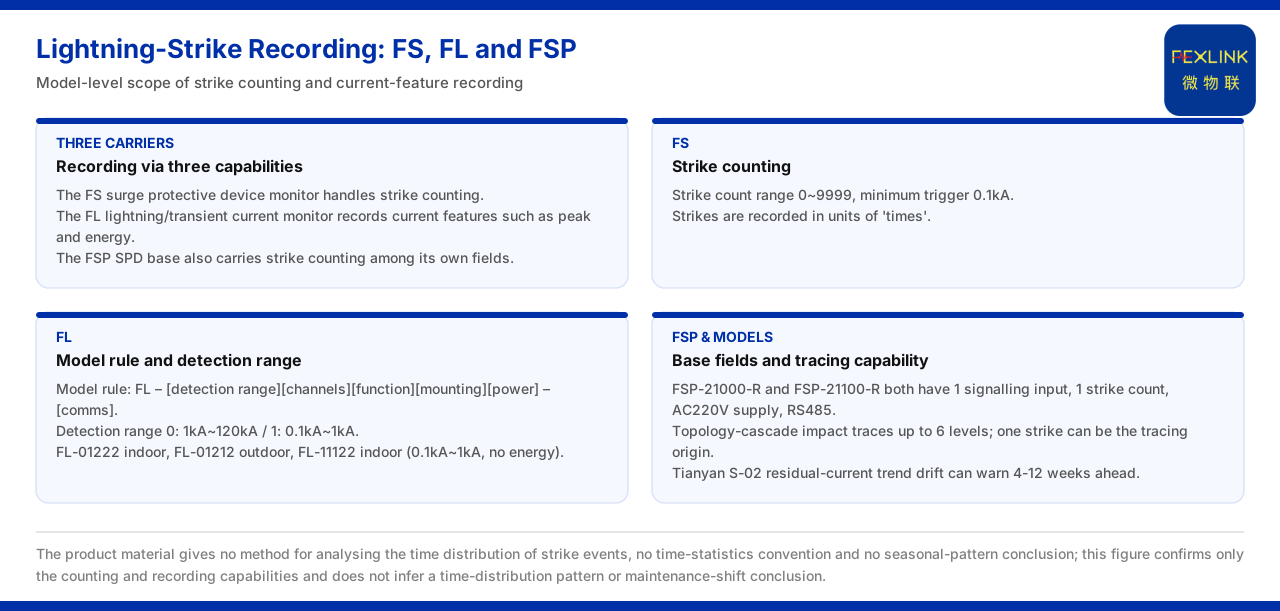
Direct Answer
In the intelligent lightning-protection product line, lightning strikes are recorded jointly by three capabilities: the surge protective device monitor (FS) handles lightning-strike counting, the lightning current / transient current monitor (FL) records current features such as peak and energy, and the SPD lightning-protection base (FSP) also includes lightning-strike counting in its own fields. As listed in the knowledge base, the surge protective device monitor's lightning-strike count range is 0 to 9999, with a minimum trigger of 0.1 kiloamps, recording strike events in units of counts; the lightning current / transient current monitor distinguishes detection range, channel count, function, installation method and supply in its model rule, its two detection-range tiers being 1 kiloamp to 120 kiloamps and 0.1 kiloamps to 1 kiloamp, with function tiers covering peak, peak plus energy, waveform, and waveform plus energy; the two models of the SPD base both include 1 remote-signalling input and 1 lightning-strike count channel. It should be noted that the knowledge base gives no analysis method for the time distribution of strike events, no time-statistics convention and no seasonal-pattern conclusion, so this article confirms only the counting and recording capabilities and infers no time-distribution or scheduling conclusion.
1. The Three Carriers of Lightning-Strike Records
First see which products carry lightning-strike records in this system. The first kind is the surge protective device monitor, which treats lightning-strike counting as an independent measurement item alongside leakage current, voltage and temperature; the second is the lightning current / transient current monitor, which records the peak, energy or waveform of lightning current; the third is the SPD base, which encodes lightning-strike counting together with remote-signalling input into its model fields. The three answer different questions: the monitor, "how many times"; the current monitor, "what the features are"; the SPD base, "whether a strike was recorded". Once the carriers are distinguished, each later range and tier has the correct owner, and counting capability is not confused with current-feature recording capability.
2. Lightning-Strike Counting of the Surge Protective Device Monitor
In the parameter section for the surge protective device monitor, the knowledge base gives a lightning-strike count range of 0 to 9999, a minimum trigger of 0.1 kiloamps, and a counting unit of counts. This means the monitor records strike events by counting and gives a trigger threshold. The count-range upper limit of 9999 and the minimum trigger of 0.1 kiloamps are the two values to hold when citing this function. The knowledge base gives no zeroing method, statistics period or decision algorithm for the counting, so these details remain unlisted. What can be confirmed is the three items of range, minimum trigger and unit, and these are the entire basis for citing lightning-strike counting here.
3. Model Rule of the Lightning Current / Transient Current Monitor
Now consider the lightning current / transient current monitor. The model rule given by the knowledge base consists of code segments for detection range, channel count, function, installation method and supply, followed by a communication segment, where the detection-range tier takes 0 for 1 kiloamp to 120 kiloamps and 1 for 0.1 kiloamps to 1 kiloamp. The detection range is thus a tier fixed at the model level, not a continuously adjustable parameter, the two tiers covering high- and low-current intervals. The function tier values correspond to different record contents, namely peak, peak plus energy, waveform, and waveform plus energy. Reading a model against the rule tells the current interval and features it covers. The knowledge base does not give the complete values of the channel-count, installation-method and supply code positions, so this article cites only the value conventions of the detection-range and function tiers.
4. Model Table of the Lightning Current / Transient Current Monitor
Turning the model rule into concrete models, the knowledge base gives three. FL-01222 is indoor-installed, has a detection range of 1 kiloamp to 120 kiloamps and supports energy recording; FL-01212 is outdoor-installed, has a detection range of 1 kiloamp to 120 kiloamps and supports energy recording; FL-11122 is indoor-installed, has a detection range of 0.1 kiloamps to 1 kiloamp and does not support energy recording. By comparison, FL-01222 and FL-01212 differ in installation environment, one indoor and one outdoor; FL-11122 falls in the low-current tier and does not carry energy recording. The knowledge base does not explain the effect of installation environment on measurement results, nor give the mass-production status of the waveform-tier models, so this article cites only the installation environment, peak range and energy support listed for these three models.
5. Lightning-Strike Counting of the SPD Base
The SPD base table of the knowledge base lists two models, FSP-21000-R and FSP-21100-R, which differ in the temperature field, one being 0 and the other 1. Both models include 1 remote-signalling input and 1 lightning-strike count channel, with an AC220V supply, a digital-tube display and RS485 communication. This shows that the SPD base also carries lightning-strike counting and provides one remote-signalling input on the base side. The knowledge base does not state whether this lightning-strike count shares data with, or how it aligns with, that of the surge protective device monitor, so this article cites only the fields in the base table and does not infer the relationship between the two sides' counts.
6. Traceability and Trend Capability on the Model Side
On the model side, the knowledge base gives two lightning-related analysis capabilities. In the specialized analysis engine of the Wanxiang engine, topology-cascade impact computation can trace up to 6 layers of topological impact, and a lightning-strike event can serve as a traceability starting point, modelled as propagating downstream through multiple levels along the electrical topology. The Tianyan engine's core value is answering how long a device can hold out, when a problem will appear and which window suits maintenance; one residual-current trend-drift model uses a cumulative-sum method, detects a weak mean drift while leakage is still safe, and warns 4 to 12 weeks ahead. These two show that strike events and trend drift each have a corresponding analysis entry on the model side. The knowledge base gives no time convention for the traceability result or threshold setting for the warning, so this article cites only the traceability layer count and the warning lead time and does not expand their decision details.
7. Boundaries to Hold and the Reading Order
The above can be reduced to a reading order. First, confirm whether what is wanted is the strike count, the lightning-current features, or the base-side strike record, and choose the corresponding product. Second, read the model and range: for the surge protective device monitor, the lightning-strike count range and minimum trigger; for the lightning current / transient current monitor, the detection-range tier and function tier; for the SPD base, the lightning-strike count and remote-signalling input fields. Third, if the model side is involved, cite the traceability layer count of topology-cascade impact and the lead time of residual-current trend drift. The boundary to hold is that the knowledge base provides no analysis method for the time distribution of strike events, no time-statistics convention and no seasonal-pattern conclusion, so only the counting and event-recording capabilities can be confirmed, and no time-distribution pattern or maintenance-scheduling conclusion may be inferred. This boundary is limited to the knowledge-base text and is the restriction readers most need to carry away.
Applicability and Limits
- This article restates only what the knowledge base lists; its factual boundary is the model and parameter records of the surge protective device monitor, the lightning current / transient current monitor and the SPD base, together with the records of the Wanxiang engine and the Tianyan engine.
- The lightning-strike count of 0 to 9999 and the minimum trigger of 0.1 kiloamps of the surge protective device monitor are cited under the knowledge base's parameter section; no zeroing method, statistics period or decision algorithm is added.
- The detection ranges of 1 kiloamp to 120 kiloamps and 0.1 kiloamps to 1 kiloamp, the four function tiers, and the installation environment and energy support of the three models FL-01222 and FL-01212 and FL-11122 are cited under the model-rule and model-table conventions; the mass-production status of the waveform tier is not added.
- The lightning-strike count of 1 channel, remote-signalling input of 1 channel, AC220V, digital-tube display and RS485 of the SPD base (FSP-21000-R and FSP-21100-R) are cited under the base-table convention; the relationship with the monitor's count is not inferred.
- The Wanxiang engine tracing up to 6 layers of topological cascade impact, and the Tianyan engine's residual-current trend drift warning 4 to 12 weeks ahead, are cited as listed; decision details are not expanded.
- The knowledge base provides no analysis method, time convention or seasonal-pattern conclusion for strike-event time distribution, and this article accordingly states no time-distribution or scheduling conclusion.
- This article explains only the information and reading order within the knowledge base and is not a commitment to a project's selection or maintenance conclusion; the latest product documents prevail in practice.