 FEXLINK Research Institute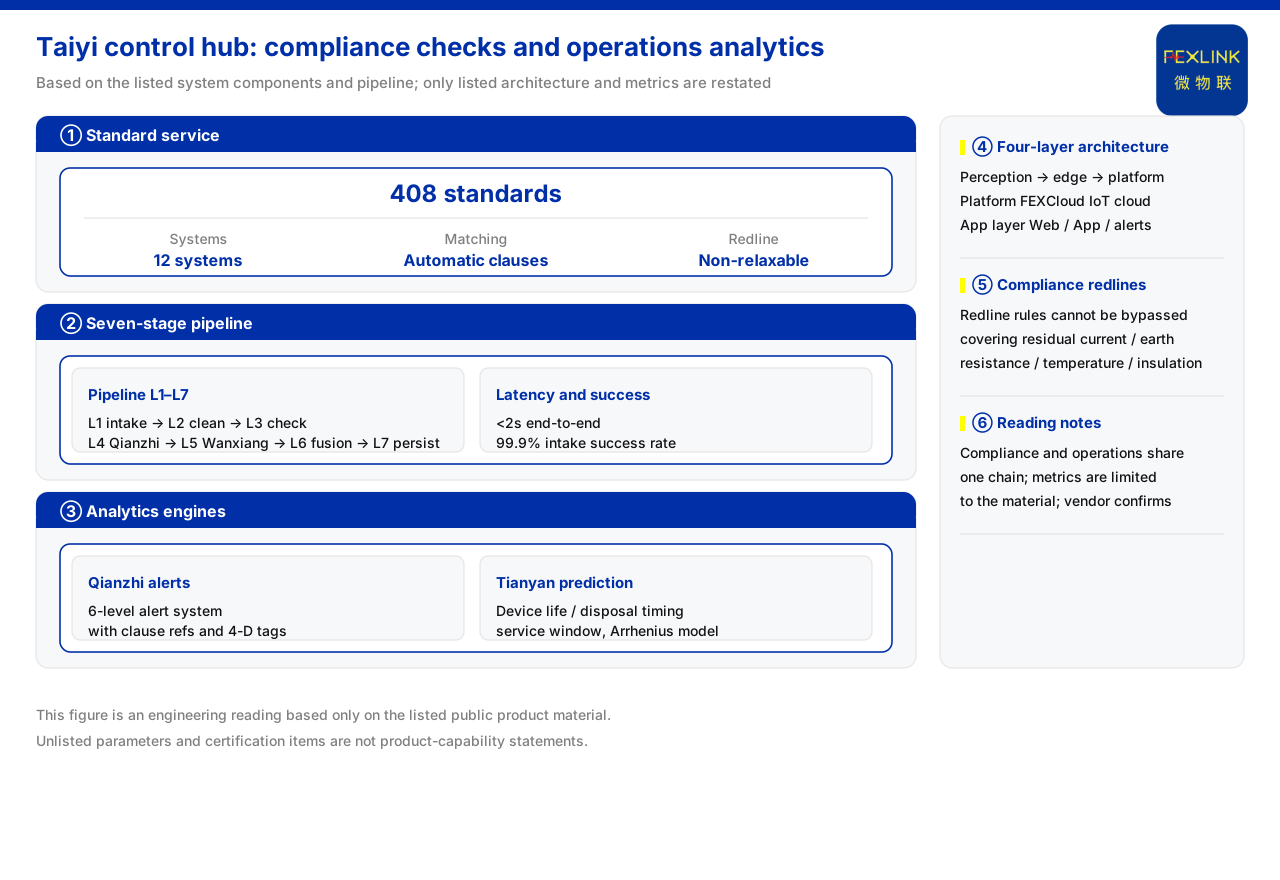
Direct answer
A monitoring scheme that must satisfy both compliance evidence and operational analysis relies on one chain that runs from standard checking to analytical decision-making: the data acquired at the front end first passes through a standards service for clause matching and red-line checking to form a compliance basis, and then passes through analysis engines for alarms and prediction to support operations. The product material describes the standards service of the Taiyi intelligent control hub system as a library of 408 standard clauses covering 12 standard systems, with automatic clause matching and non-relaxable red lines; the system uses a seven-stage pipeline with an end-to-end time of less than 2 seconds and a data access success rate of 99.9%. Compliance and operations are therefore not two parallel systems but the earlier and later halves of the same chain.
1. Compliance evidence relies on the standards service and the red-line guard
The product material records that the Taiyi intelligent control hub system includes a standards service whose library holds 408 standard clauses, covering 12 standard systems such as GB, GB-T, DL, IEC and UL, and that it has automatic clause-matching capability with non-relaxable red lines. This provides the basis for compliance evidence: when a piece of data triggers a check, the system can match it to the corresponding standard clause, rather than giving only an isolated numerical alarm. At the same time the system has red-line rules that cannot be bypassed, for example a residual current of 300 mA against GB 13955, an abnormal open circuit of grounding resistance against GB 50057, a three-phase voltage imbalance over 15% against GB/T 15543, a line temperature of 110 degrees Celsius against GB 16895, and an insulation resistance below 0.5 MΩ against GB/T 16895. That the red lines cannot be relaxed means the compliance judgment is not adjusted by operational preference.
2. The seven-stage pipeline moves the check forward
The product material gives the seven-stage pipeline of the system: access, cleaning, standard verification, Qianzhi analysis, Wanxiang assessment, fusion decision-making and persistence. Standard verification sits after cleaning and before analysis, which shows that the compliance check is a stage preceding analysis rather than an after-the-fact supplement. An end-to-end time of less than 2 seconds and a data access success rate of 99.9% mean that the output from the moment data enters the system to the check and the analysis can be completed within a very short time. Moving the check forward makes the compliance conclusion arise before the operational analysis, and this is where the order of the two halves of the chain is fixed.
3. The platform layer and the application layer carry operations
According to the four-layer architecture in the product material, the platform layer is carried by the FEXCloud IoT cloud platform, responsible for device access, time-series data and inference; the application layer provides visualisation, alarm management, analytical reports and mobile inspection. The conclusions and clause references produced by the compliance check need to land on such a platform before they can be searched and retained, and operational analysis equally needs the data foundation of the platform layer. For a monitoring scheme, the same data is used both for the check and for visualisation and reporting. The existence of the platform layer and the application layer lets compliance evidence and operational analysis share one data foundation rather than acquiring data separately.
4. Alarms carry clause references and impact tags
The product material records that the Qianzhi engine uses a six-level alarm system, and that each alarm carries a standard clause reference, four-dimension impact tags, a confidence level and a scenario tag. The four-dimension impact tags cover safety, efficiency, lifetime and carbon, expressed on a scale of 0 to 100. This design links compliance and operations directly: the clause reference serves compliance evidence, while the impact tags and the confidence level serve operational judgment. One alarm can answer both whether a standard is met and how large the impact is on safety, efficiency, lifetime and carbon, so that compliance records and operational analysis do not keep separate accounts.
5. Predictive analysis supports maintenance decisions
The product material describes that the predictive analysis of the Tianyan engine answers how much longer a device can serve, when it may fail, and which time window suits maintenance, with a theoretical basis including the Arrhenius equation, an exponential growth pattern of leakage current and a non-linear growth curve of contact resistance. This part faces operations: above the compliance floor it further gives trend judgments and maintenance scheduling. If only the compliance check were done, the system could answer only whether the line was crossed; with predictive analysis, compliance data can be turned into a maintenance plan. Compliance and operations thus divide the work: the former guards the floor, the latter optimises the rhythm above the floor.
6. How the two halves of the chain connect
Connecting the above, a scheme that serves both compliance evidence and operational analysis contains four stages: front-end devices acquire and upload data through the four-layer architecture; the standards service performs clause matching and red-line checking to form a compliance record with clause references; the Qianzhi engine organises the results into operable alarms with graded levels and impact tags; and the Tianyan engine gives predictions and maintenance windows above the alarms and trends. The compliance record answers whether the standards are met, the operational analysis answers how maintenance should be arranged, and both share the same data foundation and the same pipeline.
7. Implications for monitoring-scheme design
Putting the standards service, the pipeline, the alarm system and the predictive analysis together yields several implications for the design of a monitoring scheme. First, the data foundation should be unified so that compliance and operations share one set of acquisition and platform, avoiding inconsistent definitions caused by two systems. Second, the standard check should be moved forward, using the seven-stage pipeline to complete clause matching and red-line judgment before analysis so that the compliance conclusion arises before the operational one. Third, alarms should carry clauses and impact tags so that one alarm supports both compliance evidence and operational analysis. Fourth, prediction should run above the compliance floor, turning data that meets the standard further into maintenance windows and lifetime judgments. These four points come from the system composition and capabilities already listed in the product material, not from additional design assumptions. Organised this way, a monitoring scheme can deliver both traceable compliance records and analysis conclusions for operations.
8. The relationship between compliance records and operational records
Although compliance evidence and operational analysis share the same data foundation, the two do not have entirely the same requirements for records. A compliance record stresses traceability: it needs to retain the triggered standard clause, the corresponding value and the time, so that whether the red line was met at that moment can be traced back. An operational record stresses comparability: it needs to retain trends, impact tags and confidence levels, so that changes in device state can be observed. The alarms in the product material carry both a clause reference and four-dimension impact tags, which shows that the system can satisfy both needs on one record. When designing a scheme, one can therefore know that there is no need to build separate record systems for compliance and operations; as long as the standard clause, the impact tags and the confidence level are kept together, compliance evidence and operational conclusions can be derived from the same record. This also explains why the standard check is placed before analysis.
Scope and limitations
First, this article explains only how a monitoring scheme can serve both compliance evidence and operational analysis; the factual boundary is limited to the standards service, pipeline, alarm system, red-line rules and predictive basis listed in the product material, and no standard clause, certification or engineering code not listed there is introduced.
Second, the product material gives no quantitative design relationship between the red-line thresholds and the protected object; the red-line values in this article are all check conditions as recorded in the material and do not constitute a protection-setting calculation.
Third, the standard-clause count, the number of standard systems, the latency and the success rate in this article are all as recorded in the material; this article does not infer the capabilities of unlisted systems from them, nor does it draw inferences about monitoring effect.
Fourth, a specific scheme must be confirmed in conjunction with the on-site object and the applicable standards; this article provides neither a compliance determination nor a maintenance plan.