 FEXLINK Research Institute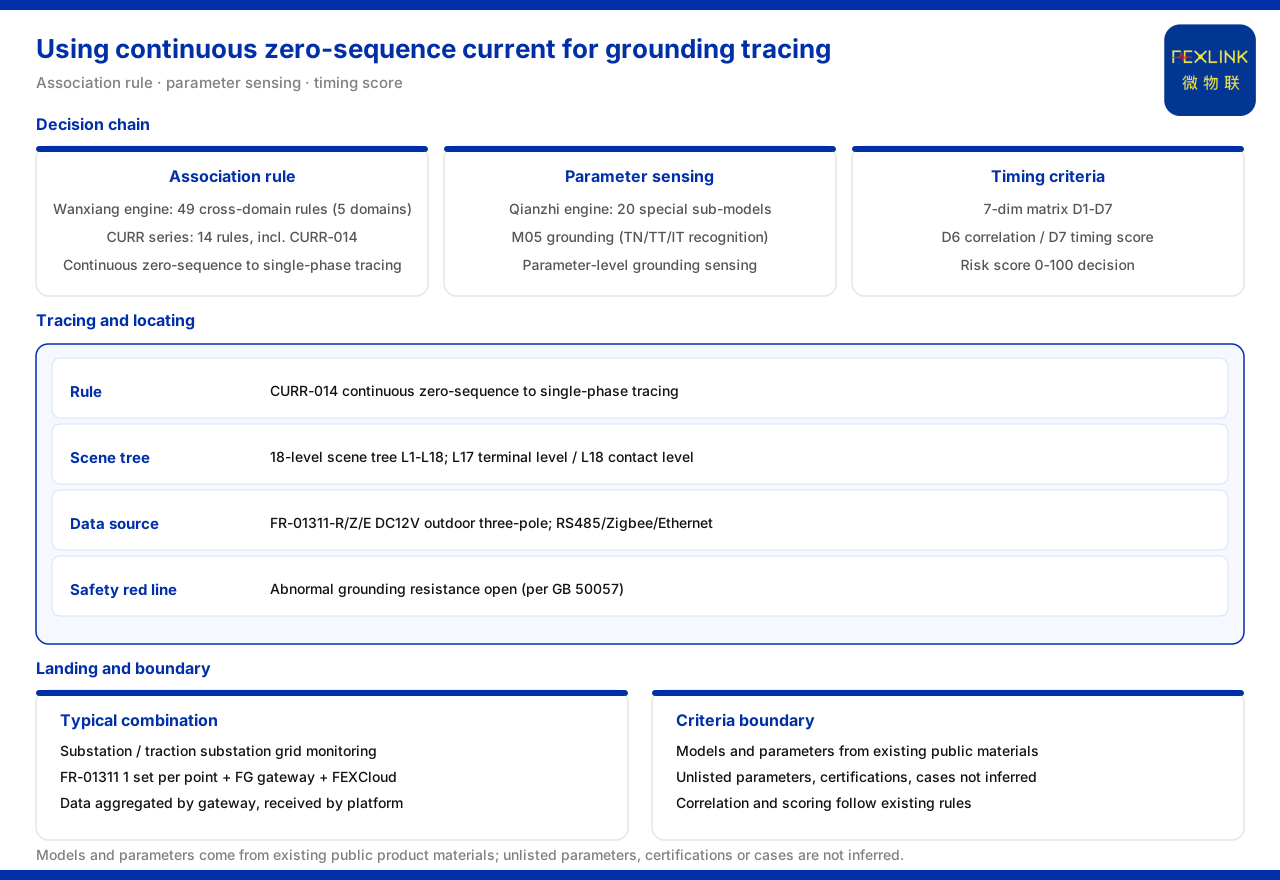
Direct answer
Persistent zero-sequence current can be used for single-phase grounding tracing because the product knowledge base writes the relationship as an explicit association rule and backs it with three kinds of support: parameter-level sensing, association verification, and time-series scoring. The product knowledge base records that the Wanxiang engine holds 49 cross-dimensional association rules organized into 5 domains, and one group of those rules explicitly links "persistent zero-sequence current" to "single-phase grounding tracing." The basic sensing comes from the basic-vital-signs sub-model group of the Qianzhi engine, whose grounding item recognizes the TN, TT, and IT grounding forms. Whether the feature is persistent is judged through the association verification and time-series risk scoring of the 7-dimensional sensing matrix. Tracing to a specific location is performed with an 18-level scene-location tree that includes the wiring-terminal level and the contact-point level. The field data source is the FR grounding resistance monitor (FR-01311-R/Z/E), and the typical combination is one set of that monitor per point plus a lightning-protection smart gateway plus the cloud platform. The safety red-line guard also lists "abnormal open circuit of grounding resistance" as one of its non-bypassable safety red-lines, on the basis of GB 50057.
1. The criterion starts from one association rule
Single-phase grounding in a distribution system does not always appear as an obvious phase-to-phase fault; its signature often falls on the zero-sequence component. The Wanxiang engine writes "persistent zero-sequence current" to "single-phase grounding tracing" as one cross-dimensional association rule, which shows that the link is not a verbal summary of field experience but a formal association entered into the engine rule base. The engine holds 49 such rules across 5 domains, and this item belongs to the current domain. The rule gives a direction: when zero-sequence current persists, the check should follow the rule back to a single-phase grounding problem instead of stopping at an isolated current reading.
2. The parameter-level sensing foundation: grounding-form recognition
For an association rule to take effect, a usable sensed quantity must come first. The product knowledge base records that the Qianzhi engine provides 20 dedicated sub-models, of which the basic-vital-signs group contains five, and one grounding item recognizes the TN, TT, and IT forms. This matters because the same zero-sequence current can have different causes and handling under different grounding forms. Only after the grounding form is identified can the question of whether the current persists and points to single-phase grounding be judged on a parameter-level premise. Grounding-form recognition is therefore a precondition for interpreting zero-sequence current, not an optional side branch.
3. Two classes of criteria: association verification and time-series scoring
The word "persistent" needs criteria to support it. The 7-dimensional sensing matrix contains association verification and time-series risk scoring, the latter giving a composite decision score from 0 to 100. The two act differently: association verification answers whether the zero-sequence current has a consistent link with other sensed quantities, while time-series risk scoring answers whether the feature is stable over time and how far the risk has accumulated. Only by using both together can "zero-sequence current present at one instant" be distinguished from "zero-sequence current persistent and pointing to single-phase grounding." This article restates that judgment structure only and does not infer any conversion between the score and a specific fault probability.
4. From feature to location: the 18-level scene-location tree
Finding single-phase grounding is not the same as finding the fault point. The Wanxiang engine provides an 18-level scene-location tree whose levels refine from L1 down to L18 and include the wiring-terminal level and the contact-point level. The tracing target can therefore be narrowed to the terminal and contact-point layer instead of stopping at the coarse conclusion that "some line has single-phase grounding." The tree's hierarchy shows that, starting from the zero-sequence current feature, the range must be narrowed level by level before it reaches an actionable location; the deeper the level, the finer the check. This article does not expand the specific criteria of each level and only explains the tree's closing role in the tracing chain.
5. Field data source and installation form
All of the above judgments rely on front-end acquisition. The product knowledge base records that the FR grounding resistance monitor (FR-01311-R/Z/E) is a DC12V unit, outdoor-mounted, using the three-electrode method, with communication selectable among RS485, Zigbee, or Ethernet, and is used to acquire the grounding-grid state. These parameters show a fixed installation device that runs online for long periods and needs a supply and a communication path, rather than a spot-check tool. The grounding state corresponding to persistent zero-sequence current needs exactly this kind of monitor, fixed on site and continuously feeding data back; without a stable data source, neither association verification nor time-series scoring can begin.
6. Typical combination: online monitoring of station and traction-substation grounding grids
The typical application scenario table lists "online monitoring of substation and traction-substation grounding grids" as the representative grounding-monitoring scenario, with a recommended combination of one FR-01311 per point plus a lightning-protection smart gateway plus the FEXCloud platform. The "one set per point" wording indicates that the configuration unit is the point: wherever a grounding position must be observed, one monitoring set is placed there; the gateway aggregates the distributed points for the uplink, and the platform receives the data. Read together as data source, gateway, and platform, the continuing zero-sequence data required for single-phase grounding tracing is precisely what this combination collects and feeds back.
7. The non-bypassable bottom line: abnormal open circuit of grounding resistance
Beyond association rules and location capability, there is a constraint that cannot be relaxed. The safety red-line guard lists 5 safety red-lines, all non-bypassable; one of them is "abnormal open circuit of grounding resistance," on the basis of GB 50057. The meaning of this red-line is that the open-circuit state of the grounding path is a bottom-line condition at the national-standard level, and no scheme may treat it as optional. For single-phase grounding tracing it is also a front-end boundary: before the zero-sequence current feature and the location are discussed, the grounding itself must be in a continuously monitorable state, otherwise the premise of the tracing does not hold.
8. Reducing the check into an ordered sequence
Taken together, the check can be reduced to an ordered sequence. Step one, confirm the data source: place the FR grounding resistance monitor (FR-01311-R/Z/E) at the grounding positions to be observed to obtain continuously fed-back data. Step two, identify the grounding form with the grounding sub-model of the Qianzhi engine's basic vital signs, clarifying the judgment premise. Step three, when zero-sequence current persists, follow the Wanxiang engine's association rule back to single-phase grounding. Step four, use both criteria: confirm consistency with association verification and judge persistence and risk accumulation with time-series risk scoring. Step five, refine along the 18-level scene-location tree down to the wiring-terminal or contact-point level. Step six, confirm that the bottom-line item of abnormal open circuit of grounding resistance has no monitoring blind spot. Following this sequence answers "on what basis, with which data, and how it lands on a specific location."
Scope and limitations
First, this article restates only what the product knowledge base lists, and the factual boundary is limited to the Wanxiang engine's association rules and scene-location tree, the Qianzhi engine's grounding sub-model and sensing matrix, the model and parameters of the grounding resistance monitor, the typical scenario combination, and the grounding-related criteria of the safety red-line guard; it introduces no unlisted parameter, certification, or case.
Second, the Wanxiang engine's 49 association rules across 5 domains, including the item linking persistent zero-sequence current to single-phase grounding tracing, and the 18-level scene-location tree containing the wiring-terminal and contact-point levels are cited as the product knowledge base lists them.
Third, the Qianzhi engine's 20 dedicated sub-models, the basic vital signs containing grounding-form recognition, and the 7-dimensional sensing matrix containing association verification and time-series risk scoring (a composite decision from 0 to 100) are cited as the product knowledge base lists them.
Fourth, the supply, mounting, measurement principle, and communication options of the FR grounding resistance monitor (FR-01311-R/Z/E), and the combination of one set per point plus gateway plus platform for online monitoring of station and traction-substation grounding grids, are cited as the product knowledge base lists them.
Fifth, the product knowledge base gives no conversion from a triggered association rule to a specific fault probability, nor does it expand the specific criteria of each level of the location tree; this article records that boundary and does not infer unlisted algorithms, thresholds, or point-layout details from it.
Sixth, this article explains only the rule and judgment structure between persistent zero-sequence current and single-phase grounding tracing, and provides no specific engineering selection, setting, or grounding-remediation plan; related conclusions must be confirmed against on-site survey and the project scheme, and the latest product materials and project scheme always prevail.