 微物联研究院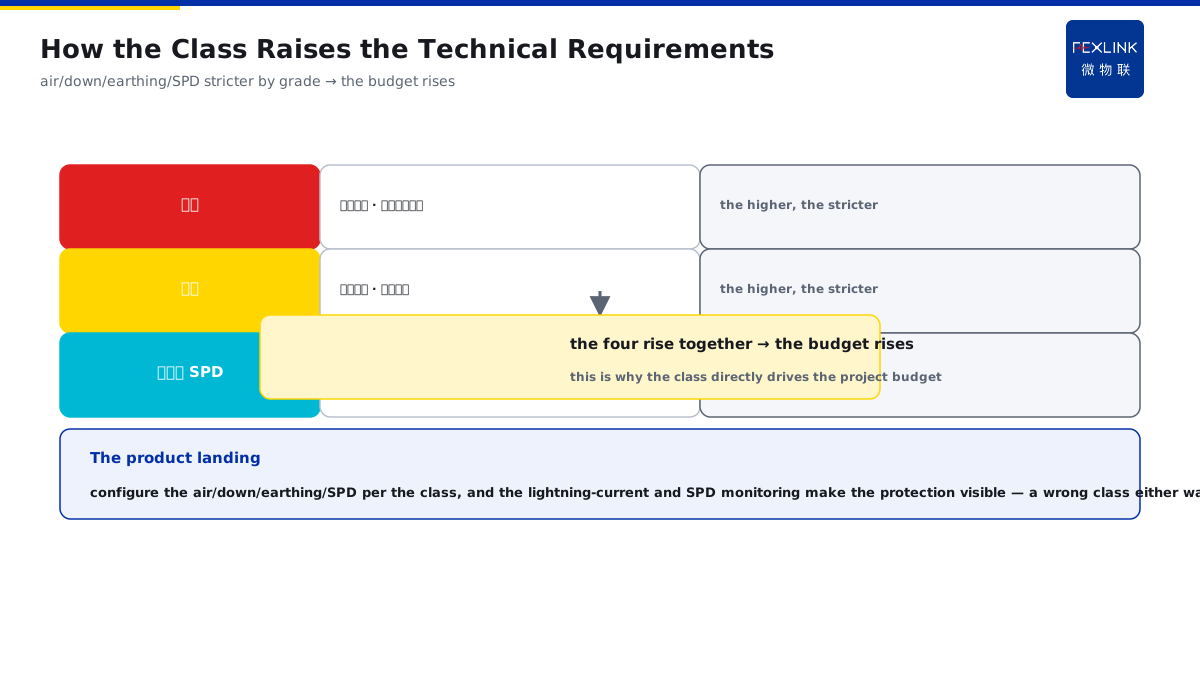
Direct Answer
When doing a project you are always told "design per the Class II protection" — what is this class actually based on? The answer: per GB 50057, the class is decided by the importance, use nature and strike-consequence severity of the building, combined with the estimated annual number of lightning strikes — Class III (ordinary), Class II (important/populated/high strike density), Class I (explosion and fire hazard environment); the higher the class, the stricter the air-termination, down-conductor, earthing and SPD requirements, and the higher the budget.
At a park an ordinary factory was designed per Class II, and the design institute pointed out that by the judgment rules it is actually Class III — the factory is of ordinary importance and the estimated annual strike number does not exceed the threshold; after redesigning per Class III, the air-termination mesh was widened and the down-conductor spacing increased, saving part of the materials alone, with no acceptance dispute. The key distinction: the class is jointly decided by "importance + consequences + the strike-number threshold" — important/populated/high strike density rises to Class II, the explosion and fire hazard environment is listed separately as Class I, and ordinary buildings are Class III; the higher the class, the stricter the technical requirements and the higher the budget, and a wrong class either wastes or reworks.
Why:
- Class III (ordinary): general civil/industrial buildings, the annual strike number not exceeding the threshold;
- Class II (important/populated/high density): important public buildings, populated places, high strike density;
- Class I (explosion and fire hazard): explosion and fire hazard environments, the most severe consequences;
- The class consequence: the higher the class, the stricter the air-termination/down-conductor/earthing/SPD requirements and the higher the budget.
Key insight: "The class is jointly decided by importance + consequences + the strike-number threshold — Class III ordinary, Class II important/populated, Class I explosion-fire hazard; the higher the class, the stricter the requirements and the higher the budget, and a wrong class either wastes or reworks."
At a project a full SPD scheme was designed per Class II, but it is actually a Class I explosion-hazard environment; the expert review pointed out that Class I has stricter SPD throughput and spacing requirements, and the original scheme did not meet them, so it had to be reworked and strengthened. Lesson: a wrong class directly causes rework — decide the class by the rules first, then the technical requirements; the order cannot be reversed.
Overview: run "how the three classes are divided → the threshold role of N → how the class raises the technical requirements → why the hazardous places are listed separately as Class I" as one classification cognition. "Design per Class II" is the most common instruction in projects, but what the class is based on and what it affects are often unclear. The classification logic of GB 50057 is "importance + consequences + the N threshold": ordinary buildings Class III, important/populated/high strike density Class II, and explosion-fire hazard environments Class I; the higher the class, the stricter the air-termination, down-conductor, earthing and SPD requirements, and the higher the budget. The four layers are unfolded below.
An "insurance-grade" analogy: think of the protection class as the coverage grade of an insurance policy. Class III is like the basic insurance — ordinary buildings with controllable losses, low coverage and low premium; Class II is like the upgraded insurance — important/populated places with larger losses, higher coverage and higher premium; Class I is like the special insurance — an explosion-fire environment, where an incident is a big matter, with the highest coverage and the strictest terms. The coverage (the protection level) corresponds to the premium (the project cost): with the class accurate, the money is spent on the blade; set too low, an incident happens and the compensation is unaffordable (insufficient protection); set too high, the premium is wasted. The insurance-grade analogy: Class III = basic insurance (ordinary buildings), Class II = upgraded insurance (important/populated), Class I = special insurance (explosion-fire) — the coverage corresponds to the budget: set accurately the money is spent right, set low the protection is insufficient, set high the money is wasted.
1. How the Three Classes Are Divided: The Judgment Logic
Step one: first look at the judgment logic and the typical examples of the three classes.
Class III (ordinary):
- General civil/industrial buildings;
- Ordinary importance, controllable consequences;
- The annual strike number not exceeding the threshold;
- Typical: ordinary factories, warehouses, residences.
Class II (important/populated/high density):
- Important public buildings;
- Populated places;
- The annual strike number exceeding the threshold;
- Typical: stadiums, hospitals, schools, shopping malls.
Class I (explosion and fire hazard):
- Explosion and fire hazard environments;
- The most severe consequences;
- Listed separately with the highest requirements;
- Typical: oil depots, chemical plants, flammable/explosive factories.
Key insight: "The three-class judgment logic — ordinary buildings Class III (ordinary importance + not exceeding the threshold), important/populated/high strike density Class II (stadiums/hospitals/schools), and explosion-fire hazard environments Class I (oil depots/chemical plants); the more severe the consequences, the higher the class."
2. The Estimated Annual Strike Number N: The Threshold Role
Step two: N is the threshold that quantifies "important buildings" into "whether to upgrade the class".
What N is:
- The estimated annual number of lightning strikes;
- Estimated by the building equivalent area × the local strike density;
- The specific calculation in KD-0223;
- The quantitative basis of the classification.
The threshold role of N:
- An ordinary building with N above the threshold rises to Class II;
- Populated/important buildings with a higher N are already Class II;
- A low N with ordinary importance is Class III;
- N is the boundary of "whether to upgrade".
How to use it:
- Calculate N first;
- Then combine with the importance to judge;
- Both together decide the class;
- Not only N, nor only the building type.
Key insight: "N is the quantitative threshold — an ordinary building with N above the threshold rises to Class II, an important building with a higher N is already Class II, and a low N with ordinary importance is Class III; N and the importance together decide the class, not only one."
3. How the Class Raises the Technical Requirements
Step three: the higher the class, the stricter the air-termination/down-conductor/earthing/SPD requirements.
The air-termination requirements:
- The higher the class, the denser the mesh;
- The smaller the rolling-sphere radius;
- The stricter the air-termination coverage.
The down-conductor requirements:
- The higher the class, the smaller the down-conductor spacing;
- More conductors;
- Higher material specifications.
The earthing and the SPD:
- The higher the class, the stricter the earthing requirement;
- The more complete the SPD setting and the larger the throughput;
- More stages;
- The budget rises accordingly.
Key insight: "The higher the class, the stricter the requirements — the denser the air-termination mesh, the smaller the rolling-sphere radius, the smaller the down-conductor spacing, and the stricter and more complete the earthing and the SPD; the four rise together, and the budget rises accordingly — this is why the class drives the budget."
4. Why the Hazardous Places Are Listed Separately as Class I
Step four: the explosion-fire hazard environments have the most severe consequences, so they are listed separately with the highest requirements.
The special nature of the hazardous places:
- A lightning spark can ignite;
- The consequences are not only equipment damage;
- Involving the personnel and property safety;
- Must be protected per the strictest requirement.
The Class I requirements:
- The air-termination/down-conductor per the highest standard;
- The bonding combined with the explosion protection;
- Stricter SPD throughput and spacing;
- Stricter construction and acceptance.
The judgment points:
- The hazardous places are directly Class I;
- Regardless of N, decided by the consequences;
- The boundary places judged by the strictest;
- Cannot be designed as an ordinary building.
Key insight: "The hazardous places are listed separately as Class I — a lightning spark can ignite, and the consequences are not only equipment damage; Class I is per the highest standard (stricter air-termination/down-conductor/bonding/SPD), regardless of N and decided by the consequences, and cannot be designed as an ordinary building."
A three-step on-site judgment for "deciding the class": for a project, decide the class in three steps. Step one, check the nature — is the building an ordinary civil/industrial, an important public, or an explosion-fire hazard environment? A hazardous place is directly Class I, no need to continue; step two, calculate N — estimate the annual strike number by the equivalent area and the local strike density (the parameters in KD-0223); step three, combine the judgment — an ordinary building with N above the threshold or populated/important is Class II, otherwise Class III. With the three steps the class is basically clear, and for disputed boundary projects take the higher grade per the "strictest" principle. The three steps: check the nature (a hazardous place is directly Class I) → calculate N (equivalent area × strike density) → combine the judgment (populated/above threshold Class II, otherwise Class III) — boundary projects take the higher grade per the strictest principle.
5. Product Implementation: The Class Landing Made Visible
WeiWuLian products bring the protection class into verifiable monitoring:
- The lightning-current monitoring: air-termination operations/strike-count records;
- The SPD monitoring: the operations/degradation of each stage online;
- The system view: the protection configured per the class on one screen;
- The data loop: after a strike, verify whether the air termination worked.
The design principle in one sentence: "The class decides the requirements and the data verifies the effect — configure the air-termination/down-conductor/earthing/SPD per the class, and the lightning-current and SPD monitoring make the protection effect visible; a wrong class either wastes or reworks."
The two typical consequences of a wrong class: one is "set too low" — a building that should be designed per Class I/II is done at the lower grade, and the air-termination mesh, the SPD throughput and the down-conductor spacing do not meet the standard; at a strike or explosion the protection fails, ranging from rework and strengthening to accident accountability; the other is "set too high" — an ordinary building done at the higher grade, with a denser mesh, more down-conductors and a more complete SPD, and the material and construction costs rise for nothing, with the owner paying for the redundant protection. Both consequences come from the same action: deciding the grade by instinct without first judging the class by the rules. The two consequences: set too low the protection fails (rework/accountability), set too high the budget is wasted (the owner pays) — both rooted in deciding the grade by instinct without the rules.
6. Common Understanding Misjudgments
- "The class only depends on the building size": wrong. Importance + consequences + the N threshold decide it together; a small building can be Class II.
- "N above the threshold is always Class II": incomplete. N is one threshold; it must be combined with the importance and the consequences.
- "Designing the hazardous places per Class II is enough": wrong. The explosion-fire hazard environments are listed separately as Class I, per the highest standard.
- "The class only affects the air termination": wrong. The air-termination/down-conductor/earthing/SPD all rise, and the budget rises as a whole.
- "A wrong class is just a drawing change": wrong. The class affects the materials and the construction; a wrong one may cause rework and acceptance disputes.
Scope and Limitations
This article explains the GB 50057 protection-class judgment logic (how the three classes are divided, the threshold role of N, the progressive rise of the technical requirements, the separate Class I for hazardous places), applicable to design-selection and acceptance-dispute judgments. The specific N calculation and mesh/spacing values follow GB 50057-2010; this article explains only the classification logic. All cases are anonymized (a park/a project) and do not refer to any specific customer.