 FEXLINK Research Institute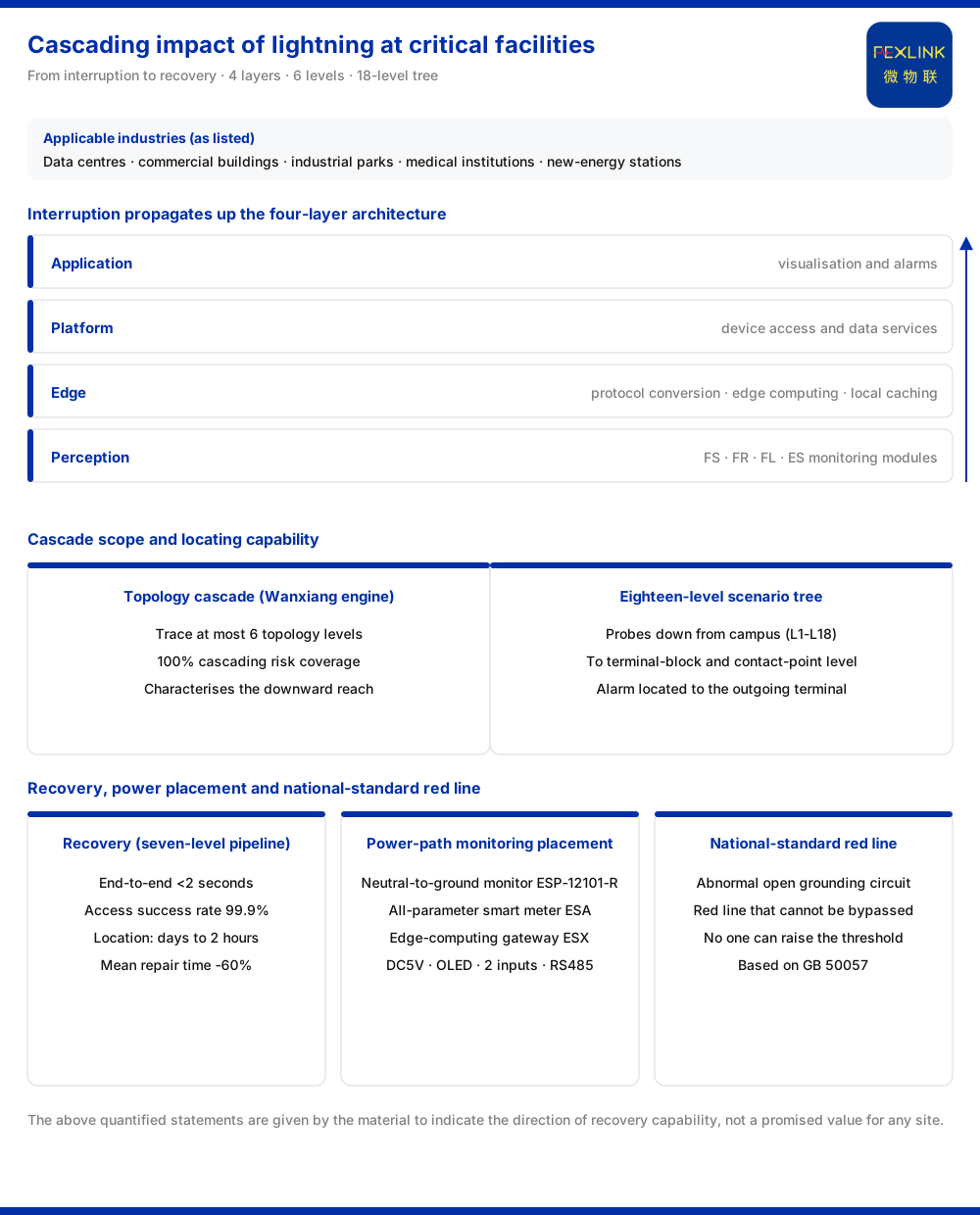
Direct answer
Under the statement of the knowledge base, what really needs to be feared after a critical facility is struck by lightning is not the failure of a single device, but that the impact will amplify level by level along the power, communication and business chains and finally present as a facility-level availability event. The product material lists data centres, commercial buildings, industrial parks, medical institutions, new-energy stations and similar as applicable industries of the Taiyi intelligent control hub system, so lightning protection and electrical safety at such sites are assessed in a system-level availability context rather than as damage to a single device. The same material gives the general four-layer architecture of the monitoring system and the topology-cascade impact capability: the former shows how one interruption propagates upward through the architecture, the latter how one event is traced downward through several levels of the electrical topology. For a critical facility, therefore, the correct question is not "which device broke", but "which levels this interruption will affect, how long location takes, and how long recovery takes".
1. Why critical facilities treat lightning protection as an availability issue
The product material lists data centres, commercial buildings, semiconductor plants, industrial parks, medical institutions, new-energy stations and similar as the applicable industries of the Taiyi intelligent control hub system. This listing defines the problem context: what these sites share is that an interruption of power or communication translates directly into business interruption, so lightning protection is no longer only an electrical matter of "protecting devices from being struck" but a safety matter concerning whether the whole system can keep running.
Putting critical facilities into a system-level availability context changes the object of observation. Damage to a single device can be solved by replacement, whereas a facility-level interruption involves multiple chains of power, communication and business, and the cost of downtime far exceeds the device itself. The material gives no limits or grades by industry, but its listing of "applicable industries" shows that for such sites lightning protection and electrical safety must be planned and monitored as system-level objects, not single points.
2. Interruption propagates upward level by level along the four-layer architecture
The product material summarises the monitoring system as a general four-layer architecture: perception layer, edge layer, platform layer and application layer. The perception layer contains the surge protective device monitor (FS series), grounding resistance monitor (FR series), lightning current / transient current monitor (FL series) and electrical safety monitoring modules; the edge layer handles protocol conversion, edge computing and local caching; the platform layer completes device access and data services; and the application layer provides visualisation and alarms.
These four layers reveal the propagation path of an interruption. The impact of a strike does not stop at the point struck: if acquisition at the perception layer is damaged, data is missing at the source; if conversion or caching at the edge layer is interrupted, data cannot be fully uplinked; and if the platform layer receives no data, the judgement and alarms of the application layer lose their basis. The impact therefore conducts upward level by level, so understanding this path is the precondition for understanding "cascading consequences".
3. The cascading scope of one event: at most six topology levels
The product material records that the Wanxiang engine has a topology-cascade impact engine, which can trace at most six levels of topology impact, and gives a statement of 100% cascading risk coverage. Together, these two answer "how far one lightning event can reach".
The electrical topology is a hierarchical connection graph. Once an event occurs at a node, the impact can conduct downward through the line for several levels, and "at most six levels" gives the depth statement of such tracing. "100% cascading risk coverage" expresses the coverage of this capability over cascading risk, not that one event necessarily damages all levels. This advances the discussion from "is there a problem at this point" to "which downstream levels will it affect", making cascading consequences characterisable rather than describable only by experience after the fact.
4. Locating to the terminal: the eighteen-level scenario tree
For cascading consequences to be handled, they must first be located. The product material records that the Wanxiang engine uses an eighteen-level scenario positioning tree, probing level by level downward from the campus until terminal-block level and contact-point level, so that an alarm can be precisely located to a specific outgoing terminal.
The significance of location granularity is especially prominent in critical facilities. For the same alarm, if it lands only on a campus or a building, operation and maintenance must investigate level by level; if it can land on a specific outgoing terminal, the scope of investigation is greatly compressed. The eighteen-level scenario tree provides exactly this framework of level-by-level probing, refining "an anomaly somewhere" into an executable maintenance object. This describes the locating capability and level statement; the material promises no on-site locating accuracy on that basis.
5. Recovery capability: latency, access success rate and location time
The product material gives the seven-level pipeline statement of the Taiyi intelligent control hub system: end-to-end under 2 seconds and a data access success rate of 99.9%, together with quantified value such as fault location time shortened from days to 2 hours and average repair time shortened by 60%.
These statements answer "how soon an interruption can be seen clearly and recovered". End-to-end latency and access success rate relate to whether the system can obtain data in time after an anomaly appears; location time and average repair time relate to the efficiency from discovery to recovery. For a critical facility, recovery capability is itself part of availability: the faster the location and the shorter the repair, the smaller the impact on business continuity. These are the material's statements, indicating the direction of recovery capability, not a promised value for any site.
6. Monitoring placement on the power path
In its selection comparison, the product material recommends "data centre neutral-to-ground voltage / distribution monitoring" as the neutral-to-ground voltage monitor (e.g. ESP-12101-R), the ESA all-parameter smart meter and the ESX intelligent edge-computing gateway. It uses DC5V supply, an OLED display and a neutral input, and has 2 switching-quantity inputs, 1 relay output and RS485 communication.
The power quality of a critical facility is the most sensitive to business, and neutral-to-ground voltage is a distribution indicator often watched at sites such as data centres. Placing the monitoring point on the power path means that interruption prevention depends not only on the lightning-protection device itself but also on continuous observation of the distribution state. The material gives the selection combination and device parameter statements, showing that such monitoring has a definite product placement in the system; it does not replace on-site verification of power supply, nor constitute a performance promise.
7. The national-standard red line: an abnormal open grounding circuit cannot be bypassed
The product material records that, in the red-line guard mechanism, an abnormal open circuit of grounding resistance is listed as a red line that cannot be bypassed: once triggered, no one can raise the threshold, and the basis is GB 50057.
Placed in the context of critical facilities, the meaning is clear: however much analysis and alarm capability the upper platform has, the reliability of the grounding path is always a fundamental link of lightning protection. Setting an abnormal open grounding circuit as a non-adjustable red line shows that it is not a soft indicator operation and maintenance may trade off, but a bottom-line constraint. This article cites only the existence and basis of this provision and infers no specific threshold or allowable range for any site.
Scope and limitations
First, citations here are limited to the product material and its fact pack, introducing no industry, parameter, certification or case not listed by the material.
Second, the applicable industries are data centres, commercial buildings, semiconductor plants, industrial parks, medical institutions and new-energy stations as listed by the material; this article does not infer the applicability of other unlisted industries.
Third, the four-layer architecture is limited to the perception, edge, platform and application layers described by the material; "at most six levels" of topology-cascade tracing and "100% cascading risk coverage" are the material's statements, with no promise of any site's event reach or accuracy.
Fourth, the locating levels of the eighteen-level scenario tree are the material's statements, and this article does not infer its locating accuracy or alarm grading at a specific site.
Fifth, the end-to-end latency, data access success rate, location time and average repair time reduction of the Taiyi intelligent control hub system are quantified material statements, not a promise for any site.
Sixth, the parameters of the neutral-to-ground voltage monitor (ESP-12101-R) are limited to the material entry; the selection combination indicates only the monitoring placement and provides no selection or configuration calculation.
Seventh, GB 50057 and the red line for an abnormal open grounding resistance are cited per the material, with no specific limits or criteria listed.