 FEXLINK Research Institute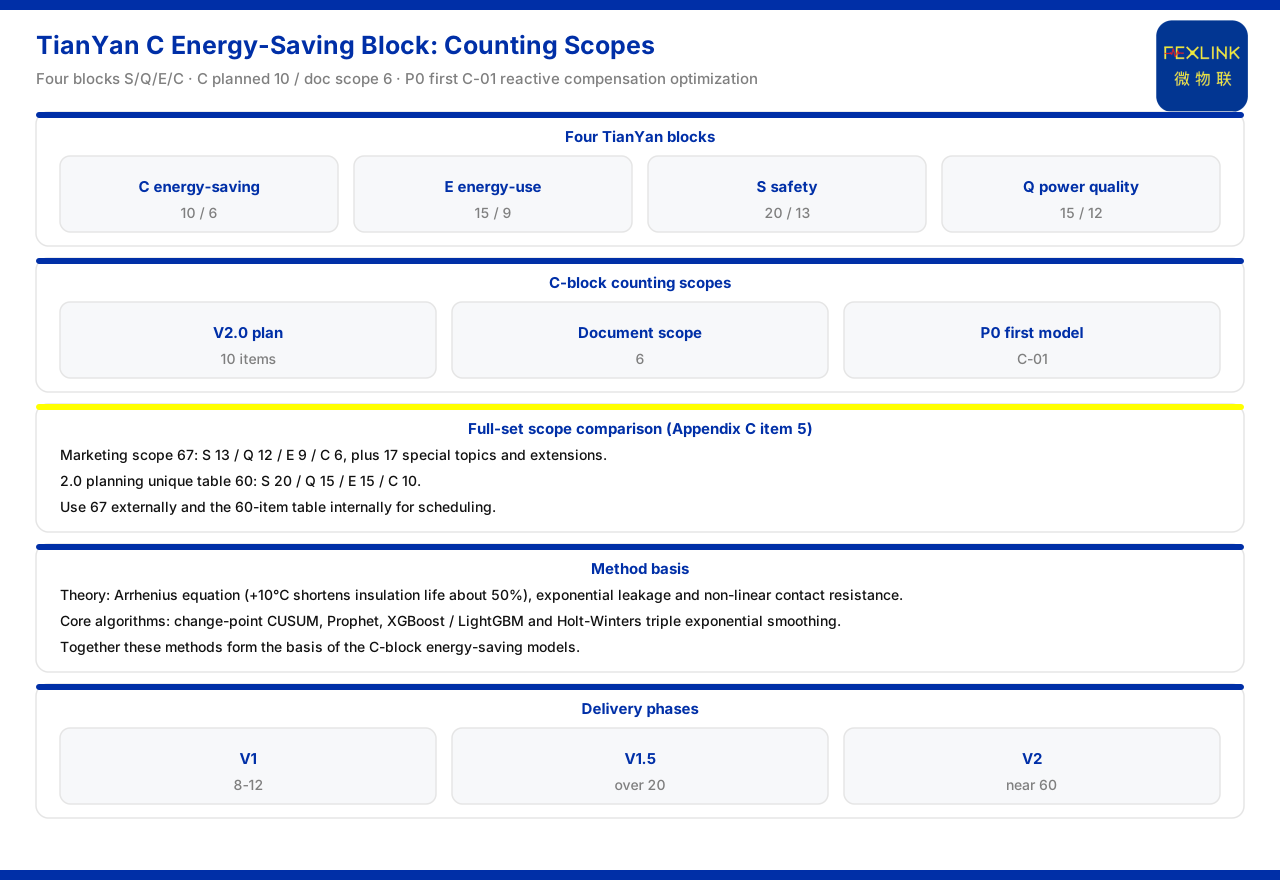
Direct answer
The Tianyan engine V2.0 is planned by four blocks, S, Q, E and C, of which C is the energy-saving measures block. The product knowledge base gives two specifications for the quantity of the C block: the V2.0 plan is 10 items, the documented scope is 6, and the first P0 model is C-01 reactive-power compensation optimisation. The "two sets of numbers" are not a contradiction but serve different purposes, external and internal: the appendix of the knowledge base explains that the marketing-document specification is 67 models across all of Tianyan, while the unique numbering table of the 2.0 plan is 60 items, and the external norm is the former while internal scheduling uses the latter. The methodological basis of the C block includes the Arrhenius equation, the exponential growth model of leakage, the non-linear growth curve of contact resistance, and algorithms such as change-point detection, Prophet, gradient-boosted trees and triple exponential smoothing. Delivery is in three stages: V1 selects 8 to 12, V1.5 expands to more than 20, and V2 approaches the full 60. This article only restates the specifications above.
The position of the C block among Tianyan's four blocks
To understand the C block, one must first see its position within Tianyan. The knowledge base records that the Tianyan engine V2.0 is planned by the four blocks S, Q, E and C, with a full planned scope of 60 to 67 models. The C block is one of them, oriented to energy-saving measure models; alongside it are S safety analysis, Q power quality and E energy-use analysis. The C block is discussed on its own because energy-saving measures directly address the goal of "giving an executable measure", which differs in responsibility from more analysis-oriented blocks such as energy-use analysis. When discussing its quantity specification, one should first fix the premise that it is one of the four blocks; otherwise numbers from different sources are easily compared as if alike and produce a wrong conclusion.
The quantity scopes of the C block: 10 items and 6
The knowledge base gives two numbers for the C block. First, the V2.0 plan is 10 items, the model count under the planning scope; second, the documented scope is 6. The two do not point to exactly the same object: the planning scope corresponds to the complete numbering table, while the documented scope corresponds to the parts actually expanded in the document. The first P0 model is C-01 reactive-power compensation optimisation, which shows that within the C block the models are delivered in an order, and C-01 is a model that lands first. When citing "how many models the C block has", one must therefore state which scope is used; otherwise 10 and 6 are misread as mutually negating numbers. This is why this article stresses the source of the scope.
Why two scopes exist
The reason for the two scopes is explained in the appendix of the knowledge base. The appendix notes that the Tianyan model count has two specifications: the marketing document is 67, made up of S block 13, Q block 12, E block 9, C block 6, plus 17 special topics and an extension part; the unique numbering table of the 2.0 plan is 60 items, made up of S block 20, Q block 15, E block 15 and C block 10. The usage given by the knowledge base is: use 67 uniformly for external purposes, and the 60-item numbering table for internal scheduling. It can be seen that the 6 and 10 of the C block are exactly how these two scopes appear in that block. With this understood, when a number appears on different occasions one can judge whether it belongs to the external statement or the internal schedule, instead of treating them as a conflict under one scope.
Delivery phases: 8 to 12, more than 20, and 60
Beyond the quantity scope, delivery rhythm is another dimension for understanding the C block. The knowledge base records that Tianyan delivery is in three stages: V1 selects 8 to 12 models, V1.5 expands to more than 20, and V2 approaches the full 60. This shows that the measure models of the C block are not all brought online at once but increase gradually with the version. For the user, this means the number of measure models available in early versions is limited, and phased planning must put the limited capability on priority scenarios; as versions advance, the coverage expands. Reading the delivery phases together with the quantity scopes avoids a common misunderstanding: treating the planned 10 as the immediately available number, or the documented 6 as the final ceiling. The two describe planning and documentation respectively, while the delivery phases describe time.
The methodological basis of the C block
The measure models of the C block rest on a definite methodological basis. The knowledge base records that the theoretical basis of Tianyan includes the Arrhenius equation (for every 10℃ rise in temperature, insulation life shortens by about 50%), the exponential growth model of leakage and the non-linear growth curve of contact resistance; the core algorithms include change-point detection, Prophet (with Arrhenius electrical knowledge injected), XGBoost and LightGBM, and Holt-Winters triple exponential smoothing. These methods correspond to different analysis goals: change-point detection identifies state transitions, Prophet forecasts trends with electrical knowledge injected, gradient-boosted trees handle classification and regression, and triple exponential smoothing handles smoothed forecasting. Matching the methodological basis with the measure goals shows why the C block can give measures in different energy-use scenarios rather than only doing numerical statistics.
Selection combination and deployment
In the product selection and AI capability comparison, the knowledge base expresses the "energy saving and carbon management" combination as the Tianyan C block (C-01 to C-06), E-09 carbon accounting and the smart energy-carbon IoT platform. This statement shows that, under the documented scope, the C block contains 6 measure models, C-01 to C-06, and together with carbon accounting and the energy-carbon platform forms the energy-saving and carbon-management plan. Selection should first confirm which scope and which delivery stage are used, then arrange the available measure models accordingly; at the same time, the measure capability of the C block should be distinguished from E-09 carbon accounting and the energy-carbon platform, with each responsibility made clear, rather than attributing all capability in the combination to a single block.
Checking sequence when using the two scopes
Setting this out as a sequence makes citation easier. First, confirm that the object is the C energy-saving measures block among the four Tianyan blocks. Second, judge whether the cited number belongs to the external scope or the internal scheduling scope. Third, if it is an external statement, use the full 67 and note that the C block within it is 6. Fourth, if it is internal scheduling, use the 60-item numbering table and note that the C block within it is 10. Fifth, together with the actual delivery stage, check against V1's 8 to 12, V1.5's more than 20 and V2's approach to the full 60 to confirm the currently available range of measure models. This sequence separates "recognise the block, split the scope, split the scenario, see the stage", avoiding treating the two numbers as mutually negating and avoiding treating the planned quantity as the immediately available quantity. The checked result should be confirmed together with the project schedule; this article does not replace internal scheduling.
Applicability and limits
First, the content of this article is limited to the product knowledge base's existing statements about the Tianyan engine's four blocks, the quantity scopes of the C energy-saving measures block, the delivery phases, the methodological basis and the selection combination.
Second, the C block's V2.0 plan of 10 and its documented scope of 6 are both listed in the knowledge base; this article does not interpret them as contradictory, nor does it infer the details of unlisted models.
Third, the marketing document's 67 and the 2.0 plan numbering table's 60 items, and the usage of using 67 uniformly for external purposes and 60 for internal scheduling, are limited to the knowledge base appendix.
Fourth, the delivery phases of V1's 8 to 12, V1.5's more than 20 and V2's approach to the full 60 are restated according to the knowledge base; this article does not promise a specific timetable.
Fifth, the Arrhenius equation, the exponential growth model of leakage, the non-linear growth curve of contact resistance and the core algorithms follow the knowledge base specification; actual capability follows the latest product materials and project plans.