 FEXLINK Research Institute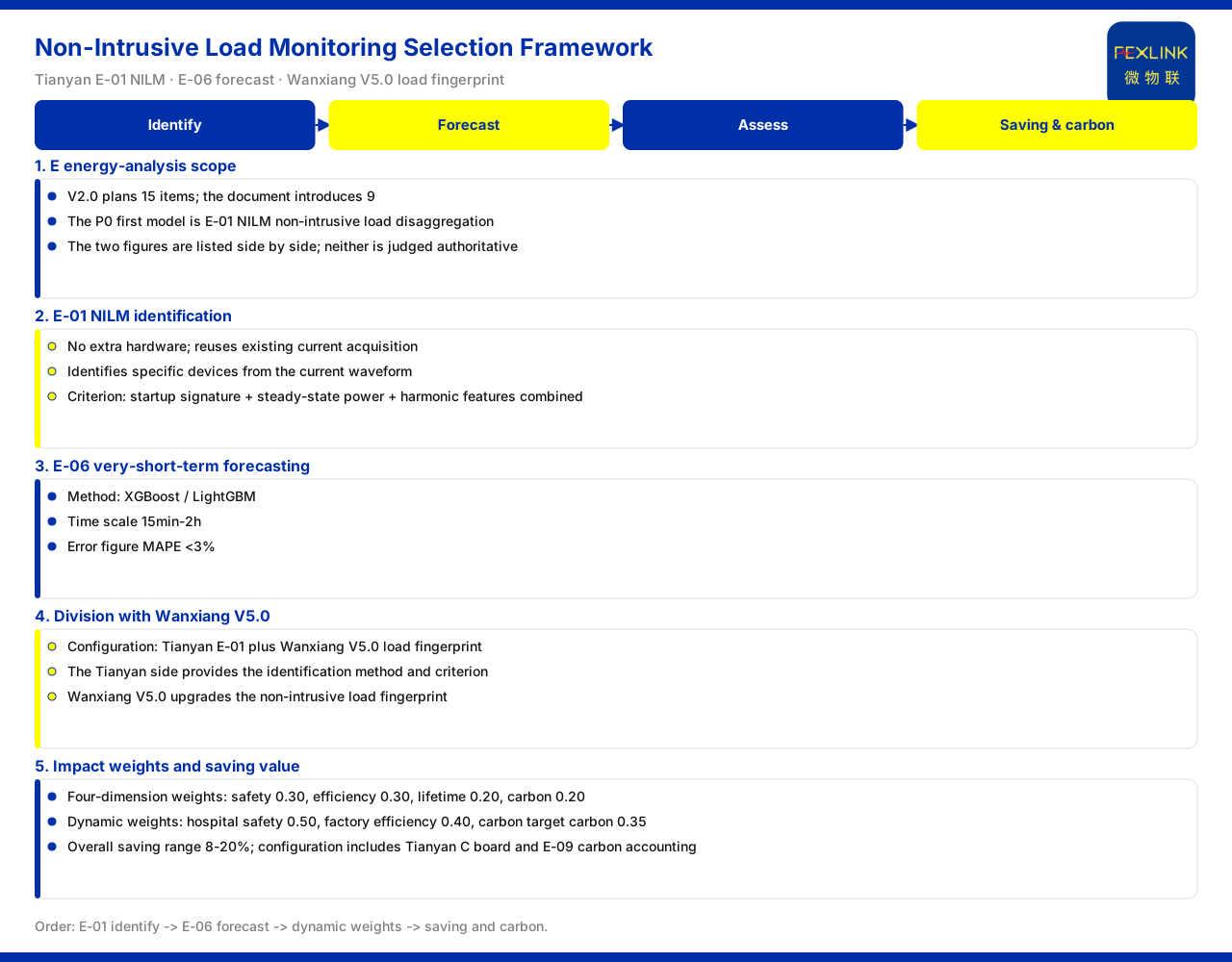
Direct answer
The core requirement of non-intrusive load monitoring (NILM) is to determine "who used the electricity" from existing current waveforms without adding a large amount of on-site hardware. According to the product knowledge base, the selection combination for this direction is "Tianyan E-01 plus Wanxiang V5.0 load fingerprints." Tianyan E-01 is the P0 first-release model of the E energy-analysis module of the Tianyan engine; its characteristic is that it requires no additional hardware and identifies specific devices through current waveforms, with the criterion being a combination of startup features, steady-state power and harmonic features. Around energy analysis, the knowledge base also lists E-06 ultra-short-term load forecasting, which uses XGBoost/LightGBM, spans a time horizon of 15 minutes to 2 hours, and has a MAPE below 3%. The following explains the knowledge-base entries item by item.
1. The scale scope of the E energy-analysis module
The knowledge base gives two sets of figures for the scale of the E energy-analysis module of the Tianyan engine: V2.0 plans for 15 items, while the document introduction scope gives 9. The two do not conflict; the former is a planning scope and the latter an introduction scope, and the knowledge base records them side by side. The same place also states that the P0 first-release model of this module is E-01, that is, NILM non-intrusive load disaggregation.
The significance of understanding these two figures is that when discussing "how many models energy analysis has," one must first confirm whether the planning scope or the introduction scope is being used, or 15 and 9 are easily misread as a contradiction. This article relays them as the knowledge base gives them and does not extrapolate the numbering or functions of the remaining models.
2. E-01 NILM: an identification method with no additional hardware
The positioning of E-01 is non-intrusive load disaggregation, for which the knowledge base gives two key descriptions. First, it requires no additional hardware, meaning the input the identification relies on comes from existing current acquisition rather than separately installing metering or sensing devices for each item of equipment. Second, it identifies specific devices through current waveforms, that is, the object of identification is the level of "specific device," and the criterion is jointly formed of three parts: startup features, steady-state power and harmonic features.
These three criteria can be understood as three observation angles within the same identification. Startup features correspond to the waveform shape at the instant a device is switched in or out, steady-state power corresponds to the power level during stable operation, and harmonic features correspond to the harmonic composition of the device current. Because the knowledge base writes the three as a joint criterion, looking at any one of them alone is insufficient for identification. This article states this accordingly and does not expand the algorithmic details or weights of each criterion.
3. E-06 ultra-short-term load forecasting
Alongside identification, there is a forecasting capability. The knowledge base records that E-06 ultra-short-term load forecasting uses XGBoost/LightGBM, with a forecasting horizon of 15 minutes to 2 hours and a MAPE below 3%. These three items correspond respectively to the method, the time range and the error scope.
Read together with E-01, the division of labour inside the energy-analysis module becomes clear: E-01 faces "which device is using electricity right now," while E-06 faces "how the load will change over the next short interval." The written time horizon of 15 minutes to 2 hours shows that its positioning is ultra-short-term rather than medium- or long-term; a MAPE below 3% is the error scope given by the knowledge base, and this article does not read it as a guarantee for any given site.
4. Division of labour with the Wanxiang engine V5.0
The NILM selection combination is "Tianyan E-01 plus Wanxiang V5.0 load fingerprints," which shows that this capability is carried jointly by the Tianyan and Wanxiang sides. The knowledge base records that the evolution direction of the Wanxiang engine V5.0 is upgrading non-intrusive load fingerprints (NILM), with related documents being the Wanxiang Engine Upgrade Technical Plan V5.0 and the Wanxiang_V5_NILM 100% Advance Plan.
The emphasis of the two sides can be seen from the names: Tianyan E-01 falls on the model side of load disaggregation and energy analysis, while Wanxiang V5.0 falls on the load-fingerprint side. The meaning of the combined selection is that the former provides the identification method and criteria, and the latter provides the comparison basis of load fingerprints. The knowledge base does not merge the two into a single module, and this article likewise states them as two separate capabilities.
The boundary between the two capabilities is also reflected in document attribution. The knowledge base records the Wanxiang-side evolution under the Wanxiang Engine Upgrade Technical Plan V5.0 and the Wanxiang_V5_NILM 100% Advance Plan, showing that the fingerprint upgrade is carried by the Wanxiang engine's own technical plan; the Tianyan-side E-01 is listed as the P0 first-release of the E energy-analysis module. The two have their own sources in the knowledge base, and this article describes them separately accordingly without conflating their advance rhythm.
5. Impact-assessment weights and industry dynamics
The results of energy analysis often need to be turned into priority judgments. The knowledge base records that the Wanxiang engine adopts a four-dimensional impact assessment with base weights of safety 0.30, efficiency 0.30, lifespan 0.20 and carbon 0.20; it also supports industry-dynamic weights, for example safety 0.50 in a hospital scenario, efficiency 0.40 in a factory scenario, and carbon 0.35 in a carbon-assessment scenario.
The use of these weights can be summarised as: first a four-dimensional base allocation, then adjustment of the weight of one dimension according to industry characteristics. Taking the factory as an example, the efficiency dimension is raised from the base 0.30 to 0.40, showing that efficiency is given higher priority in that scenario. This article relays only the weight values and the scenario correspondences, and does not infer how the weights participate in specific calculations.
6. The value scope of energy saving and carbon management
Energy analysis ultimately serves energy saving and carbon management. The knowledge base records that among the quantified value indicators of the Taiyi intelligent control hub system, the comprehensive energy-saving potential is 8% to 20%; the selection for energy saving and carbon management is the Tianyan C module (C-01 to C-06) plus E-09 carbon accounting, on top of which the smart energy-carbon IoT platform is added.
Read together with the preceding energy analysis, the path from data to value can be seen: E energy analysis provides load and forecasting information, the C module and E-09 carbon accounting undertake the accounting of energy saving and carbon emissions, and the platform carries aggregation and presentation. This article states the scopes listed in the knowledge base and does not extend the accounting method.
7. Selection and implementation order
The entries can be drawn together into one order. First, clarify whether the goal is identification or forecasting: choose E-01 NILM when the question "who is using electricity" must be answered, and E-06 when "how the load will change next" must be answered. Second, for NILM adopt the combination of "Tianyan E-01 plus Wanxiang V5.0 load fingerprints," with the identification side relying on the joint criterion of startup features, steady-state power and harmonic features, and the fingerprint side relying on the Wanxiang V5.0 load-fingerprint capability. Third, determine the dynamic weights of the four-dimensional impact assessment according to industry. Fourth, when energy-saving and carbon-management results must be produced, include the Tianyan C module, E-09 carbon accounting and the smart energy-carbon IoT platform.
Scope and limitations
- The content of this article is limited to the existing statements of the product knowledge base on entries related to Tianyan E energy analysis, E-01 NILM, E-06 ultra-short-term load forecasting and Wanxiang V5.0 load fingerprints, and does not extend to algorithmic details or deployment conclusions not listed in the knowledge base.
- The 15 items (V2.0 planning) and 9 items (document introduction scope) of the E energy-analysis module are scopes listed side by side in the knowledge base, and this article does not judge which of the two governs.
- The criteria of E-01 (a combination of startup features, steady-state power and harmonic features) and the XGBoost/LightGBM, 15 minutes to 2 hours and MAPE below 3% of E-06 are scopes listed in the knowledge base and do not constitute a commitment regarding the results for a specific project.
- The four-dimensional impact-assessment weights and the industry-dynamic weights are cited as the knowledge base gives them, and this article does not infer their calculation method.
- The comprehensive energy-saving potential of 8% to 20% and the energy-saving and carbon-management selection are knowledge-base scopes and do not constitute a commitment regarding the energy saving of a specific project.
- This article constitutes no commitment regarding any unlisted indicator; actual capability is subject to the latest product documentation and the project solution.