 FEXLINK Research Institute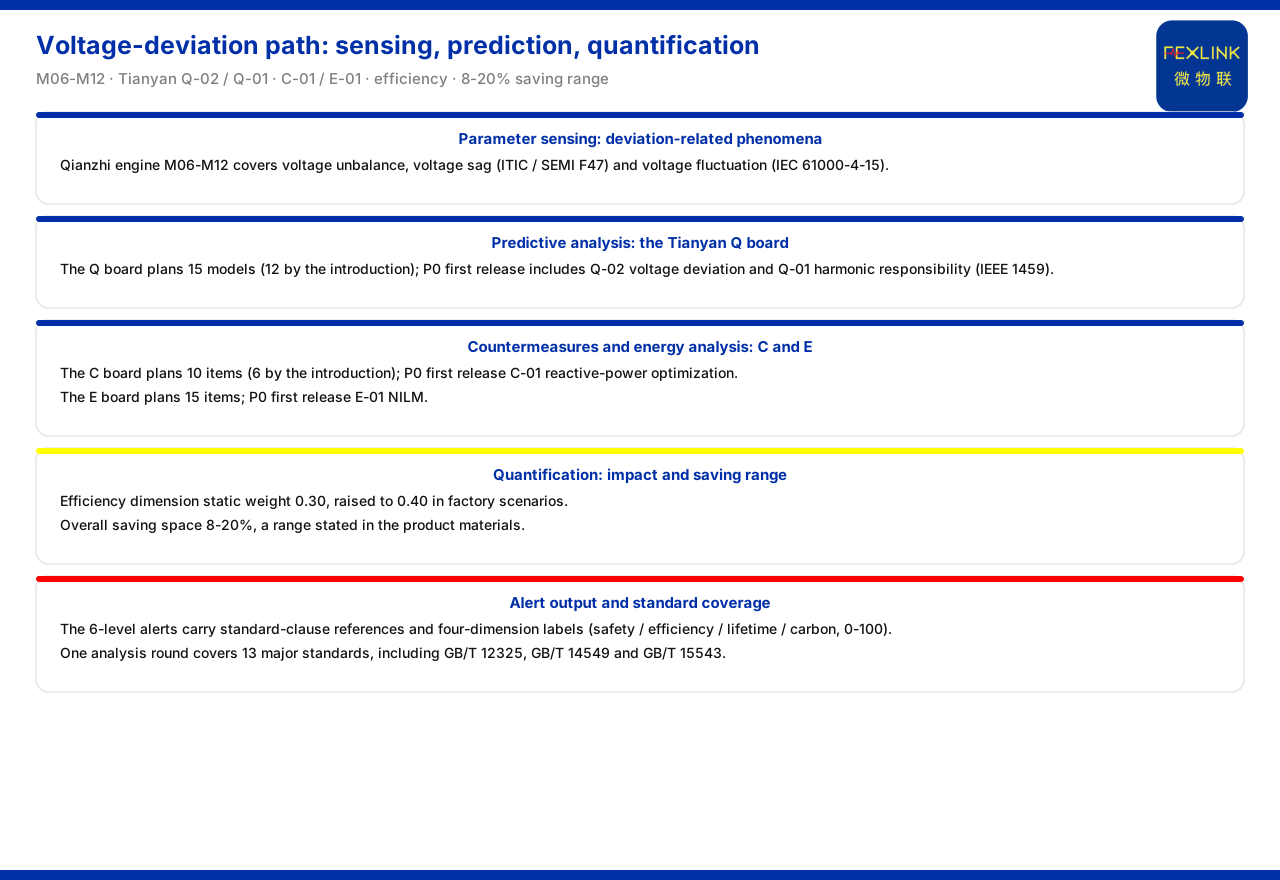
Direct answer
Voltage-deviation treatment is not just about pulling a measured value back into the permitted interval; more importantly it is about stringing deviation identification, cause location, energy-saving measures and benefit quantification into one traceable chain. According to the existing product material, this chain can be carried jointly by three kinds of capability: parameter-level perception sub-models are responsible for finding electrical phenomena such as voltage imbalance, voltage sags and voltage fluctuation; the predictive-analysis section is responsible for turning criteria such as the voltage deviation and harmonic responsibility division into treatment recommendations; and the four-dimension impact assessment and alarm tags are responsible for converting the treatment effect into scores on the four dimensions of safety, efficiency, lifetime and carbon. Here the comprehensive energy-saving space gives a quantitative figure of 8% to 20%, which is a range listed in the product material and is not extended by this article into a commitment for a specific site.
1. The place of voltage deviation in the power-quality section
In the product material, the power-quality section of the Tianyan engine plans fifteen models and states twelve in its introduction; its P0 first-release models include Q-02 voltage deviation. The Q-01 harmonic responsibility division alongside Q-02 uses IEEE 1459 as its criterion basis, and the two are both sources of predictive-analysis capability for voltage-deviation treatment. That is, voltage deviation is not an isolated indicator: it needs both an analysis model facing the deviation itself and supporting criteria such as harmonic responsibility division to move from "how large the deviation is" to "where the responsibility lies and what should be treated first".
2. Parameter-level sensing: the entry to deviation-related electrical phenomena
The quantification of voltage deviation cannot be separated from parameter-level sensing. The power-quality health check of the Qianzhi engine in the product material covers electrical parameters such as voltage imbalance, voltage sags and voltage fluctuation with sub-models M06 to M12; voltage sags refer to the ITIC and SEMI F47 figures, and voltage fluctuation to the IEC 61000-4-15 figure. The significance of these sub-models is that they turn the primary-side and secondary-side waveforms on site into comparable parameters, providing input for the subsequent deviation analysis.
3. Standards basis and criteria
On the standards support, the product material specifies that a single round of analysis by the Qianzhi engine covers thirteen main standards including GB/T 12325, GB/T 14549 and GB/T 15543, where GB/T 12325 is the standard basis for the voltage-deviation criterion. Bringing standard clauses into the analysis process means the deviation conclusion is not given from experience but returns to a clause comparison. The product material also points out that the alarm system outputs the standard clause reference together with the alarm, so that the voltage-deviation treatment recommendation can point to a specific criterion source. For the user, this way of outputting "conclusion plus clause" makes review easier: one can see both that the deviation is judged abnormal and the standard clause on which the judgment rests, reducing dependence on a single experiential judgment.
4. The model chain from deviation to energy-saving measures
The reason voltage deviation can be linked to energy-saving benefit is that it affects energy consumption through the operating efficiency of equipment and thus falls into the efficiency dimension. In the product material the Tianyan engine has a C energy-saving-measures section and an E energy-usage-analysis section: the C section plans ten items and states six, with the P0 first release being C-01 reactive-power-compensation optimisation; the E section plans fifteen items, with the P0 first release being E-01 non-intrusive load identification. The two link up with the power-quality section to form a model chain from voltage and energy-consumption sensing to energy-saving-measure output: the perception sub-models first give the deviation and energy-consumption characteristics, the measures section then gives treatment actions such as reactive-power compensation, and the energy-usage analysis finally checks the energy-consumption change after treatment. This chain splits "finding the deviation" and "giving the measure" into two successive stages, so that the argument for energy-saving benefit has an intermediate process to inspect rather than only a final figure.
5. The four-dimension impact assessment and the efficiency dimension
The four-dimension impact assessment of the Wanxiang engine in the product material contains four dimensions, safety, efficiency, lifetime and carbon, with static weights of 0.30 for safety, 0.30 for efficiency, 0.20 for lifetime and 0.20 for carbon. The weights are not fixed: in the dynamic-weight example the efficiency weight of a factory scenario is raised to 0.40. For voltage deviation this mechanism provides a way to count the treatment benefit into the efficiency dimension: once the deviation affects energy consumption through operating efficiency, it can be reflected by the efficiency score. The four-dimension assessment is therefore not only a risk tag but also a carrier for the benefit argument. It should be noted that the static and dynamic weights are two different levels of figure, the former a baseline and the latter an example of industry-specific adjustment, and together they show that the same assessment framework can be rebalanced by scenario.
6. How alarms carry the benefit argument
The six-level alarm system of the Qianzhi engine in the product material specifies that each alarm carries a standard clause reference and four-dimension impact tags, the tags being expressed on the four dimensions of safety, efficiency, lifetime and carbon on a scale of zero to one hundred. This means a voltage-deviation-type alarm can directly carry an efficiency-dimension score, giving the energy-saving benefit argument specific point support rather than stopping at a qualitative description. The score comes from the mechanism listed in the product material, and this article makes no further inference about the scoring algorithm. Putting the score and the clause reference in the same alarm brings an extra benefit: the treatment recommendation can explain both "why it is judged abnormal" and "which dimension benefits after treatment", making it easy to compare the disposal priority of different deviation events in one table.
7. The quantitative figure of comprehensive energy-saving space
On the benefit range, the Taiyi intelligent control hub system in the product material lists the quantitative value indicator "comprehensive energy-saving space of 8% to 20%". This is the only range figure used by this article when quoting energy-saving benefit and should not be read as a commitment for any site. Because this range works with the efficiency dimension above, the reactive-power-compensation optimisation of the C section and the energy-usage analysis of the E section, the benefit argument can be expressed as: sense the deviation and energy-consumption characteristics, output the treatment measure, and then make a quantitative comparison with the four-dimension score and the comprehensive energy-saving space range. The order here matters: sensing and measures come first, the range comparison comes after, and the range itself does not replace on-site measurement.
8. A reviewable order of exposition
Connecting the sections above, the argument for voltage-deviation treatment can proceed in this order: first, obtain parameters such as voltage imbalance, voltage sags and voltage fluctuation from the parameter-level sub-models of the Qianzhi engine; second, complete the predictive analysis of Q-02 voltage deviation and Q-01 harmonic responsibility division in the power-quality section of the Tianyan engine; third, give and check the treatment actions through the reactive-power-compensation optimisation of the C energy-saving-measures section and the non-intrusive load identification of the E energy-usage-analysis section; fourth, give the dimension-by-dimension scores through the four-dimension impact assessment of the Wanxiang engine and the alarm tags of the Qianzhi engine; and fifth, close the benefit argument with the range figure of the comprehensive energy-saving space. Such an order lets every step return to a specific section of the product material, reducing the room for cross-stage inference.
Scope and limitations
- This article is limited to the existing statements of the product material on the power-quality section, the parameter-level sub-models, the standards basis, the four-dimension impact assessment, the alarm system and the comprehensive energy-saving space range; it makes no inference about unlisted algorithms, model-count details or deployment conclusions.
- The weights (safety 0.30, efficiency 0.30, lifetime 0.20, carbon 0.20, factory efficiency 0.40), the model counts (fifteen, twelve, ten, six, fifteen), the number of standards (thirteen) and the energy-saving range (8% to 20%) in this article are all figures listed in the product material and do not constitute a commitment to the results of a specific project.
- The ITIC, SEMI F47 and IEC 61000-4-15 figures referred to by voltage sags and voltage fluctuation are criterion references listed in the product material; this article does not present them as a determination of the compliance of any product.
- The statement that the four-dimension score is on a scale of zero to one hundred is limited to the mechanism listed in the product material; this article does not infer a specific scoring-weight algorithm or an industry-specific balancing method.
- This article does not constitute a commitment to any unlisted indicator; actual capability is subject to the latest product material and project scheme.